


Hundreds of Thousands of Palestinians Return to Gaza City as Hamas Deploys Forces

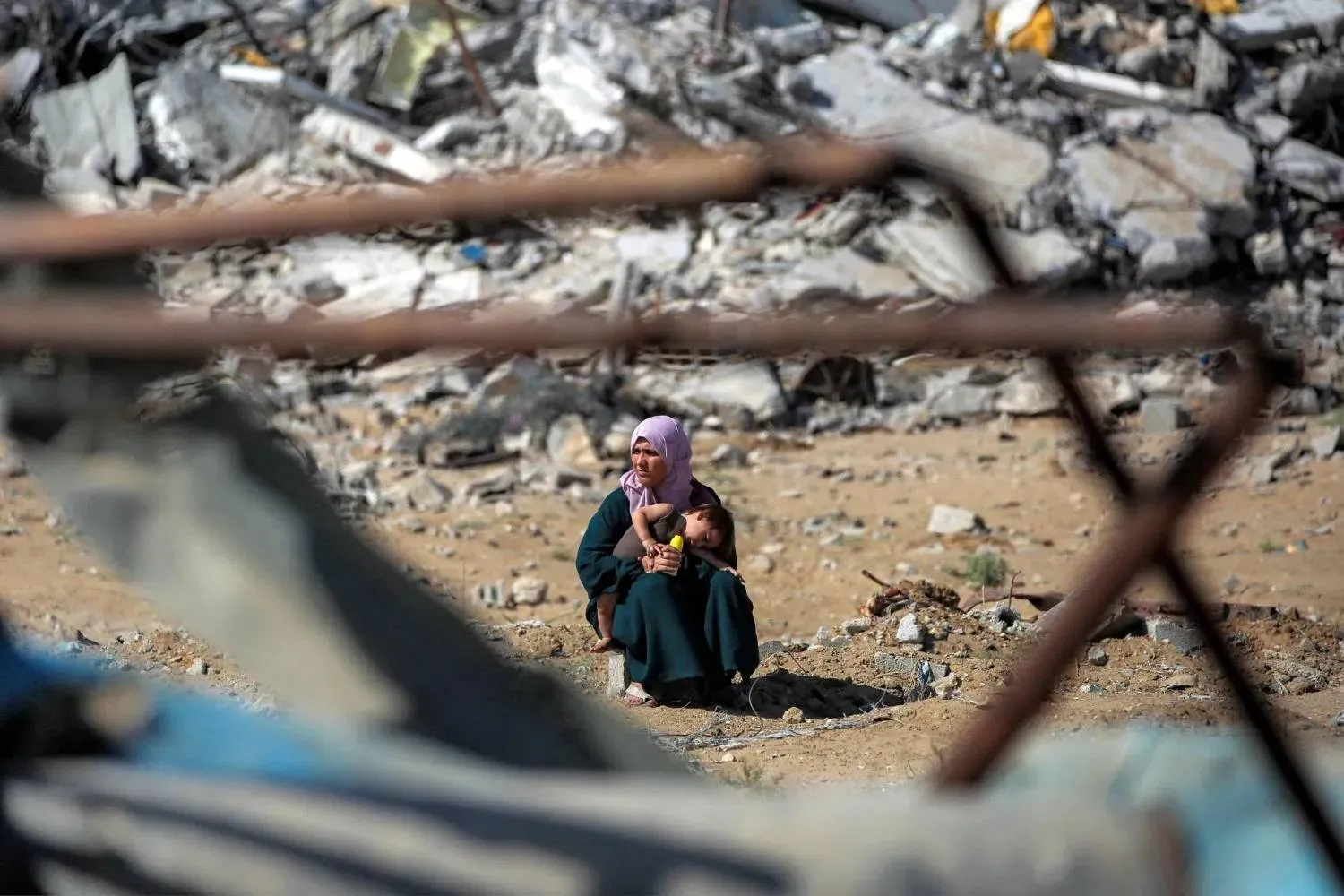
A Palestinian woman holds her child beside piles of rubble while heading toward Gaza City on Friday. (AFP)
TT

Hundreds of Thousands of Palestinians Return to Gaza City as Hamas Deploys Forces

A Palestinian woman holds her child beside piles of rubble while heading toward Gaza City on Friday. (AFP)

As dawn broke Friday, thousands of residents from Gaza City and the northern Strip streamed toward the Nuwairi area and the coastal al-Rashid Street, hoping to return to their homes after nearly a month of displacement.

Israeli forces initially blocked their passage before withdrawing around noon, clearing the way for hundreds of thousands to pour northward on foot and in vehicles.

The Israeli army announced that the ceasefire had taken effect at 12 p.m. local time in both Palestine and Saudi Arabia, though the truce was meant to begin earlier after Israel’s government voted overnight to approve the agreement.

Joy and ruin

Videos posted by journalists, activists, and remaining residents showed scenes of jubilation as Gazans made their way back through shattered neighborhoods. Despite the devastation, many said they were overjoyed simply to return.

Safaa al-Hannawi, 41, from Shati refugee camp west of Gaza City, said she had been waiting since early morning in Nuwairi near the Netzarim axis, hoping to reach her home, uncertain whether it was completely destroyed or partially damaged as she had left it a month ago.

“I can’t describe how happy I am to be back in the spirit of my life,” she said, referring to Gaza City and her neighborhood. Al-Hannawi said she planned to bring her tent from Mawasi Khan Younis and live in it if her home was gone. “But I won’t leave the area again,” she added.

Elsewhere, Yassine al-Barawi, a resident of Al-Nasr district in Gaza City, loaded his belongings into his car and immediately headed north as soon as Israeli forces announced civilians could return. His house was still standing, though damaged.

“I’d rather live in what’s left of my home than in a tent on barren farmland with nothing to sustain life,” he told Asharq Al-Awsat. “When they said we could go back, I rushed to leave. I couldn’t believe it would actually happen, not after our first displacement that lasted more than a year and a half.”

Hours earlier, the roughly 130,000 people who remained in Gaza City had ventured out to survey what was left of their homes and neighborhoods, many reduced to rubble by Israeli operations in recent weeks.

Widespread destruction

Nour Yaghi, 37, from the Sheikh Radwan neighborhood in northern Gaza City, said he reached his area early Friday after sheltering near Gaza’s port in recent weeks only to find it obliterated.

“The devastation is beyond description,” Yaghi said. “Our house and the neighboring ones are just piles of rubble. Seventy percent of Sheikh Radwan is gone, destroyed by booby-trapped military vehicles and airstrikes.”

Mousa al-Najjar from al-Shati camp said entire housing blocks had been flattened. “It will take months just to clear the main roads,” he said. “Anyone returning from the south won’t even recognize where their house once stood.”

According to Gaza’s municipality, more than 85 percent of the city has been destroyed. Medical sources said over 73 bodies were recovered from streets and homes in Gaza City after Israeli troops withdrew, while at least 20 more were found in Khan Younis.

Hamas forces reemerge

Hamas security forces were seen redeploying in parts of central and southern Gaza, as well as on the outskirts of Gaza City. The Interior Ministry in Gaza said its security services would begin restoring order in areas vacated by the Israeli army and “address the chaos the occupation sought to spread over the past two years.”

The Israeli military, meanwhile, warned residents to avoid several “highly dangerous” areas, including Beit Hanoun, Beit Lahia, Shujaiyya, and parts of Khan Younis near the Philadelphi corridor and Rafah crossing.

Military spokesperson Brig. Gen. Effi Defrin said Hamas “is no longer what it was when the war began two years ago. It has been defeated everywhere we fought it.” He urged civilians to stay away from Israeli-controlled zones to ensure their safety.

Gaza’s toll

In a statement marking the ceasefire, the Hamas-run Government Media Office accused Israel of committing “a full-scale genocide” in Gaza, using food, water, and medicine as weapons of war. It said Israel had destroyed 90 percent of the enclave’s civilian infrastructure and seized more than 80 percent of its territory through invasion and forced displacement.

The office estimated that Israel dropped more than 200,000 tons of explosives on Gaza and bombed the Mawasi area over 150 times despite designating it a “safe humanitarian zone.”

According to its figures, some 77,000 Palestinians were killed or remain missing, including more than 20,000 children and 12,500 women. About 67,000 bodies have been recovered, while 9,500 people remain unaccounted for. Over 1,000 infants under one year old were among the dead, including 450 newborns killed during the war, it said.

The report said more than 39,000 families were wiped out in airstrikes, and that women, children, and the elderly made up over half of all victims.

At least 1,670 medical workers, 140 civil defense members, 254 journalists, and more than 1,000 police and emergency responders were killed. Injuries totaled around 170,000, including thousands with amputations, paralysis, or blindness. Over 6,700 detainees, including medical and media staff, remain in Israeli custody under harsh conditions.

Gaza’s health system has “completely collapsed,” the office said, with 38 hospitals destroyed, hundreds of attacks on health facilities, and more than 788 assaults on medical services. Israel also destroyed 670 schools, 165 universities and educational institutions, killing 13,500 students, 830 teachers, and nearly 200 academics.

The statement added that 835 mosques were completely destroyed, several churches were damaged, and 40 cemeteries were razed. Israeli forces allegedly exhumed more than 2,450 bodies and established seven mass graves inside hospitals.

Nearly 300,000 housing units were demolished and 200,000 others heavily damaged, displacing about two million people. Many remain in tattered tents under dire humanitarian conditions.

The office accused Israel of using starvation as a weapon, keeping Gaza’s crossings closed for over 600 days and blocking thousands of aid trucks, resulting in more than 460 deaths from hunger and malnutrition. It estimated Gaza’s direct economic losses at over $70 billion after two years of war.

Three Dead After Flooding Hits Northwest Syria

A child watches as civil defense teams open flooded roads in Idlib. (SANA)
TT

Three Dead After Flooding Hits Northwest Syria

A child watches as civil defense teams open flooded roads in Idlib. (SANA)

Two children and a Syrian Red Crescent volunteer have died as a result of flooding in the country's northwest, state media said on Sunday.

The heavy rains in Syria's Idlib region and the coastal province of Latakia have also wreaked havoc in displacement camps, according to authorities, who have launched rescue operations and set up shelters in the areas.

State news agency SANA reported "the death of a Syrian Arab Red Crescent volunteer and the injury of four others as they carried out their humanitarian duties" in Latakia province.

The Syrian Red Crescent said in a statement that the "a mission vehicle veered into a valley", killing a female volunteer and injuring four others, as they went to rescue people stranded by flash floods.

"A fifth volunteer was injured while attempting to rescue a child trapped by the floodwaters," it added.

SANA said two children died on Saturday "due to heavy flooding that swept through the Ain Issa area" in the north of Latakia province.

Authorities said Sunday they were working to clear roads in displacement camps in flooded parts of Idlib province.

The emergencies and disaster management ministry said 14 displacement camps in part of Idlib province were affected, with tents swamped, belongings swept away and around 300 families directly impacted.

Around seven million people remain internally displaced in Syria, according to the United Nations refugee agency, some 1.4 million of them living in camps and sites in the country's northwest and northeast.

The December 2024 ouster of longtime ruler Bashar al-Assad after more than 13 years of civil war revived hopes for many to return home, but the destruction of housing and a lack of basic infrastructure in heavily damaged areas has been a major barrier.


Hamas’s Meshal Rejects Disarmament or 'Foreign Rule'

Boys walk past the rubble of destroyed buildings in the Jabalia camp for Palestinian refugees in the northern Gaza Strip on February 8, 2026. (Photo by Omar AL-QATTAA / AFP)
TT

Hamas’s Meshal Rejects Disarmament or 'Foreign Rule'

Boys walk past the rubble of destroyed buildings in the Jabalia camp for Palestinian refugees in the northern Gaza Strip on February 8, 2026. (Photo by Omar AL-QATTAA / AFP)

A senior Hamas leader said Sunday that the Palestinian movement would not surrender its weapons nor accept foreign intervention in Gaza, pushing back against US and Israeli demands.

"Criminalizing the resistance, its weapons, and those who carried it out is something we should not accept," Khaled Meshal said at a conference in Doha.

"As long as there is occupation, there is resistance. Resistance is a right of peoples under occupation ... something nations take pride in," said Meshal, who previously headed the group.

A US-brokered ceasefire in Gaza is in its second phase, which foresees that demilitarization of the territory -- including the disarmament of Hamas -- along with a gradual withdrawal of Israeli forces.

Hamas has repeatedly said that disarmament is a red line, although it has indicated it could consider handing over its weapons to a future Palestinian governing authority.

Israeli officials say that Hamas still has around 20,000 fighters and about 60,000 Kalashnikovs in Gaza.

A Palestinian technocratic committee has been set up with a goal of taking over the day-to-day governance in the battered Gaza Strip, but it remains unclear whether, or how, it will address the issue of demilitarization.

The committee operates under the so-called "Board of Peace," an initiative launched by US President Donald Trump.

Originally conceived to oversee the Gaza truce and post-war reconstruction, the board's mandate has since expanded, prompting concerns among critics that it could evolve into a rival to the United Nations.

Trump unveiled the board at the World Economic Forum in the Swiss ski resort of Davos last month, where leaders and officials from nearly two dozen countries joined him in signing its founding charter.

Alongside the Board of Peace, Trump also created a Gaza Executive Board - an advisory panel to the Palestinian technocratic committee - comprising international figures including US envoys Steve Witkoff and Jared Kushner, as well as former British prime minister Tony Blair.

On Sunday, Meshal urged the Board of Peace to adopt what he called a "balanced approach" that would allow for Gaza's reconstruction and the flow of aid to its roughly 2.2 million residents, while warning that Hamas would "not accept foreign rule" over Palestinian territory.

"We adhere to our national principles and reject the logic of guardianship, external intervention, or the return of a mandate in any form," Meshal said.
"Palestinians are to govern Palestinians. Gaza belongs to the people of Gaza and to Palestine. We will not accept foreign rule," he added.


Rescue Teams Search for Survivors in Building Collapse that Killed at Least 2 in Northern Lebanon

A Lebanese flag is pictured, in the aftermath of a massive explosion, in Beirut's damaged port area, Lebanon August 17, 2020. REUTERS/Hannah McKay
TT

Rescue Teams Search for Survivors in Building Collapse that Killed at Least 2 in Northern Lebanon

A Lebanese flag is pictured, in the aftermath of a massive explosion, in Beirut's damaged port area, Lebanon August 17, 2020. REUTERS/Hannah McKay

At least two people were killed and four rescued from the rubble of a multistory apartment building that collapsed Sunday in the city of Tripoli in northern Lebanon, state media reported.

Rescue teams were continuing to dig through the rubble. It was not immediately clear how many people were in the building when it fell.

The bodies pulled out were of a child and a woman, the state-run National News Agency reported.

Dozens of people crowded around the site of the crater left by the collapsed building, with some shooting in the air.

The building was in the neighborhood of Bab Tabbaneh, one of the poorest areas in Lebanon’s second largest city, where residents have long complained of government neglect and shoddy infrastructure. Building collapses are not uncommon in Tripoli due to poor building standards, according to The AP news.

Lebanon’s Health Ministry announced that those injured in the collapse would receive treatment at the state’s expense.

The national syndicate for property owners in a statement called the collapse the result of “blatant negligence and shortcomings of the Lebanese state toward the safety of citizens and their housing security,” and said it is “not an isolated incident.”

The syndicate called for the government to launch a comprehensive national survey of buildings at risk of collapse.
