


China Hits Back on US Port Fees with Retaliatory Levies

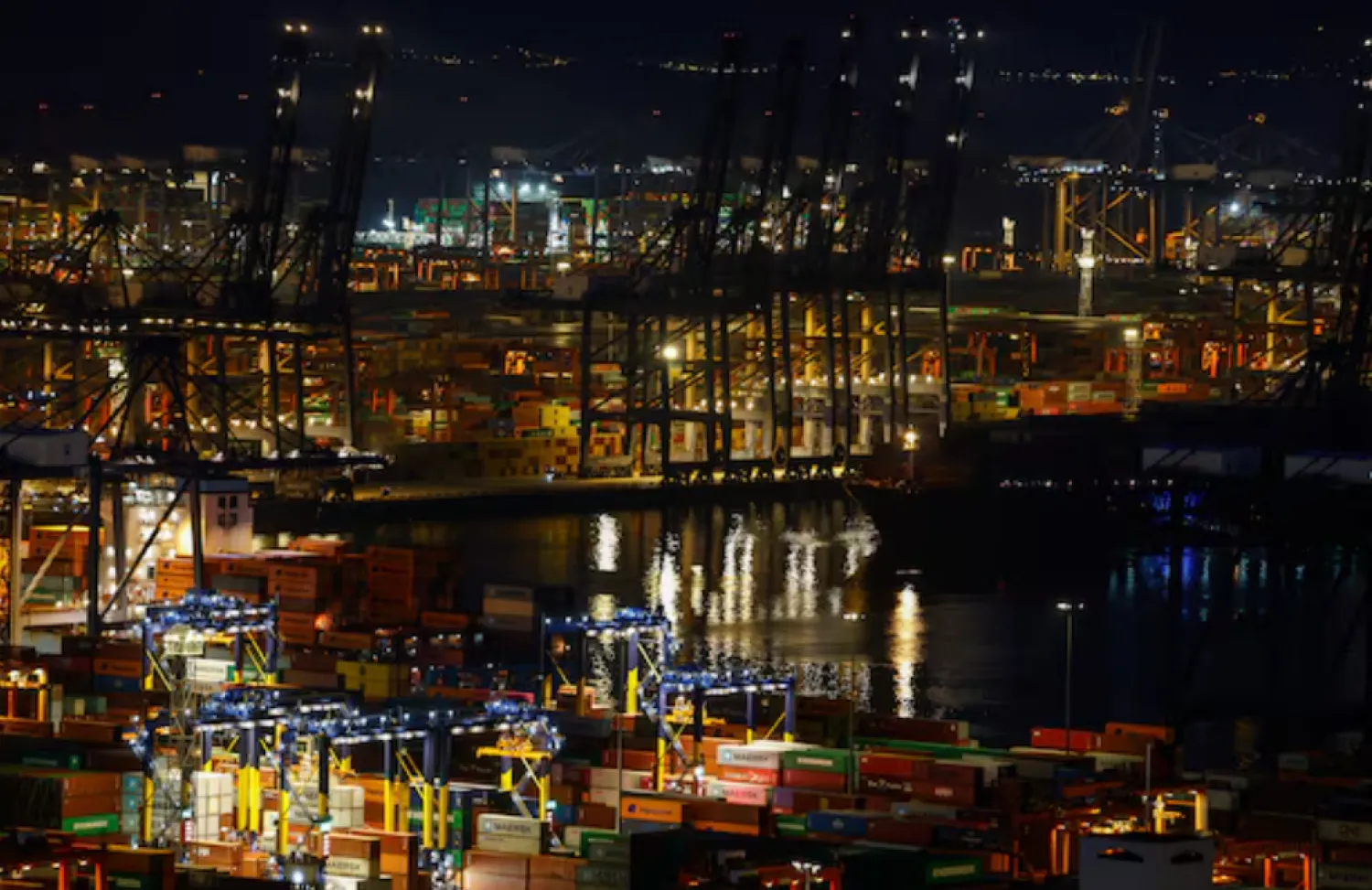
A general view of Yantian port at night in Shenzhen, Guangdong province, China May 9, 2025. REUTERS/Tingshu Wang
TT

China Hits Back on US Port Fees with Retaliatory Levies

A general view of Yantian port at night in Shenzhen, Guangdong province, China May 9, 2025. REUTERS/Tingshu Wang

China will slap port fees on US-owned, operated, built, or flagged vessels on Tuesday as a countermeasure to US port fees on China-linked ships starting the same day, China's transport ministry stated.

Later, US President Donald Trump said he was raising tariffs on Chinese exports to the US to 100% and imposing export controls on critical software in a reprisal to export limits by China on rare earth minerals, Reuters reported.

There are relatively few US-built or US-flagged vessels conducting international trade, but China will ensnare more ships by applying levies to companies with 25% or more of their shares or board seats held by US-domiciled investment funds, analysts said.

"This casts a wide net and could affect many public shipping companies with a listing on US stock exchanges," said Erik Broekhuizen, a marine research and consulting manager at ship brokering firm Poten & Partners.

"The potential impact is significant."

On Tuesday, ships built in China - or operated or owned by Chinese entities - will also need to pay a fee at their first port of call in the United States.

US-based shipping company Matson told customers it is subject to the new China port fees and has no plans to change its service schedule.

Also likely affected are CMA-CGM's US-based American President Lines and Israel-based Zim, which appears to have more than 25% of its shares owned by US entities, Lars Jensen, CEO of container shipping-focused consultancy Vespucci Maritime, said on LinkedIn.

The fees in both China and the US will apply to 100 vessels owned by Poseidon's Seaspan and chartered by container lines, said Jensen.

Maersk Line Limited, APL, Zim and Seaspan did not immediately respond to requests for comment on the fees.

Oil tanker operators are mostly based outside the United States, but they may get stung by China's port fees because they are listed in the US, analysts said.

For example, Scorpio Tankers has the industry's largest and youngest fleet and is US-listed. It did not immediately respond to a request for comment.

The Chinese port fees "have thrown the tanker market in turmoil," Broekhuizen said in a client note, adding many vessels that could be affected are already on their way to China.

Nearly 10% of the very large crude carrier fleet, and 13% of the Suezmax, Afra and LR2 fleet would be affected, according to an analysis by ship broker and fleet data provider Fearnleys.

An analysis by Vortexa showed 43 liquefied petroleum gas-carrying super tankers, or 10% of the global fleet, will be affected by China's port fees, said Samantha Hartke, who heads Americas analysis for the energy research firm.

Vessels owned or operated by a Chinese entity will face a flat fee of $50 per net tonnage per voyage to the US China-owned carrier COSCO, including its OOCL fleet, is the most exposed with fees of around $2 billion in 2026, analysts said. COSCO did not immediately comment.

CHINA CALLS US FEES DISCRIMINATORY

The US fees on China-linked vessels, following a probe by the US Trade Representative, are part of a broader US effort to revive domestic shipbuilding and blunt China's naval and commercial shipping power.

"It is clearly discriminatory and severely damages the legitimate interests of China's shipping industry, seriously disrupts the stability of the global supply chain, and seriously undermines the international economic and trade order," the Chinese ministry said.

The USTR's office did not respond to a request for comment.

Over the past two decades, China has catapulted itself to the No. 1 position in the shipbuilding world, with its biggest shipyards handling both commercial and military projects.

The fees announced by China, like those put in place by the US, "add further complexity and cost to the global network that keeps goods moving and economies connected, and risk harming their exporters, producers, and consumers at a time when global trade is already under pressure," said Joe Kramek, president and CEO of the World Shipping Association.

RATES RISE OVER THREE YEARS

For US-linked vessels berthing at Chinese ports starting Tuesday, the rate will be 400 yuan ($56.13) per net metric ton, the Chinese transport ministry said.

That will increase to 640 yuan ($89.81) from April 17, 2026, and to 880 yuan ($123.52) from April 17, 2027.

For vessels calling at Chinese ports from April 17, 2028, the charge will be 1,120 yuan ($157.16) per net metric ton.

Tensions between China and the United States have deepened since September, with the two superpowers struggling to move beyond their trade tariff truce - a 90-day pause from August 11 that ends around November 9.

Retaliatory tariffs in the US-China trade war this year have sharply curtailed Chinese imports of US agriculture and energy products.



IMF: Saudi Transformation on Track Supported by Deeper Reforms

The Saudi capital, Riyadh (Reuters)
TT

IMF: Saudi Transformation on Track Supported by Deeper Reforms

The Saudi capital, Riyadh (Reuters)

Saudi Arabia enters a new phase described as one of the most sensitive and influential in the course of its economic transformation, according to the International Monetary Fund (IMF), which said next year will be pivotal for the Kingdom thanks to deeper reforms implemented throughout the past years.

In a “country focus” released last month, Amine Mati and Yuan “Monica” Gao Rollinson, both in the IMF’s Middle East and Central Asia Department, showed that growth in Saudi Arabia has been fueled not only by investment, but also by people as private sector job creation has surged, particularly among women while unemployment rates reached record-lows.

The two economists said the resilience shown in 2025 underscores the progress already achieved in reducing the economy’s exposure to oil fluctuations.

They said that despite oil prices falling nearly 30% below their 2022 peak, the non-oil economy maintained strong momentum.

“This strength reflects the impact of Saudi Vision 2030 reforms—diversification gaps with emerging markets have narrowed, and the business environment now rivals that of advanced economies,” the two IMF experts said.

At the same time, Saudi Arabia is strategically shifting some of its spending priorities, with some of its investment focus moving toward AI and advanced technologies as part of its broader effort to diversify the economy.

The IMF paper said deeper reforms—including the steadfast implementation of recently enacted laws that ease access for foreign investors— will help foster an investor-friendly business environment and attract more private investment.

At the banking sector, it noted that the Saudi Central Bank’s continued vigilance in monitoring emerging risks will be critical in preventing vulnerabilities from building up.

“As conditions evolve, the central bank should continue to proactively deploy prudential measures to keep the financial system resilient,” it said.

Over time, deepening capital markets—so that companies can raise more financing through bonds and equity—will help ease pressure on banks, facilitate credit for small and medium enterprises, and create a more balanced mix of funding for the economy.

Looking ahead, Saudi Arabia faces a new test: how to sustain reform momentum in an era of potentially lower oil revenues without slipping back into the stop-and-go cycles that followed past oil booms, the two IMF economists said.

They said fortunately, Saudi Arabia approaches this challenge from a position of relative strength thanks to public debt-to-GDP ratios that remain low while foreign assets are still ample.

At the same time, the IMF noted that the sustainability of such progress relies on Saudi Arabia’s ability to anchor spending decisions within a consistent, multi-year framework will be vital for maintaining long-term sustainability.

The Fund showed that sustaining Saudi Arabia’s growth momentum will increasingly depend on two engines: a skilled workforce and a vibrant private sector.

Deeper reforms—including the steadfast implementation of recently enacted laws that ease access for foreign investors— will help foster an investor-friendly business environment and attract more private investment.

“The sovereign wealth fund can act as a complementary catalyst here by spurring new projects and partnerships, while making sure it leaves ample room for both domestic and international private investors to thrive,” the IMF paper noted.

Last October, the IMF had raised Saudi Arabia's economic growth forecast to 4% for 2026, supported by the expansion of non-oil activities and higher oil prices.

Meanwhile, the Saudi Finance Ministry forecasted real GDP growth of 4.6% in 2026, driven by non-oil activities and private-sector leadership.


Iraq’s Oil Minister Says Talks Ongoing with Chevron on West Qurna 2 Oilfield

A Chevron logo at the Chevron building in Houston, Texas, US August 19, 2025. (Reuters)
TT

Iraq’s Oil Minister Says Talks Ongoing with Chevron on West Qurna 2 Oilfield

A Chevron logo at the Chevron building in Houston, Texas, US August 19, 2025. (Reuters)

Iraq's oil minister said on Saturday that talks were ‌ongoing ‌with ‌US ⁠major Chevron regarding ‌the Lukoil-operated West Qurna-2 field, the Russian company's ⁠largest foreign ‌asset.

Chevron ‍and ‍Exxon Mobil ‍are among potential bidders for Lukoil's overseas assets following US ⁠sanctions on the Russian oil producer.


China’s Consumer Inflation Scales 3-Year High but Deflation Battle Far from Over

 Chinese girls dressed in Qing Dynasty attire take pictures outside the Forbidden City in Beijing, China, Wednesday, Jan. 7, 2026. (AP)
Chinese girls dressed in Qing Dynasty attire take pictures outside the Forbidden City in Beijing, China, Wednesday, Jan. 7, 2026. (AP)
TT

China’s Consumer Inflation Scales 3-Year High but Deflation Battle Far from Over

 Chinese girls dressed in Qing Dynasty attire take pictures outside the Forbidden City in Beijing, China, Wednesday, Jan. 7, 2026. (AP)
Chinese girls dressed in Qing Dynasty attire take pictures outside the Forbidden City in Beijing, China, Wednesday, Jan. 7, 2026. (AP)

China's annual consumer price inflation accelerated to a 34-month high in December, but the full-year rate slumped to the lowest in 16 years while producer deflation persisted, backing market expectations for more stimulus to shore up soft demand.

Imbalances in the $19 trillion economy have worsened over the past year even as growth is on course to meet Beijing's target of "around 5%" for 2025, buoyed by policy support and resilient goods exports.

US President Donald Trump's global trade war has added to persistently soft consumer demand, which has remained a drag on confidence and growth for years amid a prolonged property crisis.

The December consumer price index (CPI) rose 0.8% from the same month in 2024, National Bureau of Statistics (NBS) data showed on Friday, matching expectations in a Reuters poll and perking up from the 0.7% increase in November.

The rise was mainly driven by food prices, especially those of fresh vegetables and beef, which expanded 18.2% ‌and 6.9% respectively, Dong ‌Lijuan, a statistician at NBS, said in a statement. Pre-New Year holiday shopping ‌and ⁠supportive policies also helped ‌boost consumer prices, Dong added.

Chinese policymakers have repeatedly pledged to support a rebound in prices with monetary policy and have cracked down on excessive competition. They have also vowed to boost people's income to unleash consumption potential and better align the country's supply and demand.

Yet, the underlying demand impulse in the economy remains weak.

"Despite expectations of a recovery, inflation remains relatively low and should not preclude further monetary easing this year," said Lynn Song, ING's chief economist for Greater China.

Zichun Huang, China economist at Capital Economics, said the elevated headline CPI was not due to the government campaign to curb so-called "involution", adding that overcapacity and deflationary pressures will persist in the coming ⁠years in the absence of stronger demand-side measures.

WHERE HAS INFLATION GONE?

Indeed, for the entire 2025, consumer price growth was flat, well below the "around 2%" goal policymakers were ‌aiming for, a sign that stimulus measures, such as a consumer goods trade-in scheme, ‍have yielded only modest results in lifting sentiment and containing ‍deflationary pressure.

Prices of gold jewellery surged 68.5%, NBS data showed.

Core inflation, ‍which excludes volatile prices of food and fuel, rose 1.2% year-on-year last month, unchanged from November.

Goldman Sachs economists estimate that core price gauge excluding gold prices edged down in December from the prior month.

Annual growth in China's consumer prices has for years failed to meet policymakers' targets as the economy struggled to recover from the pandemic.

A prolonged property market crisis and a weak job market have contributed to lackluster household demand as well as overcapacity and price competition among producers.

On a monthly basis, CPI climbed 0.2% in December, compared with a 0.1% dip the previous month and a forecast for a 0.1% rise.

The producer ⁠price index (PPI) fell 1.9% year-on-year in December, remaining in a deflationary funk for more than three years even as it eased from a 2.2% drop in November. The gauge was expected to have fallen 2% in the Reuters poll.

NBS's Dong attributed the moderation in factory-gate deflation to both global commodity prices, including rising prices of non-ferrous metals, and policies for controlling capacity in key industries.

Capital Economics' Huang, however, said there hasn't been "any fundamental improvement in overcapacity."

"Prices of consumer durables continued to fall at a faster pace than during the depths of the global financial crisis, highlighting that the issue of excess supply remains unresolved in much of the manufacturing sector," she said.

For the whole year, PPI fell 2.6%.

Given the slowdown in economic momentum in the second half of last year, the market is watching for signs of additional government support measures in 2026 as top leaders have committed to pursuing a more proactive macroeconomic policy framework.

The central government has allocated 62.5 billion yuan ($8.95 billion) from special treasury bond proceeds to local governments to ‌keep funding the consumer goods trade-in scheme in 2026.

The government has also pledged to flexibly use monetary policy tools, such as cuts to interest rates and banks' reserve requirement ratio, to keep liquidity ample and spur growth.