

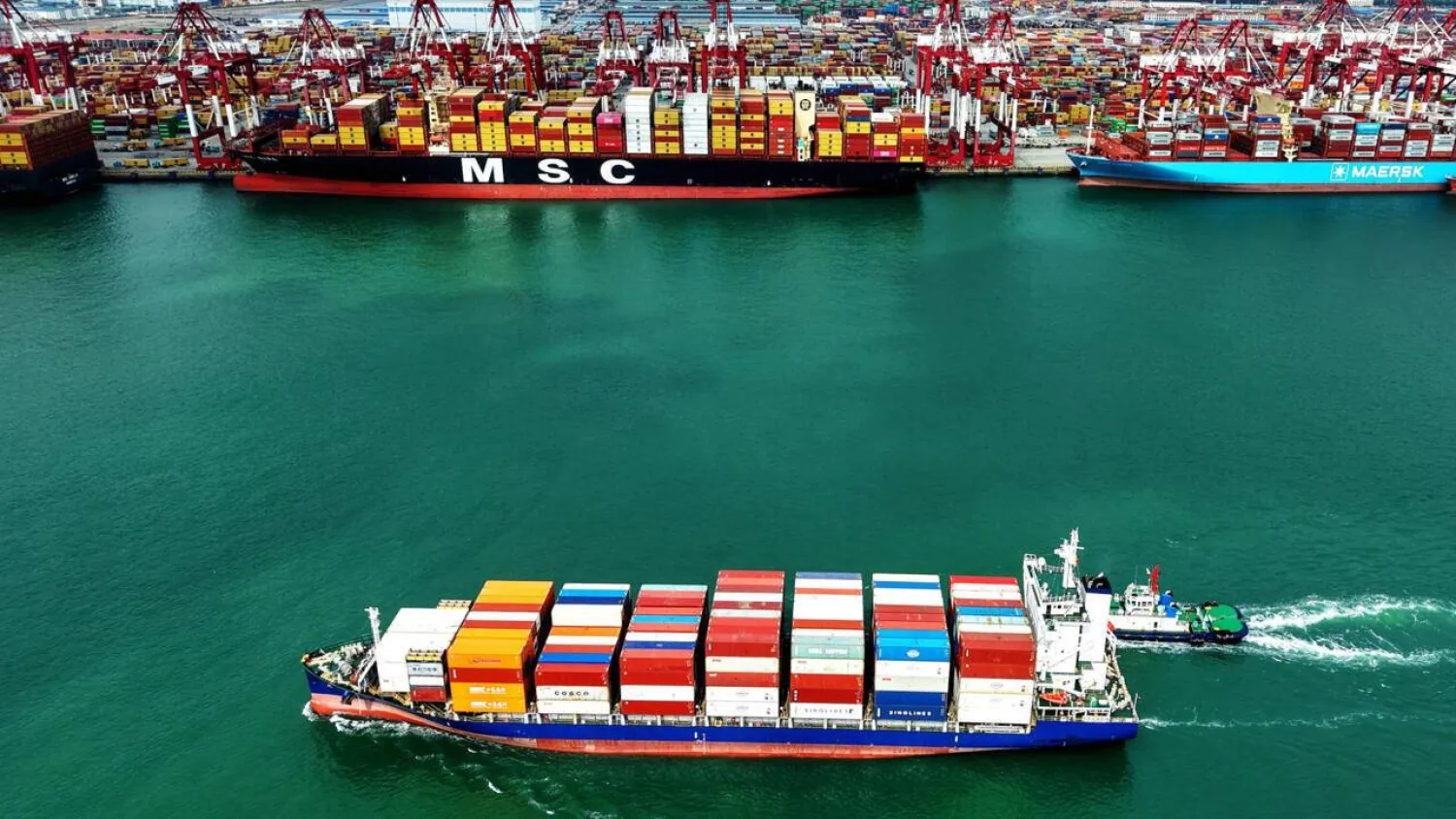

China Accuses US of 'Double Standards' over New Tariffs Threat

The trade war between Beijing and Washington has reignited with export restrictions and threats of additional retaliatory tariffs. AFP
TT

China Accuses US of 'Double Standards' over New Tariffs Threat

The trade war between Beijing and Washington has reignited with export restrictions and threats of additional retaliatory tariffs. AFP

China accused the United States of "double standards" on Sunday, after President Donald Trump threatened an additional 100 percent tariff on the world's second-largest economy.

Trump reignited his trade war with China on Friday, accusing Beijing of imposing "extraordinarily aggressive" new export curbs relating to rare earths.

He announced extra levies -- plus export controls on "critical software" -- due to take effect from November 1, and threatened to cancel a meeting with Chinese President Xi Jinping, AFP reported.

On Sunday, China's Ministry of Commerce called Trump's tariff threat a "typical example of 'double standards'".

The ministry said Washington had ratcheted up economic measures against Beijing since September.

"Threatening high tariffs at every turn is not the right approach to engaging with China," it said in an online statement.

Chinese goods currently face US tariffs of 30 percent under levies that Trump brought in while accusing Beijing of aiding in the fentanyl trade, and over alleged unfair practices.

China's retaliatory tariffs are currently at 10 percent.

Rare earths have been a major sticking point in recent trade negotiations between the two superpowers.

They are critical to manufacturing everything from smartphones and electric vehicles to military hardware and renewable energy technology.

China dominates global production and processing of these materials, and on Thursday announced new controls on the export of technologies used for the mining and processing of critical minerals.

In response, Trump said on his Truth Social platform that China had taken a "very hostile" stance and should not be "allowed to hold the World 'captive'".

The US leader also threatened to pull out of a mooted meeting with Xi at the Asia-Pacific Economic Cooperation summit in South Korea later this month.

It would have been the first face-to-face encounter between the leaders of the world's two largest economies since Trump returned to power in January.

Tensions flare again

A few months ago, Beijing and Washington agreed an uneasy truce in their tit-for-tat trade war that started earlier this year and threw bilateral trade into serious jeopardy.

But tensions have boiled up again in recent days.

China said on Friday that it would impose "special port fees" on ships operated by and built in the US, calling it a "defensive action".

It took aim at the US's own port fees charged on Chinese ships, claiming they "severely harmed China's interests".

Washington announced those fees in April as part of an effort to revive American shipbuilding after a decades-long decline that has seen China and other Asian nations come to dominate the industry.



Sources: Spain, Algeria in Talks to Increase Pipeline Gas Supply by Up to 10%

Spanish Foreing Affairs Minister Jose Manuel Albares speaks during a press conference after the Cabinet meeting at Moncloa Palace in Madrid, Spain, 24 March 2026.  EPA/CHEMA MOYA
Spanish Foreing Affairs Minister Jose Manuel Albares speaks during a press conference after the Cabinet meeting at Moncloa Palace in Madrid, Spain, 24 March 2026. EPA/CHEMA MOYA
TT

Sources: Spain, Algeria in Talks to Increase Pipeline Gas Supply by Up to 10%

Spanish Foreing Affairs Minister Jose Manuel Albares speaks during a press conference after the Cabinet meeting at Moncloa Palace in Madrid, Spain, 24 March 2026.  EPA/CHEMA MOYA
Spanish Foreing Affairs Minister Jose Manuel Albares speaks during a press conference after the Cabinet meeting at Moncloa Palace in Madrid, Spain, 24 March 2026. EPA/CHEMA MOYA

Spain and Algeria are in talks to increase the supply of natural gas via the Medgaz pipeline from Algeria by as much ⁠as 10%, two ⁠sources familiar with the matter said.

Talks are in advanced stage, one of the ⁠sources said, adding that a preliminary agreement may be reached during Spanish Foreign Minister Jose Manuel Albares's visit to Algiers this week.

The increase would be possible as the ⁠pipeline ⁠between the countries has capacity to increase the flow of gas by around 1 billion cubic meters (bcm) per year, Reuters quoted them as saying.

Spain and Algeria agreed to strengthen their energy partnership, Albares said on Thursday after meeting Algerian President Abdelmadjid Tebboune.

Algeria is "a stable and reliable" supplier of gas, Albares said.

The Iran conflict has upended energy markets and increased volatility, leading some to look elsewhere ⁠for their gas. Spanish power ⁠utility Naturgy's CEO Francisco Reynes said this week the company wanted to strengthen its relationship with its Algerian supplier and shareholder Sonatrach.

Naturgy has gas contracts with the Algerian state oil and gas company for ⁠about 5 billion cubic meters per year, according to figures the Spanish company gave to the market in 2022.

Algerian gas made up more than 29% of Spain's total gas imports in the first two months of the year, according to data from Spanish gas grid operator Enagas.

It comes via the Medgaz pipeline, in which Naturgy is ⁠a minority ⁠partner and Sonatrach holds a 51% stake. Sonatrach also has a stake of about 4% in Naturgy.

Other countries are also asking Algeria for more gas in the face of disruption caused by the conflict in the Middle East.

Italian Prime Minister Giorgia Meloni said she hoped Algeria would send more gas to her country during a visit to Algiers this week.


TotalEnergies to Honor All LNG Contracts Despite Qatar Outages

FILE PHOTO: The logo of French oil and gas company TotalEnergies is seen at a petrol station in Paris, France, March 25, 2026. REUTERS/Abdul Saboor/File Photo
TT

TotalEnergies to Honor All LNG Contracts Despite Qatar Outages

FILE PHOTO: The logo of French oil and gas company TotalEnergies is seen at a petrol station in Paris, France, March 25, 2026. REUTERS/Abdul Saboor/File Photo

TotalEnergies' CEO Patrick Pouyanne said on Thursday that the company made a decision not to declare force majeure to any of its liquefied natural gas customers, and that it would respect all the LNG contracts in terms of price and ⁠volume.

Qatar, the world's biggest ⁠LNG producer, has declared force majeure on all of its LNG output after being attacked as part of the US-Israeli war with Iran.

"We said to our customers we will ⁠not invoke force majeure and not deliver the gas... We want to be security of supply for our customers," Pouyanne said.

"Yes, we'll miss energy coming from Qatar and Abu Dhabi, but our portfolio is large enough to redirect part of it," he added, according to Reuters.

Analysts estimate TotalEnergies takes 5.2 million metric tons per annum (mtpa) from ⁠its ⁠share of the QatarEnergy LNG trains.

Sources have said Shell, the world's biggest LNG trader, had declared force majeure on cargoes it buys from QatarEnergy and sells on. Analysts estimate Shell takes 6.8 mtpa of Qatari LNG.

Pouyanne also said that the current energy crisis makes renewables more attractive as they are not subject to the volatility from geopolitical instability.


India Secures 60 Days of Oil Supply amid Hormuz Disruption

Small boats sail loaded with goods in front of a container ship in the waters of the Strait of Hormuz off the coast of Oman, June 25, 2025 (AFP)
TT

India Secures 60 Days of Oil Supply amid Hormuz Disruption

Small boats sail loaded with goods in front of a container ship in the waters of the Strait of Hormuz off the coast of Oman, June 25, 2025 (AFP)

India has secured crude oil supplies for the next 60 days, ensuring stable fuel supplies in the country despite disruption in shipments from the Middle East, the oil ministry said in a statement on Thursday.

India, the world's third biggest oil consumer and importer, was buying over 40% of its oil imports from the Middle East. Those supplies are disrupted due to the US-Israeli war on Iran.

Higher availability of crude in global markets, mainly from the Western hemisphere, has helped offset the shortfall, the government said.

Taking advantage of a temporary US waiver, Indian refiners have also ramped up purchases of Russian crude, securing millions of barrels to fill the supply gap.

"Despite the situation at the Strait of Hormuz, India is today receiving more crude oil from its 41-plus suppliers across the world than what was previously arriving through the Strait," the ministry said.

As a net exporter of petroleum products, India’s domestic availability of petrol and diesel remains structurally secure, the government said.

The world's fourth-largest refiner has oil and fuel stocks sufficient to meet 60 days of demand, against a total storage capacity of 74 days, it added.

"Nearly two months of steady supply is available for every Indian citizen, regardless of what happens globally. The next two months of crude procurement have also been secured," it added.

India has asked refiners to maximize production of liquefied petroleum gas, used as cooking fuel, as the nation was buying 90% of its LPG imports from the Middle East.

Domestic daily LPG production has been increased by 40% to 50,000 metric tons against a requirement of 80,000 tons, it said.

In addition, Indian companies have secured 800,000 tons of LPG cargoes from the United States, Russia, Australia, and other countries, it said.

These shipments, arriving across India's 22 LPG import terminals, provide roughly one month of assured supply, with further procurement underway, the government said.