


German Ambassador to Yemen to Asharq Al-Awsat: Houthis Must Decide if They Want Peace or Conflict

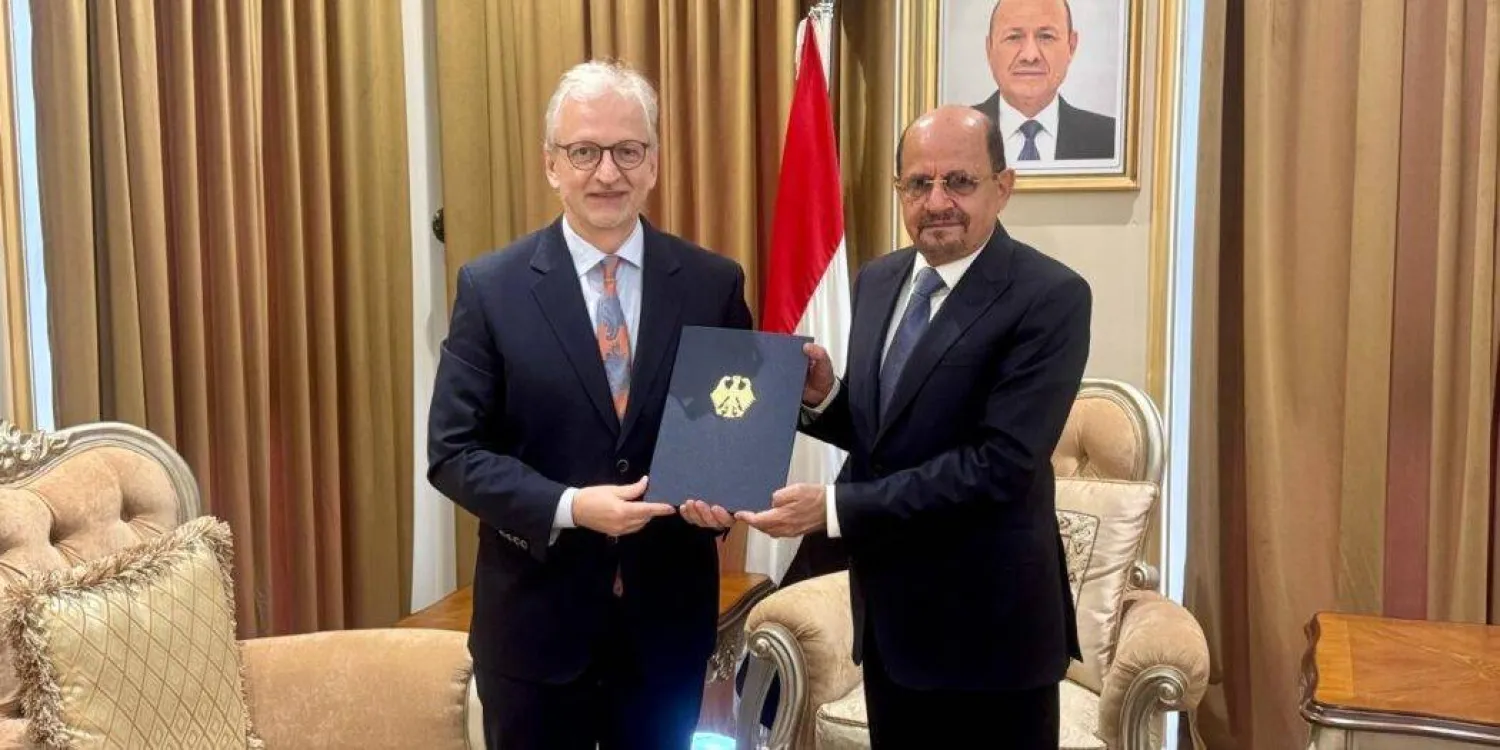
German Ambassador to Yemen Thomas Schneider presents his credentials to Foreign Minister Dr. Shaya Zindani in August. (Saba)
TT

German Ambassador to Yemen to Asharq Al-Awsat: Houthis Must Decide if They Want Peace or Conflict

German Ambassador to Yemen Thomas Schneider presents his credentials to Foreign Minister Dr. Shaya Zindani in August. (Saba)

Germany has adopted a careful and calm diplomatic approach in Yemen since the eruption of its conflict. German Ambassador to Yemen Thomas Schneider explained that Berlin is approaching the Yemeni file from a comprehensive perspective that takes into account the complexities of the region.

It is focusing on helping the Yemeni people find the right way forward in achieving stability in their country, he told Asharq Al-Awsat in an interview.

Appointed to his post in August, he expressed Germany’s deep concern over the attack by the Iran-backed Houthi militants against shipping in the Red Sea and their abduction of United Nations staff.

He called on the Houthis to reassess their choices and to decide whether they want to be partners in peace or continue along the path of conflict and division.

Yemen needs a strong and united government, he urged. The international community needs an effective Yemeni partner it can rely on.

He therefore called on the Yemeni parties to discuss their internal disputes to reach settlements and agreements that can allow them to move forward together effectively.

On coordination with Saudi Arabia, Schneider said the Kingdom plays a central and pioneering role in the Arab and Muslim worlds. Its stance on Yemen is very important for Germany.

A solution to the crisis in Yemen cannot be reached without Saudi Arabia, he stressed.

On Iran, Schneider said it must not be a threat to its neighbors or the international community, adding that if it truly wanted to bolster regional stability, then Yemen was the ideal place to prove its good intentions.

He added that Iran is the Houthis’ top backer and so it must ask itself what type of role it wants to play in the region: does it want to be part of the solution or part of the problem?

Germany has disputes with Iran over a number of issues, such as its nuclear file, but it is still an important country in the region, he acknowledged.

It needs to act in a way that does not threaten its neighbors or the world, he urged.

Historic ties

The ambassador said Yemen and Germany boast very old, deep and historic ties. They enjoy close cooperation when it comes to development with several German development agencies and institutions active in Yemen.

Today, Berlin is focusing on helping the Yemeni people find a way to move forward and revive their country, Schneider told Asharq Al-Awsat.

Germany has its interests too, he went on to say. It is concerned with ensuring the security and safety of navigation in the Red Sea and Gulf of Aden. It is also concerned with illegal migration that passes through Yemen to Africa and then Europe.

First and foremost, however, Germany is concerned with the security of the Yemeni people and it is working on ensuring that no food crisis or famine take place because of the current situation, Schneider said.

Peace or conflict

Asked about Germany’s position on the Houthis and its control of the capital, Sanaa, the ambassador replied that Berlin has been following the situation in Yemen. He said it was unfortunate that the conflict had been militarized and that the Houthis had seized large swathes of the country.

He urged a quick settlement of the conflict. Everyone responsible for Yemen must work together to end the violence and turn to a peaceful solution to the crisis.

However, it seems that the Houthis are unlikely to opt for such a solution, lamented the envoy, expressing his deep alarm over their attacks on Red Sea shipping.

Such attacks are categorically unacceptable, he declared, as is the abduction of UN staff.

The staff are there to help the Yemeni people; they represent the international community. How can someone who commits such acts be viewed as a partner for peace? asked Schneider.

He therefore called on the Houthis to reassess their choices and decide whether they want peace or if they want to prolong the conflict and division.



Disputes Over Quotas Stall Iraq Government Talks

A handout image released by the Iraqi Parliament Media Office on April 11, 2026, shows Iraqi members of parliament attending a session to elect a new president, in Baghdad. (Photo by IRAQ PARLIAMENT MEDIA OFFICE / AFP)
TT

Disputes Over Quotas Stall Iraq Government Talks

A handout image released by the Iraqi Parliament Media Office on April 11, 2026, shows Iraqi members of parliament attending a session to elect a new president, in Baghdad. (Photo by IRAQ PARLIAMENT MEDIA OFFICE / AFP)

Rivalries within Iraq’s Shiite Coordination Framework have led to a political deadlock over naming a new prime minister, as internal disagreements persist over both the selection mechanism and the division of ministerial posts among the bloc’s factions.

According to sources, a meeting of Coordination Framework leaders - postponed several times in recent days - will focus on finding a solution that reconciles two approaches: one based on the “electoral weight” of member blocs, and the other on “political consensus” to choose a compromise candidate acceptable to all parties.

The bloc has failed to agree on a nominee during two previous meetings after votes between two leading candidates ended in a tie, deepening divisions and delaying a decision. The upcoming session is seen as potentially decisive, though another postponement remains possible if differences persist.

An Iraqi political source said a decision on the prime minister could come within hours as the constitutional deadline approaches.

“I expect the matter to be settled one way or another, because next Saturday marks the final deadline, and continued delay is already having a negative impact even among their own base,” the source said.

The source added that if the alliance adopts the criterion of electoral weight, Ihsan al-Awadi, the candidate backed by Prime Minister Mohammed Shia al-Sudani, would have the strongest chances. However, if the decision remains confined to the bloc’s leadership, the contest would stay within a pool of 12 votes, with the balance possibly tipping in favor of Bassem al-Badri.

The dispute extends beyond the selection mechanism to include internal bargaining over the distribution of ministries and sovereign portfolios. Some factions have tied their support for any candidate to the size of their share in the next government, further complicating negotiations.

Two prominent candidates have emerged with nearly equal backing within the Coordination Framework, resulting in a deadlock and reviving the option of a compromise candidate if neither consensus nor a majority decision can be reached.

The Coordination Framework, formed after the most recent elections, includes several major Shiite forces, among them alliances led by former prime ministers Nouri al-Maliki and Haider al-Abadi, as well as the bloc of current Prime Minister Mohammed Shia al-Sudani, who is heading a caretaker government. Political pressure is mounting as the constitutional deadline nears for the president to designate a new prime minister.

The election of President Nizar Amidi has triggered the formal government formation process, with a constitutional deadline set to expire on April 26, placing political forces under pressure to avoid a return to prolonged deadlock.

With complications persisting, there are many scenarios, including a last-minute agreement, further delay, or a shift toward a compromise candidate. The standoff underscores fragile cohesion within the Shiite camp and a widening gap between electoral calculations and the demands of political consensus.


Fallout from Iran War Casts Shadow over Egypt’s New Budget

Egypt’s House of Representatives being briefed on the government’s outlook on the state budget (House of Representatives)
TT

Fallout from Iran War Casts Shadow over Egypt’s New Budget

Egypt’s House of Representatives being briefed on the government’s outlook on the state budget (House of Representatives)

The economic fallout from the Iran war has cast a shadow over Egypt’s new state budget, Finance Minister Ahmed Kouchouk told parliament on Wednesday, as he presented the draft before it was referred to specialized committees for discussion, with the government pledging swift amendments “to enhance its ability to deal with current and potential risks.”

Kouchouk’s statement came a day after Prime Minister Mostafa Madbouly addressed the House of Representatives, focusing on the damage caused by the conflict and ways to manage its repercussions.

He said the government was treating the current regional escalation as a “prolonged crisis,” whose end is difficult to predict given the complexity and overlap of regional and international dynamics, and suggested its economic effects could last through the end of the year.

During the presentation of the 2026-2027 fiscal year budget, 600 billion Egyptian pounds ($11.5 billion) were allocated for energy subsidies, including electricity support, which rose by 39%, according to the finance minister.

A total of 832.3 billion pounds was earmarked for social protection - a 12% annual increase - to support the most vulnerable groups, alongside 90 billion pounds set aside for programs to support economic activity. (The dollar is equivalent to about 52 Egyptian pounds.)

The minister said spending priorities focus on healthcare, education, social protection, and support for production and exports, alongside flexible precautionary policies to address potential challenges and strike a balance between fiscal discipline and economic stimulus. He pointed to “uncertainty in markets and disruptions in trade and supply chains,” describing them as “major challenges and pressures on economies, especially emerging markets.”

Data presented to lawmakers also indicated a 3% reduction in fuel consumption and a 15% cut in electricity and lighting use in response to recent developments. Regarding national projects, the government decided to postpone or slow the implementation of “slow-moving” or fuel-intensive projects on an exceptional basis for three months, renewable if needed.

According to the minister, the government has also decided to limit spending in the final quarter of the current fiscal year to essential expenditures only, including wages, salaries, pensions, and the needs of the health, electricity and petroleum sectors.

Egypt’s budget has been affected by rising costs of securing energy supplies, prompting the government to increase subsidy allocations in the new budget while relying on consumption rationalization and hedging against future developments in the conflict, said economist Mohieddin Abdel Salam. He noted that Egypt has been significantly impacted by rising oil and gas prices.

Figures presented by the finance minister showed the government has mobilized about 135.6 billion pounds since early March to ensure the stability of vital sectors. This includes 90.6 billion pounds for the energy sector, 30 billion pounds to secure essential commodities, subsidized goods, wheat and sugar, and 15 billion pounds to support the healthcare sector and provide medicines.

Abdel Salam told Asharq Al-Awsat that uncertainty remains over Egypt’s ability to attract foreign investment, as some investors are wary of committing funds in the region due to war-related risks. However, he said Egypt could still benefit from opportunities if it manages to distance itself from ongoing tensions.

He noted that these conditions have led to tighter fiscal policies, reflected in holding interest rates steady rather than cutting them, as well as austerity measures and reduced spending by government institutions.

This can be seen in the new budget, he added, which focuses on vital sectors and strengthening social support, particularly amid declining revenues from the Suez Canal and tourism, and potential impacts on remittances from Egyptians abroad.


French Delegation in Algeria to Mend Ties, Rebuild Trust

Chairman of the Algerian Economic Renewal Council, center
TT

French Delegation in Algeria to Mend Ties, Rebuild Trust

Chairman of the Algerian Economic Renewal Council, center

A delegation from the Mouvement des Entreprises de France (Medef) is set to visit Algeria on Thursday, with its president Patrick Martin leading around 40 senior company executives, in an economic push aimed at repairing trade relations strained by political tensions over the past two years.

According to sources within the French diplomatic network based in Algeria, the mission seeks to inject new momentum into direct economic dialogue between the two sides and to restore the position of French companies in the Algerian market.

The visit is also seen as a practical step toward rebuilding trust between economic stakeholders, with the goal of moving past a period of stagnation and reviving trade and investment flows.

Reports cited by Algerian daily El Watan on Wednesday, quoting sources close to the Algerian Economic Renewal Council - the country’s largest employer body - said Medef’s visit will last two days.

The trip comes after a prolonged period of tension in bilateral relations that has affected economic exchanges. Observers say the move is not merely a protocol visit but an attempt to relaunch dialogue between business communities on both sides.

The main objective is to resume talks within the framework of the Algeria-France Economic Relations and Friendship Council, chaired by businessman Kamel Moula, who also heads the Algerian Economic Renewal Council, at a time when French economic presence in Algeria has significantly declined in recent years.

Sources from the Algerian Economic Renewal Council told Asharq Al-Awsat that the planned meetings in Algiers will be limited to bilateral sessions focusing on priority sectors, notably food security and energy - through projects linked to solar power and green hydrogen - as well as healthcare, digitalization and construction.

The mission offers French companies an opportunity to reaffirm their presence and reassure partners of their long-term commitment, the same sources said. It also aims to address certain obstacles, including lengthy administrative procedures, which are estimated to have tripled since 2024.

Observers consider the visit a key test of prospects for reviving economic relations between the two countries.

The Medef visit comes amid signs of a gradual political thaw in relations between Algiers and Paris. A visit by French Interior Minister Laurent Nunez to Algeria in February, during which he was received by President Abdelmadjid Tebboune at the presidential palace, helped pave the way for a measured easing of tensions.

In recent media comments, Michel Bisac, head of the Algerian-French Chamber of Commerce and Industry, warned of the potential fallout from the political crisis between Algeria and France, fueled by political and media circles close to the far right. The crisis erupted in summer 2024 after Paris recognized Moroccan sovereignty over Western Sahara.

“We are in a very delicate situation,” Bisac said, expressing regret over threats “not only to political ties but also economic relations between the two countries.”

He added that if Algeria were to apply to France the same trade measures it previously imposed on Spain after Madrid backed Morocco’s autonomy plan for Western Sahara in 2022, “the bill would be costly for the French economy, with losses approaching 4.8 billion euros.”

That figure reflects the value of French exports to Algeria, a key pillar for several industrial sectors’ foreign trade. Bisac noted that around 6,000 French companies currently operate “for and with Algeria,” supplying goods and services or engaging in industrial partnerships.

“These companies would face serious difficulties if the situation worsens,” he warned, stressing the growing fragility of bilateral economic exchanges. “Until recently, I had great hope ... but today I want to clearly stress the need to avoid escalation.”