


Fatal Bear Attacks Hit New Record in Japan

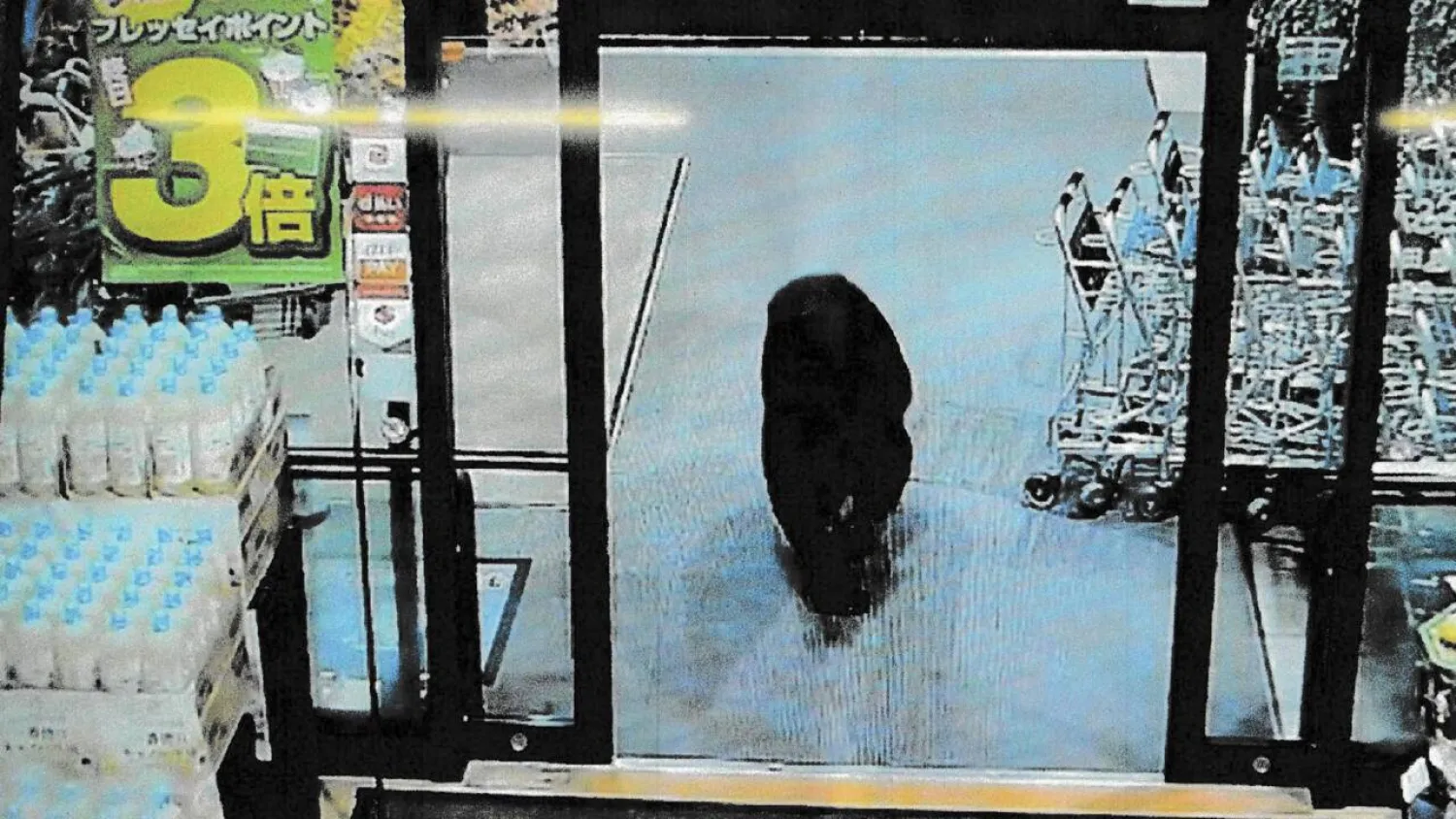
Last week an adult bear entered a supermarket in Numata, Gunma, north of Tokyo. STR / GUNMA PREFECTURAL POLICE VIA JIJI PRESS/AFP/File
TT

Fatal Bear Attacks Hit New Record in Japan

Last week an adult bear entered a supermarket in Numata, Gunma, north of Tokyo. STR / GUNMA PREFECTURAL POLICE VIA JIJI PRESS/AFP/File

Bears have killed a record seven people in Japan this year, the highest since 2006 when the survey started, an environment ministry official said Thursday.

More and more wild bears have been spotted in Japan in recent years, even in residential areas, due to factors including a declining human population and climate change.

"This is the largest toll since 2006 when statistics started," surpassing five victims recorded in the 2023-24 fiscal year, the ministry official told AFP on condition of anonymity.

The statement followed confirmation that a man found dead last week in the northern region of Iwate was killed by a bear.

Including the fatal cases, at least 108 people have been injured since April when the fiscal year started.

This is up from 85 incidents of injury including three fatal cases the previous fiscal year, and compares with 219 in 2023/24, according to the environment ministry survey.

Last week a 1.4-meter (4.5-foot) adult bear entered a supermarket in Numata, Gunma, north of Tokyo.

The animal lightly injured a man in his 70s and another in his 60s, regional police and fire officials said.

The store is close to mountainous areas, but has never had bears come near before, Hiroshi Horikawa, a management planning official at the grocery store chain, told AFP.

"It entered from the main entrance and stayed inside for roughly four minutes," he said.

"It almost climbed onto the fish case and damaged glass. In the fruits section, it knocked over a pile of avocados and stamped on them," he added.

The store's manager told local media that around 30 to 40 customers were inside at the time, and that the bear became agitated as it struggled to find the exit.

The same day a farmer in Iwate region was scratched and bitten by a bear, accompanied by a cub, just outside his house.

And earlier this month a Spanish tourist was attacked by a bear at a bus stop in the scenic village of Shirakawa-go in central Japan.

Climate change is a factor in the increased number of incidents because of its effects on foods that the animals eat, such as acorns, as well as hibernation times.

Japan has two types of bears: Asian black bears -- also known as moon bears -- and the bigger brown bears which live on the main northern island of Hokkaido.

Thousands of the animals are shot every year.


World Not Ready for Rise in Extreme Heat, Scientists Say

A security officer looks on as the roof of Rod Laver Arena is closed due to extreme heat during the men's singles match between Italy's Jannik Sinner and USA's Eliot Spizzirri on day seven of the Australian Open tennis tournament in Melbourne on January 24, 2026. (AFP)
TT

World Not Ready for Rise in Extreme Heat, Scientists Say

A security officer looks on as the roof of Rod Laver Arena is closed due to extreme heat during the men's singles match between Italy's Jannik Sinner and USA's Eliot Spizzirri on day seven of the Australian Open tennis tournament in Melbourne on January 24, 2026. (AFP)

Nearly 3.8 billion people could face extreme heat by 2050 and while tropical countries will bear the brunt cooler regions will also need to adapt, scientists said Monday.

Demand for cooling will "drastically" increase in giant countries like Brazil, Indonesia and Nigeria, where hundreds of millions of people lack air conditioning or other means of beating the heat.

But even a moderate increase in hotter days could have a "severe impact" in nations not used to such conditions like Canada, Russia and Finland, said scientists from the University of Oxford.

In a new study, they looked at different global warming scenarios to project how often people in future might experience temperatures considered uncomfortably hot or cold.

They found "that the population experiencing extreme heat conditions is projected to nearly double" by 2050 if global average temperatures rise 2C above preindustrial times.

But most of the impact would be felt this decade as the world fast approaches the 1.5C mark, the study's lead author Jesus Lizana told AFP.

"The key take away from this is that the need for adaptation to extreme heat is more urgent than previously known," said Lizana, an environmental scientist.

"New infrastructure, such as sustainable air conditioning or passive cooling, needs to be built out within the next few years to ensure people can cope with dangerous heat."

Prolonged exposure to extreme heat can overwhelm the body's natural cooling systems, causing symptoms ranging from dizziness and headaches to organ failure and death.

It is often called a silent killer because most heat deaths occur gradually as high temperatures and other environmental factors work together to undermine the body's internal thermostat.

Climate change is making heatwaves longer and stronger and access to cooling -- especially air conditioning -- will be vital in future.

- 'Dangerously underprepared' -

The study, published in the journal Nature Sustainability, projected that 3.79 billion people worldwide could be exposed to extreme heat by mid-century.

This would "drastically" increase energy demand for cooling in developing nations where the gravest health consequences would be felt. India, the Philippines and Bangladesh would be among biggest populations impacted.

The most significant change in "cooling degree days" -- temperatures hot enough to require cooling, such as air conditioning or fans -- were projected in tropical or equatorial countries, particularly in Africa.

Central African Republic, Nigeria, South Sudan, Laos and Brazil saw the biggest rise in dangerously hot temperatures.

"Put simply, the most disadvantaged people are the ones who will bare the brunt of this trend our study shows for ever hotter days," urban climate scientist and research co-author Radhika Khosla told AFP.

But wealthier countries in traditionally cooler climates also "face a major a problem -- even if many do not realize it yet", she added.

Countries like Canada, Russia and Finland may experience steep drops in "heating degree days" -- temperatures low enough to require indoor heating -- under a 2C scenario.

But even a moderate rise in hotter temperatures would be felt more acutely in countries not designed to withstand heat, the authors said.

In these countries, homes and buildings are usually constructed to maximize sunshine and reduce ventilation, and public transport runs without air conditioning.

Some cold-climate nations may see a drop in heating bills, Lizana said, but over time these savings would likely be replaced by cooling costs, including in Europe where air conditioning is still rare.

"Wealthier countries cannot sit back and assume they will be OK -- in many cases they are dangerously underprepared for the heat that is coming over the next few years," he said.


Americans Hunker Down, Help Each Other Under Blizzard and Brutal Cold

People walk across Sixth Avenue as snow falls in the Manhattan borough of New York City on January 25, 2026. (AFP)
TT

Americans Hunker Down, Help Each Other Under Blizzard and Brutal Cold

People walk across Sixth Avenue as snow falls in the Manhattan borough of New York City on January 25, 2026. (AFP)

Tens of millions of Americans hunkered down on Monday or ventured out to help neighbors ​under bitter cold, blizzards of snow and lashings of freezing rain from a huge winter storm that paralyzed the eastern United States.

From New York and Massachusetts in the northeast to Texas and North Carolina in the south, roads were frozen slick with ice and buried under often more than a foot of snow.

In some southern states, residents faced winter conditions unseen in those areas for decades, with inch-thick ice coating branches, bringing down trees and power lines.

Flights were canceled, schools were shut and volunteers staffed emergency shelters to provide warmth for the needy and homeless.

"I just saw a need ‌for getting people ‌out of the cold," said Ryan DuVal, who owns a ‌vintage ⁠firetruck ​and was ‌driving it through the frozen streets of Tulsa, Oklahoma, looking for people who needed help.

"You know, just cruise the streets, see someone, offer a ride. If they take it, great. If not, I can at least warm them up in the truck and just get them a water, meal, something. And it's just giving back to the community like everybody should do."

Winter storm warnings covered 118 million people. An estimated 157 million were warned to bundle up against cold, ranging from sub-zero Fahrenheit temperatures (-18 Celsius) along the Canadian border to ⁠below freezing as far south as the Gulf of Mexico.

DEEP SNOW, THICK ICE

New York Governor Kathy Hochul said she had mobilized National Guard ‌troops in New York City, Long Island and the Hudson ‍Valley to assist with the state's emergency ‍storm response.

Announcing that schools would be shut for a remote school day, New York City's Mayor Zohran ‍Mamdani quipped: "I know that this may disappoint some students, so if you do see me, feel free to throw a snowball at me."

The onslaught of snow, ice and winds hit air travel especially hard, with major carriers forced to cancel more than 11,000 US flights scheduled for Sunday, according to an industry tracking service FlightAware.com.

More than ​820,000 electricity customers were without power as of 4 a.m. EST (0900 GMT) across a swathe of southern states from Texas to Virginia, according to PowerOutage.us.

Worst-hit was Tennessee, ⁠accounting for nearly a third of the outages. Calling the storm "historic," President Donald Trump on Saturday approved federal emergency disaster declarations for a dozen states, mostly in the mid-South.

While the storm system was expected to drift away from the East Coast into the Atlantic on Monday, more Arctic air was forecast to rush in behind it, prolonging bitter cold, icy conditions over the next few days, the weather service said.

Still, despite the emergency and the danger, the winter conditions were fun for many, including in Washington DC, where a huge crowd gathered for a raucous impromptu snowball fight in Meridian Hill Park, one man wearing an astronaut space suit.

Families brought sleds to Capitol Hill, where children zoomed down the steep slope below the marble-domed seat of the US Congress.

"It's beautiful. It's so fun to go down Capitol Hill. It was great ‌powder this morning. Getting a little sleety now but we're having a great time!" said a man who pushed his daughter down the hill on a purple plastic sled.


Egypt to Adopt Restrictions on Children’s Social Media Use to Fight 'Digital Chaos'

A close-up shows a mobile phone displaying the app UdenUSA, which translates to Without USA in Danish, Copenhagen, Denmark, 21 January 2026. EPA/Liselotte Sabroe  DENMARK OUT
A close-up shows a mobile phone displaying the app UdenUSA, which translates to Without USA in Danish, Copenhagen, Denmark, 21 January 2026. EPA/Liselotte Sabroe DENMARK OUT
TT

Egypt to Adopt Restrictions on Children’s Social Media Use to Fight 'Digital Chaos'

A close-up shows a mobile phone displaying the app UdenUSA, which translates to Without USA in Danish, Copenhagen, Denmark, 21 January 2026. EPA/Liselotte Sabroe  DENMARK OUT
A close-up shows a mobile phone displaying the app UdenUSA, which translates to Without USA in Danish, Copenhagen, Denmark, 21 January 2026. EPA/Liselotte Sabroe DENMARK OUT

Egypt's Parliament is looking into ways to regulate children’s use of social media platforms to combat what lawmakers called “digital chaos,” following some western countries that are considering banning young teenagers from social media.

The House of Representatives said in a statement late Sunday that it will work on a legislation to regulate children’s use of social media and “put an end to the digital chaos our children are facing, and which negatively impacts their future.”

Legislators will consult with the government and expert bodies to draft a law to “protect Egyptian children from any risks that threaten its thoughts and behavior," the statement said.

The statement came after President Abdel-Fattah al-Sisi on Saturday urged his government and lawmakers to consider adopting legislation restricting children’s use of social media, “until they reach an age when they can handle it properly.”

The president's televised comments urged his government to look at other countries including Australia and the United Kingdom that are working on legislations to “restrict or ban” children from social media.

About 50% of children under 18 in Egypt use social media platforms where they are likely exposed to harmful content, cyberbullying and abuse, according to a 2024 report by the National Center for Social and Criminological Research, a government-linked think tank.

In December, Australia became the first country to ban social media for children younger than 16. The move triggered fraught debates about technology use, privacy, child safety and mental health and has prompted other countries to consider similar measures.

The British government said it will consider banning young teenagers from social media while tightening laws designed to protect children from harmful content and excessive screen time.

French President Emmanuel Macron urged his government to fast-track the legal process to ensure a social media ban for children under 15 can be enforced at the start of the next school year in September.
