
First Putin-Al-Sharaa Meeting Signals Renewed Russia-Syria Ties

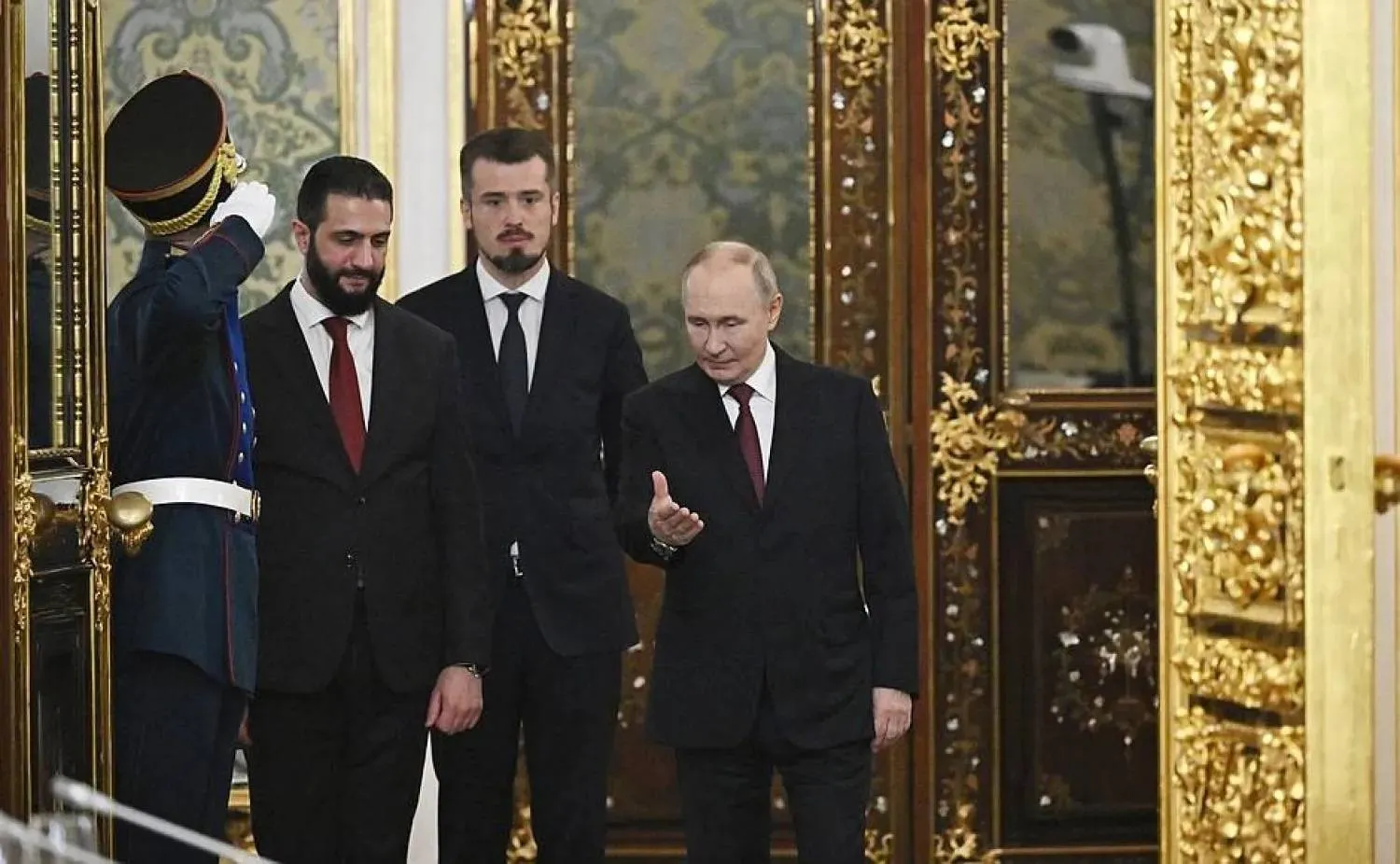
Russian President Vladimir Putin welcomes Syrian President Ahmed al-Sharaa at the Kremlin, Wednesday. (DPA)
TT

First Putin-Al-Sharaa Meeting Signals Renewed Russia-Syria Ties

Russian President Vladimir Putin welcomes Syrian President Ahmed al-Sharaa at the Kremlin, Wednesday. (DPA)

A year ago, few would have imagined this scene: Syrian President Ahmed al-Sharaa sitting in one of the Kremlin’s grandest halls, warmly received, while opposite him, President Vladimir Putin was flanked by Russia’s top decision-makers.

Just a few kilometers away, the ousted Syrian leader, once a close Kremlin ally, likely watched the encounter with a mix of nostalgia and regret. The “humanitarian refugee,” as he is sometimes described, may have followed the public portion of the meeting on screens from afar, in the Kremlin’s Green Reception Hall—reserved for receptions of prominent world leaders.

The scene, unimaginable a year ago, reflected the Kremlin’s pragmatic approach and swift adaptation to Syria’s new political reality.

Putin and al-Sharaa Meeting in Moscow

Putin appeared at ease discussing relationships spanning eight decades, avoiding mention of the lean years, and emphasizing that Russia’s ties are built on long-term national interests, not fleeting political moments.

Al-Sharaa, fully aware of the historical significance, echoed his counterpart’s earlier calls—a man who, until last year, had demanded his head “dead or alive”—and calmly noted Syria’s internal changes without using terms that might irritate Moscow, such as “liberation of Syria.”

Russian Military Bases

Behind the public optics lay meticulously orchestrated protocols, a hallmark of Kremlin diplomacy. From al-Sharaa’s entrance, greeted by the presidential guard, to the exit of cameras before closed-door discussions, every detail followed strict procedure.

As expected, sensitive topics were omitted from the open session. There was no mention of Russia’s military bases—a top Kremlin priority—or of Syria’s transitional justice demands, including the extradition of former President Bashar al-Assad.

Yet these issues were present in the discussions, as later remarks by Kremlin spokesperson Dmitry Peskov and Foreign Minister Sergey Lavrov partially indicated, though without any sign of formal agreement.

Regarding the bases, Moscow confirmed that both presidents had discussed their future, but details remained sparse, suggesting further technical, political, and military deliberations are needed. Leaks hint at a shared interest in creating a new legal framework governing Russian forces in Syria, defining their roles, size, and authority on the ground.

Al-Sharaa’s vague reference to “respecting all previously signed agreements” could be misinterpreted. Observers note that Syria honoring commitments does not necessarily imply continued adherence to outdated documents, with reports pointing to a potential review announced during the recent Moscow visits by Syrian foreign and defense ministers.

Preliminary indications from Syrian sources suggest a possible agreement on joint management at the Hmeimim airbase and reopening Latakia Airport, though Russian confirmation has not emerged.

Assad and Transitional Justice

The question of Assad’s fate was apparently addressed only tangentially, not as an official demand. When asked, Peskov declined to comment, saying: “We have nothing to say on this matter.” Syrian sources in Moscow, however, suggested that transitional justice and the handover of Assad and other former regime figures were briefly mentioned in general terms.

Another ambiguous point concerned Moscow’s potential domestic role, whether in stabilizing certain regions or supporting Syrian authorities. Before the meeting, speculation abounded about Russia mediating with northeastern Kurdish groups, southern Druze factions, or even Israel, to curb ongoing Israeli incursions.

Experts cited by Asharq Al-Awsat confirmed Russia’s capability, noting prior experience in southern Syria and along the Golan demarcation, though the Kremlin denied that Russian patrols in Syrian territories were discussed at the meeting.

The issue is tied to Russia’s “capacity” should future agreements be reached. Experts also stress its strategic importance if Moscow and Damascus coordinate on restructuring and training the Syrian army, potentially including the provision of air and ground defenses—a topic raised during the Syrian chief of staff’s recent Moscow visit.

Regional coordination and diplomatic channels with Israel would be essential to prevent further attacks, suggesting Russia could resume a guarantor role for both Damascus and Jerusalem, particularly in contested zones and army rehabilitation.

Russian Debt and Reconstruction

A key aspect of the new relationship involves Syrian debts to Russia and potential compensation claims. While detailed discussions have yet to take place, early signs indicate Moscow’s willingness to approach the matter on two fronts:

A preliminary readiness to forgive Syrian debts as part of broader Russian support to alleviate economic pressure, contingent on clear reciprocal steps, including granting Russian companies stakes in reconstruction and key sectors.

An alternative Russian approach favoring direct involvement in rebuilding critical infrastructure—energy, transport, and other strategic facilities originally developed with Russian assistance.

This aligns with publicly announced post-meeting intentions for Russian participation in reconstructing Syria’s infrastructure, arguably the easiest initiative to implement immediately.

Energy, Transport, and Humanitarian Support

Accompanying al-Sharaa in Moscow were Foreign Minister Asaad Hassan al-Shaibani, Defense Minister Major General Murhaf Abu Qasra, General Intelligence Director Hussein Al-Salama, and Secretary General of the Presidency of Syria Maher al-Sharaa.

Immediately after the presidential meeting, Deputy Prime Minister Alexander Novak, Russia’s energy minister, told reporters that Russian companies were eager to return to Syria, offering robust support for energy projects and major oil and gas initiatives, alongside infrastructure and humanitarian aid—especially urgent food and medical supplies.

Novak said: “Today we discussed specific projects in energy, transport, tourism, healthcare, and cultural and humanitarian sectors.”

He added that Syria urgently needs reconstruction across energy, railway, and transport infrastructure, and that Russian firms are prepared to assist, drawing on Soviet-era experience.

Syrian Finance Minister Mohammed Yisr Barniyeh echoed this at the IMF and World Bank annual meetings, highlighting Syria’s willingness to offer Russia “huge opportunities to support the country’s reconstruction.”

Moving Forward

The Kremlin meeting established a broad framework for moving past Syria’s recent turbulent chapter, partially transcending the Assad era. While explicit or covert Russian support for remnants of the former regime is no longer on the table, finalizing agreements on all pending issues remains a complex task. Experts stress the need to operationalize joint government mechanisms and continue detailed discussions on each file.

The presidents reportedly agreed to resume flights between Moscow and Damascus—a small but symbolic step in normalizing ties. The Syrian foreign and defense ministers remained in Moscow after al-Sharaa’s departure, with reports suggesting upcoming agreements with Russia, though details have yet to be disclosed.


Syria Moves Military Reinforcements East of Aleppo After Telling Kurds to Withdraw

Military vehicles drive along a road as the last Kurdish-led Syrian Democratic Forces (SDF) fighters left the Syrian city of Aleppo on Sunday, state-run Ekhbariya TV said, following a ceasefire deal that allowed evacuations after days of deadly clashes, in Latakia, Syria, January 14, 2026. (Reuters)
TT

Syria Moves Military Reinforcements East of Aleppo After Telling Kurds to Withdraw

Military vehicles drive along a road as the last Kurdish-led Syrian Democratic Forces (SDF) fighters left the Syrian city of Aleppo on Sunday, state-run Ekhbariya TV said, following a ceasefire deal that allowed evacuations after days of deadly clashes, in Latakia, Syria, January 14, 2026. (Reuters)

Syria's army was moving reinforcements east of Aleppo city on Wednesday, a day after it told Kurdish forces to withdraw from the area following deadly clashes last week.

The deployment comes as Syria's government seeks to extend its authority across the country, but progress has stalled on integrating the Kurds' de facto autonomous administration and forces into the central government under a deal reached in March.

The United States, which for years has supported Kurdish fighters but also backs Syria's new authorities, urged all parties to "avoid actions that could further escalate tensions" in a statement by the US military's Central Command chief Admiral Brad Cooper.

On Tuesday, Syrian state television published an army statement with a map declaring a large area east of Aleppo city a "closed military zone" and said "all armed groups in this area must withdraw to east of the Euphrates" River.

The area, controlled by Kurdish forces, extends from near Deir Hafer, around 50 kilometers (30 miles) from Aleppo, to the Euphrates about 30 kilometers further east, as well as towards the south.

State news agency SANA published images on Wednesday showing military reinforcements en route from the coastal province of Latakia, while a military source on the ground, requesting anonymity, said reinforcements were arriving from both Latakia and the Damascus region.

Both sides reported limited skirmishes overnight.

An AFP correspondent on the outskirts of Deir Hafer reported hearing intermittent artillery shelling on Wednesday, which the military source said was due to government targeting of positions belonging to the US-backed, Kurdish-led Syrian Democratic Forces.

- 'Declaration of war' -

The SDF controls swathes of the country's oil-rich north and northeast, much of which it captured during Syria's civil war and the fight against the ISIS group.

On Monday, Syria accused the SDF of sending reinforcements to Deir Hafer and said it would send its own personnel there in response.

Kurdish forces on Tuesday denied any build-up of their personnel and accused the government of attacking the town, while state television said SDF sniper fire there killed one person.

Cooper urged "a durable diplomatic resolution through dialogue".

Elham Ahmad, a senior official in the Kurdish administration, said that government forces were "preparing themselves for another attack".

"The real intention is a full-scale attack" against Kurdish-held areas, she told an online press conference, accusing the government of having made a "declaration of war" and breaking the March agreement on integrating Kurdish forces.

Syria's government took full control of Aleppo city over the weekend after capturing its Kurdish-majority Sheikh Maqsud and Achrafieh neighborhoods and evacuating fighters there to Kurdish-controlled areas in the northeast.

Both sides traded blame over who started the violence last week that killed dozens of people and displaced tens of thousands.

- PKK, Türkiye -

On Tuesday in Qamishli, the main Kurdish city in the country's northeast, thousands of people demonstrated against the Aleppo violence, while shops were shut in a general strike.

Some protesters carried Kurdish flags and banners in support of the SDF.

"This government has not honored its commitments towards any Syrians," said cafe owner Joudi Ali.

Other protesters burned portraits of Turkish Foreign Minister Hakan Fidan, whose country has lauded the Syrian government's Aleppo operation "against terrorist organizations".

Türkiye has long been hostile to the SDF, seeing it as an extension of the Kurdistan Workers' Party (PKK) and a major threat along its southern border.

Last year, the PKK announced an end to its long-running armed struggle against the Turkish state and began destroying its weapons, but Ankara has insisted that the move include armed Kurdish groups in Syria.

On Tuesday, the PKK called the "attack on the Kurdish neighborhoods in Aleppo" an attempt to sabotage peace efforts between it and Ankara.

A day earlier, Ankara's ruling party levelled the same accusation against Kurdish fighters.

The Britain-based Syrian Observatory for Human Rights reported 45 civilians and 60 soldiers and fighters from both sides killed in the Aleppo violence.


Lebanon Says France to Host Conference to Support Army

French Special Presidential Envoy to Lebanon, Jean-Yves Le Drian looks on during a meeting with Lebanese Prime Minister Nawaf Salam (not pictured) at the Government Palace in Beirut, Lebanon, 14 January 2026. (EPA)
TT

Lebanon Says France to Host Conference to Support Army

French Special Presidential Envoy to Lebanon, Jean-Yves Le Drian looks on during a meeting with Lebanese Prime Minister Nawaf Salam (not pictured) at the Government Palace in Beirut, Lebanon, 14 January 2026. (EPA)

Lebanon said Wednesday that a conference in support of the country's army as it seeks to disarm Hezbollah would take place in Paris on March 5.

The announcement follows recent promises of support to the military, which lacks funds, equipment and technical expertise.

Presidency spokeswoman Najat Charafeddine said President Joseph Aoun met French envoy Jean-Yves Le Drian, Saudi envoy Yazid bin Farhan and ambassadors including from the US, Egypt and Qatar, discussing preparations for "a conference to support the Lebanese army and internal security forces".

"It was decided to hold the conference in Paris on March 5, to be opened by French President Emmanuel Macron," she said at the presidential palace.

Under US pressure and fearing expanded Israeli strikes, Lebanon has committed to disarming the Iran-backed Hezbollah, which was badly weakened in more than a year of hostilities with Israel that largely ended in late 2024.

Last week, Lebanon's army said it had completed the first phase of its plan to disarm the group, covering the area south of the Litani river, around 30 kilometers (20 miles) from the Israeli border.

A plan for the disarmament north of the Litani is to be presented to cabinet next month.
Israel, which accuses Hezbollah or rearming, has criticized the army's progress as insufficient, while Hezbollah has rejected calls to surrender its weapons.

Lebanon's army has dismantled tunnels and other military infrastructure belonging to Hezbollah near the Israeli border in recent months, seizing weapons and ammunition, despite its limited capacities.

Despite the ceasefire, Israel has kept up regular strikes on Lebanon, usually saying it is targeting Hezbollah, and has maintained troops in five south Lebanon areas it deems strategic.

Last month, talks with international envoys in Paris touched on the Lebanese army's needs, while its chief agreed to document its progress in disarming Hezbollah.


Iraqi Officials Arrest Man Wanted by Australian Police as 'Number One Priority'

Australian Federal Police Commissioner Krissy Barrett said the arrested man, Kazem Hamad, was a threat to national security. (Getty Images file)
TT

Iraqi Officials Arrest Man Wanted by Australian Police as 'Number One Priority'

Australian Federal Police Commissioner Krissy Barrett said the arrested man, Kazem Hamad, was a threat to national security. (Getty Images file)

Iraqi officials have arrested a man wanted by Australian Federal Police as a person of interest in ​the investigation into a spate of firebombings, including an antisemitic attack on a Melbourne synagogue, police said on Wednesday.

Australian Federal Police Commissioner Krissy Barrett said the arrested man, Kazem Hamad, was a threat to national security and that she had identified ‌him as her "Number ‌One priority".

Iraq's National ‌Center ⁠for ​International ‌Judicial Cooperation said in a statement that Kadhim Malik Hamad Rabah al-Hajami had been arrested as part of a drugs investigation, after a request from Australia.

Barrett said Iraqi officials had made an independent decision to arrest the man ⁠in their own criminal investigation, after Australian Federal Police provided ‌information to Iraqi law enforcement ‍late last year.

"This ‍arrest is a significant disruption to an ‍alleged serious criminal and his alleged criminal enterprise in Australia," she said in a statement.

In October, Barrett said that in addition to being a ​suspect in arson attacks in Australia linked to the tobacco trade, the man ⁠was "a person of interest in the investigation into the alleged politically-motivated arson attack on the Adass Israel Synagogue" in Melbourne.

Australia expelled Iran's ambassador in August after the Australian Security Intelligence Organization traced the funding of hooded criminals who allegedly set fire to the Melbourne synagogue in December 2024 to Iran's Revolutionary Guard Corps.

Hamad, previously convicted in Australia for drug trafficking ‌offences, was deported from Australia to Iraq in 2023.