
Gen Z Protests against Corruption and Inequality are Shaking Morocco. Here's What to Know

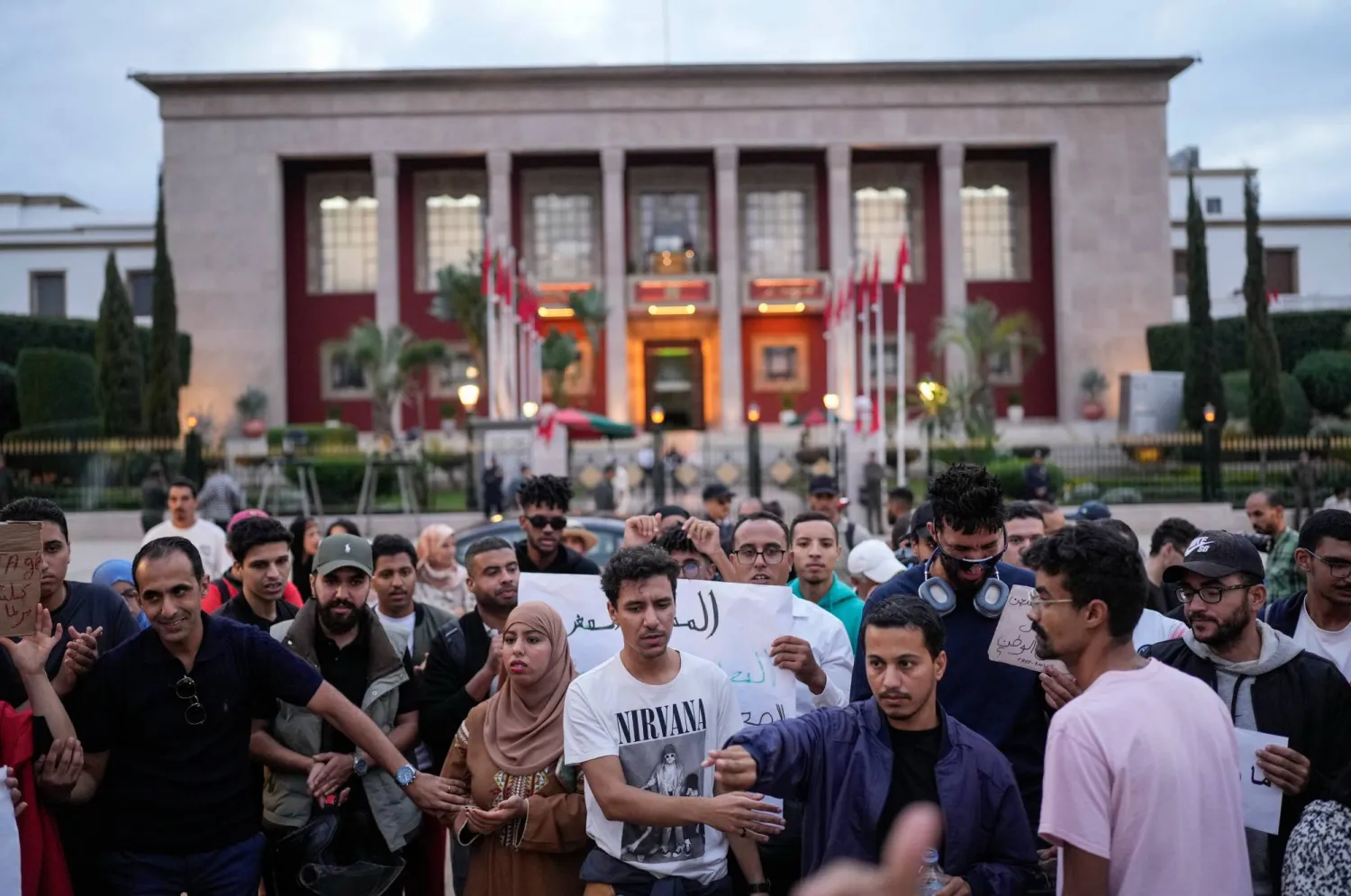
People take part in a youth-led protest against corruption and calling for education and healthcare reforms, in Rabat, Morocco, Thursday, Oct. 9, 2025. (AP Photo/Mosa'ab Elshamy)
TT

Gen Z Protests against Corruption and Inequality are Shaking Morocco. Here's What to Know

People take part in a youth-led protest against corruption and calling for education and healthcare reforms, in Rabat, Morocco, Thursday, Oct. 9, 2025. (AP Photo/Mosa'ab Elshamy)

Demonstrations in more than a dozen cities have jolted Morocco for weeks, with the young people behind them showing they can translate digital discontent into a real-world movement that authorities can’t ignore.

The North African nation is the latest to be rocked by “Gen Z” protests against corruption, lack of opportunity and business as usual. New protests are expected Saturday, said The Associated Press.

Similar movements have risen in countries such as Madagascar, Kenya, Peru and Nepal. They differ in origin but share a common refusal to go through institutions like political parties or unions to be heard.

In Morocco, anger has boiled over contrasts between government spending on stadiums in the lead-up to the 2030 FIFA World Cup and a subpar health system that lags behind countries with similarly sized economies.

Here’s what to know:

Meet the protesters

A leaderless collective called Gen Z 212 — named after Morocco’s dialing code — is the engine behind the protests. Members debate strategy on Discord, a chat app popular with gamers and teens. The core group has about 180,000 members, but spinoffs have also sprouted, organizing demonstrations in towns independently.

Like other nations swept by Gen Z protests, Morocco is experiencing a youth bulge, with more than half of the population under 35. Yet, as the country pours billions into infrastructure and tourism, unemployment for Moroccans ages 15-24 has climbed to 36%. And with opportunity lacking, more than half of Moroccans under 35 say they have considered emigrating, according to a June survey from non-partisan research network Afrobarometer.

When demonstrations turned violent earlier this month, officials said most participants were minors and rights groups said many detained were under 18.

What they are protesting

Morocco is Africa’s most visited country, appealing to tourists from around the world with its medieval palaces, bustling markets and sweeping mountain and desert landscapes. But not far from tourist routes, the daily reality for most of Morocco’s 37 million people includes soaring costs of living and stagnating wages.

The North African Kingdom has made significant strides in lifting standards of living, but development has been uneven and critics say it has exacerbated inequities.

Morocco boasts Africa’s only high-speed rail line and is constructing seven new stadiums and renovating seven others in preparation for the World Cup. It plans to spend more than $5 billion on infrastructure for the event, some from the private sector. Yet with a monthly minimum wage of around $300, many languish in poverty in areas where roads are unpaved, hospitals lack doctors and classrooms are underfunded and overcrowded.

Morocco has only 7.7 medical professionals per 10,000 inhabitants and far fewer in parts of the south and east where protests have become most heated. The public health system provides more than 80% of care, but accounts for only 40% of spending, with the rest coming from private or out-of-pocket costs.

Before Gen Z 212, localized protests against regional inequities and government priorities erupted, including in Al Haouz, where many remain in tents more than two years after a deadly 2023 earthquake. Anger boiled in September after eight women died giving birth in a public hospital in the coastal city of Agadir. Despite its renovated airport and reputation as a destination for tourists, the city is the capital of one of Morocco’s poorest provinces where residents have decried a lack of doctors and quality medical care.

Protesters, angry over corruption, have targeted Prime Minister Aziz Akhannouch and Health Minister Amine Tahraoui, his former business associate. Akhannouch, one of Morocco’s richest men, controls most of the country’s gas stations, and one of his companies recently won controversial government contracts for new desalination projects.

Morocco’s business interests, including the royal family’s investment fund Al Mada, have also projected substantial profits from World Cup-related developments, including new stadiums, train lines and hotels, according to the magazine Jeune Afrique.

Gen Z's key chants Protesters have chanted “Stadiums are here, but where are the hospitals?" in a jab at Morocco’s spending on spectacle projects for the World Cup and what many see as the government's blindness to everyday hardship.

“Freedom, dignity and social justice" is another slogan carried over from past movements denouncing limited political freedoms and economic exclusion, without offering specific demands for reform.

The protesters' demands Gen Z 212 published a letter addressed to King Mohammed VI asking him to dismiss the government and corrupt political parties, release detainees and convene a government forum to hold officials accountable.

The political demands diverged from earlier nebulous calls for dignity and social justice, and reflected a broad sentiment that Morocco has not made serious strides to overcome problems that the king vowed to address during 2017 mass demonstrations. At the time, he acknowledged development had not adequately trickled down to benefit all.

Though the king is the country’s highest authority, Gen Z protesters directed their ire at government officials and called on him to oversee reforms. Many on the streets shouted: “The people want the King to intervene."

In an address to Parliament this month, the king defended Morocco’s vision for the future, arguing that large-scale projects and social programs can advance together. He mirrored some of the protesters’ grievances but didn’t address the movement directly.

“Social justice is not a temporary priority,” he said. “There should be no contradiction or competition between major national projects and social programs, as both share the same goal: developing the country and improving the living conditions of citizens wherever they may be."

How the government has responded

Security forces have alternated between crackdown and retreat.

Riot police and plainclothes officers arrested demonstrators en masse on the weekend of Sept. 27 and 28. Police in a small town outside of Agadir fired on demonstrators they claimed were storming one of their posts in early October, killing three, and a police van rammed into protesters in the eastern city of Oujda, injuring one.

But elsewhere, security forces eased their presence, standing aside as rioters and looters set cars ablaze and smashed storefronts.

Moroccan courts have handed down a string of convictions tied to the protests, with sentences ranging from four to 20 years for vandalism and incitement, according to Human Rights Watch.

After the initial protests, Akhannouch and several of his Cabinet members said the government was open to dialogue with protesters and suggested fortifying existing hospitals with additional staff and opening new medical facilities.

But as Moroccans watch stadiums being built in a matter of months, promised changes have rung hollow to many demonstrators since no official has yet proposed redirecting stadium funds to social services.

“The government is taking patchwork measures to ease the pressure," Youssef, a 27-year-old demonstrator, said. "Their reforms will take years.”


Sept. 11’s Legacy Endures a Quarter-Century Later

A Palestinian man holds up a poster of ousted Iraqi leader Saddam Hussein (L) and wanted al-Qaeda leader Osama bin Laden during a demonstration by some 1,000 people in the West Bank town of Hebron 10 April 2004, in support of the Iraqi resistance against the US-led coalition. (AFP via Getty Images)
TT

Sept. 11’s Legacy Endures a Quarter-Century Later

A Palestinian man holds up a poster of ousted Iraqi leader Saddam Hussein (L) and wanted al-Qaeda leader Osama bin Laden during a demonstration by some 1,000 people in the West Bank town of Hebron 10 April 2004, in support of the Iraqi resistance against the US-led coalition. (AFP via Getty Images)

Rarely does a day deserve to be called “the day that shook the world.” September 11, 2001, claimed that distinction the moment it happened. At first, many could scarcely believe what they were seeing on their screens. The sight of civilian aircraft exploding into symbols of American power and success in New York and Washington was shocking and deadly. A quarter-century later, there is no denying the mark that day left on the US, the Middle East and the world.

The day set in motion by al-Qaeda leader Osama bin Laden brought down two governments: the Taliban in Afghanistan and Saddam Hussein’s government in Iraq. Afghanistan may have returned to life under a diluted form of Taliban rule, but the Middle East is still paying the price for the regional imbalances created when the US military uprooted Iraq’s Baathist government.

The fall of both governments was an enormous, unintended gift to Iran, now engaged in a military conflict with the United States.

The world was not accustomed to seeing the US attacked at home. On December 7, 1941, Japan attacked the US base at Pearl Harbor in Hawaii. Washington declared war on Japan the next day, and the rest is history.

On September 11, bin Laden brought the war onto American soil itself, prompting George W. Bush to launch a war against what he regarded as strongholds of terrorism.

It was no surprise that a wounded America, led by Bush, decided to topple the government of Mullah Mohammed Omar, who insisted on sheltering bin Laden and ignored calls to distance himself from the al-Qaeda leader or hand him over.

But the greater response came in the Middle East. In 2003, the region watched a US armored vehicle pull Saddam Hussein’s statue from its pedestal in Baghdad’s Firdos Square. It would later watch the hangman’s noose tighten around Saddam’s neck, alarming two men: Libya’s Moammar al-Gaddafi and Yemen’s Ali Abdullah Saleh.

Bin Laden deliberately chose mostly Saudis for the team that attacked New York and Washington, hoping to provoke a crisis and rupture relations between Washington and Riyadh. He did not get what he wanted, but the attacks posed a test across the Muslim world.

Many voices in the US called for terrorism to be uprooted at its source. The attacks unsettled the US and the West’s relations with many countries. They also strained relations between Western governments and Arab and Muslim communities, particularly as waves of migration increased. Today, the far-right is on the rise in several parts of Europe.

Yasser Arafat was living in Gaza that day. He was troubled by the attention focused on a few Palestinians in the West Bank and Gaza who handed out sweets to celebrate the attacks and express their anger at American bias toward Israel.

Despite his advanced age, Arafat insisted on donating blood for those wounded in New York and Washington and went to a Gaza hospital. Some say that, in the first hours, he feared Palestinians might have been involved in carrying out the attacks.

Al-Gaddafi was also alarmed, although both he and Saddam initially imagined that the attacks would weaken the US. Al-Gaddafi asked Foreign Minister Abdulrahman Shalgham to arrange for Algerian President Abdelaziz Bouteflika to tell Bush that Libya was ready to normalize relations and open a new chapter with the US.

Bouteflika conveyed the Libyan position, but the US president told his visitor: “Tell al-Gaddafi that he must immediately surrender his nuclear program’s arsenal, or we will go and destroy it ourselves.”

Shalgham, having gauged the tense mood in America, told a meeting in Tripoli that the United States would occupy Afghanistan, Iraq and Libya. The Libyan leader did not hesitate to bow to Bush’s demands.

The US used Iraq’s alleged possession of weapons of mass destruction as a pretext for attacking the country. It also claimed that the Iraqi government had ties to al-Qaeda. Many did not believe the claim, particularly given the stark differences between Saddam and bin Laden and the vastly different ideologies that guided them.

The prevailing impression was that the allegation had been fabricated. In fact, no relationship existed. But Saddam made a serious error in the 1990s, while bin Laden was in Sudan, when he sent a member of Syria’s Muslim Brotherhood to meet him there. The al-Qaeda leader showed no interest in cooperating with what he called the “infidel Baathist regime.”

The Iraqi government tried again, sending an intelligence official named Farouk Hijazi. A meeting with bin Laden was arranged through Sudanese Islamist leader Hassan al-Turabi. After the meeting, which lasted more than three hours, Hijazi returned to Iraq and advised Saddam to abandon the idea of working with bin Laden, who reportedly demanded permission to establish independent camps on Iraqi soil.

The Iraqi government dropped the idea of cooperating with bin Laden. But US intelligence agencies exploited murky threads of contact between the two sides and used them to justify the invasion of Iraq.

The US toppled the Taliban and Saddam’s government and launched a prolonged hunt for al-Qaeda leaders.

On May 2, 2011, bin Laden, hiding in Abbottabad, Pakistan, was taken by surprise when US troops stormed his compound. America exacted revenge on the architect of the attacks on New York and Washington and disposed of his body at sea.

Osama bin Laden was gone, but al-Qaeda’s imprint exacted an enormous price from the countries of the Middle East.


What Options Does Hezbollah Have in Dealing with Israeli Escalation?

Portraits of current and former Iranian and Hezbollah leaders displayed at a rally, in the southern suburbs of Beirut, Lebanon, September 2, 2026. (Reuters)
TT

What Options Does Hezbollah Have in Dealing with Israeli Escalation?

Portraits of current and former Iranian and Hezbollah leaders displayed at a rally, in the southern suburbs of Beirut, Lebanon, September 2, 2026. (Reuters)

Hezbollah finds itself facing an increasingly difficult equation as Israeli escalation in South Lebanon has widened in recent days. How will the party respond to mounting Israeli strikes without being drawn into a broader confrontation that Israeli Prime Minister Benjamin Netanyahu may be seeking either to postpone Israel’s elections or improve his prospects in them.

At the same time, Hezbollah is facing growing pressure from its support base, which is bearing the brunt of the strikes and demanding a response capable of deterring Tel Aviv. Yet the group’s options appear largely constrained by regional developments, particularly the course of US-Iran negotiations, as well as domestic political calculations in Lebanon.

A response could benefit Netanyahu

Sources familiar with Hezbollah’s position said the Iran-backed party has largely avoided signaling whether it intends to retaliate or continue exercising restraint and adhering unilaterally to the ceasefire agreement.

They told Asharq Al-Awsat that Hezbollah is currently focusing on holding the Lebanese authorities responsible for addressing the situation, noting that the group had previously called on the government to engage in dialogue over the expanding Israeli offensive and the failure of negotiations.

The sources see no indication so far that Hezbollah may make a military response. They argue that one objective of Israel’s widening offensive is to provoke Hezbollah and Iran into retaliating and trigger a broader war, which could benefit Netanyahu electorally or help him postpone the polls.

Limited ability to confront Israel

Hilal Khashan, a professor of political science at the American University of Beirut, took a different view, saying Hezbollah has no options left because its military power has collapsed, particularly after its decision to hand over Ali al-Taher — “a symbol of its pride” — to Israel rather than surrender it to the Lebanese army.

“Hezbollah lacks the ability not only to fight Israel, but even to provoke it,” Khashan told Asharq Al-Awsat. “It sent two drones, and we saw the results.”

The academic believes the party’s current priority is to retain its weapons domestically after its military role in confronting Israel has effectively ended, although Hezbollah “insists on living in denial.”

He expects Israeli escalation to continue ahead of the heated elections, saying it will not be confined to Lebanon but could extend to the West Bank, Gaza and southern Syria, amid continued threats of strikes against Iran.

“As for America’s ability to pressure Israel, it appears limited,” Khashan noted, saying this means an expansion of Israeli operations into Lebanon's Bekaa Valley cannot be ruled out.

Three options for Hezbollah

Retired Lebanese army Brig. Gen. Mounir Shehadeh offered a different assessment, identifying three options available to Hezbollah.

“The first is a broad, direct military response,” he told Asharq Al-Awsat. “This is the option that could give Israel the pretext it is seeking to expand its target list, take the escalation deeper into Lebanon and perhaps strike Lebanese infrastructure. It is therefore a high-cost option.”

The second is to refrain entirely from responding. That also carries a price because Israel could interpret it as evidence that it can impose new realities without paying a cost, particularly following the escalation over Ali al-Taher and the continuing strikes, he explained.

The third option is a calibrated, limited response. “In my view, this is the most logical option if the group decides to respond,” Shehadeh said.

Such action would seek to establish the principle that “aggression carries a cost” without triggering an all-out confrontation, he went on to say. Hezbollah could simultaneously maintain a policy of ambiguity by declining to claim every operation, particularly if it wanted to preserve room for political maneuver.

Shehadeh said Hezbollah may be facing a more complicated calculation: whether to respond to Israel now or wait until the direction of US-Iran negotiations becomes clearer.

Waiting for the outcome of those talks would not necessarily mean surrendering or remaining passive, he noted. Instead, Hezbollah could defer a major response while keeping the option of limited retaliation open, since a broad confrontation at this stage could benefit Israel more than the party and give it an opportunity to widen the war before the regional picture becomes clearer.

Shehadeh expects Hezbollah to avoid, in the near term, initiating a major response that could trigger an all-out war. At the same time, the group cannot indefinitely tolerate continued Israeli escalation without responding.

He stressed that the most realistic scenario is to contain the escalation, monitor developments on the ground, take into account the US-Iran diplomatic track and keep open the option of a limited, carefully calibrated response if Israel crosses certain lines.


Iran's Hormuz Leverage Wanes as US Economic Squeeze Bites

Vessels in the Strait of Hormuz near the beach of Bandar Abbas, Iran, September 5, 2026. (Reuters)
TT

Iran's Hormuz Leverage Wanes as US Economic Squeeze Bites

Vessels in the Strait of Hormuz near the beach of Bandar Abbas, Iran, September 5, 2026. (Reuters)

Six months after a conflict that rattled markets and pushed the region to the brink of a wider war, the tide may be turning against Iran as Washington unleashes an unprecedented economic offensive to achieve what military force could not.

After years of surviving sanctions, Tehran is now confronting one of the harshest squeezes in the regime's history, according to Iranian insiders and regional sources cited by Reuters.

A US naval blockade and tougher sanctions are curbing oil exports, ‌restricting access to foreign currency and exposing growing strains in the economy.

The campaign has led US and regional officials to wager that mounting economic pressure can force Tehran to allow free passage through the Strait of Hormuz, which carries about a fifth of global oil and LNG supplies.

Their bet rests on a simple calculation: Iran is suffering more economic damage than it is inflicting. Efforts to choke off oil exports have cut state revenues, while attempts to disrupt shipping through Hormuz have not triggered the global economic shock Tehran hoped would force Washington to compromise. Energy markets have adjusted and alternative supplies have continued to flow.

Whether the pressure will force concessions remains unclear, the regional sources said. Tehran has failed to impose the costs it hoped would break Washington's resolve but has shown little sign of abandoning demands for sanctions relief, access to frozen assets and recognition of its security role in Hormuz.

Still, a new formula for resolving the standoff is now under discussion between mediators and Iran, the sources said.

Can Tehran outlast the squeeze?

Three senior Iranian sources acknowledged that Washington's campaign is becoming increasingly difficult to withstand. The latest measures have sharply restricted Tehran's ability to access foreign currency, import goods and tap global financing networks that have helped keep the economy afloat.

Iranian leaders fear a worsening economy, marked by surging prices, weaker trade and pressure on household incomes, could reignite nationwide unrest that has repeatedly challenged Tehran.

Shortages of key imports, including fuel and wheat, are becoming an increasing concern, officials said.

US Treasury Secretary Scott Bessent described the strategy as a “one-two punch” combining the blockade with “the toughest sanctions in history.”

“It is going to work in Iran and we are going to collapse this regime,” he told CNBC.

For some US, Israeli and regional officials, such ‌strains strengthen ⁠hopes that economic pressure could eventually carry political consequences inside Iran by triggering unrest, widening rifts within the leadership and weakening its grip on power.

Others remain skeptical that economic and military coercion will produce a political rupture, pointing to decades of failed efforts to destabilize the regime and Tehran's willingness to suppress dissent. They argue Iran's rulers may again prove more resilient than their adversaries expect.

Resilience test

Dennis Ross, a former US negotiator, said Washington may be interpreting Iran's economic distress as evidence of strategic success when the reality is more complicated. Tehran remains determined to demonstrate it can control Hormuz, but appears to be calibrating its use of force while keeping further escalation in reserve.

The Revolutionary Guards may believe Iran can absorb the economic pain and outlast the pressure rather than compromise, ⁠Ross said.

“The Iranians have consistently surprised us in terms of their resiliency,” he added, saying he doubted economic and military pressure alone would force a retreat. Hardliners, he said, may believe they can endure and ultimately secure what they want.

Resilience may depend as much on public tolerance as Tehran's ability to absorb economic hardship, said Burcu Ozcelik, a senior research fellow at the Royal United Services Institute.

“Of course, the economic squeeze raises the risk of public unrest, but for now, a wartime mentality appears to have a significant hold ⁠over the population,” said Ozcelik. “Foreign military intervention, civilian casualties and the perception of a wider civilization confrontation with a US-led order are sustaining a degree of 'Iran-first' patriotic support, tolerance or simply patience with the regime.”

The result is a more stubborn impasse than Washington may have anticipated. Economic pressure is deepening the pain, but Tehran's powerful Revolutionary Guards may see endurance, backed by the threat of escalation, as leverage rather than a reason to concede.

The key question is not whether Iran is ⁠hurting, but whether it is hurting enough to compromise before either side slips toward another confrontation, the regional sources said.

Ross said the clearest path to a deal may lie in the dispute over shipping fees through the Strait of Hormuz. Iran could abandon any demand for a toll while retaining the right to charge for legitimate navigational, security or environmental services, he said.

Such an arrangement could give both sides a claim to victory, allowing Tehran to step back without appearing to capitulate.

“If you could announce that the Strait were reopened,” Ross said, “I think Trump would do a deal.”