

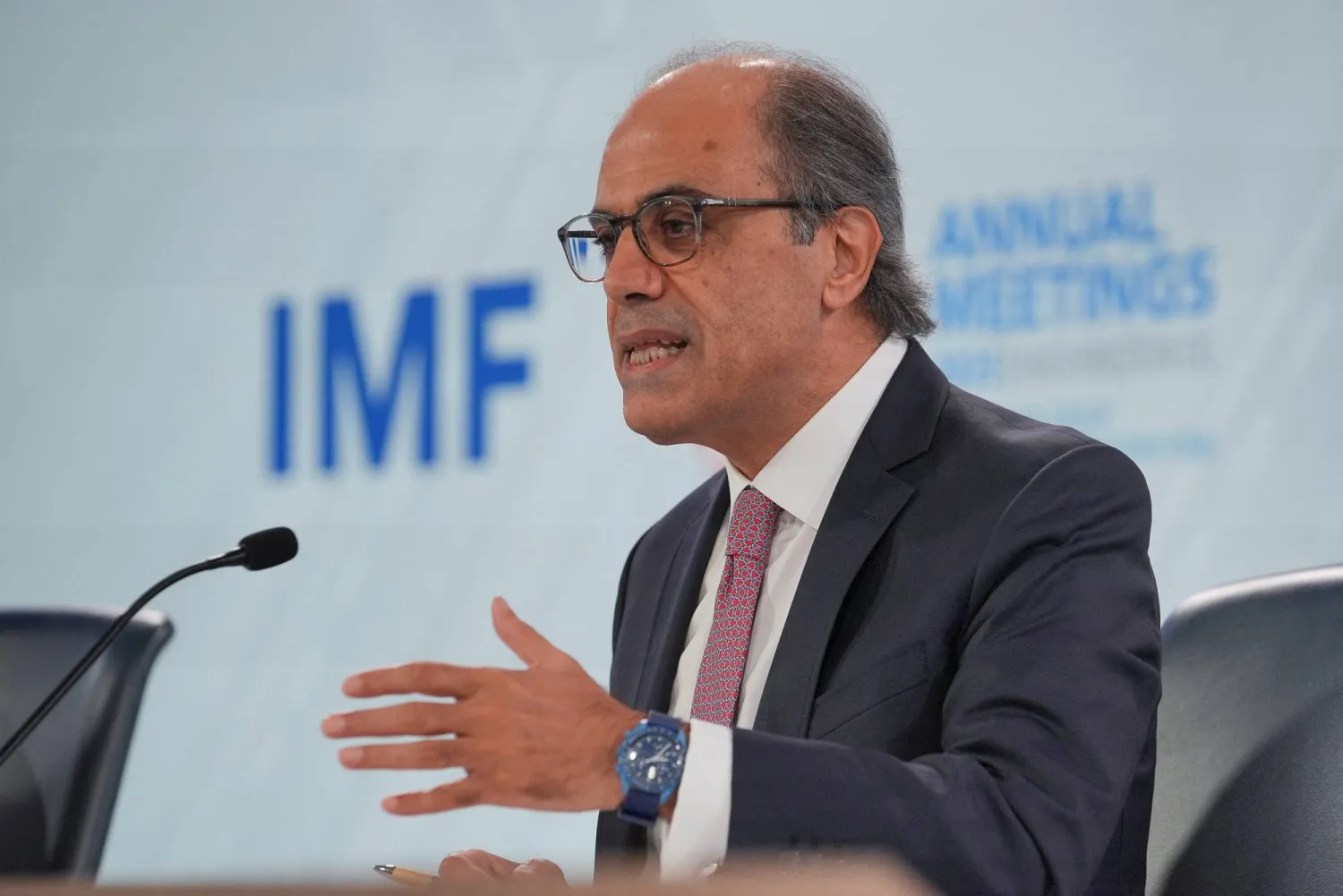

IMF: Middle East Economies Show Resilience Amid Global Tensions

Director of the IMF’s Middle East and Central Asia Department Jihad Azour speaks during the press conference (Reuters). 
TT

IMF: Middle East Economies Show Resilience Amid Global Tensions

Director of the IMF’s Middle East and Central Asia Department Jihad Azour speaks during the press conference (Reuters). 

The International Monetary Fund (IMF) has affirmed that economies in the Middle East and Central Asia continue to demonstrate strong resilience and adaptability despite heightened geopolitical tensions and global economic shocks. The Fund projects that growth in the region will accelerate to around 4% in 2025, driven by the dynamism of non-oil sectors, stronger fiscal indicators, and the successful implementation of structural reforms in many countries.

The remarks came during a press briefing held on Friday by Jihad Azour, Director of the IMF’s Middle East and Central Asia Department, on the sidelines of the IMF–World Bank Annual Meetings in Washington. Azour outlined the key findings of the latest Regional Economic Outlook report and highlighted the challenges facing the region’s economies.

Resilience and Turning Point

“Economies in the region have shown significant resilience and flexibility in confronting external shocks and geopolitical tensions,” Azour said. He described the current moment as a “period of reassessment” following the ceasefire agreement in Gaza, emphasizing the need to translate economic stability into more inclusive, sustainable growth that can generate jobs.

Azour noted that countries like Egypt and Jordan stand as examples of how economies can absorb the impact of nearby conflicts while maintaining financial stability.

Gulf Economies Lead in Diversification

Azour praised the performance of Gulf Cooperation Council (GCC) countries, saying they have “successfully and gradually diversified their economies in recent years,” relying increasingly on non-oil sectors. This shift has contributed to stable growth rates, lower unemployment, and rising private investment.

He pointed to the efforts of Saudi Arabia, the UAE, and Qatar to develop technology, tourism, and renewable energy sectors as a model for broader economic transformation. Prudent fiscal policies, he added, have strengthened the banking sector and kept public debt levels low.

Azour explained that the impact of recent US–China tariff measures on the region has been limited, as trade ties with the US are relatively modest and energy exports have largely been exempt from tariffs.

Egypt’s Economic Gains

The IMF official singled out Egypt for “notable improvement” since the launch of its economic reform program with the Fund. Inflation has eased significantly, projected to drop to around 11.8% in the coming year. Growth is expected to reach 4.3% in FY 2024/25 and 4.5% in FY 2025/26, while public debt is set to decline gradually as fiscal discipline improves.

He stressed the importance of enhancing the business climate, expanding private sector participation, and redefining the role of the state as an enabler rather than a competitor. While there are no plans to extend the current program with Egypt, Azour said the focus remains on accelerating private sector–led job creation and strengthening social protection.

Despite the war in Gaza reducing Suez Canal revenues by roughly $7 billion and slowing tourism, Egypt has shown strong financial and economic adaptability, he noted.

Uneven but Positive Regional Outlook

The IMF expects regional growth to rise from 2.1% in 2024 to 4% in 2025. Oil exporters are projected to see growth increase from 2.3% to 4%, supported by a gradual ramp-up in oil production and non-oil activity. Oil-importing countries such as Egypt, Jordan, Morocco, and Tunisia are also expected to recover, with growth rising from 1.5% to 3.9% on average. The Caucasus and Central Asia are forecast to grow by 4.4%, helped by higher commodity prices and remittance inflows.

Post-Conflict Uncertainty

Azour said the post-ceasefire period in Gaza represents a crucial stage for reassessment. While final reconstruction cost estimates are not yet available, he emphasized that “the international community’s priority should be supporting reconstruction in a way that ensures financial stability and gradually revives economic activity.”

He warned, however, that ongoing instability in Gaza, Yemen, Lebanon, and Syria remains a major source of uncertainty that could undermine investor confidence and strain public finances.

Policy Vigilance and Reform

Azour cautioned that inflation remains elevated in several energy-importing countries, urging governments to keep monetary policy vigilant to curb price pressures. He called for sustained structural reforms to boost governance and transparency, improve public spending efficiency, and invest in education, digital infrastructure, and innovation.

He stressed that the IMF’s strategy is to support inclusive and sustainable growth that reduces inequality and addresses climate challenges.

“We are optimistic about the region’s trajectory,” Azour concluded. “But turning economic resilience into inclusive growth requires determination. The IMF will continue to support governments in building confidence and stability. The region has all the ingredients to be a key driver of global growth in the coming years.”


Aljadaan: Emerging Markets Account for 70% of Global Growth

Al-Jadaan speaking to the attendees at the "AlUla Conference for Emerging Market Economies" (Asharq Al-Awsat
TT

Aljadaan: Emerging Markets Account for 70% of Global Growth

Al-Jadaan speaking to the attendees at the "AlUla Conference for Emerging Market Economies" (Asharq Al-Awsat

Saudi Minister of Finance Mohammed Aljadaan stressed Sunday that the world economy is going through a “profound transition,” saying emerging markets and developing economies now account for nearly 60 percent of the global Gross Domestic Product (GDP) in purchasing power terms and over 70 percent of global growth.

In his opening remarks at the AlUla Conference for Emerging Market Economies, organized by the Saudi Ministry of Finance and the IMF in AlUla, the minister said these economies have become an increasingly important driver of global growth with their share of global economy more than doubling since 2010.

“Today, the 10 emerging economies in the G20 alone account for more than half of the world growth. Yet, they face a more complex and fragmented environment, elevated debt levels, slower trade growth and increasing exposure to geopolitical shocks.”

“Unfortunately, more than half of low income countries are either in or at the risk of debt distress. At the same time global trade growth has slowed at around half of what it was pre the pandemic,” Aljadaan added.

The Finance Minister stressed that the Saudi experience over the past decade has reinforced three lessons that may be relevant to the discussions at the two-day conference, which brings together a select group of ministers and central bank governors, leaders of international organizations, leading investors and academics.

“First, macroeconomic stability is not the enemy of growth. It is actually the foundation,” he said.

“Structural reforms deliver results only when institutions deliver. So there is no point of reforming ... if the institutions are unable to deliver,” he stated.

Finally, he said that “international cooperation matters more, not less, in a fragmented world.”


Georgieva from AlUla: Growth Still Lacks Pre-pandemic Levels

Kristalina Georgieva speaking to attendees at the second edition of the AlUla Conference for Emerging Market Economies (Asharq Al-Awsat)
TT

Georgieva from AlUla: Growth Still Lacks Pre-pandemic Levels

Kristalina Georgieva speaking to attendees at the second edition of the AlUla Conference for Emerging Market Economies (Asharq Al-Awsat)

International Monetary Fund (IMF) Managing Director Kristalina Georgieva said Sunday that world growth still lacks pre-pandemic levels, expressing concern as she expected more shocks amid high spending and rising debt levels in many countries.

Georgieva spoke at the AlUla Conference for Emerging Market Economies, organized by the Saudi Ministry of Finance and the IMF in AlUla.

The two-day conference brings together a select group of ministers and central bank governors, leaders of international organizations, leading investors and academics to deliberate on policies to global stability, prosperity, and multilateral collaboration.

Georgieva said that the conference was launched last year in recognition of the growing role of emerging market economies in a world of sweeping transformations.

“I came out of this gathering .... With a sense of hope for the pragmatic attitude and determination to pursue good policies and build strong institutions,” she said.

Georgieva stressed that “good policies pay off,” and said that growth rates across emerging economies reached four percent this year, exceeding by a large margin those of advanced economies that are around 1.5 percent.


Saudi Arabia’s flynas, Syrian Civil Aviation Authority Partner to Launch 'flynas Syria'

The new airline will operate commercial air transport services in accordance with approved regulations and standards (flynas)
TT

Saudi Arabia’s flynas, Syrian Civil Aviation Authority Partner to Launch 'flynas Syria'

The new airline will operate commercial air transport services in accordance with approved regulations and standards (flynas)

Saudi budget carrier flynas has signed an agreement with the Syrian General Authority of Civil Aviation and Air Transport to establish a new commercial airline under the name "flynas Syria," with operations scheduled to begin in the fourth quarter of 2026.

Saturday’s agreement comes within the framework of bilateral cooperation between Saudi Arabia and Syria, as well as the strategic investment agreements between the two countries, coordinated with the Saudi Ministry of Investment and the Syrian General Authority of Civil Aviation and Air Transport.

The new airline will operate commercial air transport services in accordance with approved regulations and standards, meeting the highest safety and aviation security requirements. All licensing and operational procedures will be completed in coordination with the relevant authorities.

The carrier will be established as a joint venture, with 51% ownership held by the Syrian General Authority of Civil Aviation and Air Transport and 49% by flynas.

The new airline will operate flights to several destinations across the Middle East, Africa, and Europe. This expansion aims to bolster air traffic to and from Syria, enhance regional and international connectivity, and meet growing demand for air travel.

"This step is part of our commitment to supporting high-quality cross-border investments. The aviation sector is a key enabler of economic development, and the establishment of 'flynas Syria' serves as a model for constructive investment cooperation,” said Saudi Minister of Investment Khalid Al-Falih.

“This partnership enhances economic integration and market connectivity and supports development goals by advancing air transport infrastructure, ultimately serving the mutual interests of both nations and promoting regional economic stability,” he added.

President of the Syrian General Authority of Civil Aviation and Air Transport Omar Hosari also stated that the establishment of flynas Syria represents a strategic step within a comprehensive national vision aimed at rebuilding and developing Syria's civil aviation sector on modern economic and regulatory foundations.

“This will be achieved while balancing safety requirements, operational sustainability, investment stimulation, and passenger services. The partnership reflects the state's orientation toward smart cooperation models with trusted regional partners, ensuring the transfer of expertise, the development of national capabilities, and the enhancement of Syria's air connectivity with regional and international destinations, in line with global best practices in the air transport industry."

flynas Chairman Ayed Al-Jeaid stated that the company continues to pursue strategies aimed at growth and international expansion, describing the agreement as a historic milestone in the company's journey and a promising investment model in partnership with Syria.

flynas CEO Bander Al-mohanna said the step represents a qualitative leap in the company's strategy and financial performance, highlighting the transfer of the company's low-cost aviation experience to the Syrian market to support regional and international air connectivity.

flynas currently operates 23 weekly flights from Riyadh, Jeddah, and Dammam to Damascus, including two daily direct flights from Riyadh, one daily flight from Jeddah, and two weekly flights from Dammam.

The airline made history on June 5, 2025, by adding the Syrian capital to its network, becoming the first Saudi carrier to resume scheduled flights to Damascus.
