


Deadly Blows and Setbacks Deepened Hezbollah’s Crisis During War with Israel

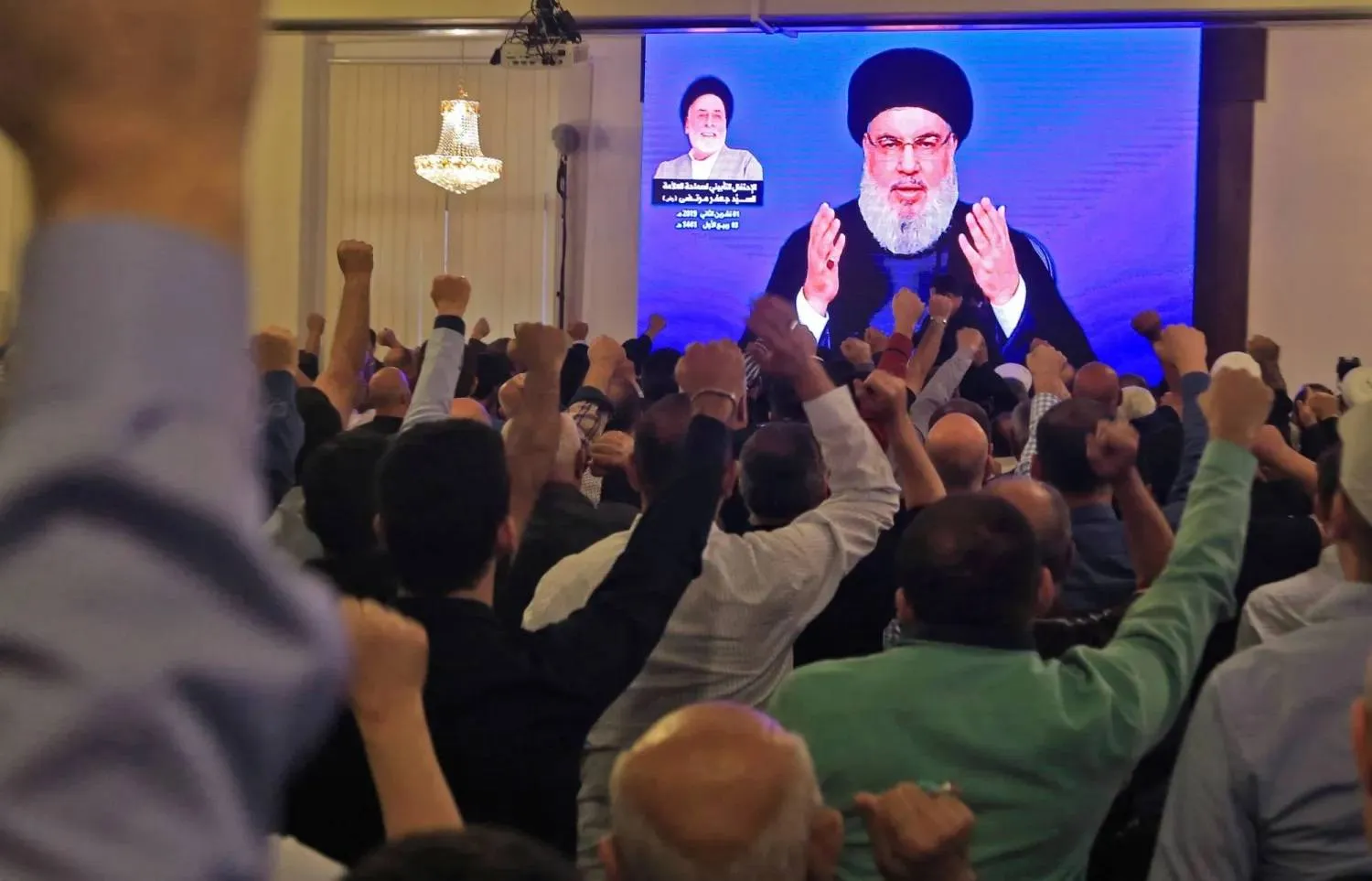
Hezbollah supporters watch a televised speech delivered by Hezbollah Secretary-General Hassan Nasrallah in Dahieh in November 2019. (AFP)
TT

Deadly Blows and Setbacks Deepened Hezbollah’s Crisis During War with Israel

Hezbollah supporters watch a televised speech delivered by Hezbollah Secretary-General Hassan Nasrallah in Dahieh in November 2019. (AFP)

Months before his assassination, former Hezbollah Secretary-General Hassan Nasrallah believed that the “support war” his party had launched against Israel in October 2023 in support of Gaza would remain within the limits of the “rules of engagement”. He believed that Iran would not allow four decades of “Islamic resistance” in Lebanon to fall easy prey to the enemy.

However, a series of wrong calculations prevented the party from taking decisive decisions during the conflict, which by September 2024 had turned into an all-out war.

This report reveals how Israel’s assassination of major Hezbollah leaderships effectively cut off Nasrallah from knowing every detail of what was happening on the ground. Field leaders appointed to replace the slain ones did not have enough information. Others have speculated that the party’s problem did not lie in the commanders, but in the loss of rocket launcher operators, who were a “rare commodity” in the party and the war.

Asharq Al-Awsat interviewed a number of Lebanese and Iraqi figures, who were in touch with the Hezbollah leadership in 2024, for this report to help fill in some gaps in the various narratives that have emerged related to the buildup to Nasrallah’s assassination in September 2024.

Lebanese authorities say 3,768 people were killed and over 15,000 injured in the war, while Israeli figures have said that Hezbollah lost around 2,500 members in over 12,000 strikes.

War within limits

In the first weeks of the war, Hezbollah was convinced that the “rules of engagement” on the ground would remain in place and that it would not turn into an all-out war, revealed a Lebanese figure who was in close contact with party military commanders.

Speaking to Asharq Al-Awsat on condition of anonymity, he stated that Nasrallah would tell meetings with influential party officials that the war would be limited to border skirmishes with Israel, as had happened in the past.

One leading Hezbollah member said the party believed that Iran would be able to “set the deterrence in the war and reach a ceasefire through maneuvering in its negotiations” with the West, added the Lebanese figure.

“The party was waiting on Iran to restore balance in the war that was tipped in Israel’s favor and to eventually reach a ceasefire without major losses,” he went on to say.

Iranian officials, led by Supreme Leader Ali Khamenei, have always said that Tehran would not abandon its allies. Nasrallah himself had always credited Iran with supporting his party financially and with weapons.

Three commanders

Speaking to Asharq Al-Awsat from his residence in Beirut’s southern suburbs, a Lebanese Shiite cleric said Hezbollah was slow in realizing that it was headed towards all-out war with Israel.

The cleric, who earned his religious studies in Iraq’s al-Najaf, lost four members of his family during the war.

Nasrallah, he added, lost key commanders who were his eyes and ears on the field.

Whenever Israel killed a field commander, it was as if Nasrallah “lost an eye that helped him see clearly. He was obsessed with following up on field developments” and Israel was taking these tools away from him, he revealed.

The greatest blows to Nasrallah were the losses of commanders Taleb Abdullah, Ibrahim Akeel, and Wissam al-Taweel.

Taweel was a prominent commander in the party’s al-Radwan unit. Israel killed him on January 8, 2024. Abdullah was responsible for Hezbollah’s operations in the central sector of the border with Israel and stretching to the Litani river. Israel killed him on June 11, 2024, in what the cleric said was the harshest blow to Nasrallah. Akeel was commander of Hezbollah’s military council. Israel killed him on September 20, 2024.

In the end, Nasrallah lost these three commanders and a state of chaos ensued in the operation rooms. “Other commanders on the field complained of how decisions were being improvised because members were acting out of alarm and suspicion instead of discipline,” said Lebanese sources.

Despite these major losses during a period of eight months, Nasrallah and his entourage continued to think inside the box and within the rules of engagement, still ruling out that an all-out war would happen.

Lebanese journalist Ali al-Amin said Nasrallah believed that the party was still capable of militarily deterring Israel and preventing a comprehensive war. He was ultimately wrong.
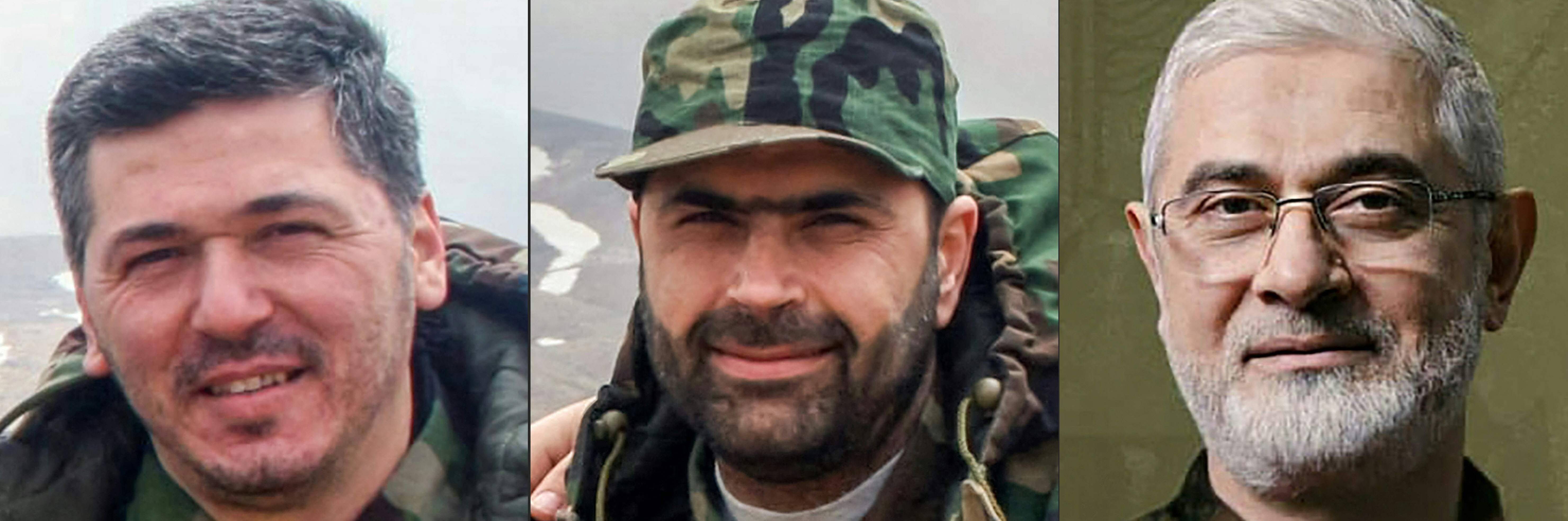
(From left to right) Slain Hezbollah commanders Ibrahim Akeel, Wissam al-Taweel and Taleb Abdullah.

Secrecy

Hezbollah’s problem lies in Hezbollah itself and how its commanders operate.

Lebanese sources explained that the field commanders killed between January and November 2024 were part of a disconnected chain of command, in that they were not a whole that relayed expertise and information smoothly.

The sources explained further: “When a commander is killed, his replacement does not have access to his predecessor’s field information and details, which are held in secrecy. This was one of Nasrallah’s problems in dealing with the war.”

More interviews with Asharq Al-Awsat revealed that each commander built his own network of relations, methods and information based on his own personal experience as an individual. When he is killed, this network dies with him, along with information about weapons caches or field plans.

At one point, Israeli drones hovering over a Hezbollah unit would have more information about the party than the newly appointed commander, said the cleric.

Israel’s infiltration

Nasrallah first started having doubts that Israel had breached Hezbollah after the assassination of Saleh al-Arouri, former Hamas deputy politburo chief, on January 2, 2024. Wissam al-Taweel was killed that same month.

The cleric said Nasrallah had not expected these assassinations and notably kept silent after they happened.

Later, he chose defense instead of offense, said Al-Amin. He revealed that field commanders had urgently requested a meeting with Nasrallah to call on him to launch an all-out war, because Israel was hunting down their members. Nasrallah adamantly refused.

Instead, the party became more isolated and began having deep doubts. The cleric explained that this is how Shiite movements in particular behave. They isolate themselves for internal reflection.

Security sources said that at the same time, Hezbollah reviewed its communications networks in the hopes of finding the Israeli breach.

A prominent Shiite figure, who has been in contact with Hezbollah since 2015, told Asharq Al-Awsat that the channels of communication with the party changed several times as more and more assassinations took place in Lebanon.

“We would come in contact with a new person every time we needed something from Dahieh (Beirut’s southern suburbs and a Hezbollah stronghold),” he added.

In August 2024, the Iranians asked Iraqi factions to support Hezbollah in its war. The Iraqi leader said they were instructed to make media statements that they were ready to go to war. A month later, Iraq’s Kataib Sayyid al-Shuhada faction said it would send 100,000 fighters to the Lebanese borders, but none did.

Pager operation

The party grew more anxious to uncover how Israel had breached it. Then came the devastating pager operation in September.

The attack isolated leaders from each other and their field networks. Communications within the party were almost dead and at some point, the remaining leaderships even gave up trying to find out where the breach was from.

Following the attack, field units did not hear anything for days from their commanders, revealed the cleric. It took the command a long time to resume contacts.

During that time, a military commander asked Nasrallah if the rules of engagement still stood. Nasrallah did not give a definitive answer, which was unusual for him, according to information obtained by Asharq Al-Awsat.

Nasrallah realized that he was now in an open war that he did not want, but it was already too late, revealed sources from leading officials who had attended important meetings.

Political science professor Ali Mohammed Ahmed tried to explain why Hezbollah refused to change its course of action. He said that maintaining the rules of engagement would ultimately not fall in Israel’s favor.

But what really tipped the war in its favor was its superior technology that Hezbollah had not taken into account.
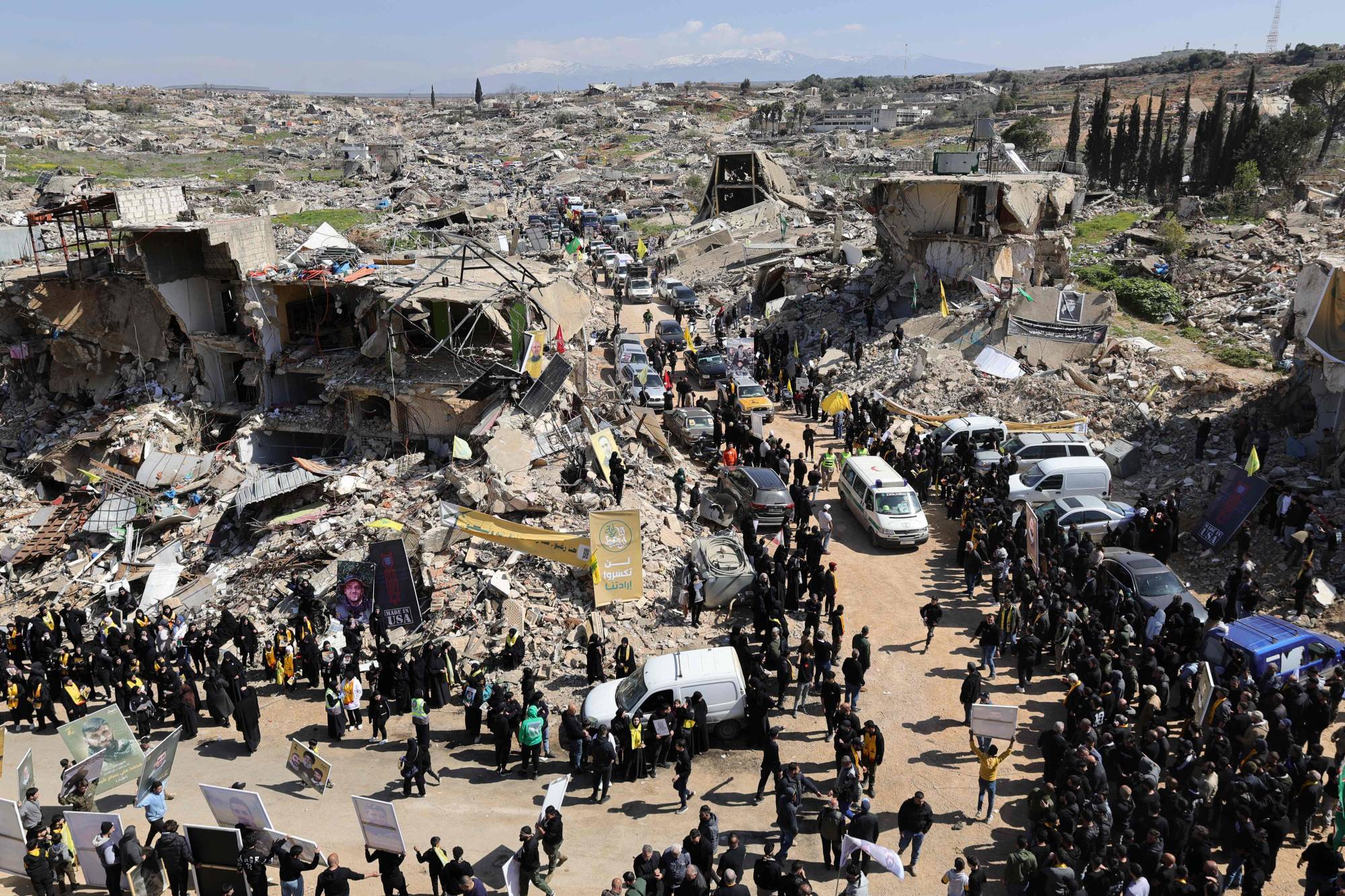
Despite major losses during a period of eight months, Nasrallah and his entourage continued to think inside the box. (AFP)

The final scene

On the day of his assassination on September 27, Nasrallah headed to Dahieh with deputy Quds Force commander in Lebanon Abbas Nilforoushan. We will never know what they discussed. They headed to an underground Hezbollah compound and soon after Israel pounded the site with tons of bunker buster bombs.

Tons of questions were raised the day after in Dahieh and everywhere.

Looking at photos of his slain relatives, the Lebanese cleric said: “It took Hezbollah supporters a long time to recover from the shock. When they did, they asked, ‘who let down whom? The party or Iran? The resistance or Wilayet al-Faqih?’”

Ahmed said Hezbollah operated in a single basic way: it could not quit a war imposed on it, and so, it fought on.

Al-Amin stressed that Nasrallah would never have opened the “support front” without backing from Iran and his conviction that Israel would take into account threats from Tehran’s proxies in Lebanon, Iraq and Yemen.

However, the successive military and security setbacks led to a state of disarray and Nasrallah effectively cut the connection between Iran and Hezbollah, he added. Eventually, both sides realized that they had fallen into a trap.

Ahmed underlined one important development that took place early on during the war. Israel killed the strategic rocket launcher operators. The operators are a “rare commodity” and difficult to replace.

Hezbollah’s problem did not lie in its loss of field commanders, but the rocket operators, he said.

When the party launched hundreds of rockets at Israel a day before the ceasefire took effect, “we realized that it succeeded in replacing the slain operators,” he added.

“No one let down anyone. The problem lies in both Iran and Hezbollah and how they seemingly could not move on from the October 7, 2023 attack. Time was moving, but they were not,” he stated.

Iraqi researcher Akeel Abbas explained that the party and Iran did not grasp the extent of the major change that was taking place, even after Israeli Prime Minister Benjamin Netanyahu said that October 7 was like his country’s September 11.

“Everyone understood that the old rules no longer stood and that new ones were being imposed by force,” he told Asharq Al-Awsat.

“Iran was incapable of keeping pace with the major changes Israel was creating. It needed more time to prepare for such a largescale confrontation,” he remarked.


Beirut’s Commodore Hotel, a Haven for Journalists During Lebanon’s Civil War, Shuts Down

People stand outside the closed Commodore hotel, in Beirut, Lebanon, Sunday, Jan. 11, 2026. (AP)
TT

Beirut’s Commodore Hotel, a Haven for Journalists During Lebanon’s Civil War, Shuts Down

People stand outside the closed Commodore hotel, in Beirut, Lebanon, Sunday, Jan. 11, 2026. (AP)

During Lebanon’s civil war, the Commodore Hotel in western Beirut's Hamra district became iconic among the foreign press corps.

For many, it served as an unofficial newsroom where they could file dispatches even when communications systems were down elsewhere. Armed guards at the door provided some sense of protection as sniper fights and shelling were turning the cosmopolitan city to rubble.

The hotel even had its own much-loved mascot: a cheeky parrot.

The Commodore endured for decades after the 15-year civil war ended in 1990 — until this week, when it closed for good.

The main gate of the nine-story hotel with more than 200 rooms was shuttered Monday. Officials at the Commodore refused to speak to the media about the decision to close.

Although the country’s economy is beginning to recover from a protracted financial crisis that began in 2019, tensions in the region and the aftermath of the Israel-Hezbollah war that was halted by a tenuous ceasefire in November 2024 are keeping many tourists away. Lengthy daily electricity cuts force businesses to rely on expensive private generators.

The Commodore is not the first of the crisis-battered country’s once-bustling hotels to shut down in recent years.

But for journalists who lived, worked and filed their dispatches there, its demise hits particularly hard.

“The Commodore was a hub of information — various guerrilla leaders, diplomats, spies and of course scores of journalists circled the cafes and lounges,” said Tim Llewellyn, a former BBC Middle East correspondent who covered the civil war. “On one occasion (late Palestinian leader) Yasser Arafat himself dropped in to sip coffee with” with the hotel manager's father, he recalled.

A line to the outside world

At the height of the civil war, when telecommunications were dysfunctional and much of Beirut was cut off from the outside world, it was at the Commodore where journalists found land lines and Telex machines that always worked to send reports to their media organizations around the globe.

Across the front office desk in the wide lobby of the Commodore, there were two teleprinters that carried reports of The Associated Press and Reuters news agencies.

“The Commodore had a certain seedy charm. The rooms were basic, the mattresses lumpy and the meal fare wasn’t spectacular,” said Robert H. Reid, the AP’s former Middle East regional editor, who was among the AP journalists who covered the war. The hotel was across the street from the international agency’s Middle East head office at the time.

“The friendly staff and the camaraderie among the journalist-guests made the Commodore seem more like a social club where you could unwind after a day in one of the world’s most dangerous cities,” Reid said.

Llewellyn remembers that the hotel manager at the time, Yusuf Nazzal, told him in the late 1970s “that it was I who had given him the idea” to open such a hotel in a war zone.

Llewellyn said that during a long chat with Nazzal on a near-empty Middle East Airlines Jumbo flight from London to Beirut in the fall of 1975, he told him that there should be a hotel that would make sure journalists had good communications, “a street-wise and well-connected staff running the desks, the phones, the teletypes.”

During Israel's 1982 invasion of Lebanon and a nearly three-month siege of West Beirut by Israeli troops, journalists used the roof of the hotel to film fighter jets striking the city.

The parrot

One of the best-known characters at the Commodore was Coco the parrot, who was always in a cage near the bar. Patrons were often startled by what they thought was the whiz of an incoming shell, only to discover that it was Coco who made the sound.

AP’s chief Middle East correspondent Terry Anderson was a regular at the hotel before he was kidnapped in Beirut in 1985 and held for seven years, becoming one of the longest-held American hostages in history.

Videos of Anderson released by his kidnappers later showed him wearing a white T-shirt with the words “Hotel Commodore Lebanon.”

With the kidnapping of Anderson and other Western journalists, many foreign media workers left the predominantly-Muslim western part of Beirut, and after that the hotel lost its status as a safe haven for foreign journalists.

Ahmad Shbaro, who worked at different departments of the hotel until 1988, said the main reason behind the Commodore’s success was the presence of armed guards that made journalists feel secure in the middle of Beirut’s chaos as well as functioning telecommunications.

He added that the hotel also offered financial facilities for journalists who ran out of money. They would borrow money from Nazzal and their companies could pay him back by depositing money in his bank account in London.

Shbaro remembers a terrifying day in the late 1970s when the area of the hotel was heavily shelled and two rooms at the Commodore were hit.

“The hotel was full and all of us, staffers and journalists, spent the night at Le Casbah,” a famous nightclub in the basement of the building, he said.

In quieter times, journalists used to spend the night partying by the pool.

“It was a lifeline for the international media in West Beirut, where journalists filed, ate, slept, and hid from air raids, shelling, and other violence,” said former AP correspondent Scheherezade Faramarzi.

“It gained both fame and notoriety,” she said, speaking from the Mediterranean island of Cyprus.

The hotel was built in 1943 and kept functioning until 1987 when it was heavily damaged in fighting between Shiite and Druze militiamen at the time. The old Commodore building was later demolished and a new structure was build with an annex and officially opened again for the public in 1996.

But Coco the parrot was no longer at the bar. The bird went missing during the 1987 fighting. Shbaro said it is believed he was taken by one of the gunmen who stormed the hotel.


Key Details of Greenland’s Rich but Largely Untapped Mineral Resources

Houses covered by snow are seen on the coast of a sea inlet of Nuuk, Greenland, on Monday, Jan. 12, 2026. (AP)
TT

Key Details of Greenland’s Rich but Largely Untapped Mineral Resources

Houses covered by snow are seen on the coast of a sea inlet of Nuuk, Greenland, on Monday, Jan. 12, 2026. (AP)

The Danish and Greenlandic foreign ministers will meet US Vice President JD Vance and Secretary of State Marco Rubio on Wednesday after President Donald Trump recently
stepped up threats to take over Greenland.

The autonomous territory of Denmark could be useful for the ​United States because of its strategic location and rich mineral resources. A 2023 survey showed that 25 of 34 minerals deemed "critical raw materials" by the European Commission were found in Greenland.

The extraction of oil and natural gas is banned in Greenland for environmental reasons, while development of its mining sector has been snarled in red tape and opposition from indigenous people.

Below are details of Greenland's main mineral deposits, based on data from its Mineral Resources Authority:

RARE EARTHS
Three of Greenland's biggest deposits are located in the southern province of Gardar.

Companies ‌seeking to ‌develop rare-earth mines are Critical Metals Corp, which bought the ‌Tanbreez ⁠deposit, ​Energy Transition Minerals, ‌whose Kuannersuit project is stalled amid legal disputes, and Neo Performance Materials.

Rare-earth elements are key to permanent magnets used in electric vehicles (EV) and wind turbines.

GRAPHITE
Occurrences of graphite and graphite schist are reported from many localities on the island.
GreenRoc has applied for an exploitation license to develop the Amitsoq graphite project.
Natural graphite is mostly used in EV batteries and steelmaking.

COPPER
According to the Mineral Resources Authority, most copper deposits have drawn only limited exploration campaigns.

Especially interesting are the underexplored areas ⁠in the northeast and center-east of Greenland, it said.

London-listed 80 Mile is seeking to develop the Disko-Nuussuaq deposit, which has ‌copper, nickel, platinum and cobalt.

NICKEL
Traces of nickel accumulations are numerous, ‍according to the Mineral Resources Authority.

Major miner ‍Anglo American was granted an exploration license in western Greenland in 2019 and has ‍been looking for nickel deposits, among others.

ZINC
Zinc is mostly found in the north in a geologic formation that stretches more than 2,500 km (1,550 miles).

Companies have sought to develop the Citronen Fjord zinc and lead project, which had been billed as one of the world's largest undeveloped zinc resources.

GOLD
The most prospective ​areas for gold potential are situated around the Sermiligaarsuk fjord in the country's south.

Amaroq Minerals launched a gold mine last year in Mt Nalunaq in ⁠the Kujalleq Municipality.

DIAMONDS
While most small diamonds and the largest stones are found in the island's west, their presence in other regions may also be significant.

IRON ORE
Deposits are located at Isua in southern West Greenland, at Itilliarsuk in central West Greenland, and in North West Greenland along the Lauge Koch Kyst.

TITANIUM-VANADIUM
Known deposits of titanium and vanadium are in the southwest, the east and south.

Titanium is used for commercial, medical and industrial purposes, while vanadium is mainly used to produce specialty steel alloys. The most important industrial vanadium compound, vanadium pentoxide, is used as a catalyst for the production of sulfuric acid.

TUNGSTEN
Used for several industrial applications, tungsten is mostly found in the central-east and northeast of the country, with assessed deposits in the south and west.

URANIUM
In 2021, ‌the then-ruling left-wing Inuit Ataqatigiit party banned uranium mining, effectively halting development of the Kuannersuit rare-earths project, which has uranium as a byproduct.


The West Bank Football Field Slated for Demolition by Israel

Israeli army bulldozers pass buildings during a military operation in Nur Shams refugee camp, near the West Bank city of Tulkarem, 12 January 2026. (EPA)
TT

The West Bank Football Field Slated for Demolition by Israel

Israeli army bulldozers pass buildings during a military operation in Nur Shams refugee camp, near the West Bank city of Tulkarem, 12 January 2026. (EPA)

Israeli authorities have ordered the demolition of a football field in a crowded refugee camp in the occupied West Bank, eliminating one of the few ​spaces where Palestinian children are able to run and play.

"If the field gets demolished, this will destroy our dreams and our future. We cannot play any other place but this field, the camp does not have spaces," said Rital Sarhan, 13, who plays on a girls' soccer team in the Aida refugee camp near Bethlehem.

The Israeli military ‌issued a demolition ‌order for the field on ‌December ⁠31, ​saying ‌it was built illegally in an area that abuts the concrete barrier wall that Israel built in the West Bank.

"Along the security fence, a seizure order and a construction prohibition order are in effect; therefore, the construction in the area was carried out unlawfully," the Israeli military said in a statement.

Mohammad Abu ⁠Srour, an administrator at Aida Youth Center, which manages the field, said the ‌military gave them seven days to demolish ‍the field.

The Israeli military ‍often orders Palestinians to carry out demolitions themselves. If they ‍do not act, the military steps in to destroy the structure in question and then sends the Palestinians a bill for the costs.

According to Abu Srour, Israel's military told residents when delivering ​the demolition order that the football field represented a threat to the separation wall and to Israelis.

"I ⁠do not know how this is possible," he said.

Israeli demolitions have drawn widespread international criticism and coincide with heightened fears among Palestinians of an organized effort by Israel to formally annex the West Bank, the area seized by Israel in the 1967 Middle East war.

Israel accelerated demolitions in Palestinian refugee camps in early 2025, leading to the displacement of 32,000 residents of camps in the central and northern West Bank.

Human Rights Watch has called the demolitions a war crime. ‌Israel has said they are intended to disrupt militant activity.
