


EU Takes Aim at Plastic Pellets to Prevent their Nightmare Cleanup

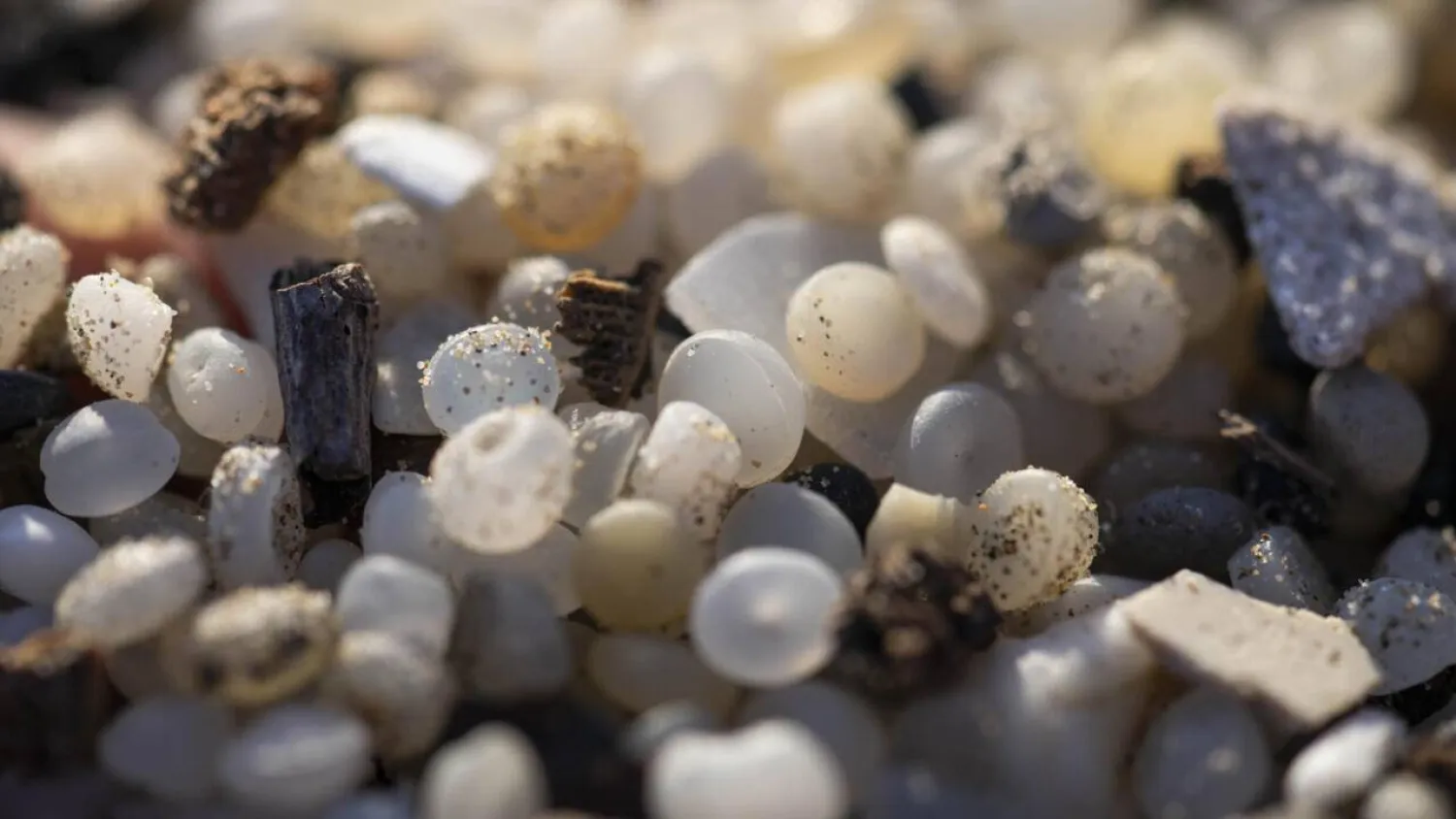
Industrial plastic pellets washed up on a Catalonian beach in 2024. Josep LAGO / AFP
TT

EU Takes Aim at Plastic Pellets to Prevent their Nightmare Cleanup

Industrial plastic pellets washed up on a Catalonian beach in 2024. Josep LAGO / AFP

At first glance, the tiny plastic pellets appear relatively harmless. No bigger than a lentil, these "nurdles" are destined to be melted down to make everything from car bumpers to salad bowls.

But when tens of millions of them spill from trucks or cargo ships they are devilish to clean up, blighting landscapes and washing up around the world for years to come.

On Thursday, the European Parliament could approve tougher new rules aimed at preventing such disastrous spills, and reducing their pollution impact, said AFP.

If approved, they will require companies in the European Union to adopt safeguards in handling and transporting nurdles, which are produced by petrochemical giants from fossil fuels.

Anywhere between 52,140 tons and 184,290 tons of pellets entered the environment in the EU in 2019, according to the European Commission, which proposed the regulations.

"This is equivalent to between 2,100 and 7,300 trucks full of pellets per year," the Commission said.

Light, buoyant and insoluble, these tiny pellets present an almost insurmountable challenge once scattered in nature.

Recovery is "a physically intense and time-consuming task" mostly done by hand, said Kevin Tallec from Cedre, a French non-profit organization that specializes in water contamination and cleanup.

"We can be 100 percent sure that if there's pellet pollution, we won't be able to recover all of them," Tallec, a marine biologist, told AFP in Brest, where Cedre is headquartered.

Chronic problem

One of the worst spills occurred off Sri Lanka in 2021 when thousands of tons of plastic pellets were lost from a stricken cargo ship.

Nurdles coated an 80-kilometer (50-mile) stretch of beach on the island's western coast, and fishing was prohibited for months.

In northwest Spain, volunteers used strainers to sift nurdles from sand along the Atlantic coast after containers full of pellets fell off a cargo vessel in late 2023.

"When I was little, I used to pick them up on the beaches, just a few at the time. But the pollution has become chronic," said Amandine Le Moan, co-founder of the French coastal conservation group Ystopia.

They are ingested by marine life, particularly sea birds and turtles, while the chemicals in microplastics also present a potential risk to human health, the Commission said.

The spills also hurt tourism and fishing, it added.

Nurdle spills often occur when an ill-placed shipping container tumbles overboard, and the International Maritime Organization (IMO) has issued non-binding recommendations to try to prevent this happening.

Major industry players that have adopted these recommendations include Armateurs de France, which represents French maritime transport and services companies.

"These containers must be identified, declared, and treated in a specific way, like chemicals and hazardous materials placed below deck," Laurent Martens, general delegate of Armateurs de France, told AFP.

Down the line

But transportation is not the only source of spills, Cedre's Tallec said, with nurdles also lost through operational channels.

"It's also a broader issue involving the value chain, which handles these pellets in a way that doesn't prevent their loss into the environment," said Lucie Padovani from Surfrider Foundation Europe, an ocean conservation group.

For example, in Ecaussinnes, an industrial town in Belgium that hosts large petrochemical operators, plastic pellets have been found scattered throughout the landscape and in local rivers.

French petrochemical giants Arkema, and the American companies Dow and ExxonMobil, declined to comment when reached by AFP.

Chemical trades groups, such as Plastics Europe and France Chimie, did not respond to AFP's requests for comment.

Plastics manufacturers insist they are not the weak link.

"We are well aware of all the issues, and obviously plastic pollution is something we need to get rid of," said Caroline Chaussard, director of sustainable development at Polyvia, an industry group for French plastics manufacturers.

"The biggest leaks are not at the processor level -- that's where they are easiest to contain, since they are in a limited area," she said.

Joseph Tayefeh, secretary general of Plastalliance, which represents European plastics makers, said "this is an expensive raw material that no one wants to waste".

"A kilo costs between 1 euro ($1.17) and 1.3 euros," he said.

Major oil- and gas-producing nations have resisted efforts to limit the amount of new plastic manufactured every year, a figure estimated at 400 million tons.

In August, the latest round of negotiations on a global treaty to combat plastic pollution collapsed without agreement.

Philippe Bolo, a French MP who lobbied for a tough treaty, said the scourge of nurdles "revealed the ubiquity of plastic" in modern life.

"The more we consume, the more we will need them," he said.


More Travel Chaos to Hit Europe as Cold Snap Brings More Snow

 People walk along the Baltic Sea shore covered in a thick blanket of snow, in Stralsund, Germany, Tuesday, Jan. 6, 2026. (Stefan Sauer/dpa via AP)
People walk along the Baltic Sea shore covered in a thick blanket of snow, in Stralsund, Germany, Tuesday, Jan. 6, 2026. (Stefan Sauer/dpa via AP)
TT

More Travel Chaos to Hit Europe as Cold Snap Brings More Snow

 People walk along the Baltic Sea shore covered in a thick blanket of snow, in Stralsund, Germany, Tuesday, Jan. 6, 2026. (Stefan Sauer/dpa via AP)
People walk along the Baltic Sea shore covered in a thick blanket of snow, in Stralsund, Germany, Tuesday, Jan. 6, 2026. (Stefan Sauer/dpa via AP)

More flights will be cancelled, trains will run late and roads will be blocked by snow across Europe in coming days as a cold snap is expected to worsen, bringing even more heavy snowfall after several days of travel disruption.

Authorities in the Netherlands told people to plan to stay at home if at all possible on Wednesday, with a fresh blizzard expected to arrive overnight.

French Transportation Minister Philippe Tabarot said on Tuesday that airlines had already been ordered to cancel at least 40% of flights at Paris's main Charles de Gaulle airport the following morning, ‌and a quarter ‌of flights at smaller Orly.

Public transportation in the Paris ‌region ⁠will probably also be ‌disrupted by the snow, he added.

At Amsterdam's Schiphol, where more than 400 flights were cancelled on Tuesday, authorities told travelers whose flights had been called off to stay away from the airport to prevent overcrowding.

"We haven't experienced such extreme weather conditions in years," Dutch airline KLM's spokesperson Anoesjka Aspeslagh said, as winter weather crippled traffic at one of Europe's main transit hubs for a fifth day.

A BIRTHDAY IN TRANSIT

Stranded at Schiphol, Simiao Sun said she feared she'd spend her 40th birthday in transit. ⁠She had been told she would have to wait three days for a rescheduled flight to Beijing.

"My child would miss ‌school and we would both miss work, so I'm queuing ‍here...hoping to get a slightly earlier ‍flight."

KLM said it was offering alternative flights where possible and doing everything to help travelers, ‍but it was "overwhelmed with inquiries".

On top of that, all domestic rail services in the Netherlands were suspended early on Tuesday after an IT outage hit the rail network. Trains began running in parts of the country after 0900 GMT, but problems persisted around Amsterdam, with high-speed Eurostar services from Amsterdam to Paris either cancelled or late.

Roads in France were gradually clearing on Tuesday after snow caused severe accidents all over the country, killing at least five people, according to ⁠BFMTV news station. Traffic in the Paris area hit a record 1,000 kilometers of jams on Monday evening.

SNOW FALLS OVER LARGE PARTS OF GERMANY AND FRANCE

In Germany, temperatures fell well below minus 10 degrees Celsius (14 degrees Fahrenheit) in the south and east early on Tuesday. Much of the country was covered in snow.

In Britain, the Meteorological Office said winter weather hazards could continue throughout the week for most of the country. Temperatures overnight to Tuesday had fallen as low as -12.5 degrees Celsius in Marham, Norfolk, in east England, marking the coldest night of the winter so far.

Heavy snow and rain have also caused havoc across the Western Balkans, closing roads, cutting power and causing rivers to flood. A woman died in the Bosnian capital Sarajevo on Monday after a ‌tree overburdened with wet snow fell on her.


Study: Climate-driven Tree Deaths Speeding Up in Australia

New research show tree mortality is rising across Australia's forest as the climate warms. DAVID GRAY / AFP/File
TT

Study: Climate-driven Tree Deaths Speeding Up in Australia

New research show tree mortality is rising across Australia's forest as the climate warms. DAVID GRAY / AFP/File

Australia's forests are losing trees more rapidly as the climate warms, a new study examining decades of data said Tuesday, warning the trend was likely a "widespread phenomenon".

The research used forest inventory data from 2,700 plots across the country, ranging from cool moist forests to dry savanna.

It excluded areas affected by logging, clearance or fires to examine how "background tree mortality" has changed in recent decades.

"What we found is that the mortality rate has consistently increased over time, in all of the different forest types," said Belinda Medlyn, a professor at Western Sydney University's Hawkesbury Institute for the Environment.

"And this increase is very likely caused by the increase in temperature," she told AFP.

The world has warmed by an average of nearly 1.2 degrees Celsius since the pre-industrial era. Most of this warming has occurred in the last 50 years.

The rate at which trees die off in a forest can vary in response to different types of disturbances, or as forests grow thicker and there is greater competition for resources.

But the research, published in the Nature Plants journal, excluded areas affected by fires or clearing, and also examined the stand basal area -- the sum of the cross-sectional areas of all trees in an area.

"The (mortality) trend over time remains even after we correct for basal area," explained Medlyn, who led the research.

The scale of the increase varied across the four different biomes surveyed, with the sharpest rise in tropical savannas.

There, the number of trees dying on average increased by 3.2 percent a year, from close to 15 per 1,000 in 1996, to nearly double that number by 2017.

The research found that the deaths were not being matched by tree growth, so forest stock overall is declining.

That makes it "very likely that the overall carbon storage capacity in the forests is declining over time", said Medlyn.

And given the trend was observed across four ecosystems -- tropical savanna, cool temperate forest, warm temperate forest and tropical rainforest -- it is likely to be "a widespread phenomenon, not just an Australian thing", she added.

The rising mortality rate tracks warming and drying linked to climate change, and the study found the fastest rise in hotter, dryer regions.

The research comes months after a study found Australia's tropical rainforests were among the first in the world to start emitting more carbon dioxide than they absorb.

Taken together, the findings paint a worrying picture of our continued ability to rely on forests to absorb our emissions.

"Forests globally currently sequester about one-third of anthropogenic carbon dioxide emissions," said Medlyn.

"Our study suggests their capacity to act as buffer will decline over time."


South Korea’s Lee Snaps Xi Selfie with Chinese ‘Backdoor’ Phone

South Korean President Lee Jae Myung (L) and his wife, Kim Hea Kyung (2nd from L), take a selfie with Chinese President Xi Jinping (2nd from R) and his wife, Peng Liyuan, by using a Xiaomi smartphone following a state dinner for the South Korean leader in Beijing, China, 05 January 2026. (EPA/Yonhap)
TT

South Korea’s Lee Snaps Xi Selfie with Chinese ‘Backdoor’ Phone

South Korean President Lee Jae Myung (L) and his wife, Kim Hea Kyung (2nd from L), take a selfie with Chinese President Xi Jinping (2nd from R) and his wife, Peng Liyuan, by using a Xiaomi smartphone following a state dinner for the South Korean leader in Beijing, China, 05 January 2026. (EPA/Yonhap)

South Korean President Lee Jae Myung snapped a selfie with Xi Jinping using a smartphone gifted to him by the Chinese leader, who had joked at their last meeting that the device might be capable of spying.

Lee posted a selfie of himself, Xi and their wives on social media platform X on Monday during a visit to Beijing.

"A selfie with President Xi Jinping and his wife, taken with the Xiaomi I received as a gift in Gyeongju," Lee wrote.

"Thanks to them, I got the shot of a lifetime," he said.

"I will communicate more frequently and collaborate more closely going forward."

In the selfie, all four first families are seen smiling.

Lee's office also posted a short YouTube video of the scene, with Xi complimenting the South Korean leader's photo skills.

The Xiaomi handset made headlines in November when Xi cracked a joke to Lee on the sidelines of an APEC summit in South Korea.

When Lee asked if the communication line on the device was secure, the Chinese leader urged him to "check if there is a backdoor" -- referring to pre-installed software that could allow third-party monitoring.

The banter was a rare display of humor from the Chinese leader, who is not often seen making jokes, let alone about espionage.

The South Korean President has said Xi was "unexpectedly quite good at making jokes".

During their ninety-minute summit on Monday, Xi urged Lee to join Beijing in making the "right strategic choices" in a world that is "becoming more complex and turbulent".

Lee's visit to China followed a US military operation in Caracas that captured Venezuelan President Nicolas Maduro and brought him to New York to face narco-trafficking charges -- a raid condemned by Beijing and Pyongyang.

Lee's selfie post sparked heavy interest online and was shared more than 3,400 times in the first few hours.

One user quipped: "Sir, do you know Nicolas Maduro used the same phone?"

The South Korean leader, who took office in June following the impeachment and removal of his predecessor over a martial law declaration, has sought to improve ties with China after a years-long diplomatic deep freeze.
