


Syria Arrests Major Officer in Charge of Notorious Assad-era Prison

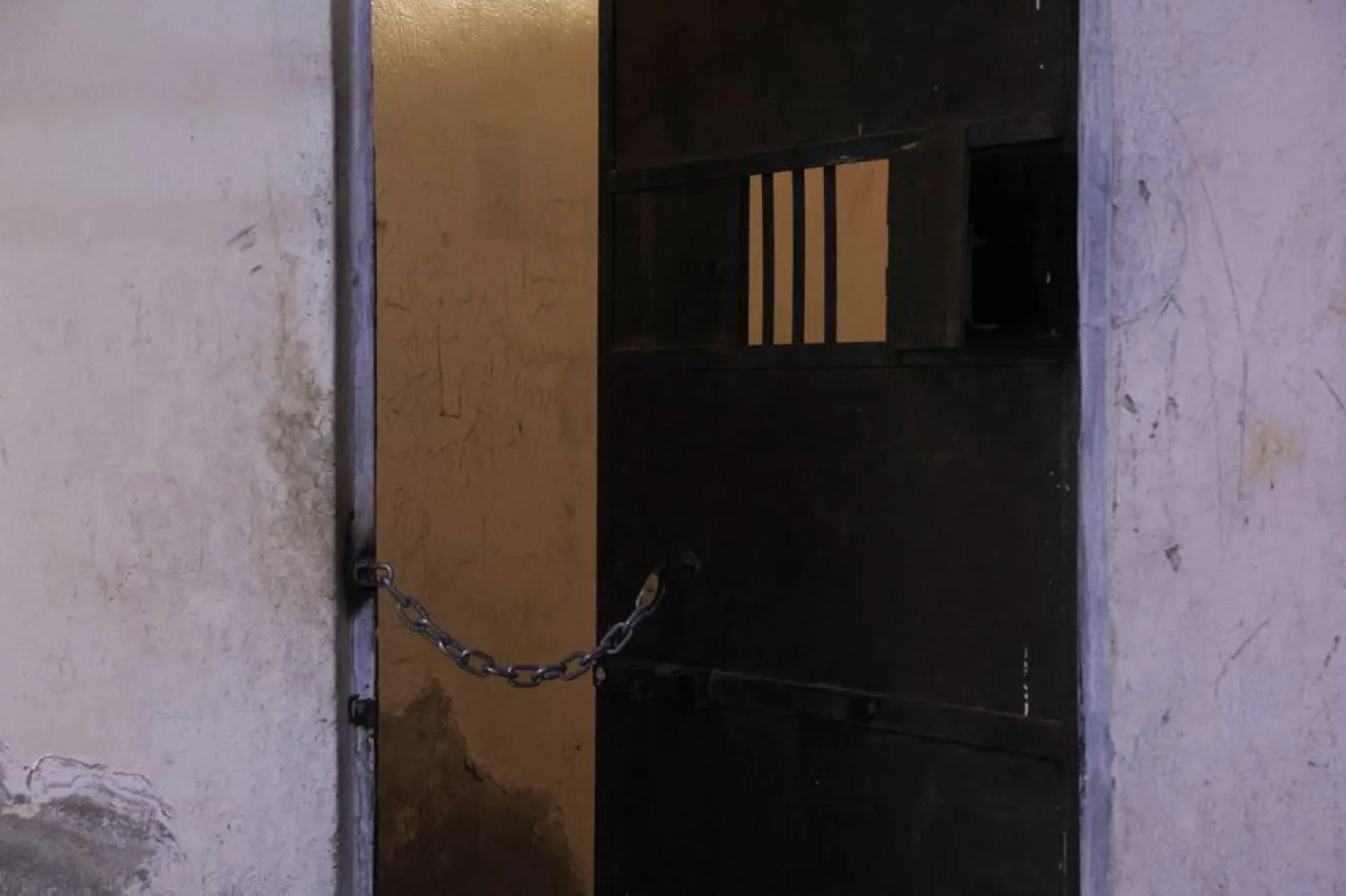
 The door to the cell at the Palestine Branch security complex in Damascus, Syria, December 15, 2024. (Reuters)
The door to the cell at the Palestine Branch security complex in Damascus, Syria, December 15, 2024. (Reuters)
TT

Syria Arrests Major Officer in Charge of Notorious Assad-era Prison

 The door to the cell at the Palestine Branch security complex in Damascus, Syria, December 15, 2024. (Reuters)
The door to the cell at the Palestine Branch security complex in Damascus, Syria, December 15, 2024. (Reuters)

Syrian authorities said on Wednesday they had arrested a former military official accused of executing detainees at the infamous Saydnaya prison during the rule of former president Bashar al-Assad.

In a statement, the interior ministry said the Damascus province's counter-terrorism branch arrested Major General Akram Salloum al-Abdullah.

It said he had held "several positions, most notably as Commander of the Military Police at the defense ministry between 2014 and 2015, during the rule of the former regime".

The ministry stated that Abdullah was "implicated in committing serious violations against detainees in Saydnaya prison", accusing him of being "directly responsible for carrying out the executions of detainees inside Saydnaya military prison... during his tenure as commander of the military police".

The prison, outside Damascus, was one of the darkest elements of Assad family rule, which ended after more than five decades when Bashar al-Assad was overthrown by opposition factions in December.

Rights group Amnesty International has called the facility a "human slaughterhouse".

The Association of Detainees and Missing Persons of Saydnaya Prison estimates that 30,000 people were taken into detention in the facility from 2011 onwards, while only around 6,000 have been released.

The others remain missing.

Diab Serriya, co-founder of the association, said that Abdullah was "the highest-ranked individual" to be arrested over Saydnaya to date.

Serriya said the military police was in charge of the prison, and that the period under Abdullah's leadership saw many executions and acts of torture against prisoners.

"He is responsible for those crimes," he told AFP.

More than 200,000 people have died in Syria's prisons, including by execution and under torture, according to the Britain-based Syrian Observatory for Human Rights monitor.



Israeli Military Kills Two in Raid, Says Palestinian Ministry

 A man sits near a street in Jerusalem's Old City, following restrictions on large gatherings amid the US-Israel conflict with Iran, March 27, 2026. (Reuters)
A man sits near a street in Jerusalem's Old City, following restrictions on large gatherings amid the US-Israel conflict with Iran, March 27, 2026. (Reuters)
TT

Israeli Military Kills Two in Raid, Says Palestinian Ministry

 A man sits near a street in Jerusalem's Old City, following restrictions on large gatherings amid the US-Israel conflict with Iran, March 27, 2026. (Reuters)
A man sits near a street in Jerusalem's Old City, following restrictions on large gatherings amid the US-Israel conflict with Iran, March 27, 2026. (Reuters)

Israeli forces killed two Palestinian men on Friday during a raid north of Jerusalem, the Ramallah-based health ministry and relatives said, while the army said troops had shot at instigators of stone throwing.

"The young man Mustafa Asaad Hamad (22 years old) was killed by Israeli gunfire in Kufr Aqab," the ministry said in a statement.

In a separate statement, it announced the death of 46-year-old Sufyan Abu Leil, who died "of critical wounds he sustained after being shot by Israeli forces in Qalandia camp this Friday afternoon".

The Palestinian entity in charge of the area, the Jerusalem governorate, reported that Israeli forces had raided the Qalandia refugee camp, adjacent to Kufr Aqab, and wounded several Palestinians with live fire early Friday.

The Israeli military said its forces had twice in 24 hours carried out "operational activities in the Qalandia area... during which violent disturbances developed, including the throwing of stones at the forces."

"The soldiers responded by firing at key instigators and hits were identified," it said in a statement.

Hamad's father Asaad Hamad told AFP at the funeral that the army entered the area at around midnight, causing clashes with local residents, during which his son was shot.

"My son was shot twice in the leg. The bullet hit an artery and he died a martyr," Asaad Hamad told AFP.

Hundreds of young men attended Hamad's funeral as his body was carried through the streets of Qalandia camp on a stretcher, wrapped in a Palestinian flag, an AFP journalist reported.

Qalandia refugee camp, Kufr Aqab and other areas around Jerusalem have seen increased Israeli raids since the beginning of 2026 after Israel launched operation "Capital Shield", which it says aims to make Jerusalem safer.

Since the operation began, the military has arrested dozens of Palestinians and destroyed several buildings it said had been illegally built in Kufr Aqab and Qalandia camp.

Palestinians fear the demolitions will pave the way for Israeli settlers to move into the area, as has happened in parts of east Jerusalem in recent months.

Violence in the West Bank, which Israel has occupied since 1967, has soared since the Hamas attack on Israel triggered the Gaza war in October 2023. It has continued despite an October 2025 ceasefire.

Israeli troops or settlers have killed at least 1,053 Palestinians, many of them gunmen, but also scores of civilians, in the West Bank since the Gaza war began, according to an AFP tally based on Palestinian health ministry figures.


G7 Ministers Urge End to Attacks Against Civilians in Middle East War

First aid responders inspect the site of an Israeli airstrike that targeted a building in the southern Lebanese town of Saksakiyeh on March 27, 2026. (AFP)
TT

G7 Ministers Urge End to Attacks Against Civilians in Middle East War

First aid responders inspect the site of an Israeli airstrike that targeted a building in the southern Lebanese town of Saksakiyeh on March 27, 2026. (AFP)

G7 foreign ministers Friday urged a stop to attacks against civilians in the Middle East war and urged Iran to immediately restore freedom of navigation in the strategic Strait of Hormuz.

A joint statement, released in the name of all G7 members, including the United States, called for "an immediate cessation of attacks against civilians and civilian infrastructure".

"There can be no justification for the deliberate targeting of civilians in situations of armed conflict as well as attacks on diplomatic facilities," it said, after the foreign ministers of the world's leading industrialized nations met in France.

The joint statement had initially not been expected, which had been seen as a potential sign of transatlantic tensions over the US-Israeli war against Iran.

US President Donald Trump had threatened to strike Iranian energy facilities, but has since rowed back on that warning to give Tehran more time for talks he said were taking place.

A major theme of the meeting outside Paris was Iran's de facto closure of the Strait of Hormuz, a key energy and trading bottleneck whose throttling has led to a surge in global energy prices.

"We reiterated the absolute necessity to permanently restore safe and toll-free freedom of navigation in the Strait of Hormuz," the statement added.

In their meeting, the ministers focused on efforts "to mitigate global economic shocks such as disruptions to economic, energy, fertilizer and commercial supply chains, which have direct impacts on our citizens", they said.


Hezbollah Says Clashed with Israeli Forces in Two South Lebanon Villages

A man checks a destroyed house that was hit in an Israeli airstrike in Saksakiyeh village, south Lebanon, Friday, March 27, 2026. (AP Photo/Hussein Malla)
TT

Hezbollah Says Clashed with Israeli Forces in Two South Lebanon Villages

A man checks a destroyed house that was hit in an Israeli airstrike in Saksakiyeh village, south Lebanon, Friday, March 27, 2026. (AP Photo/Hussein Malla)

Hezbollah said Friday its members had clashed directly with Israeli forces in two south Lebanon villages, as Israeli airstrikes on several areas killed at least six people, according to the health ministry.

In a statement, Hezbollah said its fighters had clashed with "Israeli enemy army forces in the villages of Bayada and Shamaa at point-blank range with light and medium weapons," while also claiming responsibility for attacks on Israeli border towns and positions.

The coastal village of Bayada, adjacent to Shamaa, lies eight kilometres from the border with Israel, according to AFP.

Israeli forces are pushing into numerous towns in southern Lebanon, with officials saying they aim to create a security zone reaching the Litani River, some 30 kilometres from the border, to push Hezbollah back and protect northern Israeli communities.

On Friday, Israel launched a series of airstrikes on several areas, particularly in southern Lebanon, according to Lebanese state media.

One of the strikes, on the town of Saksakiyeh in the Sidon district, killed "four civilians and wounded eight others," in an initial toll reported by the health ministry.

At dawn, Israel had targeted the Tahouitet al-Ghadir area in Beirut's southern suburbs without prior warning, killing two people, according to the health ministry.

Israeli army spokesperson Effie Defrin said Friday that "Contrary to the declaration by the Lebanese government earlier this year - Hezbollah is still operating and conducting attacks from southern Lebanon."

"If the Lebanese government will not disarm Hezbollah, the (army) will," he said.

After nearly four weeks of war between Hezbollah and Israel, Nicolas Von Arx, regional director of the International Committee of the Red Cross, warned Friday that "the humanitarian situation is worsening and civilians, as usual, are paying the highest price" in Lebanon.

After meeting Lebanese President Joseph Aoun, he said, "Civilians must be protected wherever they are, whether they remain in their homes or are forced to flee".

According to the authorities, the war has forced more than one million people to flee their homes, and more than a thousand people have been killed since the conflict began.