
Rubio: Knesset's Moves on West Bank Annexation a Threat to Gaza Deal

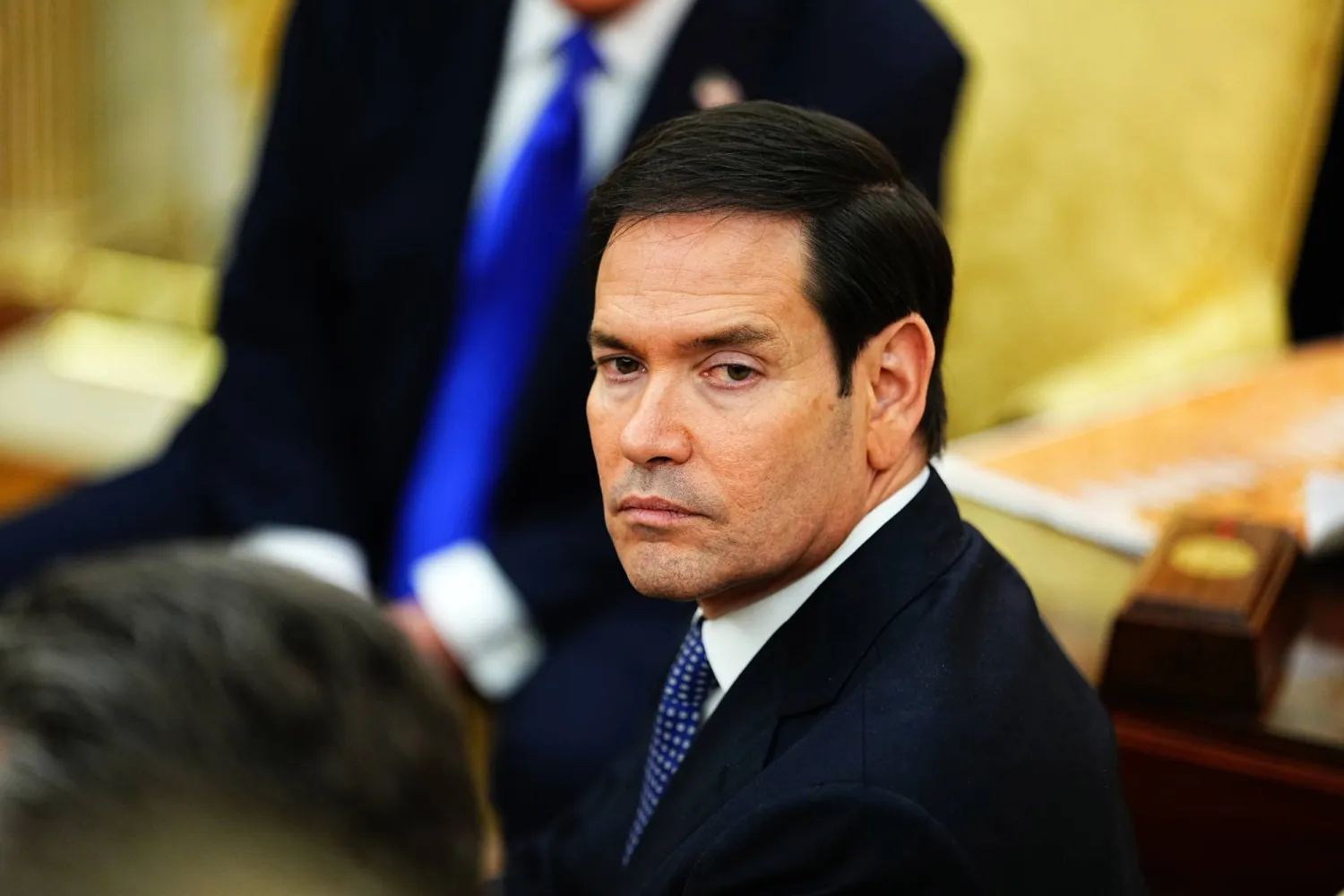
US Secretary of State Marco Rubio looks in the Oval Office of the White House in Washington, DC, USA, 22 October 2025. EPA/AARON SCHWARTZ
TT

Rubio: Knesset's Moves on West Bank Annexation a Threat to Gaza Deal

US Secretary of State Marco Rubio looks in the Oval Office of the White House in Washington, DC, USA, 22 October 2025. EPA/AARON SCHWARTZ

US Secretary of State Marco Rubio said on Wednesday that the Israeli Knesset's move towards the annexation of West Bank would threaten President Donald Trump's plan to end the conflict in Gaza.

"They passed a vote in the Knesset, but the president has made clear that’s not something we’d be supportive of right now," Rubio told reporters on the tarmac before boarding his flight to depart for Israel. "We think there’s potential for it to threaten the peace deal."

"They’re a democracy, people are going to have their votes, people are going to take these positions, but at this time we think it might be counterproductive," he added.

The bill applying Israeli law to the occupied West Bank, a move tantamount to annexation of land which Palestinians want for a state, won preliminary approval from Israel's parliament on Wednesday.

The vote was the first of four needed to pass the law and it coincided with the visit of US Vice President JD Vance to Israel, a month after Trump said that he would not allow Israel to annex the West Bank.

Prime Minister Benjamin Netanyahu's Likud party did not support the legislation, which was put forth by lawmakers outside his ruling coalition and passed by a vote of 25-24 out of 120 lawmakers. A second bill by an opposition party proposing the annexation of the Maale Adumim settlement passed by 31-9.

Some members in Netanyahu's coalition - from National Security Minister Itamar Ben-Gvir's Jewish Power party and Finance Minister Bezalel Smotrich's Religious Zionism faction - voted in favor of the bill, which would require a lengthy legislative process to ultimately pass.

Members of Netanyahu's coalition have been calling for years for Israel to formally annex parts of the West Bank, territory to which Israel cites biblical and historical ties.

Israel argues the territories it captured in the 1967 war are not occupied in legal terms because they are on disputed lands, but the United Nations and most of the international community regard them as occupied.

The UN's highest court in 2024 said that Israel's occupation of Palestinian territories, including the West Bank, and its settlements there are illegal and should be withdrawn as soon as possible.

Netanyahu's government had been mulling annexation as a response to a string of its Western allies recognizing a Palestinian state in September, but appeared to scrap the move after Trump's objection.

The Palestinian foreign ministry said Israel will have no sovereignty over Palestinian land, condemning the Knesset's move.

"The Ministry of Foreign Affairs affirms that the occupied Palestinian territory in the West Bank, including Jerusalem, and the Gaza Strip, is a single geographical unit over which Israel has no sovereignty," it said.

Hamas said in a statement on Wednesday that the Israeli votes on the West Bank and Maale Adumim bills reflected "the ugly face of the colonial occupation.”

"We affirm that the occupation's frantic attempts to annex West Bank lands are invalid and illegitimate," it said.

Appeal Trial of Tunisia Jailed Prominent Lawyer Starts

People stand outside a closed court during a nationwide strike in Tunis, Tunisia November 22, 2018. REUTERS/Zoubeir Souissi
TT

Appeal Trial of Tunisia Jailed Prominent Lawyer Starts

People stand outside a closed court during a nationwide strike in Tunis, Tunisia November 22, 2018. REUTERS/Zoubeir Souissi

The appeal trial of a prominent Tunisian lawyer jailed on anti-terror charges started on Thursday, after the judge rejected the defense's demand of his provisional release on health grounds.

Ahmed Souab's lawyers and relatives said his health condition had become critical since his jailing in April last year as part of what many said was a crackdown on political dissent.

The court rejected his provisional release and postponed the hearing to February 23, his lawyer, Fedi Snene, told AFP.

Souab -- also a rights advocate and a former judge -- was detained after claiming that judges were under political pressure to hand down hefty sentences last year in a mass trial of critics of President Kais Saied.

He had been a member of the defense team during the high-profile mass trial, and last October he was sentenced to five years in prison in a speedy trial that lasted less than two minutes.

UN Special Rapporteur on human rights defenders Mary Lawlor said on Wednesday Souab had been convicted on "baseless charges" and called for his "immediate release".

Snene rejected accusations against Souab, saying "he should not be in prison".

"He is a well-known man of law, who served for nearly 30 years as a judge before becoming a lawyer," Snene added.

Souab's son, Saeb, told AFP the family had submitted a "substantial medical file" asking the judge for his release pending a verdict.

Saeb said his father suffered a heart attack in 2022 and that his cardiologist had certified that prison conditions could worsen his health.

Souab had accused authorities of putting "a knife to the throat of the judge who was to deliver the verdict" during the mass trial that saw around 40 public figures sentenced to long terms on charges including plotting against the state.


At Least 21 Drown in Nile Boat Sinking in Sudan

At least 21 people drowned when a boat sank in the Nile River in northern Sudan, according to the local state government and eyewitnesses interviewed by AFP. (REUTERS)
TT

At Least 21 Drown in Nile Boat Sinking in Sudan

At least 21 people drowned when a boat sank in the Nile River in northern Sudan, according to the local state government and eyewitnesses interviewed by AFP. (REUTERS)

At least 21 people drowned when a boat sank in the Nile River in northern Sudan, according to the local state government and eyewitnesses interviewed by AFP.

River Nile State said Thursday that 21 bodies had been recovered after the accident, listed their names and warned that some passengers were still missing.

The boat was crossing the river between the villages of Tayba al-Khawad and Deim al-Qarai, according to the local government's statement.

The statement did not explain the cause of the accident.

Eyewitnesses told AFP the boat was carrying 30 people.

The Sudanese Doctors Network said in a statement that six of the boat's passengers survived.

The group said the incident exposes "the fragility of river transport and the absence of basic safety requirements, as well as the complete absence of local authorities and civil defense rescue teams in the early hours of the incident".

Many Sudanese rely on river transport via single-engine boats captained by solo operators.

The country's infrastructure has been collapsing due to a war that has been ongoing for nearly three years.

The war has divided the country between the army and their enemy, the paramilitary Rapid Support Forces, with road closures and a severe deterioration in public services and medical and educational infrastructure.


Syria Affirms Deep Ties with Saudi Arabia

Saudi Ambassador to Damascus Dr. Faisal Al-Mujfel visits the Kingdom’s pavilion, guest of honor at the Damascus International Book Fair (Saudi Embassy account). 
TT

Syria Affirms Deep Ties with Saudi Arabia

Saudi Ambassador to Damascus Dr. Faisal Al-Mujfel visits the Kingdom’s pavilion, guest of honor at the Damascus International Book Fair (Saudi Embassy account). 

Syria has reaffirmed the strength of its relations with Saudi Arabia during a visit by the Saudi ambassador to Damascus, Dr. Faisal Al-Mujfel, to the Saudi pavilion, guest of honor at the 2026 Damascus International Book Fair.

Saudi Arabia’s participation in the fair, held from Feb. 6-16, is led by the Literature, Publishing and Translation Commission.

At the start of the visit, Al-Mujfel met Syria’s Minister of Culture, Mohammad Yassin Saleh, who welcomed the Kingdom’s designation as guest of honor as a clear affirmation of the depth of Saudi-Syrian cultural relations, based on partnership and mutual respect.

Saleh praised Saudi Arabia’s cultural efforts and commended the pavilion for showcasing activities that reflect the richness and diversity of Saudi cultural heritage.

He noted that the Saudi program highlights the Kingdom’s commitment to supporting culture and literature at both the Arab and international levels. The pavilion features a wide range of events, including seminars and poetry evenings, with the participation of leading Saudi writers and intellectuals.

During a guided tour, the Saudi ambassador was briefed on the creative diversity presented at the pavilion. Exhibits include a collection of manuscripts, a section dedicated to traditional Saudi attire, displays of archaeological replicas, and a selection of publications issued by the Literature, Publishing and Translation Commission.

Among the featured works are titles from the “Translate” initiative, the “Saudi Literature Comics” series, and short story collections from Saudi authors, offering visitors insight into the Kingdom’s contemporary literary scene.

The commission is overseeing Saudi Arabia’s participation as guest of honor at the 2026 book fair, presenting what it described as a vibrant cultural experience that celebrates Saudi creativity and promotes dialogue through books.

The program aligns with the Kingdom’s National Culture Strategy under Vision 2030, which emphasizes cultural exchange, knowledge sharing, and constructive dialogue among nations, while reinforcing Saudi Arabia’s role in the Arab and global cultural landscape.

The visit was attended by several Arab diplomats accompanying the Saudi ambassador, including the ambassadors of Bahrain, Oman and Lebanon, as well as the chargé d’affaires of the United Arab Emirates embassy in Damascus.