
Tigers in Trouble as Malaysian Big Cat Numbers Dwindle

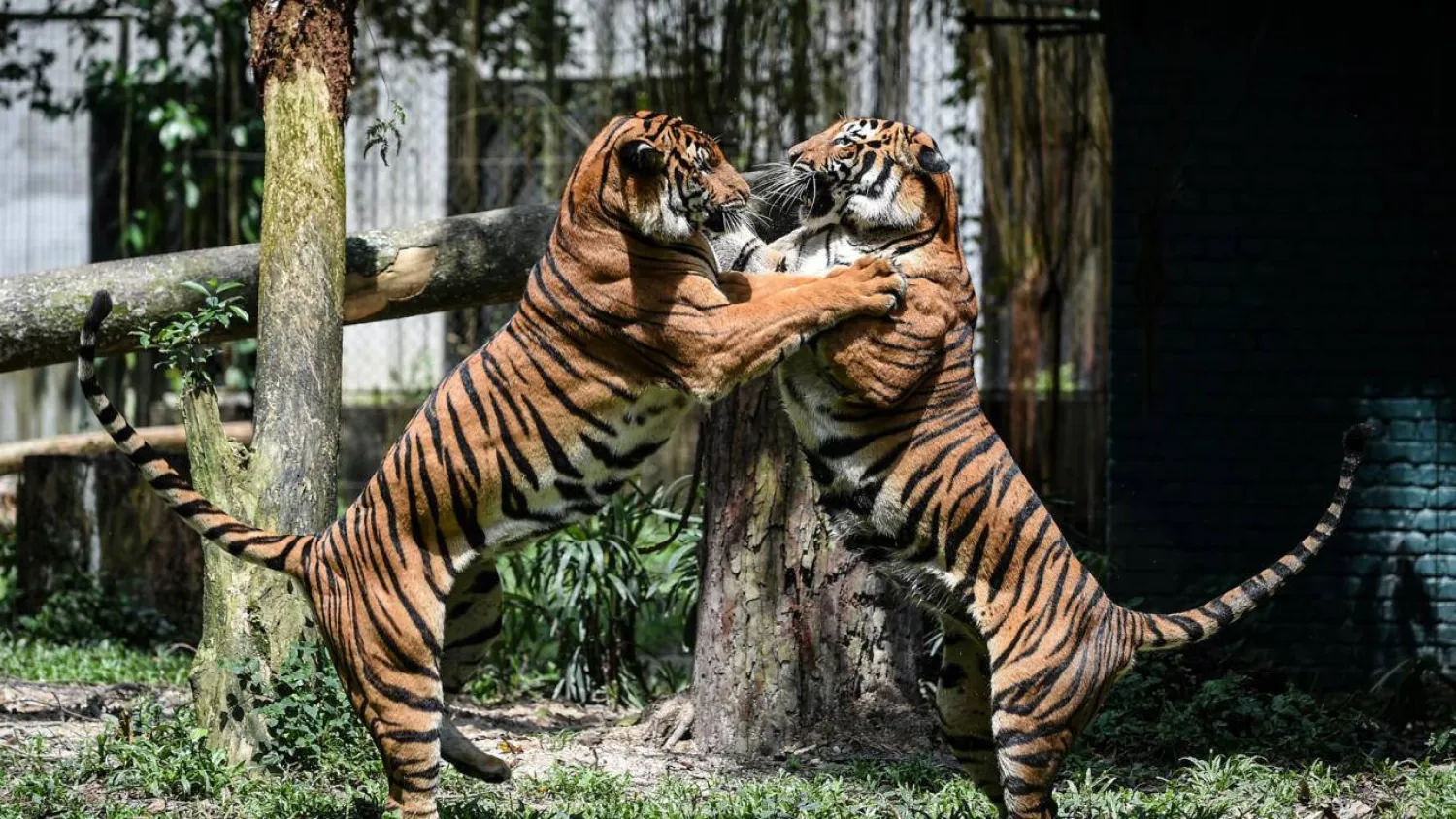
Malaysian experts and officials admit that resources fall far short of what is needed to protect the country's famed big cat, listed as critically endangered. MOHD RASFAN / AFP/File
TT

Tigers in Trouble as Malaysian Big Cat Numbers Dwindle

Malaysian experts and officials admit that resources fall far short of what is needed to protect the country's famed big cat, listed as critically endangered. MOHD RASFAN / AFP/File

For two years, Malaysian conservationists tracked a tiger named "Bulan" as she raised four cubs. Then a fatal traffic accident made her another statistic in the country's dwindling population.

Malaysia's national animal is in trouble.

Poaching, food loss and diminishing habitat have slashed the population from 3,000 in the 1950s to less than 150 roaming free today, according to official estimates.

The government said last month it was ramping up efforts to combat wildlife crime, introducing AI-enabled camera traps and methods to detect smuggling at airports.

But experts and officials admit that resources fall far short of what is needed to protect the country's famed big cat, listed as critically endangered.

Bulan (Moon in Malay) was killed on the East-West Highway, a throughfare notorious for animal traffic incidents.

"We were devastated when we lost her," said Lara Ariffin, president of the Tiger Protection Society of Malaysia (RIMAU).

"Not only that, she was butchered after she was run over," Ariffin told AFP, showing graphic pictures of the animal's carcass.

"They took her canines, they took her claws. For me, it was like desecrating the dead."

The fate of the apex predator's population leapt back into local headlines recently after a dead tiger was found in the back of a car in southern Johor state, sparking public outrage.

Three poachers were later handed seven-year jail sentences and a $59,000 fine, but experts say the business remains enticing.

'Serious money'

A single Malayan tiger carcass can fetch around $60,000 on the black market, according to Malaysia's Department of Wildlife and National Parks.

Tiger bones go for about $1,186 per kilogram, while teeth, claws, and even whiskers -- used in acupuncture -- fetch around $118 each, Kadir said.

The department did not respond to AFP's request for comment.

Even animals that escape poachers can be harmed by snares made from cheap plastic, rope or metal cable.

Camera traps have spotted animals with injuries or even missing limbs.

Research shows Malaysia feeds demand for tiger parts in Vietnam and further afield in China, with cross-border poaching syndicates using drug, gun and human trafficking routes to move their wares.

The first six months of 2025 saw 201 wildlife smuggling arrests and seized illegal assets valued at $30.5 million, Malaysia's top internal security and public order police officer told local media.

"These figures tell you poaching is no longer a small-scale crime. It is organized, cross-border -- and backed by serious money," Azmi Abu Kassim said.

'No overnight success'

The Malaysian government admits it has limited manpower, funding and equipment to deal with the challenge, though there are efforts to address the problem.

Joint operations by Malaysian police and wildlife services have resulted in hundreds of arrests and millions of dollars in seizures, officials said.

And community-based ranger programs run by NGOs like RIMAU employ more than 1,000 local community members.

"Malaysia has made great progress in fighting illegal poaching," said Ariffin, who produced a documentary called "Malaysia's Last Tigers".

"We are moving in the right direction, but there is no guaranteed success overnight."

The local chapter of the New York-based Wildlife Conservation Society estimates at least 5,000 rangers are needed to properly patrol Malaysia tiger habitats.

"The first line of defense is not there, meaning we don't have enough front-line rangers to protect our wildlife from poachers," WCS country director Mark Rayan Darmaraj told AFP.

"Poachers are still able to operate simply because they outnumber enforcement personnel, and once they're inside the jungle, it's like looking for a needle in a haystack," he said.

That's a view echoed by other NGOs working on conservation.

"The issue is not a lack of commitment, but a lack of capacity," WWF-Malaysia told AFP.

"The next 10 years will decide whether we can bring back the roar of the Malayan tiger."



Freezing Rain Paralyses Transport in Central Europe

Smoke from chimneys billows over snow-covered rooftops during sunrise as freezing temperatures have hit the country, in Prague, Czech Republic, January 11, 2026. (Reuters)
TT

Freezing Rain Paralyses Transport in Central Europe

Smoke from chimneys billows over snow-covered rooftops during sunrise as freezing temperatures have hit the country, in Prague, Czech Republic, January 11, 2026. (Reuters)

Freezing rain led to flights being suspended at Vienna airport on Tuesday, while neighboring Slovakia, Czech Republic and Hungary also experienced travel disruptions.

Snow and freezing temperatures buffeted Europe last week, with gale-force winds and storms claiming some 15 lives, causing travel mayhem, shutting schools, and cutting power to hundreds of thousands.

A thick layer of ice on the Vienna airport runways led to arriving flights being diverted to other airports, while all departing flights were put on hold early Tuesday.

Austria's state railway company OeBB also asked travelers to postpone non-urgent journeys, with numerous train connections facing interruptions and cancellations.

In neighboring Slovakia, the Bratislava airport was also closed early Tuesday due to bad weather.

Slovak police on Facebook urged people to avoid travel because of "extreme" ice and snow in the west of the country.

In the Czech Republic, ice was also hampering road and rail traffic.

Prague airport came to a virtual standstill, with firefighters having to de-ice the runways.

Around 50 people were treated for injuries because of the icy conditions, according to Prague's emergency services, cited by the CTK agency.

In Hungary, meteorological services also issued alerts for freezing rain and snowfall as severe winter conditions affect a large part of the country.

Trains and flights were experiencing delays, while authorities reported drift ice on the Danube and the Tisza rivers, where icebreakers have been put on alert.

Lake Balaton in the west of the country is currently frozen -- a relatively rare phenomenon seen about once every ten to fifteen years.

However, authorities warned that the ice is still too thin for skating, urging the public to be cautious.


AI Helps Fuel New Era of Medical Self-testing

Neurable research scientist Alicia Howell-Munson demonstrates the company's headset, which it says can detect early signs of Alzheimer's disease. Patrick T. Fallon / AFP
TT

AI Helps Fuel New Era of Medical Self-testing

Neurable research scientist Alicia Howell-Munson demonstrates the company's headset, which it says can detect early signs of Alzheimer's disease. Patrick T. Fallon / AFP

Beyond smart watches and rings, artificial intelligence is being used to make self-testing for major diseases more readily available -- from headsets that detect early signs of Alzheimer's to an iris-scanning app that helps spot cancer.

"The reason preventive medicine doesn't work right now is because you don't want to go to the doctor all the time to get things tested," says Ramses Alcaide, co-founder and CEO of startup Neurable.

"But what about if you knew when you needed to go to the doctor?"

Connected rings, bracelets and watches -- which were everywhere at last week's Consumer Electronics Show in Las Vegas -- can already monitor heart rate, blood pressure and glucose levels, with varying degrees of accuracy.

These gadgets are in high demand from consumers. A recent study published by OpenAI showed that more than 200 million internet users check ChatGPT every week for information on health topics.

On Wednesday, OpenAI even launched a chatbot that can draw on a user's medical records and other data collected by wearable devices, with their consent, to inform its responses.

Using electroencephalogram (EEG) technology, Neurable has developed a headset that records and deciphers brain activity.

The linked app compares data with the user's medical history to check for any deviation, a possible sign of a problem, said Alcaide.

"Apple Watch can pick up Parkinson's, but it can only pick it up once you have a tremor," Alcaide said. "Your brain has been fighting that Parkinson's for over 10 years."

With EEG technology, "you can pick these things up before you actually see physical symptoms of them. And this is just one example."

Detection before symptoms

Some people have reservations about the capabilities of such devices.

"I don't think that wearable EEG devices are reliable enough," said Anna Wexler, a University of Pennsylvania professor who studies consumer detection products, although she acknowledges that "AI has expanded the possibilities of these devices."

While Neurable's product cannot provide an actual diagnosis, it does offer a warning. It can also detect signs of depression and early development of Alzheimer's disease.

Neurable is working with the Ukrainian military to evaluate the mental health of soldiers on the front lines of the war with Russia, as well as former prisoners of war, in order to detect post-traumatic stress disorder (PTSD).

French startup NAOX meanwhile has developed EEG earbuds linked to a small box that can help patients with epilepsy.

Rather than detect seizures, which are "very rare," the device recognizes "spikes" -- quick, abnormal electrical shocks in the brain that are "much more difficult to see," said NAOX's chief of innovation Marc Vaillaud, a doctor by training.

NAOX's device -- which has been cleared by the US Food and Drug Administration -- is designed to be worn at night, to track several hours of data at a time.

The company is working with the Rothschild and Lariboisiere hospitals in Paris to try to better understand the links between these brain "spikes" and Alzheimer's disease, which have been raised in scientific papers.

Advances in AI and technology in general have paved the way for the miniaturization of cheaper detection devices -- a far cry from the heavy machinery once seen in medical offices and hospitals.

IriHealth is preparing to launch, for only about $50, a small smartphone extension that would scan a user's iris.

The gadget relies on iridology, a technique by which iris colors and markings are believed to reveal information about a person's health, but which is generally considered scientifically unreliable.

But the founders of IriHealth -- a spin-off of biometrics specialist IriTech -- are convinced that their device can be effective in detecting anomalies in the colon, and potentially the lungs or the liver.

Company spokesman Tommy Phan said IriHealth had found its device to be 81 percent accurate among patients who already have been diagnosed with colon cancer.


Hawaii's Kilauea Volcano Puts on Spectacular Lava Display

Kilauea has been regularly throwing out thousands of tonnes of molten rock and gases since it burst to life in December 2024. UNITED STATES GEOLOGICAL SURVEY/AFP
TT

Hawaii's Kilauea Volcano Puts on Spectacular Lava Display

Kilauea has been regularly throwing out thousands of tonnes of molten rock and gases since it burst to life in December 2024. UNITED STATES GEOLOGICAL SURVEY/AFP

Hawaii's Kilauea was spraying a spectacular fountain of lava on Monday, keeping up its reputation as one of the world's most active volcanoes.

For over a year now, Kilauea has been regularly throwing out thousands of tons of molten rock and gases since it burst to life in December 2024, reported AFP.

Volcanologists with the US Geological Survey said the incandescent lava was being hurled more than 1,500 feet (460 meters) into the air, with plumes of smoke and gases rising as high as 20,000 feet (six kilometers).

Eruptions such as this one tend to last around one day, the USGS said, but can still vent up to 100,000 tons of sulfur dioxide.

This gas reacts in the atmosphere to create a visible haze known as vog -- volcanic smog -- which can cause respiratory and other problems.

Tiny slivers of volcanic glass, known as "Pele's hair," are also being thrown into the air.

Named after Pele, the Hawaiian goddess of volcanoes, the strands can be very sharp and can cause irritation to the skin and eyes.

The eruption poses no immediate danger to any human settlement, with the caldera having been closed to the public for almost two decades.

Kilauea has been very active since 1983 and erupts relatively regularly.

It is one of six active volcanoes located in the Hawaiian Islands, which also include Mauna Loa, the largest volcano in the world.

Kilauea is much smaller than neighboring Mauna Loa, but it is far more active and regularly wows helicopter-riding tourists who come to see its red-hot shows.