
Iran ‘Closer to Paralysis’ After Year of War, Sanctions

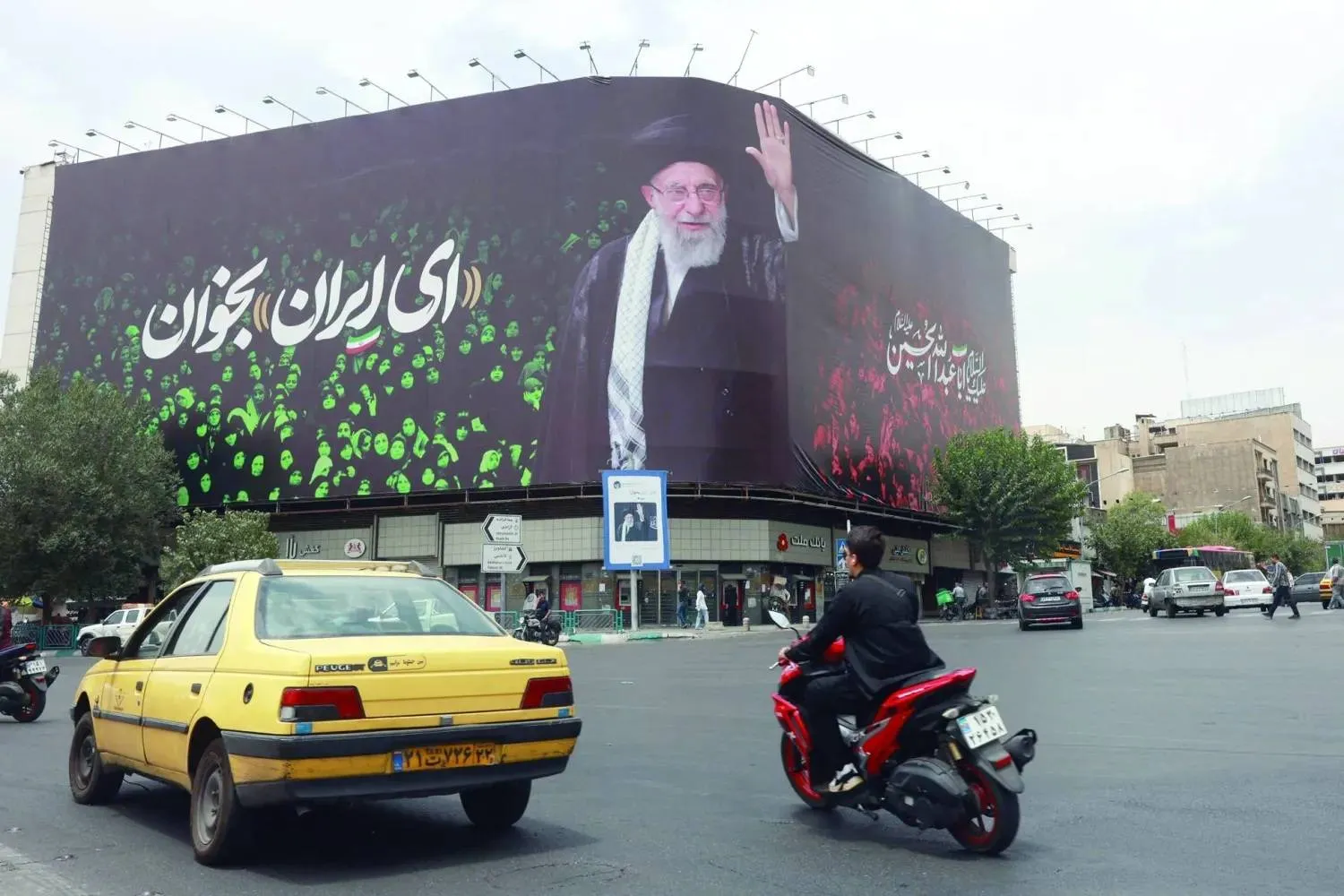
Cars pass a billboard of Khamenei reading “O Iran” at Enghelab (Revolution) Square in central Tehran (AFP)
TT

Iran ‘Closer to Paralysis’ After Year of War, Sanctions

Cars pass a billboard of Khamenei reading “O Iran” at Enghelab (Revolution) Square in central Tehran (AFP)

Iran has come under bombardment, faced the reinstatement of United Nations sanctions, and seen its economy sink deeper into crisis this year.

An analysis published by the AP points to Iran still not taking any major action to halt the slide, restart crucial nuclear negotiations with the West nor fully prepare for possible further hostilities with Israel and the US.

In the past, Iran’s 86-year-old Supreme Leader Ali Khamenei heralded the benefit of Tehran’s “strategic patience” in confronting its enemies.

According to The AP, concern is growing that patience has slipped into paralysis as Iran’s partners in its self-described “Axis of Resistance” have been devastated and there’s no overt sign of materiel support from either China or Russia.

“One of the harms and dangers facing the country is precisely this state of neither war nor peace, which isn’t good,” Khamenei himself warned in September.

But there’s been no move to change that calculus, as Iranians themselves remain fearful of war resuming. Each fire or industrial accident becomes grist for new worry as they watch their life savings further dwindle as Iran’s rial currency falls to historic lows against the US dollar.

“Even if we accept that the possibility of a second war exists, the right approach to governing the country is not to keep public opinion in constant anxiety through recurring alerts every few days,” said Ali Abdullah Khani, an analyst with Iran’s Presidential Strategic Affairs Office, in an interview published in October by the website NourNews.

“Such a policy places the nation in a permanent state of crisis, a condition in which it always seems that war could break out at any moment, and as a result, all managerial and political capacities are consumed by confronting a presumed and hypothetical conflict.”

Iran Tries to Talk Sanctions Away

The United Nations reimposed sanctions on Iran last month, but Tehran has sought to downplay their effect or even insist they don’t exist. The sanctions date from Tehran’s 2015 nuclear deal and were reimposed by a mechanism known to diplomats as “snapback.”

China, Iran and Russia issued a tripartite statement over the weekend, decrying them as “legally and procedurally flawed.”

But while China and Russia have signaled they won’t enforce the sanctions, the US, European nations and others are.

Some of the measures are pretty out of date, for instance, sanctions on Iranian Revolutionary Guard Gen. Qassem Soleimani, who was killed in a US drone strike in Baghdad during President Donald Trump’s first term in 2020.

But the main ones squeeze Iran’s Central Bank and its oil exports, one of the few sources of hard currency for the government. That could allow for the seizure of Iranian crude oil shipments on the seas, something that in the past has sparked confrontations with Tehran.

Iranian Gov’t at Odds

The June war saw Israel kill top leadership in Iran’s regular military and its paramilitary Revolutionary Guard, a force answerable only to Khamenei that controls its own arsenal of ballistic missiles. In the time since, Iran has held no major military parades and conducted only limited drills at sea, likely out of the concern of providing Israel with any tempting targets.

Criticism is slowly rising to the surface of Iran’s theocracy, which under Khamenei has grown into various competing camps and agencies often tasked with the same missions.

Ali Shamkhani, a top adviser to Khamenei who survived an Israeli attack targeting him during the war, said in an online video that Iran’s earlier attacks against Israel in 2024 “did not achieve the outcomes” sought by Tehran, a rare acknowledgment by a senior official of the low accuracy plaguing the theocracy’s vaunted missile arsenal.

He also even went as far as to openly muse about Iran pursuing a nuclear weapon — something Tehran long has insisted it doesn’t want to do despite the West and the International Atomic Energy Agency saying the Islamic Republic had an organized weapons program up until 2003.

“Now that it has become clear, Iran should have developed this capability for itself,” Shamkhani said.

Khamenei Halts Talks with West

Then there is Khamenei himself, with no clear front-runner to succeed him. His profile has dropped since the war, with more delays surrounding the release of his remarks — likely again a security measure against possibly being targeted by Israel.

Yet at a moment when talks with the US and the Europeans represent one path out of Iran’s issues, he’s been adamant that negotiations can’t be held. He gave a speech as both Iranian President Masoud Pezeshkian and Foreign Minister Abbas Araghchi went to New York for the UN General Assembly, which had the effect of stopping them from having direct negotiations.

“Once a decision is made, everyone must follow it, whether they support it or not,” Araghchi told the state-run IRNA news agency in August, before the summit.

Speaking to athletes on Monday, Khamenei kept up his criticism of the US president and insisted Iran “will not submit to coercion.”

Trump “prides himself on ‘bombing and destroying Iran’s nuclear industry,’” Khamenei said. “Fine, keep living that fantasy.”

But for now, it doesn’t appear time is on Iran’s side.


Iran Executes Man Accused of Spying for Israel

An anti-US and anti-Israeli billboard is displayed on a building in Tehran, Iran, January 4, 2026. Majid Asgaripour/WANA (West Asia News Agency) via Reuters
TT

Iran Executes Man Accused of Spying for Israel

An anti-US and anti-Israeli billboard is displayed on a building in Tehran, Iran, January 4, 2026. Majid Asgaripour/WANA (West Asia News Agency) via Reuters

​Iran executed a man accused of spying for Israel, the Iranian judiciary's media outlet Mizan reported on Wednesday, naming the defendant as ‌Ali Ardestani.

Entangled ‌in a ‌decades-long ⁠shadow ​war ‌with Israel, Iran has executed many people it has accused of having links with Israel's intelligence service and facilitating its operations ⁠in the country.

"The death sentence ‌of Ali Ardestani ‍for the ‍crime of espionage in favor ‍of the Mossad intelligence service by providing the country's sensitive information was carried ​out after approval by the Supreme Court and ⁠through legal procedures," Mizan said.

Executions of Iranians convicted of spying for Israel have significantly increased this year, following a direct confrontation between the two regional enemies in June, when Israeli and US forces ‌struck Iran's nuclear facilities.


China Bans Two Taiwan Ministers for Alleged ‘Independence Activities’, Angering Taipei

A man walks past a screen broadcasting news about military drills conducted by China around Taiwan, in Beijing, China, 30 December 2025. (EPA)
TT

China Bans Two Taiwan Ministers for Alleged ‘Independence Activities’, Angering Taipei

A man walks past a screen broadcasting news about military drills conducted by China around Taiwan, in Beijing, China, 30 December 2025. (EPA)

Beijing banned two Taiwanese ministers from entering ​China for alleged separatist activities related to "Taiwan independence" on Wednesday, prompting an angry response from Taipei, which said it would not bow to "threats and intimidation."

The office described Taiwanese Interior Minister Liu Shyh-fang and Education Minister Cheng Ying-yao as "die-hard Taiwan independence secessionists" and banned them as well as their relatives, from entry. The ban also extends to Hong Kong and Macau.

Beijing claims democratically governed Taiwan as its own territory and has not ruled out the use of force to take control of the island. Taipei strongly objects ‌to Beijing's sovereignty claims ‌and says only Taiwan's people can decide their ‌future.

Taiwan's ⁠Mainland ​Affairs Council ‌issued a strong protest, saying the move gravely undermined cross-strait relations and would only provoke anger among the public.

It accused Beijing of seeking to create a "chilling effect beyond the named individuals, to coerce Taiwanese people into abandoning their determination to uphold the status quo and their democratic freedoms."

China was also attempting to claim jurisdiction over Taiwan by treating such cases as "domestic criminal offences", the council said in a statement, calling the efforts clumsy and ineffective.

"Threats and ⁠intimidation will never shake the resolve of the Taiwanese people to uphold democracy and freedom," it said. "All serious ‌consequences arising from the Chinese Communist authorities' actions that provoke ‍instability in cross-strait relations must be borne ‍entirely by the Chinese side."

China has now listed 14 people as "secessionists", the ‍office's spokesperson Chen Binhua told reporters at a weekly news briefing, in an announcement that comes a week after the Chinese military carried out its most extensive ever war games around the island. The list already includes Taiwan Vice President Hsiao Bi-khim, head of the island's National Security Council ​Joseph Wu and Defense Minister Wellington Koo.

A third person, Chen Shu-Yi, a prosecutor from Taiwan's High Prosecutors Office, was accused of being an accomplice ⁠in alleged separatist activities and will be held "accountable for life".

The spokesperson called on the public to submit evidence and leads on the prosecutor's activities based on which China would impose "severe punishment", without specifying what those measures would be.

Chen said the purpose of the actions against a small number of "Taiwan independence die-hards" was to "fundamentally safeguard national sovereignty and territorial integrity", and that the moves were not aimed at Taiwanese citizens in general.

Taipei has complained about Beijing’s “long-arm jurisdiction” to pressure the Taiwanese people and said Chinese laws do not apply in Taiwan, which has its own judicial system.

China fired dozens of rockets towards Taiwan and deployed a large number of warships and aircraft near the island last week in massive war games around the ‌island, causing dozens of domestic flights in Taiwan to be cancelled and drawing concern from regional allies and the West.


South Korea’s Lee Says He Asked Xi to Play a Mediating Role on North Korea

In this photo released by Xinhua News Agency, visiting South Korean President Lee Jae Myung, left, shakes hands with Chinese President Xi Jinping prior to their bilateral meeting at the Great Hall of the People, in Beijing, Monday, Jan. 5, 2026. (Yue Yuewei/Xinhua via AP)
TT

South Korea’s Lee Says He Asked Xi to Play a Mediating Role on North Korea

In this photo released by Xinhua News Agency, visiting South Korean President Lee Jae Myung, left, shakes hands with Chinese President Xi Jinping prior to their bilateral meeting at the Great Hall of the People, in Beijing, Monday, Jan. 5, 2026. (Yue Yuewei/Xinhua via AP)

South Korean President Lee Jae Myung said on Wednesday that much progress had been ​made in restoring trust with Beijing, and that he had asked Chinese President Xi Jinping to play a role in mediating Seoul's efforts to engage North Korea.

Lee, who held talks with Xi this week, said the Chinese leader had noted patience was needed when they discussed nuclear-armed North Korea. ‌Lee was speaking ‌to South Korean media in ‌Shanghai ⁠with ​his ‌remarks relayed live on television.

The South Korean president said he laid out the efforts - so far without success - that Seoul had been making to engage North Korea in dialogue and improve relations, and asked Xi to play a role to mediate for peace ⁠on the Korean peninsula.

"President Xi acknowledged our efforts so far ‌and said patience is needed," Lee ‍said.
Lee has been on ‍a state visit to China and his ‍meeting with Xi was their second in less than three months.

Lee has sought to open a "new phase" in ties with China, after several frosty years and with South ​Korea's popular cultural exports being shut out of the Chinese market due to a dispute ⁠over a US missile defense system deployment in South Korea in 2017.

"President Xi said 'talk is easy, but action is not so easy,'" Lee said, as he talked about how building trust and respect between countries takes work.

Diplomatic relations are inherently complex in balancing each other's key national interests, Lee said he had told Xi, adding he hoped recent tension between Tokyo and Beijing could be resolved.

Lee said South Korea ‌considered its ties with Japan as important as its relations with China.