


China's Rare Golden Monkeys Debut at European Zoos

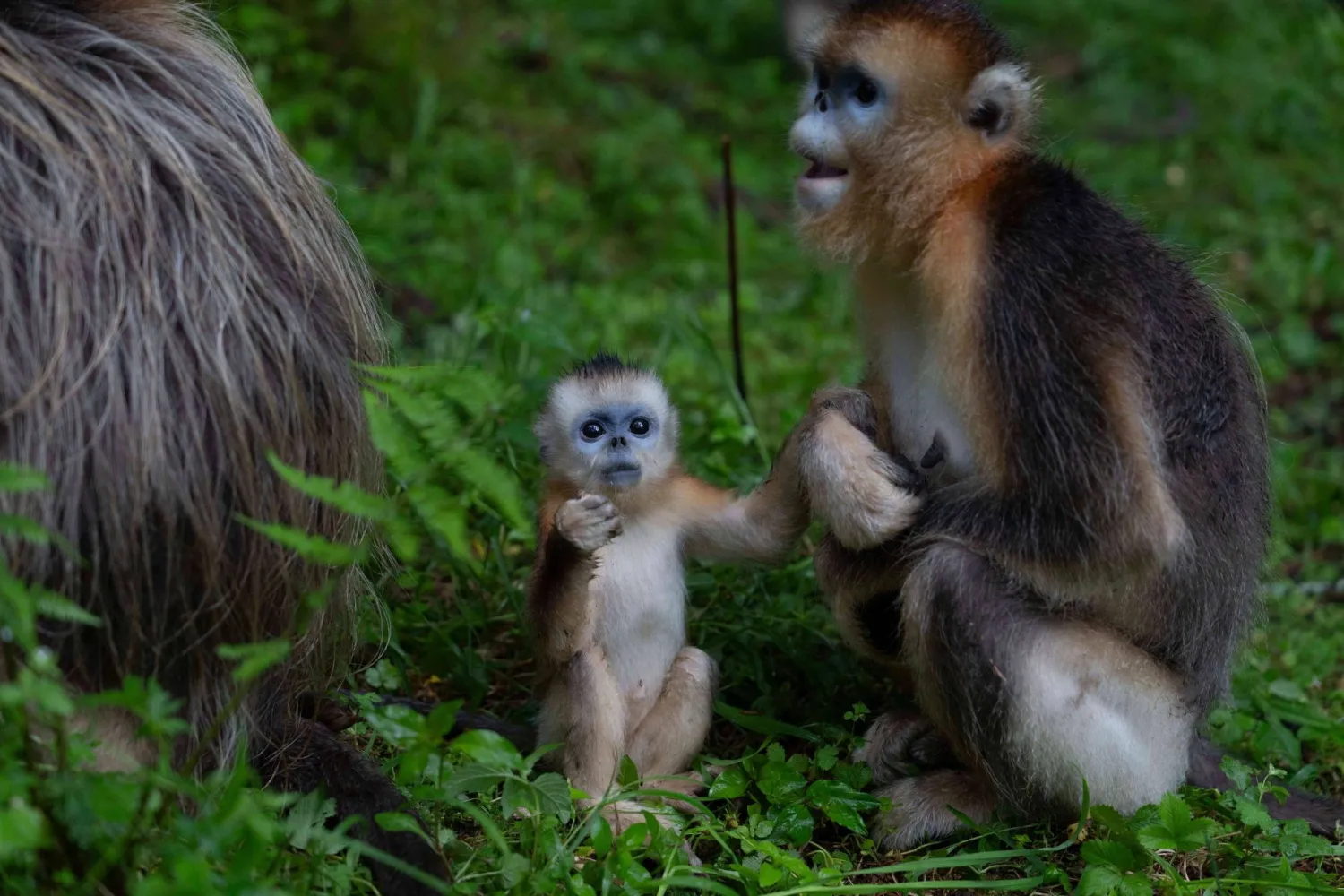
Golden snub-nosed monkeys sit together in the Shennongjia National Park in Shennongjia in central China's Hubei province on Wednesday, June 18, 2025. (AP Photo/Ng Han Guan)
TT

China's Rare Golden Monkeys Debut at European Zoos

Golden snub-nosed monkeys sit together in the Shennongjia National Park in Shennongjia in central China's Hubei province on Wednesday, June 18, 2025. (AP Photo/Ng Han Guan)

With their distinctive shaggy orange manes, pale blue faces and dense fur covering their hands and feet, it's hard to mistake China's endangered golden snub-nosed monkeys for any other animal.

These rare and charismatic monkeys, unique to the frigid mountains of central China, have recently joined the country's famous pandas as furry envoys to zoos in Europe for the first time — on loan for 10 years from the same government-overseen group that coordinates official panda exchanges, The Associated Press reported.

As with “ panda diplomacy,” some observers cheer new opportunities for scientific and conservation collaboration, while others raise concerns about the welfare of individual animal ambassadors transported around the world.

Leaping among red and gray-tiled roofs Three golden monkeys arrived at France’s Beauval Zoo in the city of Saint-Aignan this April, following an agreement to mark the 60th anniversary of the establishment of diplomatic relations between the People’s Republic of China and France.

Another trio of golden monkeys arrived at the Pairi Daiza zoo in Hainaut, Belgium, in May. The zoo distributed Belgian and Chinese hand flags to visitors on the day the monkeys arrived.

After a monthlong quarantine, the two sets of monkeys made their public debuts. So far, they appear to be in good health, according to the two zoos, adapting to new climates outside Asia for the first time.

At Pairi Daiza, the habitat enclosure for Liu Yun, Lu Lu and Juan Juan includes traditional Chinese gazebos with red columns and gray-tiled roofs, where the monkeys spend much of their time jumping between logs and rope ladders and scrambling over roofs.

“The diplomatic aspect comes from this cultural awareness,” said Pairi Daiza spokesperson Johan Vreys.

The hope is to build longstanding scientific exchanges between the zoos and Chinese authorities, said Anaïs Maury, the communications director for the Beauval Zoo.

The zoo is in discussions with China to launch joint research and conservation programs “similar to those already in place for other emblematic species like pandas,” Maury said.

A short history of modern animal ambassadors Both giant pandas and golden snub-nosed monkeys are endangered animals that are unique to China and they can only be moved outside the country with approval from the central government, said Elena Songster, an environmental historian at St. Mary’s College of California.

While both species are considered national treasures, only monkeys have deep roots in Chinese art and culture, appearing in countless paintings and as characters in classic literature, including the wily Monkey King in the 16th century novel “Journey to the West."

When pandas stepped, rolled, scratched and stumbled onto the world stage in recent decades, they quickly became symbols of modern China — in part to due to their own “cuddly cuteness” and deft diplomatic presentation, said Susan Brownell, a China historian at the University of Missouri, St. Louis.

The original soft power couple from post-war China was a pair of giant pandas, Ping Ping and Qi Qi, sent to the Soviet Union in 1957 to celebrate the 40th anniversary of the October Revolution, which led to the establishment of the world’s first Communist state.

In 1972, a pair of pandas was sent to the US for the first time, following President Richard Nixon’s historic visit to Beijing. In 1984, China switched from gifting pandas to loaning them.

Following outcry from animal-rights activists, China ended the practice of short-term loans and began longer leases, usually around a decade. In this arrangement through the China Wildlife Conservation Association, part of the money that an overseas zoo pays annually to China must be earmarked for habitat conservation or scientific research to benefit the species.

Still, what benefits a species may not be beneficial to an individual animal.

Transporting animals over long distances and sending their offspring back to China, as the agreements require, may highly stress animals, said Jeff Sebo, an environmental and bioethics researcher at New York University.

“Animal health and welfare matters,” he said, “not just for geopolitical or strategic aims.”

Habitat conservation in China Within China, the golden snub-nosed monkeys today live across a swath of central and southwestern China that includes parts of Sichuan, Shaanxi, Gansu and Hubei provinces.

At the Shennongjia National Park in Hubei, conservation efforts since the 1980s have helped increase the region’s population threefold to around 1,600 monkeys today, said Yang Jingyuan, president of the Academy of Sciences at the park.

It’s unclear exactly how to evaluate the diplomatic track record of furry ambassadors.

Still, in an era of rising global tensions, “I think pandas are a really useful entryway,” said James Carter, a China historian at Saint Joseph’s University in Philadelphia. “Pandas open up an opportunity for people to think something positive about China — they’re cute, they don’t do anything bad.”

The golden snub-nosed monkeys now at zoos in France and Belgium are so far the only ones outside of Asia.

“China’s golden snub-nosed monkeys aren’t globally iconic yet,” said Brownell, “but there may be potential for them to be in the future.”



Brigitte Macron Visits an Old Friend in China: Giant Panda Called Yuan Meng

FILE - French First lady Brigitte Macron attends a naming ceremony of the panda born at the Beauval Zoo, in Saint-Aignan-sur-Cher, France, on Dec. 4, 2017. (AP Photo/Thibault Camus, Pool, File)
TT

Brigitte Macron Visits an Old Friend in China: Giant Panda Called Yuan Meng

FILE - French First lady Brigitte Macron attends a naming ceremony of the panda born at the Beauval Zoo, in Saint-Aignan-sur-Cher, France, on Dec. 4, 2017. (AP Photo/Thibault Camus, Pool, File)

French first lady Brigitte Macron caught up with an old friend — a giant panda born in France — at the tail end Friday of a visit to China with President Emmanuel Macron.

At a panda reserve in southwest China that Yuan Meng now calls home, the first lady marveled at how big he has grown. She helped choose his name — which means “accomplishment of a dream” — when he was born in a French zoo in 2017.

“When they're born, they're like this,” she said, holding up two fingers a short distance apart. Meanwhile, the chunky male roamed in his enclosure, feasting on bamboo and ignoring bystanders who cried out his name, hoping to elicit a reaction.

“They have a very independent character,” she said. “They do only what they want.”

For decades, China has deployed what's often called “panda diplomacy” to smooth and promote relations with other countries, gifting the animals to friendly nations and lending pandas to zoos overseas on commercial terms.

Emmanuel Macron’s state visit this week to China, his fourth as president, included meetings with Chinese leader Xi Jinping and other officials, discussing Russia’s war in Ukraine, trade ties and other issues.

The China Wildlife Conservation Association said during the visit that it signed a letter of intent to send two of the animals to the Beauval Zoo south of Paris in 2027 under what would be a new 10-year round of panda cooperation with France.

The French zoo sent two 17-year-old pandas — Huan Huan, a female, and her partner Yuan Zi — back to China last month after 13 years on loan in France.

Yuan Meng was their cub, conceived using artificial insemination.

Despite being made in France, he officially belonged to the Chinese government. Yuan Meng bid ‘’adieu’’ to France in 2023, sent off to a new life in the Chengdu Research Base of Giant Panda Breeding in southwest China where Brigitte Macron, considered to be his “godmother,” dropped in to see him.

Huan Huan and Yuan Zi also produced female twins in France in 2021.

Huanlili and Yuandudu are also expected to leave the Beauval Zoo for China in the future. The China Wildlife Conservation Association has previously said that it expects them to remain at the French zoo until January 2027.


Florida Kicks Off 1st Black Bear Hunt in a Decade, Despite Pushback

FILE - A black bear is weighed by FWC Biologists Alyssa Simmons and Mike Orlando at the Rock Springs Run Wildlife Management Area near Lake Mary, Fla., Oct. 24, 2015. (Luis Santana/Tampa Bay Times via AP, file)
TT

Florida Kicks Off 1st Black Bear Hunt in a Decade, Despite Pushback

FILE - A black bear is weighed by FWC Biologists Alyssa Simmons and Mike Orlando at the Rock Springs Run Wildlife Management Area near Lake Mary, Fla., Oct. 24, 2015. (Luis Santana/Tampa Bay Times via AP, file)

For the first time in a decade, hunters armed with rifles and crossbows are fanning out across Florida's swamps and flatwoods to legally hunt the Florida black bear, over the vocal opposition of critics.

The state-sanctioned hunt began Saturday, after drawing more than 160,000 applications for a far more limited number of hunting permits, including from opponents who are trying to reduce the number of bears killed in this year's hunt, the state's first since 2015, The Associated Press reported.

The Florida Fish and Wildlife Conservation Commission awarded 172 bear hunt permits by random lottery for this year's season, allowing hunters to kill one bear each in areas where the population is deemed large enough. At least 43 of the permits went to opponents of the hunt who never intend to use them, according to the Florida chapter of the Sierra Club, which encouraged critics to apply in the hopes of saving bears.

The Florida black bear population is considered one of the state's conservation success stories, having grown from just several hundred bears in the 1970s to an estimated more than 4,000 today.

Opponents have questioned whether the hunt was necessary, but they were unable to convince the courts to halt it.

Here's what to know.

A limit of one bear per hunter The 172 people who were awarded a permit through a random lottery will be able to kill one bear each during the 2025 season, which runs from Dec. 6 to Dec. 28. The permits are specific to one of the state's four designated bear hunting zones, each of which have a hunting quota set by state officials based on the bear population in each region.

In order to participate, hunters must hold a valid hunting license and a bear harvest permit, which costs $100 for residents and $300 for nonresidents, plus fees. Applications for the permits cost $5 each.

The regulated hunt will help incentivize maintaining healthy bear populations, and help fund the work that is needed, according to Mark Barton of the Florida chapter of Backcountry Hunters and Anglers, an advocacy group that supported the hunt.

Having an annual hunt will help guarantee funding to "keep moving conservation for bears forward,” Barton said.

Hunting as a management tool According to state wildlife officials, the bear population has grown enough to support a regulated hunt and warrant population management. The state agency sees hunting as an effective tool that is used to manage wildlife populations around the world, and allows the state to monetize conservation efforts through permit and application fees.

"While we have enough suitable bear habitat to support our current bear population levels, if the four largest subpopulations continue to grow at current rates, we will not have enough habitat at some point in the future," reads a bear hunting guide published by the state wildlife commission.

Opponents meanwhile have called the hunt cruel, unnecessary and an excuse for hunters to bag a trophy animal when the real issue is the ever-growing human population encroaching on bear habitat.

Stricter regulations than the last hunt This year’s hunting plan has more stringent rules than the 2015 hunt, in which permits were provided to anyone who could pay for them, resulting in more than 3,700 permits issued. That led to a chaotic event that was shut down days early. Of the 304 bears killed, at least 38 were females with cubs, meaning the young bears may have died too.

Ultimately, wildlife officials decided to call off the hunt after its second day after a higher than expected number of bears were killed, though hunters did not exceed the statewide quota.

Doug Moore regularly sees bears on the more than 6,000 acres of timberland that he manages in northeast Florida. The president of a local hunting club, Moore is generally supportive of the new regulations for the bear hunt, even though he and his family members weren't issued a permit this year.

Moore described the management of the 2015 hunt as “fouled up” and “totally wrong" but said, “they’re doing it right this time."

Activists were issued dozens of permits Backers of the hunt have said that growing numbers of bears present a safety problem, with local officials sharing reports of bears on porches, rooting through garbage cans and roaming neighborhoods and playgrounds.

Activists have argued that the state should instead focus on other means of curbing nuisance bears and assuring safety through better trash management.

While opponents failed to convince a judge to stop the hunt, they were issued about a quarter of the overall permits, after activists applied for hunting tags they never intend to use.

“Somewhere out there a bear will be walking the grounds of the Panhandle, and I gave them a stay of execution,” said Joel Cleveland, an opponent of the hunt who was issued one of the permits.


British Man Makes Artwork in Size of Human Blood Cell

David A Lindon's latest sculpture is the same size as a human blood cell, mould spores, bacteria, talcum powder or a fog droplet (David A Lindon)
TT

British Man Makes Artwork in Size of Human Blood Cell

David A Lindon's latest sculpture is the same size as a human blood cell, mould spores, bacteria, talcum powder or a fog droplet (David A Lindon)

A micro artist said he has beaten his own world record by creating the smallest handmade sculpture ever.

David A Lindon, from Bournemouth, Dorset, says his latest sculpture, The Yellow Smiley Face, is “invisible to the human eye,” with measurements of only 11.037 by 12.330 microns, according to BBC.

Lindon said his artwork lived on a first-class stamp on a micro dot on the eye of the late Queen.

It has now broken his previous smallest handmade sculpture world record, The Lego Brick.

Lindon, who has 12 Guinness World Records in total, is known for his work creating miniature pieces of art, including three microscopic re-creations of Van Gogh masterpieces on a watch mechanism which sold for £90,000.

The Red Lego Brick measures 0.02517mm by 0.02184mm.

“My Yellow Smiley Face artwork is half the size of my Red Lego Brick artwork, which in turn was already four times smaller than the previous record,” the artist said.

He said it was the same size as either a human blood cell, mould spores, bacteria, talcum powder and a fog droplet.

Other of Lindon's tiny creations include unique animals crafted within the eye of a needle, from a blue whale to a delicate peacock butterfly.

“I probably am completely bonkers,” he jokes.

The stamp where Yellow Smiley Face lives is mounted on a glass tower and housed inside a sealed glass box.