


Iraq Election Campaign Heats Up as Sudani Accuses Rivals of ‘Lies

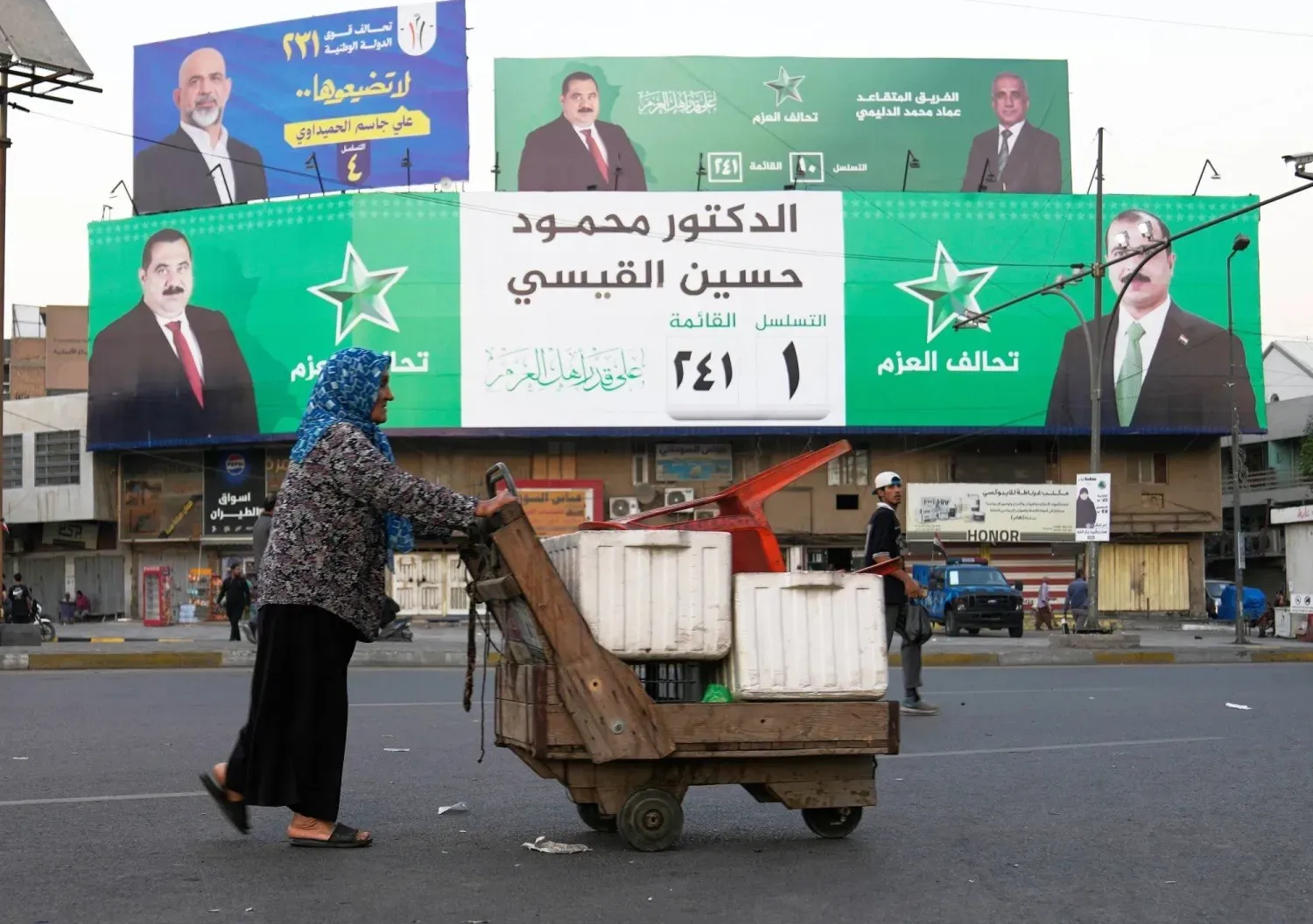
A woman pushes a cart past a banner for Iraq’s parliamentary elections in Baghdad (AP)
TT

Iraq Election Campaign Heats Up as Sudani Accuses Rivals of ‘Lies

A woman pushes a cart past a banner for Iraq’s parliamentary elections in Baghdad (AP)

Iraq’s parliamentary election campaign is intensifying as the country heads toward a pivotal vote that many warn will shape its political trajectory, either reinforcing stability or plunging the country back into uncertainty.

The stakes grew higher this week with a new judicial disclosure surrounding the killing of an election candidate in a case tied to political rivalry.

Prime Minister Mohammed Shia Al-Sudani described the upcoming elections as “decisive” for Iraq’s future.

“The results will either lay the foundation for stability and protect what has been achieved, or they will lead to setbacks and the loss of these gains,” he said during a meeting with tribal leaders in Baghdad.

Al-Sudani urged voters to “choose their representatives wisely,” stressing his government’s efforts since taking office to “improve services, provide jobs, secure contracts for workers, and fight corruption.”

At another campaign event, he called for “broad and informed participation,” saying that competition “must be based on programs and projects, not empty slogans.”

He highlighted what he described as declining unemployment and poverty rates as evidence of his government’s performance.

The prime minister faces a critical political test in the November elections, which could determine whether he secures a second term, something rare in Iraqi politics since 2003.

French President Emmanuel Macron announced plans to visit Iraq soon, underscoring France’s support for Baghdad’s sovereignty and stability.

“France has deep affection for Iraq, and I believe the prime minister has set out a great agenda for his country,” Macron said. “At a time of widespread instability in the region, Iraq’s stability and respect for its sovereignty are essential for the stability of the entire Middle East.”

Macron expressed hope to make the trip before the end of the year, a move observers see as a diplomatic show of support ahead of a sensitive electoral moment for Baghdad.

A total of 7,768 candidates, including more than 2,200 women, are competing for 329 seats in parliament. Key political blocs such as the Sadrist movement, led by Moqtada Al-Sadr, and the Nasr Coalition of Haider Al-Abadi have announced they will boycott the vote.

Meanwhile, Iraq’s Supreme Judicial Council announced new findings in the killing of Safaa Al-Mashhadani, a Baghdad Provincial Council member and parliamentary candidate, who was assassinated in Tarmiyah, north of the capital.

The Karkh First Investigation Court said in a statement that two suspects confessed to the crime, and evidence, including surveillance footage, confirmed their role. The investigating judge noted that the murder was “criminal in nature and linked to electoral rivalry among people from the same area,” and that legal procedures are under way.

Separately, the Independent High Electoral Commission fined 540 candidates for campaign violations, mostly for hanging posters and banners in unauthorized areas. Among them were 82 women. The Kurdistan Region accounted for about 12 percent of all recorded violations nationwide.



Indonesia Slams 'Unacceptable' Peacekeeper Casualties in Lebanon

FILE PHOTO: UNIFIL vehicles drive on a main road in Qlayaa, amid escalating hostilities between Israel and Hezbollah, as the US-Israel conflict with Iran continues, in Qlayaa, southern Lebanon, March 27, 2026. REUTERS/Karamallah Daher/File Photo
TT

Indonesia Slams 'Unacceptable' Peacekeeper Casualties in Lebanon

FILE PHOTO: UNIFIL vehicles drive on a main road in Qlayaa, amid escalating hostilities between Israel and Hezbollah, as the US-Israel conflict with Iran continues, in Qlayaa, southern Lebanon, March 27, 2026. REUTERS/Karamallah Daher/File Photo

The Indonesian government on Saturday slammed as "unacceptable" an explosion that injured three of its peacekeepers in Lebanon within days of three other blue helmets from the Southeast Asian nation being killed.

The United Nations Interim Force in Lebanon (UNIFIL) said three peacekeepers were wounded in a blast that occurred inside a UN facility near Adaisseh on Friday afternoon, and rushed to hospital.

Two were seriously wounded.

The UN Information Center in Jakarta said the "origin of the explosion" was unknown but identified the injured soldiers as Indonesian.

"Repeated attacks or incidents of this kind are unacceptable," the Indonesian foreign ministry said in a statement.

"Regardless of their cause, these events underscore the urgent need to strengthen protection for UN peacekeeping forces amid an increasingly dangerous conflict situation."

The government urged the UN Security Council to investigate the events and "to immediately convene a meeting of troop-contributing countries to UNIFIL to conduct a review and take measures to enhance the protection of personnel serving with UNIFIL".

Friday's incident came just days after an Indonesian peacekeeper died when a projectile exploded on March 29 in southern Lebanon, where Israel and Hezbollah have been fighting since Lebanon was drawn into the Middle East war.

A UN security source told AFP on condition of anonymity Tuesday that fire from an Israeli tank was responsible for that attack.

A day later, two more Indonesian peacekeepers died after an explosion struck a UNIFIL logistics convoy, also in southern Lebanon.

The father of one of the two fallen soldiers, 33-year-old Zulmi Aditya Iskandar, said this week he was shocked that peacekeepers were losing their lives in the conflict.

"We were really sad and regretful, because this is a UN troop, a peacekeeping troop, not deployed for war," 60-year-old Iskandarudin told reporters at his house in West Java province.

The bodies of the three peacekeepers are scheduled to arrive in Jakarta on Saturday evening, according to the military.

The Indonesian National Armed Forces has said it will deploy more than 750 personnel to Lebanon next month as part of the scheduled UNIFIL peacekeeping troop rotation.


Strike Kills One Iraqi Fighter near Syria Border

Mourners attend the funeral of members of Iraq's Hashed al-Shaabi, who were killed in an airstrike in the town of al‑Qaim near the Syrian border, amid heightened regional tensions due to the US-Israel conflict with Iran, in Baghdad, Iraq, March 12, 2026. REUTERS/Stringer
TT

Strike Kills One Iraqi Fighter near Syria Border

Mourners attend the funeral of members of Iraq's Hashed al-Shaabi, who were killed in an airstrike in the town of al‑Qaim near the Syrian border, amid heightened regional tensions due to the US-Israel conflict with Iran, in Baghdad, Iraq, March 12, 2026. REUTERS/Stringer

An attack killed one fighter from the former paramilitary coalition Hashed al-Shaabi on Saturday, the alliance said, blaming the US and Israel.

Iraq has been dragged into the war between the United States, Israel and Iran, with strikes targeting both US interests and pro-Iran groups in the country, reported AFP.

"This treacherous attack resulted in the martyrdom of one PMF fighter and the wounding of four others, as well as a member of the ministry of defense," said a short statement from the group, which is also known as the Popular Mobilization Forces (PMF), adding it was a "Zionist-American attack".

The PMF is a coalition of armed groups -- formed in 2014 to fight extremists-- that is now part of Iraq's regular army, but also contains pro-Iran factions who have a reputation for acting independently.

PMF positions have been repeatedly targeted since the outbreak of war, with the group consistently blaming the attacks on the US and Israel.

According to the group's statement, the latest attack targeted a position in western Anbar province of the 45th Brigade, which belongs to the US-blacklisted, pro-Iran Kataeb Hezbollah group.

Kataeb Hezbollah is part of the umbrella movement known as the Islamic Resistance in Iraq, which has been claiming daily attacks since the start of the war on US interests in Iraq and the region.

The Pentagon has said helicopters have carried out strikes against pro-Iran armed groups in Iraq during the war.

Washington has strongly denied claims it has targeted Iraqi security forces.


Houthis Threaten ‘Gradual Escalation’ after Fourth Attack on Israel

Houthi gunmen during a rally in Sanaa called by their leader (AFP) 
TT

Houthis Threaten ‘Gradual Escalation’ after Fourth Attack on Israel

Houthi gunmen during a rally in Sanaa called by their leader (AFP) 

Yemen’s Houthi group has threatened “gradual escalation” after claiming a fourth attack on Israel, about a week after entering the war alongside Iran as part of the Tehran-led “axis of resistance.”

The move comes as Yemen’s internationally recognized government steps up rhetoric, saying a decisive battle to retake the state from Houthi control is nearing. Israel, for its part, said it is consulting Washington on how to respond to the Houthi attacks, despite their limited impact compared with sustained fire from Iran and Hezbollah.

In a televised statement late Thursday, Houthi military spokesman Yahya Saree said the group launched “a salvo of ballistic missiles” at “vital Israeli targets in the occupied Jaffa area.” He claimed the operation was carried out in coordination with Iran and Hezbollah and had “successfully achieved its objectives.”

The Houthis said their intervention in what they described as a “major and exceptional battle” would be incremental, adding they would adjust their actions depending on “the enemy’s escalation or de-escalation.”

The latest strike marks the fourth since the group announced direct involvement in the regional confrontation, underscoring growing coordination among Iran-backed actors, including Hezbollah and armed Iraqi factions.

Limited effect

The Houthis had claimed a third attack a day earlier. The Israeli military said it intercepted a missile launched from Yemen “without casualties or damage,” adding early detection allowed it to neutralize the threat.

Analysts say such attacks are unlikely to do more than stretch Israel’s air defenses, already under pressure from multiple fronts, including Iran and Hezbollah.

In his first appearance since announcing the escalation, Houthi leader Abdul Malik al-Houthi said the group had shifted from political and media backing of Iran to “direct operational engagement.”

He framed the attacks as part of “joint operations of the axis of resistance,” describing the confrontation as “a duty that transcends geographical borders.” He also defended joining the war, saying neutrality “is not an option,” despite growing concern inside Yemen over the economic and security risks.

Al-Houthi urged supporters to maintain weekly pro-Iran rallies and step up mobilization, including sending school students to summer camps—long used by the group for recruitment.

Government signals offensive

Tareq Saleh, a member of Yemen’s Presidential Leadership Council, said “the battle to end the Houthi coup is approaching,” adding national forces would act “as one team.”

State media reported his remarks during a visit to forces on Yemen’s west coast, where he praised troops as “a safety valve for the republic,” signaling confidence in their ability to regain the initiative.

Saleh also pointed to the regional dimension, saying Iranian actions against Gulf states and Jordan show Tehran’s project is “destructive” and “has never truly been directed at Israel.”

Rejecting Houthi claims, he said the group “pretends to confront Israel” while using that narrative to justify violence against Yemenis, noting the conflict with the Houthis dates back to 2004, well before current regional tensions.