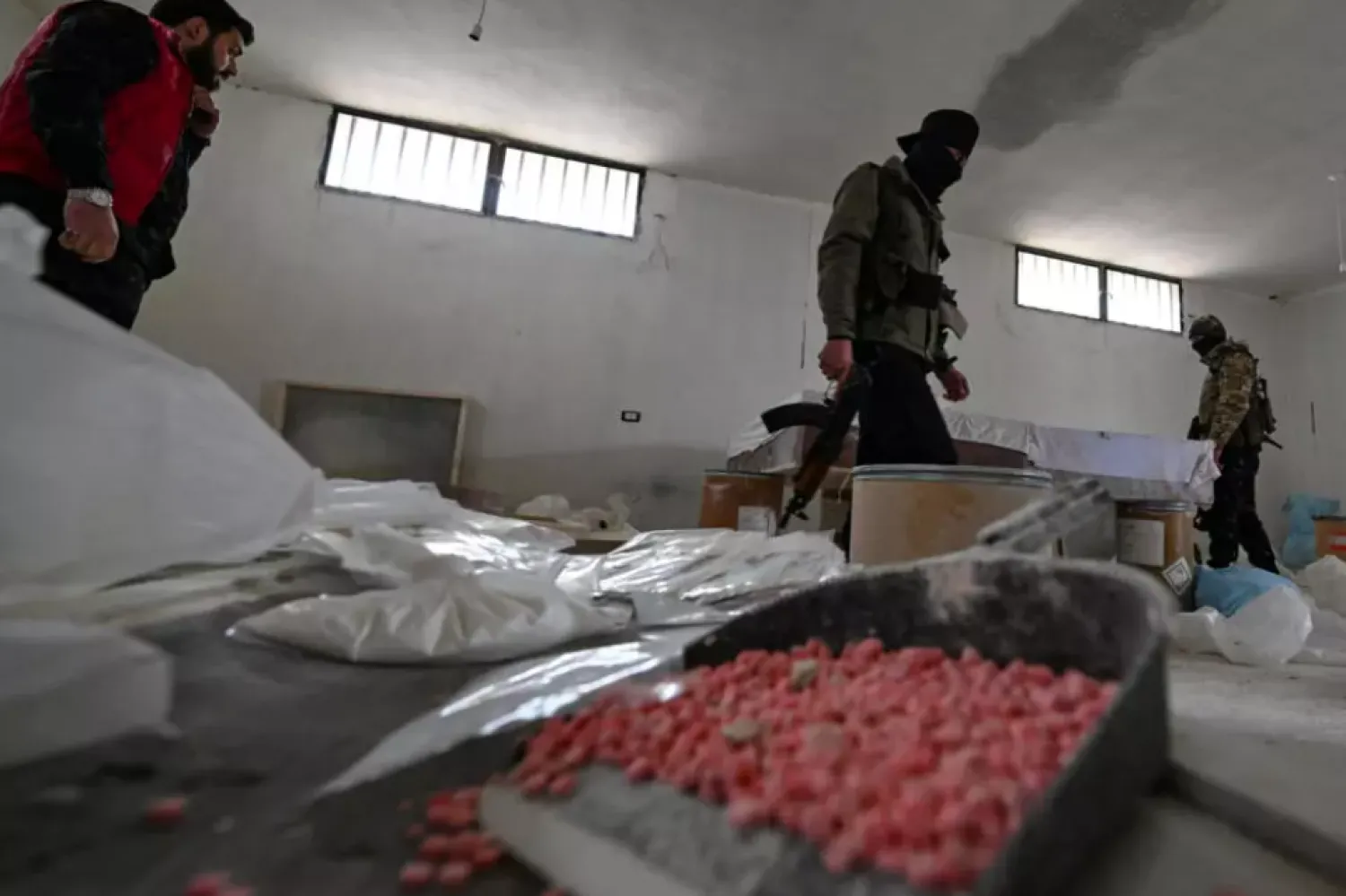
Syria Announces Seizure of 11 Million Captagon Pills from Lebanon

In the building raided by Syrian border security, AFP correspondents saw large bags of captagon pills © LOUAI BESHARA / AFP
TT

Syria Announces Seizure of 11 Million Captagon Pills from Lebanon

In the building raided by Syrian border security, AFP correspondents saw large bags of captagon pills © LOUAI BESHARA / AFP

The Syrian interior ministry said that it had seized about 11 million captagon stimulant pills that entered the country from neighboring Lebanon in one of the largest busts since the fall of former ruler Bashar al-Assad.

In a statement, the interior ministry said "the anti-narcotics branch in Homs province seized a vehicle coming from Lebanon containing approximately 11 million captagon pills".

The statement added that the authorities are continuing to "conduct the necessary investigations to uncover the identities of those involved and identify the criminal networks linked to the operation".

Captagon, which is similar to amphetamines, became Syria's largest export during the civil war that erupted in 2011, with its trade serving as a key funding source for the government of ousted president Assad, AFP reported.

Since his fall in December, the new authorities have reported numerous major seizures of captagon across the country. However, neighboring countries continue to report the interception of large shipments.

In Lebanon, Assad's ally Hezbollah also faced accusations of using the captagon trade to finance itself.

The Lebanese military announced in September the seizure of 64 million captagon pills in the east in one of the largest operations against the illicit stimulant in the country.

The synthetic drug has flooded the region, with neighboring countries occasionally announcing seizures and asking Lebanon and Syria to ramp up efforts to combat the trade.


Hezbollah’s Selective Turn to State Exposes Paralysis

Hezbollah parliamentary bloc head Mohammed Raad meets Lebanese President Joseph Aoun (Lebanese Presidency)
TT

Hezbollah’s Selective Turn to State Exposes Paralysis

Hezbollah parliamentary bloc head Mohammed Raad meets Lebanese President Joseph Aoun (Lebanese Presidency)

Since the ceasefire reached with Israel in November 2024, Hezbollah has shown a striking shift in its political conduct, particularly in how it deals with Lebanese state institutions.

A group long used to operating outside official channels is now, despite its escalatory rhetoric, shifting responsibility to the state on issues ranging from Lebanese prisoners held by Israel and postwar reconstruction to indirect negotiations with Tel Aviv.

Since the ceasefire, Hezbollah has also refrained from responding militarily to Israel, with no direct action recorded, in clear contrast to its traditional discourse built around retaliation and deterrence.

At the same time, the group continues to reject any discussion of handing over its weapons. It has launched a campaign against officials who have spoken about restricting arms to the state north of the Litani River.

This was evident in remarks by Mohammed Raad, head of Hezbollah’s parliamentary bloc, following his meeting with Lebanese President Joseph Aoun on Wednesday, after tensions had surfaced between the two sides over recent statements by the president urging the group to act with restraint.

While Raad did not address the issue of weapons during his remarks at the presidential palace, he reiterated Hezbollah’s stance of placing responsibility on the state regarding liberation, prisoners, and reconstruction.

He said the group was committed to understanding and cooperation to achieve the goals of all Lebanese, starting with ending the occupation, securing the release of prisoners, strengthening stability, enabling residents to return to their homes and villages, launching reconstruction efforts, and having the state assume responsibility for protecting sovereignty, with Hezbollah supporting it when necessary, while rejecting all forms of intervention and tutelage.

This approach is also reflected in Hezbollah’s meetings with Aoun and Prime Minister Nawaf Salam to hand over lists of Lebanese prisoners and explicitly call on the state to take full responsibility for the issue. This practice was not typical of the group in previous phases.

Contradiction and confusion

Sources close to the presidency declined to comment on Raad’s remarks or assess the meeting with Aoun, telling Asharq Al-Awsat that there was an apparent contradiction and confusion in Hezbollah’s behavior and positions. At the same time, everyone awaited the outcome of US-Iranian negotiations.

They said what was happening amounted to buying time, and that the state was not a menu from which responsibilities could be selectively chosen.

They said Hezbollah wanted the state to shoulder responsibility for all outstanding issues, which was indeed the state’s duty, even though the group had launched its support front without consulting it and continued to reject the implementation of state decisions. They described Hezbollah officials as lacking clarity in defining their objectives.

Clear incapacity

Opposition political analyst Ali al-Amin described Hezbollah’s behavior, combining escalatory rhetoric with rejection of disarmament while demanding the state resolve outstanding issues, as a clear expression of its inability to respond to repeated Israeli strikes, including killings and destruction.

Amin told Asharq Al-Awsat that Hezbollah was also attempting to transfer the consequences of the war to the state, channeling the complaints of displaced and affected citizens toward state institutions, as if to say the matter was the state’s responsibility, while ignoring what was required of it in terms of handing over its weapons.

He said that when the discussion turns to the role of the state, weapons are framed in terms of dignity and honor, but when it comes to bearing burdens, citizens are told the state is responsible.

Despite this, Amin said Hezbollah had succeeded to some extent in shifting these burdens, noting that it had not paid housing compensation, issued checks that were not honored, and that citizens were now being told the state would pay instead.

At the same time, the group had not carried out any response against Israel, raising a question it avoided answering: whether it no longer wanted to fight Israel.

Confusion and mutual benefit

Amin said Hezbollah was seeking to reduce the cost of confrontation and transfer the burden to the state without abandoning its tools or strategic options.

He said the group wanted to preserve the current situation, with ongoing Israeli attacks used to justify retaining weapons. At the same time, Israel benefits from their continued presence to strengthen its leverage and impose conditions on Lebanon later.

He added that Lebanon was facing a state of confusion: no fighting, no resistance, no liberation, only a continued insistence on retaining arms whose remaining function was unclear, except as an Israeli pretext for further attacks and for weakening the Lebanese state.


UK Sanctions Sudanese Army and RSF Leaders

Sacks of crops are stacked at the El Obeid crops market, in El Obeid, North Kordofan State, Sudan, January 14, 2026. REUTERS/El Tayeb Siddig
TT

UK Sanctions Sudanese Army and RSF Leaders

Sacks of crops are stacked at the El Obeid crops market, in El Obeid, North Kordofan State, Sudan, January 14, 2026. REUTERS/El Tayeb Siddig

Britain sanctioned six individuals suspected of committing atrocities in Sudan's war or of fueling the conflict through the supply of mercenaries and military equipment, the government said on Thursday.

The measures targeted senior commanders in both the Rapid Support Forces (RSF) and the Sudanese Armed Forces, the government said.

The conflict between ⁠the two forces has displaced millions, drawn in regional powers and caused a vast humanitarian crisis since it broke out in April 2023.

"We urgently need a ceasefire, and safe access for humanitarian relief agencies ⁠to reach all those in need," British foreign minister Yvette Cooper, who visited the Sudan-Chad border this week, said in the statement.

"Through these sanctions, we will seek to dismantle the war machine of those who perpetrate or profit from the brutal violence in Sudan," Cooper added.

The British government also sanctioned three individuals - Alvaro ⁠Andres Quijano, Mateo Andres Duque Botero, and Claudia Viviana Oliveros Forero - suspected of recruiting foreign fighters for the conflict or facilitating the purchase of military equipment.

Others sanctioned include Abu Aqla Mohamed Kaikal, a former RSF Commander and current head of the Sudan Shied Forces, RSF Field Commander Hussein Barsham, and RSF Financial Advisor Mustafa Ibrahim Abdel Nabi Mohamed.


Euro-Med Human Rights Monitor: Israel’s Chemical Spraying of Farmland in Lebanon, Syria Amounts to War Crime

Fire and smoke rises after Israeli airstrikes on Kfar Hatta in southern Lebanon, Lebanon, January 11, 2026. REUTERS/Ali Hankir
TT

Euro-Med Human Rights Monitor: Israel’s Chemical Spraying of Farmland in Lebanon, Syria Amounts to War Crime

Fire and smoke rises after Israeli airstrikes on Kfar Hatta in southern Lebanon, Lebanon, January 11, 2026. REUTERS/Ali Hankir

The Israeli army’s spraying of chemical substances over vast agricultural areas in southern Lebanon and Syria amounts to a “war crime,” the Euro-Mediterranean Human Rights Monitor said Thursday.

Beirut accused Israel on Wednesday of spraying the herbicide glyphosate on the Lebanese side of their shared border, with President Joseph Aoun decrying a "crime against the environment.”

More than a year after a ceasefire was struck to end a war between Israel and Hezbollah, border areas in Lebanon remain largely deserted and Israel continues to carry out regular airstrikes in the south.

After collecting samples following the recent spraying, the Lebanese agriculture and environment ministries said some of them showed concentrations of glyphosate "20 to 30 times higher than the average" in the area.

In a joint statement, they expressed worries about "damage to agricultural production" and soil fertility.

Aoun denounced the spraying as a "flagrant violation of Lebanese sovereignty and a crime against the environment and health.”

The UN peacekeeping mission in Lebanon, UNIFIL, said Monday that it had been notified by Israel of its plans to spray a "non-toxic chemical substance" near the border and warned to take shelter.

“The deliberate targeting of civilian farmland violates international humanitarian law, particularly the prohibition on attacking or destroying objects indispensable to civilian survival,” said the Euro-Mediterranean Human Rights Monitor Thursday.

“Large-scale destruction of private property without specific military necessity amounts to a war crime and undermines food security and basic livelihoods in the affected areas,” it added.

Euro-Med Monitor also said that it documented Israeli aircraft spraying pesticides of unknown composition over farmland in the countryside of Quneitra in southern Syria last month.

“The direct targeting of civilian objects caused widespread crop destruction, posing a serious threat to economic and food security and violating farmers’ rights to work and to an adequate standard of living by destroying their primary sources of income without military justification,” it added.

The Monitor called on the international community “to act immediately by establishing an independent fact-finding mission to collect samples from affected soil and crops in southern Lebanon and the countryside of Quneitra, subject them to thorough laboratory analysis, determine the chemical composition of the substances used, assess their toxicity, and evaluate any potential violation of the Chemical Weapons Convention or relevant international environmental protocols.”