


UN Human Rights Investigator Delivers Gaza Report from South Africa Because of US Sanctions 

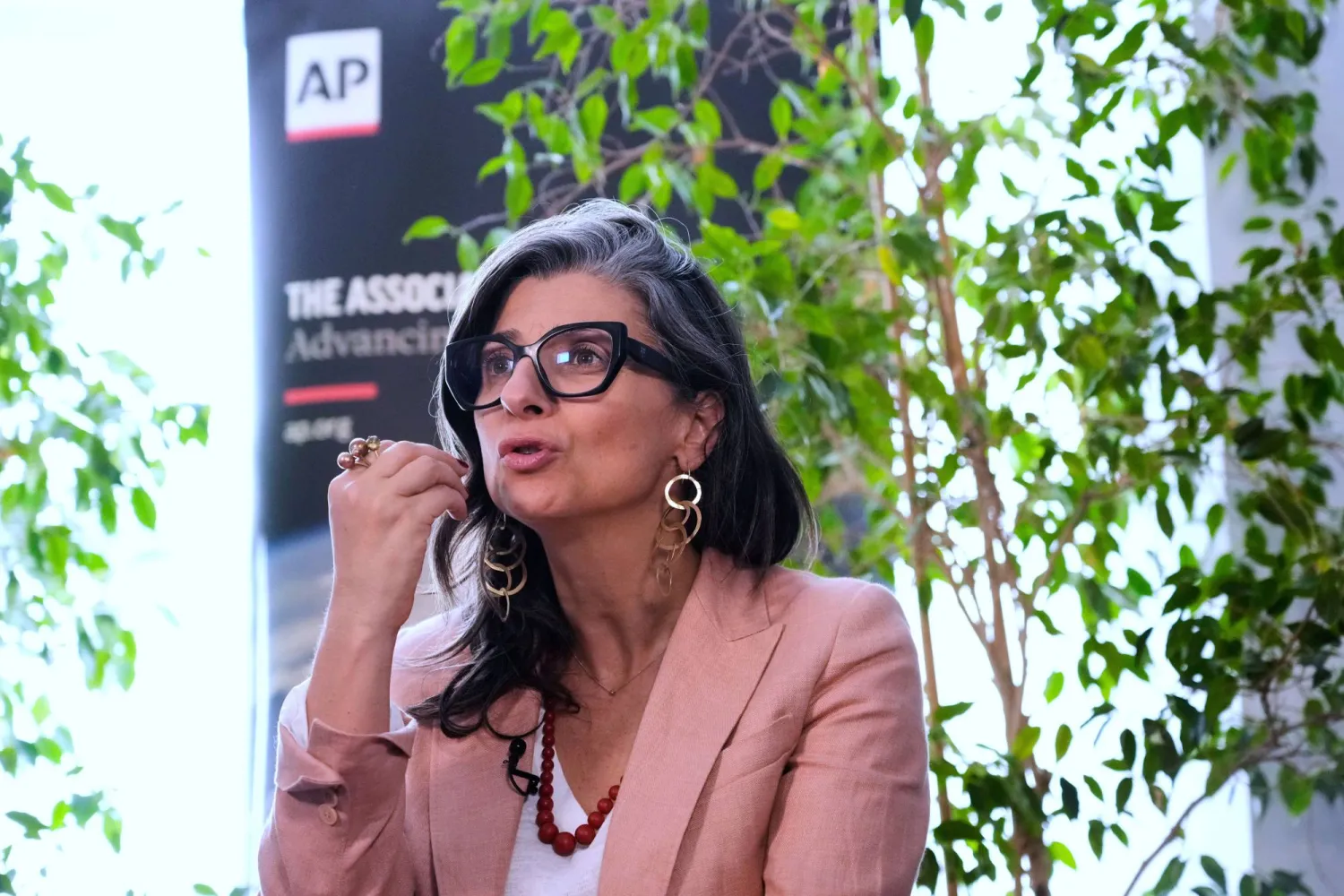
Francesca Albanese, the UN special rapporteur for the West Bank and Gaza, is interviewed by the Associated Press in Rome, July 29, 2025. (AP)
TT

UN Human Rights Investigator Delivers Gaza Report from South Africa Because of US Sanctions 

Francesca Albanese, the UN special rapporteur for the West Bank and Gaza, is interviewed by the Associated Press in Rome, July 29, 2025. (AP)

An independent UN investigator again took world nations to task Tuesday for not standing up to the US over sanctions it imposed on her — penalties that complicated her ability to deliver in person her latest assessment of Israeli human rights abuses in the Palestinian territories.

Calling the sanctions “unlawful and spiteful,” Francesca Albanese told the General Assembly via video from South Africa that it “should already have confronted this dangerous precedent.”

“These measures are an assault on the UN itself — on its independence, its integrity, its very soul,” she said before turning to her report on Gaza and the West Bank. Hours later, she told reporters that despite the unprecedented attacks against her as a UN investigator, powerful countries have not taken “concrete steps beyond declarations and condemnations” since the US decision this summer.

Albanese demurred when asked whether the United Nations and its officials, including Secretary-General Antonio Guterres, had supported her during this time, saying she'd rather not comment.

An Italian human rights lawyer, Albanese is a “special rapporteur" — an outside expert who is tapped by the UN Human Rights Council to assess human rights in a particular place or subject area. The rapporteurs have no formal authority, but their views can inform world opinion and prosecutors at the International Criminal Court and other venues.

As the special rapporteur for the West Bank and Gaza since May 2022, Albanese has issued trenchant critiques of Israel's policies in the territories and, especially, its war against Hamas in Gaza. She has repeatedly described Israel's actions as “genocide” and “apartheid.” Albanese repeated those assertions Tuesday as she described a Gaza that “remains strangled, starved, shattered” during a shaky ceasefire that she portrayed as far short of a plan for peace.

Israel and the US, its key ally, vociferously spurn Albanese's claims.

In response to her presentation Tuesday, Danny Danon, the Israeli ambassador to the UN, blasted her report as “shameful” and “one-sided" and disparaged Albanese personally, calling her a “witch.”

“She has taken the word ‘genocide,’ born from the ashes of the Holocaust, and turned it into a weapon, not to defend the victims of history, but to attack them,” Danon said during a UN committee meeting. Multiple other countries' representatives condemned his comments.

Israel has long taken issue with the Human Rights Council and its rapporteurs, seeing them as biased.

The State Department said in a statement released Tuesday evening that “Francesa Albanese has openly supported antisemitism, terrorism, and has engaged in lawfare against the United States and our interests. In light of these facts, she was sanctioned earlier this year and will not be granted a visa to travel to America.”

In announcing the sanctions against Albanese in July, US Secretary of State Marco Rubio made similar accusations, saying she had “spewed unabashed antisemitism, expressed support for terrorism, and open contempt for the United States, Israel and the West.”

Albanese rejected those assertions and countered that she was being attacked for doing her job and that she wouldn't stop.

“I did everything I did in good faith, and knowing that, my commitment to justice is more important than personal interests,” she told The Associated Press in a July interview.

When the US imposed sanctions on Albanese, the UN high commissioner for human rights, Volker Türk, called for their “prompt reversal.” The UN's chief spokesperson, Stéphane Dujarric, called the sanctions “unacceptable.”

The war in Gaza began when Hamas-led fighters stormed into Israel and killed some 1,200 people, mostly civilians, and took 251 people captive on Oct. 7, 2023. Israel’s retaliatory campaign killed more than 67,000 people, according to Gaza’s Health Ministry. It is part of the Hamas-run government and does not differentiate between combatants and civilians in its count, which the UN sees as a reliable estimate. The war also displaced the vast majority of Gaza’s 2.3 million people, demolished much of its infrastructure and sparked widespread hunger.

More than two weeks after the ceasefire started and was quickly tested, tensions escalated Tuesday after Israel said Hamas had fired on its forces in southern Gaza and wasn't living up to the agreement's terms on the return of hostages' remains. Israeli Prime Minister Benjamin Netanyahu then ordered the army to immediately carry out “powerful strikes,” and Hamas vowed to delay handing over the body of a hostage.

Albanese urged the UN's member countries to achieve a permanent end to the fighting in Gaza and a full Israeli withdrawal from the Palestinian territories.

“Calling a ceasefire a ‘peace plan’ while enabling occupation and killings to continue is not diplomacy. It is Orwellian doublespeak,” she said.

The US-brokered ceasefire was styled as the first stage of a peace plan that President Donald Trump aired last month.



Hadi’s Death Ends a Journey Through Transformation in Yemen

 Former Yemeni president during his address to the UN annual meeting (United Nations)
Former Yemeni president during his address to the UN annual meeting (United Nations)
TT

Hadi’s Death Ends a Journey Through Transformation in Yemen

 Former Yemeni president during his address to the UN annual meeting (United Nations)
Former Yemeni president during his address to the UN annual meeting (United Nations)

Former Yemeni President Field Marshal Abdrabbuh Mansur Hadi died on Thursday in the Saudi capital, Riyadh, at the age of 81, closing one of the most complex political and military chapters in Yemen’s history since unification in 1990.

Hadi’s name became closely associated with Yemen’s transitional period, the National Dialogue Conference, and the prolonged war that erupted after the Houthis overthrew the state in late 2014.

He was neither a confrontational leader nor a populist figure. Throughout his career, he was seen as a quiet institutional figure who preferred to work behind the scenes and avoided sharp confrontations, even while at the center of some of the gravest crises in Yemen’s modern history.

That left his legacy divided between two contrasting views. Supporters regarded him as a consensus figure who spared the country an even deeper collapse, while critics held him responsible for failing to confront the Houthis’ expansion as most of northern Yemen fell under their control.

Hadi was born on Sept. 1, 1945, in the village of Dhakin in Al-Wadea district of Abyan province in southern Yemen. He grew up in a modest rural setting before turning to a military life early.

He received military training at several foreign academies, most notably Britain’s Royal Military Academy Sandhurst, where he graduated in 1966. He also pursued higher military studies at Egypt’s Nasser Military Academy and took specialized courses in the former Soviet Union.

Hadi rose through the ranks of the People’s Democratic Republic of Yemen (formerly South Yemen) and held command posts in the armored corps. The bloody events of January 1986 became the defining turning point in his political and military path.

After the faction of former Southern President Ali Nasser Mohammed lost those confrontations, Hadi left for Sanaa with thousands of southern military personnel. There, he began a new phase inside the northern Yemeni state before Yemen’s two parts united in 1990.

Hadi’s profile rose during the summer war of 1994, when the late President Ali Abdullah Saleh appointed him defense minister to fight the attempted secession led by the then vice president, the late Ali Salem al-Beidh.

After the war ended and unity was consolidated, Saleh named Hadi vice president in October 1994. He remained in the post for about 18 years, one of the longest vice presidential tenures in Yemen’s history.

During those years, Hadi became known inside the ruling establishment as the “silent man.” He rarely entered battles among centers of power or became a visible party to the tribal and military rivalries surrounding Saleh.

He kept the image of a disciplined administrative and military official, making him acceptable to domestic and foreign players as a non-confrontational figure.

President of the transition

When protests erupted in 2011 against Saleh’s rule, Yemen entered a period of deep political turmoil that ended with the Gulf initiative, which transferred power to Hadi as a consensus president for the transition.

In February 2012, Hadi was elected Yemen’s consensus president with broad local, regional, and international backing, amid hopes he could rescue the country from collapse and rebuild the state on new foundations.

The main early milestone of his rule was the comprehensive National Dialogue Conference between 2013 and 2014. The conference brought together political and social forces, including the Houthis and the Southern Movement, to draft a project for a modern federal state.

Many Yemenis saw the National Dialogue as a historic chance to end chronic conflicts and build a new state. But later events pushed the country in a completely different direction.

In September 2014, the Houthis swept into the capital Sanaa, and seized state institutions before placing Hadi under house arrest.

Although he submitted his resignation under pressure, Hadi fled to Aden in February 2015 and said he remained committed to his constitutional legitimacy. Expanding Houthi attacks later drove him to Riyadh.

From the Saudi capital, Hadi led the internationally recognized government throughout the years of war. He relied on broad support from the Saudi-led Arab coalition and on the political and legal cover provided by UN Security Council Resolution 2216.

During those years, his government retained the recognition of the United Nations and the international community. Hadi continued to represent Yemen abroad despite losing effective authority over the seized capital, Sanaa, and large parts of the north.

A contested legacy

Hadi’s personality and governing style divided Yemenis and observers.

Critics said his calm temperament and tendency to wait weakened state institutions at decisive moments. They said his slow decision-making allowed the Houthis to expand and take Sanaa. He was also criticized for relying on partisan and tribal networks that failed to settle the battle.

Supporters said he inherited an exhausted country and a divided army, and faced an armed project backed by a regional power in highly exceptional circumstances.

They argue that Hadi preserved the legal legitimacy of the Yemeni state and prevented its complete slide into international isolation.

People close to him also say his commitment to dialogue and consensus was not a weakness, but a political conviction that spared Yemen wider wars in the early stages of the crisis.

Throughout his rule, Hadi enjoyed exceptional regional and international support. Gulf states, led by Saudi Arabia, backed the transfer of power in Yemen through the Gulf initiative.

After the Houthi takeover, Hadi became the face of the only internationally recognized Yemeni legitimacy. He received broad political and military support from the Arab coalition, as well as backing from the United States and European countries.

During the war years, Yemen kept its seat at the United Nations and other international organizations in the name of Hadi’s government. That was seen as one of his most important political achievements, especially as the Houthis sought international recognition.

Leaving power quietly

In April 2022, Hadi announced he was transferring all his powers to the Presidential Leadership Council headed by Rashad al-Alimi, a move widely seen as a pivotal shift inside the internationally recognized camp.

The decision followed Yemeni-Yemeni consultations hosted by Riyadh, amid pressure to reorganize anti-Houthi forces and unite their political and military components.

The step drew a broad regional and international welcome as a peaceful and orderly transfer of power. Hadi then chose to withdraw almost completely from politics during his final years.

The Yemeni presidency announced on Thursday that Hadi had died after health problems, praising what it described as his “national positions” and his role in preserving legitimacy and Yemen’s unity.

With his death, Yemen loses the last president to lead the unified country under full international recognition before state institutions fragmented and the open war was triggered by the Iran-backed Houthis.

He leaves behind a political and military legacy that will remain the subject of long debate among Yemenis.

The man who came to power as the “consensus candidate” found himself leading a country collapsing under divisions and the Houthi takeover. He remained committed to the legitimacy of the state until he left office, then departed quietly, drawing the curtain on one of the most complex chapters in Yemen’s contemporary history.


Sadr Gives Armed Wing One Week to Join Gov’t

A motorcycle passes a poster of Muqtada al-Sadr on a street in Baghdad, May 27, 2026 (AFP)
TT

Sadr Gives Armed Wing One Week to Join Gov’t

A motorcycle passes a poster of Muqtada al-Sadr on a street in Baghdad, May 27, 2026 (AFP)

Sadrist movement leader Muqtada al-Sadr has given his armed wing one week to complete its break from the movement and join state institutions, as a senior figure in Iraq’s ruling Coordination Framework described “armed resistance” as a “burden on society.”

Sadr said on Wednesday he was merging his armed wing, Saraya al-Salam, into the state and called on Popular Mobilization Forces factions to hand over their weapons.

A day later, he ordered Saraya al-Salam commanders to complete the separation and integration process within a week.

A document issued by Sadr’s office said he had “assigned a number of commanders in Saraya al-Salam to complete the procedures for separating the military side from the movement and move toward integration with state institutions.”

According to the document, Sadr tasked the director of his private office, Haider al-Jabri, the military adviser, Abu Doaa al-Issawi, the jihadist aide, Tahseen al-Hamidawi, and other officials with completing the separation within one week.

The full handover is to be completed by June 5, with the civilian side folded into Al-Bunyan al-Marsous in coordination with official authorities.

Members of the Sadrist movement say Al-Bunyan al-Marsous is a charitable institution that provides social assistance to different groups inside and outside Iraq.

Prime Minister Ali al-Zaidi welcomed Sadr’s move, saying it marked “an important path toward strengthening internal stability and consolidating the principle of restricting weapons to the state.”

Zaidi called on all factions to work under the umbrella of the state and its official institutions, stressing that the state “is the sole authority authorized to carry weapons and enforce the law.”

Sadr had previously announced the dismantling of his armed wing in 2017 and 2019, but his latest position comes as a new government faces regional and international pressure to disarm factions.

Saraya al-Salam is part of the Popular Mobilization Forces through brigades 313, 314 and 315, and carries out security duties in several areas, most notably Samarra.

Rejection of uncontrolled weapons

Asaib Ahl al-Haq, led by Qais al-Khazali, said the movement and its parliamentary wing, the Sadiqoun bloc, believe in the authority of the state and in restricting weapons to its control, rejecting any uncontrolled arms or weapons outside official institutions.

Khaled al-Saadi, a member of Sadiqoun’s political bureau, told the press that “Asaib supports restricting weapons to the state, provided the state can protect Iraq’s security by land, air and sea from various threats.”

Asaib Ahl al-Haq leader Qais al-Khazali said earlier that “a resistance that does not have an integrated project for construction and development may, over time, become a burden on society.”

Kataib Sayyid al-Shuhada spokesman Kazem al-Fartousi said his faction’s position on handing over weapons to the government was “firm and not subject to change,” but added that “resistance weapons” would remain as long as the reasons for their existence continued.

Fartousi told the press that “the brigades view their support for Prime Minister Zaidi in managing the state and achieving stability as positive, but at the same time reject the idea of handing over weapons at the current stage.”

He also criticized the idea of “directly integrating all armed formations into the security services,” saying “each side has its own specialization, and any discussion of full integration into state institutions is linked to specific security and political circumstances,” as he put it.

It is widely rumored that five armed factions have agreed to restrict their weapons to government institutions, though no clear details have emerged on how such a process would be carried out. Harakat al-Nujaba and Kataib Hezbollah, however, have refused to comply with disarmament requests.

Nazem al-Saidi, head of Harakat al-Nujaba’s executive council, said earlier this month that efforts to restrict weapons target “undisciplined” arms that cause “chaos,” not “resistance weapons.”

Disarmament plan

Asharq Al-Awsat revealed on May 9, 2026, that an Iraqi committee, including Prime Minister-designate Zaidi, outgoing Prime Minister Mohammed Shia al-Sudani, and Hadi al-Amiri, was working to complete an “executive project” to disarm armed factions, ahead of presenting it to Washington, amid mounting US pressure to keep militias away from the new government and state institutions.

The committee had presented militia leaders with “ideas on how to disarm,” but some meetings “did not proceed calmly,” according to people familiar with the matter.

The plan includes removing heavy and medium weapons and restructuring the Popular Mobilization Forces, alongside expected changes to sensitive security agencies, including the intelligence service.

But political sources questioned the government’s ability to implement the project, saying it may be aimed at “buying time.” Prominent factions, including Kataib Hezbollah and Harakat al-Nujaba, have declared they will not hand over weapons “whatever the cost.”


Israel PM Says Orders Army to Take Control of 70 Percent of Gaza Strip

Palestinians gather on a heavily damaged street to perform morning prayers marking the start of Eid al-Adha in Khan Younis in the southern Gaza Strip on May 27, 2026. (AFP)
TT

Israel PM Says Orders Army to Take Control of 70 Percent of Gaza Strip

Palestinians gather on a heavily damaged street to perform morning prayers marking the start of Eid al-Adha in Khan Younis in the southern Gaza Strip on May 27, 2026. (AFP)

Israeli Prime Minister Benjamin Netanyahu said Thursday he had ordered the country's military to take control of 70 percent of the Gaza Strip, in defiance of the terms of a fragile ceasefire that took effect in October.

"We are currently squeezing Hamas. We now control 60 percent of the territory in the strip," he said at a conference in an occupied West Bank settlement, according to a video aired by Israel's Channel 12 network.

He said the military had controlled 50 percent of Gaza under the terms of the ceasefire, adding: "My directive is to move to... 70 percent".

"We're squeezing them from all (sides). We'll deal with what's left afterwards."

The first phase of the truce saw the last hostages seized in Hamas's October 7, 2023 attacks on Israel, which triggered the war in Gaza, released in exchange for Palestinians detained by Israel.

The transition to the second phase, which was supposed to involve Hamas's disarmament and a gradual withdrawal of the Israeli army, has been stalled for months.

Under the terms of the ceasefire, Israeli forces were to pull back behind a so-called "yellow line", a demarcation between the area under Hamas control and that held by the Israeli army.

Netanyahu announced on May 15 that the Israeli army had expanded its grip on the Gaza Strip.

"There were those who said: get out, get out. We did not get out. Today we control... how much? 60 percent. Tomorrow we shall see," he said at the time.

Gaza remains gripped by daily violence, with both the Israeli military and Hamas accusing one another of violating the truce in effect since October 10.

Israel has killed more than 900 people since the ceasefire, according to Gaza's health ministry, which operates under Hamas authority and whose figures are considered reliable by the United Nations.

Israel said on Wednesday it had killed the new head of Hamas's armed wing in Gaza, Mohammed Odeh, after killing his predecessor earlier this month.

Since Hamas's October 2023 attack, Israel has systematically targeted the group's leaders, both in Gaza and across the region.

Odeh is the fourth head of the Ezzedine Al-Qassam Brigades that Israel says it has killed since the start of the Gaza war.

On Wednesday, Israeli Defense Minister Israel Katz repeated Israel's goal of ending Hamas's rule over the Palestinian territory and alluded to a plan for the forced displacement of its residents.

"The plan for voluntary migration from Gaza will also be implemented -- everything will be done at the right time and in the right way," he said.