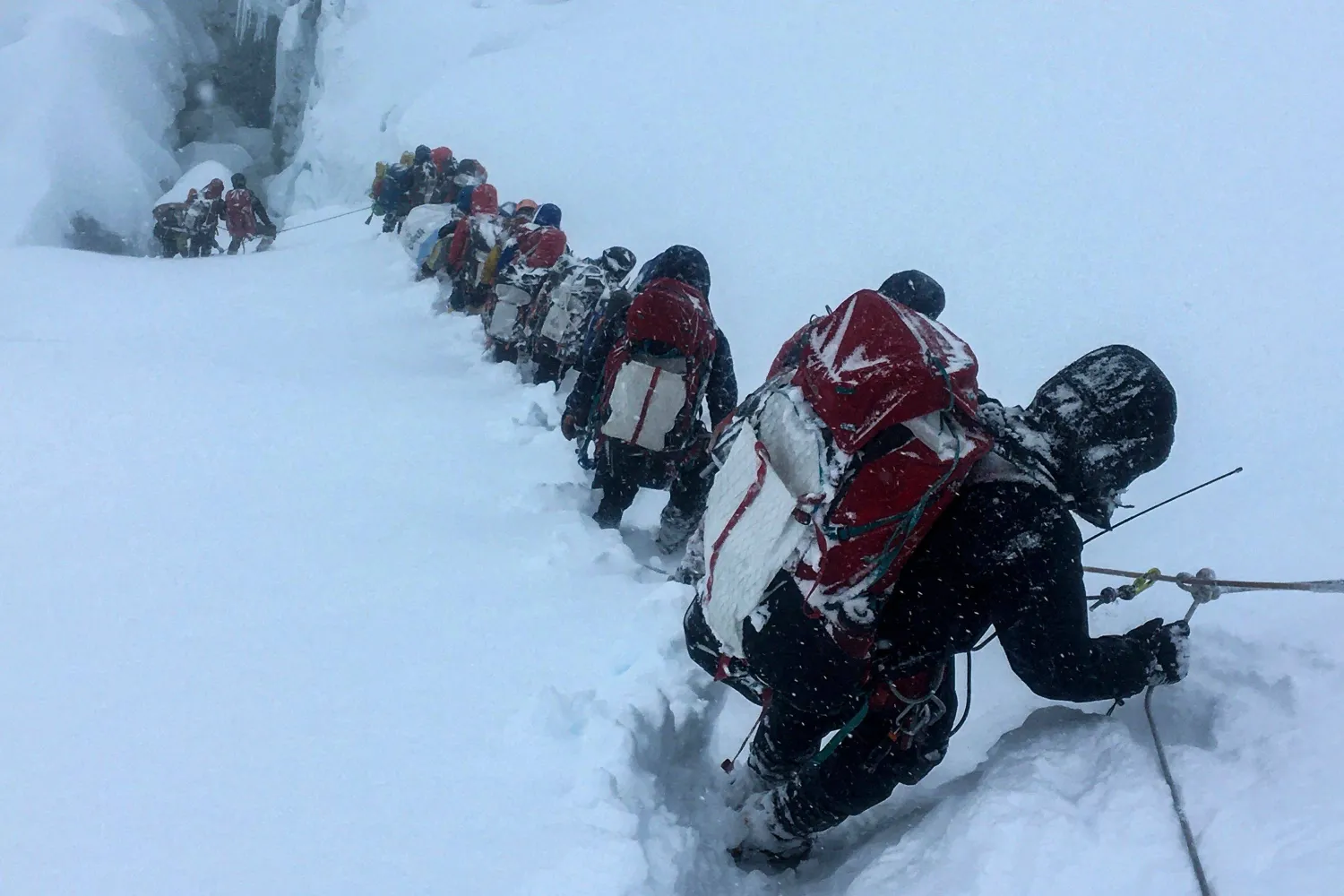
Heavy Snowfall from Cyclone Winds Halts Everest Tourism in Nepal, Tibet 

In this photograph taken on June 2, 2021, mountaineers descend from the summit of Mount Everest (8,848.86-meter), in Nepal. (AFP)
TT

Heavy Snowfall from Cyclone Winds Halts Everest Tourism in Nepal, Tibet 

In this photograph taken on June 2, 2021, mountaineers descend from the summit of Mount Everest (8,848.86-meter), in Nepal. (AFP)

The Nepali and Chinese sides of the Everest region were closed to tourism on Wednesday due to heavy snow brought by cyclone winds, with deep snowdrifts causing a helicopter to crash as it tried to rescue stranded trekkers, authorities said.

Visited by thousands of trekkers and climbers, the region around Mount Everest has been blanketed by snow since Monday as a cyclone from the Bay of Bengal churned across India, ushering in a second bout of severe snowfall in the Himalayas this month.

Authorities in Nepal have halted trekking on many hiking routes due to rain at lower elevations and heavy snowfall on higher trails and have urged hikers not to venture out or proceed with their treks in the Annapurna, Manaslu and Dhaulagiri areas, home to some of the world's highest peaks.

A small private helicopter flying to Lobuche near the Everest Base Camp to rescue stranded trekkers crashed when it tried to land, Civil Aviation Authority of Nepal spokesperson Gyanendra Bhul said.

CAAN video showed the helicopter, which slipped on the snow while landing, lying on its side. The pilot survived and was later rescued. It was unclear whether the trekkers had been rescued.

STRANDED TREKKERS

Army and police rescuers guided hundreds of trekkers in Manang district to safety since Tuesday, Nepal Army spokesperson Raja Ram Basnet said.

He said about 1,500 hikers, including 200 foreigners of different nationalities, their guides and local trekkers had lost their way as hiking trails were buried under deep snow.

"Rescuers cleared the snow from trail and brought them down to safer places," Basnet told Reuters in Kathmandu.

Weather officials have forecast heavy rain and snow on Thursday and Friday due to the passage of Cyclone Montha, which roared into India's southeastern state of Andhra Pradesh on Tuesday night.

On the Tibetan side of Everest, ticket sales had been suspended since Tuesday afternoon as roads turned icy and visibility plunged, creating impassable conditions for vehicular traffic, according to the tourism department of Tingri county.

It was unclear if there were tourists trapped inside the Everest region in Tibet. The press office of the Tibetan government did not immediately respond to a Reuters request for comment.

Weather forecast data shows temperatures in Tingri are expected to dip further below freezing this week.

In early October, a blizzard stranded hundreds of trekkers near the eastern face of Everest on the Tibetan side. All of the trekkers were taken to safety in a large-scale rescue operation that spanned several days under sub-freezing conditions.

In Nepal, more than 50 people had died due to floods and landslides triggered by heavy rains.


NASA Unveils New Space Telescope to Give 'Atlas of the Universe'

NASA Administrator Jared Isaacman speaks about the Nancy Grace Roman Space Telescope after it was unveiled to the public at NASA's Goddard Space Flight Center in Greenbelt, Maryland on April 21, 2026. (Photo by SAUL LOEB / AFP)
TT

NASA Unveils New Space Telescope to Give 'Atlas of the Universe'

NASA Administrator Jared Isaacman speaks about the Nancy Grace Roman Space Telescope after it was unveiled to the public at NASA's Goddard Space Flight Center in Greenbelt, Maryland on April 21, 2026. (Photo by SAUL LOEB / AFP)

NASA unveiled a new telescope on Tuesday to scan vast swathes of the universe for planets outside our solar system and probe the mysteries of dark matter and dark energy.

The Roman space telescope is expected to discover tens of thousands of planets, possibly offering clarity about how many could be out there.

"Roman will give the Earth a new atlas of the universe," NASA administrator Jared Isaacman told a news conference at the Goddard Space Flight Center in Maryland, where the telescope went on display.

The 12-meter (39-feet), silvery contraption with massive solar panels will be transported to Florida ahead of a launch into space aboard a SpaceX rocket planned for September at the earliest.

Roman, which took more than $4 billion and over a decade to build, is named after astronomer Nancy Grace Roman, nicknamed the "Mother of Hubble" for her role in developing the landmark space telescope.

Thirty-six years after Hubble launched into space, revolutionizing astronomical observations, NASA hopes Roman will help to shed light on questions that remain unresolved.

Boasting a field of view at least 100 times larger than Hubble's, the telescope will sweep across vast regions of space from its position 1.5 million kilometers (930,000 miles) from Earth.

The telescope will send 11 terabytes of data a day down to Earth, said Mark Melton, a systems engineer at Goddard Space Flight Center.

"In the first year, we'll have sent down more data than Hubble will have for its entire life," he told AFP.

The telescope's wide-angle lens will allow NASA to conduct a census of the objects that make up our universe, said Nicky Fox, associate administrator for NASA's Science Mission Directorate.

"Roman will discover tens of thousands of new planets outside our solar system. It will reveal billions of galaxies, thousands of supernovae and tens of billions of stars," she said.

This wealth of information will enable NASA to tease out areas of interest that can then be investigated by complementary telescopes, such as the James Webb Space Telescope.

But Roman will also study the invisible -- dark matter and dark energy, whose origins remain unknown but which are thought to constitute 95 percent of our universe.

Dark matter is believed to be the glue that holds galaxies together, while dark energy pulls them apart by making the universe expand faster and faster over time.

Thanks to its infrared vision, the telescope will be able to observe light emitted by celestial bodies billions of years ago, effectively looking back in time to hopefully discover more about the two phenomena.

Complementing the work of Europe's Euclid space telescope and the Vera Rubin Observatory in Chile, Roman will probe "how the dark matter structures itself throughout cosmic time" and "calculate how fast galaxies are moving away from us," Darryl Seligman, an assistant professor of physics and astronomy at Michigan State University, told AFP.

These discoveries could fundamentally change our understanding of the structure of our universe, said astrophysicist Julie McEnery, who led the Roman project.

"If Roman wins a Nobel Prize at some point, it's probably for something we haven't even thought about or questioned yet," said Melton.


Macarons Used to Bore Me, Says French Pioneer Pierre Herme

French pastry chef Pierre Herme poses at Pierre Herme's headquarters in Paris on March 24, 2026. (AFP)
TT

Macarons Used to Bore Me, Says French Pioneer Pierre Herme

French pastry chef Pierre Herme poses at Pierre Herme's headquarters in Paris on March 24, 2026. (AFP)

Pierre Herme, the French master of macarons, says he was inspired to build his multi-country empire selling the sugary French treats by a desire to reinvent an object he felt was boring.

Starting out his career aged 14, he discovered macarons, two halves of light almond biscuit separated by a sugary aromatic filling, while working at high-end Parisian brands Fauchon and Laduree.

"We made vanilla, chocolate and coffee, and very quickly I realized I didn't like that. It bored me," he told AFP in an interview.

Descended from a long line of bakers and pastry chefs from Alsace in eastern France, Herme founded his own brand in 1997, calling it "Pierre Hermé" and adopting the language and look of high-end fashion labels.

His first store was in Tokyo before another one followed in Paris.

Unexpected flavor pairings became his signature, such as the famous Mogador -- milk chocolate and passion fruit -- or Ispahan, a best-seller combining raspberry, lychee and rose.

"Overnight, I was selling almost nothing else," he explained.

His shops can now be found everywhere from Jakarta to Tashkent.

The man dubbed in the press "the Picasso of pastry" presides over 110 outlets worldwide.

"What has made me successful over the past 50 years? Audacity," he told AFP.

- 'Lack of meaning' -

Aged 64, he no longer touches a spatula at work, but he happily cooks at home in Paris.

He also travels extensively and collects art.

Having come of age long before the internet and social media, Herme is disdainful of some of the influencer-driven trends in food nowadays that others see as helping promote home cooking and innovation in the kitchen.

"What particularly annoys me is the lack of meaning. There's noise, but no meaning in the creation," he comments.

He has various industry roles including president of a World Cup for dessert-making and vice-president of the leading global association of pastry chefs, Relais Desserts.

He is also preparing a bid to have French pastry-making expertise recognized as part of UNESCO's Intangible Cultural Heritage.

His priority is to ensure his brand continues to thrive despite the well-known risks of over-expansion that can see standards fall for consumers.

"Let's say I prefer long-term work to short-term results. Recognition lasts; fame is fleeting," he added.


Specialized Tour at Berlin Zoo Brings Joy to People Living with Dementia

Monika Jansen, 85, touches a sculpture of a rhino as she takes part in a guided tour for people with dementia organized by Malteser Deutschland, part of the international Catholic aid organization Malteser Order of Malta, at the Zoo in Berlin, Germany, Thursday, March 26, 2026. (AP Photo/Markus Schreiber)
TT

Specialized Tour at Berlin Zoo Brings Joy to People Living with Dementia

Monika Jansen, 85, touches a sculpture of a rhino as she takes part in a guided tour for people with dementia organized by Malteser Deutschland, part of the international Catholic aid organization Malteser Order of Malta, at the Zoo in Berlin, Germany, Thursday, March 26, 2026. (AP Photo/Markus Schreiber)

Christel Krueger peered through thick glass and murky water at the Berlin Zoo, staring in awe at a mother hippopotamus and her child sleeping on a sandbar.

Krueger, 86, and her daughter were on a specialized zoo tour last month for people who live with dementia that was organized by Malteser Deutschland, part of the international Catholic aid organization Malteser Order of Malta.

On the tour with Krueger, Ingrid Barkow watched from her wheelchair as the elephants roamed their habitat, while Monika Jansen balanced on her tiptoes to get a better view of a rhinoceros.

“When I get home, I’ll still be thinking about it,” said Jansen, 85. “Maybe even at night, while I’m sleeping and dreaming about it.”

The three women are among roughly 1.6 million people living with dementia in Germany, according to the Office of the National Dementia Strategy. The figure is expected to rise to 2.8 million by 2050.

Museums and other cultural institutions across the globe have added specialized, barrier-free tours and guides to their repertoire in recent years, some made possible by advances in technology.

These include sign-language tours for people who are deaf and hard of hearing, touch-based events for those with blindness or low vision and programs for people on the autism spectrum.

The Berlin chapter of Malteser Deutschland last year designed a cultural program in the capital catering to people with dementia.

“People with dementia aren’t very visible in our society. It’s still a major taboo subject, yet it actually affects a great many people and it’s important that they continue to be at the heart of society," project coordinator Christine Gruschka said. "They have a right to participate, just like everyone else.”

Millions of people around the globe have some form of dementia, a progressive loss of memory, reasoning, language skills and other cognitive functions.

People can experience changes in personality, emotional control and even visual perception. Alzheimer’s is the most widely recognized type, but there are many others, with their own symptoms and underlying biology.

Malteser Berlin's tours for people with dementia occur at the zoo, the Museum of Natural History, Britzer Garden and Charlottenburg Palace, with hopes of expanding to other locations.

“‘Normal’ tours — so-called normal tours — are often too fast, too loud, with too many people and too many distractions," The Associated Press quoted Gruschka as saying. "That’s why we’ve made it our goal to create programs specifically for people with dementia: Where they still feel seen, where they feel comfortable, and where they can still show that they’re still here and can still be part of it.”

Dementia-specific tours are key for caregivers and families Krueger, Jansen and Barkow followed Malteser Berlin tour coordinator Carola Tembrink around the Berlin Zoo, accompanied by their daughters and a caregiver.

Tembrink skipped the majority of the zoo's vast offerings to focus on the hippo, rhino and elephant habitats so the participants would not get too tired or overwhelmed.

“The zoo is a wonderful place for tours like this because almost everyone who grew up in Berlin has been here as a child," Tembrink said. "And especially for people with dementia, childhood memories are often still present — they just need to be jogged a bit — and that happens naturally when they see the animals, smell the air as they enter the zoo, or when they go into the rhino house and catch a different scent.”

For the caregivers and families, the tours are a lifeline. During long and sometimes frustrating days of caring for someone with dementia, a specialized tour lets them connect with others who understand the journey.

Krueger was formally diagnosed last year with dementia, but her daughter, Kerstin Hoehne, said the symptoms appeared more than two years ago.

“What’s nice is that it’s also with, let’s say, like-minded people, that you’re not alone, but that you have a sense of belonging because everyone else might have the same problem,” Hoehne said.

Barkow's daughter, Manuela Grudda, said the tour brought them closer together. Grudda pushed Barkow's wheelchair through the zoo, her hands caressing her mother's shoulders or pointing out the animals.

“I can’t really communicate with her in a normal way, of course, but I see that when I show her something, she looks at it, she’s paying attention, and that’s important,” Grudda said. “And it just makes me happy that she’s not just in her own world, but also in this one.”