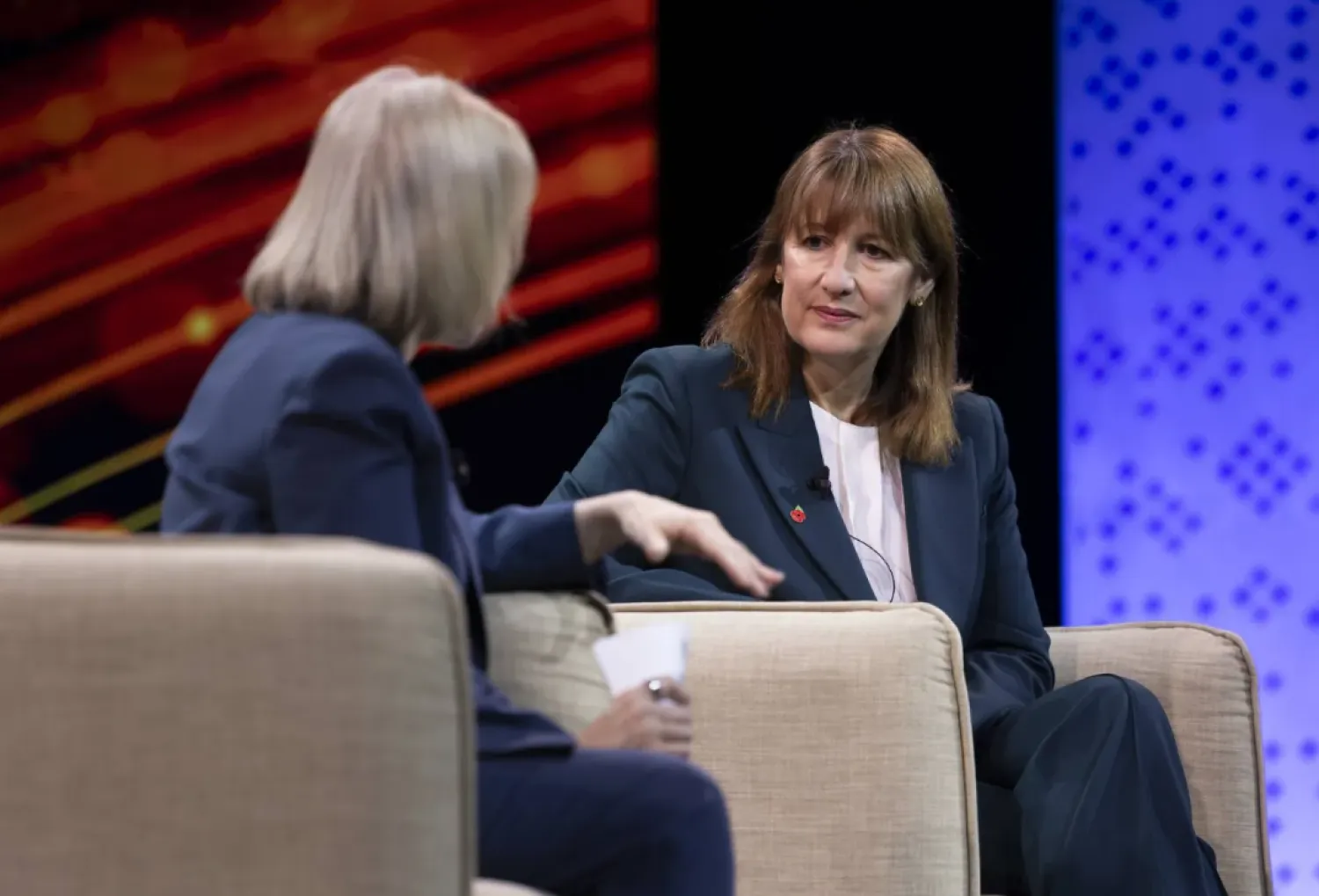

UK Chancellor to Asharq Al-Awsat: Strengthening Partnership with Saudi Arabia a Top Priority

Reeves speaks during the Future Investment Initiative Conference in Riyadh (Asharq Al-Awsat)
TT

UK Chancellor to Asharq Al-Awsat: Strengthening Partnership with Saudi Arabia a Top Priority

Reeves speaks during the Future Investment Initiative Conference in Riyadh (Asharq Al-Awsat)

UK Chancellor of the Exchequer Rachel Reeves affirmed that strengthening relations and economic partnership with Saudi Arabia represents a top priority for her government, noting that under the ambitious Vision 2030, Saudi Arabia finds in the United Kingdom an ideal partner thanks to Britain’s stability, regulatory flexibility, and global expertise.

She revealed her government’s plan to support major projects that unleash growth, starting with the expansion of Heathrow Airport and extending to infrastructure spending exceeding £725 billion ($958.7 billion) over the next decade.

In an exclusive interview with Asharq Al-Awsat from Riyadh, Reeves said her participation in the Future Investment Initiative (FII) Conference stems from a key goal: deepening mutual investment and trade. She confirmed that this visit, the first by a UK Chancellor to the Gulf in six years, reflects London’s seriousness in strengthening regional relations.

“This visit marks the first time a UK Chancellor has travelled to the Gulf in six years, which reflects just how seriously this government takes our relationship with Saudi Arabia and the wider region,” Reeves said.

“I’m here with one of the largest UK business delegations to the Gulf in recent years, and our participation is driven by our number one priority: growth.”

“At a time of global uncertainty, the UK offers stability, regulatory agility and world-class expertise – qualities that make us an ideal partner for Saudi Arabia's ambitious Vision 2030 transformation,” she added.

Reeves emphasized the economic complementarity between the two nations, noting that her delegation includes UK business leaders in key sectors such as financial services, life sciences, AI, clean energy, and advanced manufacturing.

She pointed out that Britain’s expertise in these fields uniquely positions London to support Saudi Arabia’s economic diversification, while Gulf investment helps drive growth and create jobs across the UK. According to her, joint trade and investment deals exceeded £10 billion over the past 18 months alone, creating more than 4,100 jobs in the United Kingdom.

Reeves and her accompanying delegation meet with Saudi Minister of Commerce Majid Al-Qasabi at the National Competitiveness Center in Riyadh (Ministry)

Deepening Mutual Investment and Trade

The Chancellor said: “My discussions are focused on deepening the two-way investment and trade that benefits families and businesses in both our countries. The £6.4 billion ($8.4 billion) package we've announced this week demonstrates the tangible results of this approach.”

According to Reeves, the package includes £5 billion in Saudi-backed exports supporting British manufacturing, alongside major investments by Barclays, HSBC and others, strengthening their presence in Saudi Arabia.

Key Priorities

Reeves said that one of her top priorities is accelerating progress on a UK–GCC Free Trade Agreement, noting that such a deal could boost bilateral trade by 16 percent and represents the kind of forward-looking partnership that creates prosperity for both sides.

“My vision is straightforward: I want Britain and Saudi Arabia to be partners of choice for each other. We regulate for growth, not just risk. We're backing key infrastructure projects like Heathrow expansion – where the Saudi Public Investment Fund holds a 15 percent stake,” she said.

She added: “We’re creating opportunities for co-investment, particularly through our National Wealth Fund and pension reforms that will unlock tens of billions for infrastructure and innovation.”

“My message at the FII this week was clear – I'm championing the UK as a stable investment destination,” she stressed, referring to Britain’s “ironclad commitment to fiscal rules and our modern Industrial Strategy focused on the sectors of the future.”

Reeves speaks during the Future Investment Initiative Conference in Riyadh (Asharq Al-Awsat)

Saudi–British Cooperation

On the most prominent areas and nature of cooperation between Riyadh and London, Reeves said: “Our partnership – built on mutual respect and shared ambition – spans multiple high-value sectors and continues to deepen.”

“Over the past 18 months alone, we've secured over £10 billion in two-way trade and investment, creating more than 4,100 UK jobs and many others in Saudi Arabia. Over 1,600 UK companies also now have a presence in the Kingdom – this is a partnership that works to the benefit of families and businesses on both sides,” she added.

“In financial services, London remains a world-leading international financial centre. We’ve launched a new concierge service – the Office for Investment: Financial Services – to help international firms establish and expand in the UK, while banking giants like Barclays and HSBC are expanding their operations in Riyadh,” Reeves explained.

She highlighted that Riyadh Air’s first-ever flight landed in London this past weekend, powered by UK-manufactured wings and Rolls-Royce engines – showing how British engineering is integral to Gulf aviation ambitions.

According to Reeves, UK firms like Quantexa are launching new AI services in the region, while Saudi cybersecurity firm Cipher is investing $50 million to open its European headquarters in London, demonstrating a partnership at the forefront of technology and innovation.

She added: “We are also collaborating closely in areas like sustainable infrastructure, clean energy, education and the life sciences. But I feel we can and must go further – a UK–GCC Free Trade Agreement would unlock huge mutual benefits, including boosting bilateral trade by 16 percent.”

Reeves and the UK business delegation at the British Residence in Riyadh (Ministry)

A British Plan to Contain Financial Challenges

On her government’s plan to address the financial challenges facing the United Kingdom, Reeves said: “After years of decline – from austerity to Brexit to the mini-budget – we inherited significant challenges. But we've moved decisively to address them whilst investing in our future.”

“We have an ironclad commitment to robust fiscal rules. This provides the stability and certainty that investors need. The IMF now projects that, after the US, the UK will be the fastest-growing G7 economy. This didn't happen by accident – it's the result of tough choices and disciplined economic management,” she added.

Reeves emphasized that “growth is our number one priority, because it's how we overcome challenges and put more money in working people's pockets. Our modern Industrial Strategy focuses on key sectors of the future – AI, life sciences, financial services, clean energy – where Britain has genuine competitive advantages, many of which are shared by our partners in the Gulf.”

She continued: “We're catalysing private investment through our National Wealth Fund, which is driving over £70 billion in investment, and pension reforms unlocking up to £50 billion for infrastructure and innovation. This creates opportunities for co-investment with partners like Gulf sovereign wealth funds.”

Reeves confirmed that the United Kingdom offers strength in uncertain times by combining stability with ambition. She referred to her government’s plan to support major projects that unleash growth, from Heathrow Airport expansion to infrastructure spending exceeding £725 billion over the next decade.

“We're open for business, but we're being strategic about building partnerships that create good jobs, boost business and bring investment into communities across the UK – from the North East to the Oxford–Cambridge corridor. That's how we build an economy that works for, and rewards, working people in Britain,” she said.

The minister concluded by stressing that “turning inwards is the wrong response to global challenges.” She affirmed that Britain remains open for business and is taking a strategic approach to building partnerships that create jobs and benefit working people across the United Kingdom.

“After landmark deals with the US, EU and India, we're accelerating progress with the GCC,” she said.
Italian Defense Minister to Asharq Al-Awsat: Relations with Saudi Arabia at an Unprecedented Strategic Strength

Guido Crosetto said Rome and Riyadh are working to support the success of the ongoing negotiations between Washington and Tehran (Italian Ministry of Defense).
TT

Italian Defense Minister to Asharq Al-Awsat: Relations with Saudi Arabia at an Unprecedented Strategic Strength

Guido Crosetto said Rome and Riyadh are working to support the success of the ongoing negotiations between Washington and Tehran (Italian Ministry of Defense).

Italian Defense Minister Guido Crosetto said relations between Rome and Riyadh have reached an unprecedented level of strategic strength, noting that the two countries are working to build genuine partnerships based on joint development, integrated supply chains, skills transfer, and the development of local capabilities.

In an interview with Asharq Al-Awsat, Crosetto stressed that cooperation between Italy and Saudi Arabia has become essential for strengthening peace and stability in the Middle East, adding that both countries are working together to support the ongoing negotiations between the United States and Iran in order to prevent regional escalation.

Speaking on the sidelines of the World Defense Show in Riyadh, the minister described the Saudi economic environment as highly attractive, noting that the event reflects the Kingdom’s growing pivotal role in technological and industrial innovation and provides a platform for discussing future scenarios and emerging technologies.

Strategic Strength

Crosetto said relations between Saudi Arabia and Italy are “excellent” and “at an unprecedented stage of strategic strength.”

He noted: “Political understanding between our leaders has established a framework of trust that translates into tangible and structured cooperation in the defense sector, both militarily and industrially. Our countries share fundamental principles: reliable partnerships, honoring commitments, the importance of diplomacy, and adherence to international law. This makes our cooperation stable, predictable, and oriented toward the long term.”

The Italian minister said the Saudi economic environment is highly attractive (Asharq Al-Awsat)

Dialogue Between the Armed Forces

Crosetto noted that dialogue between the armed forces of the two countries is ongoing and includes the exchange of operational expertise, doctrines, strategic analyses, and regional scenario assessments, adding that this “enhances interoperability and mutual understanding.”

He stressed that the Red Sea and the Arabian Gulf are two closely interconnected strategic regions, and their security represents a shared interest for Italy and Saudi Arabia.

"In this context, cooperation between Rome and Riyadh is essential to strengthening peace and stability in the Middle East, with particular attention to supporting political solutions in Lebanon, Gaza, and Syria, as well as advancing the ongoing negotiations between the United States and Iran, which are a critical element in preventing regional escalation.”

According to the minister, “this political commitment is complemented by a practical commitment,” noting that Italy is among the most active Western countries in providing healthcare to Palestinian civilians through medical evacuations, the transport of humanitarian aid, and the deployment of naval medical capabilities. He described this as “a concrete example of how military tools can serve humanitarian and stabilization objectives.”

Meeting Between the Crown Prince and Meloni

The Italian defense minister said the meeting between Prime Minister Giorgia Meloni and Saudi Crown Prince and Prime Minister Mohammed bin Salman gave strong momentum to bilateral relations.

“At the military level, cooperation is expanding in training, logistics, military doctrine, technological innovation, maritime security, and the protection of critical infrastructure. There is also growing interest in emerging domains, including cyberspace, outer space, and advanced systems.”

Saudi Crown Prince Mohammed bin Salman meets with Italian Prime Minister Giorgia Meloni in AlUla, January 2025 (SPA).

He continued: “At the industrial level, we are moving beyond the traditional client-supplier relationship and seeking to build real partnerships based on joint development, integrated supply chains, skills transfer, and the development of local capabilities.”

Saudi Arabia a Key Partner for Italy’s Energy Security

Crosetto emphasized that cooperation between Italian companies and their Saudi counterparts in defense capabilities, technology transfer, aviation projects, and shipbuilding is fully aligned with Saudi Vision 2030, which aims to strengthen the Kingdom’s industrial, technological, and human capital base.

“Italian companies’ contributions are not limited to providing platforms; they also include expertise, training, and engineering support. This approach extends beyond the defense sector to infrastructure, technology, tourism, and major projects such as NEOM, highlighting the complementarity between our economies.”

He continued: “Cooperation also includes the energy sector and the energy transition, as Saudi Arabia is a key partner for Italy’s energy security, with growing collaboration in hydrogen and renewable energy. In addition, there is an emerging strategic focus on critical and strategic raw materials, a sector in which the Kingdom is investing heavily and which could see significant growth in both industrial and technological cooperation.”

Saudi Economic Environment Highly Attractive

Crosetto said the recent Italian 'Industry Days' forum held in Riyadh, organized in cooperation between the two countries’ defense ministries, sent a very strong signal of expanding bilateral cooperation, attracting both small and medium-sized enterprises and major industrial groups and leading to the creation of tangible operational links.

“The Saudi economic environment is highly attractive, featuring major public investments, a streamlined tax system, incentives for materials and equipment, and double-taxation avoidance agreements, making the Kingdom a strategic industrial partner.”

He added: “Trade exchange is not limited to the defense sector. Italian products are in strong demand in other sectors such as machinery, fashion, design, and pharmaceuticals. Bilateral agreements exceeding €10 billion include major companies such as 'Leonardo' and 'Fincantieri'.”

Visit of Prince Khalid bin Salman

The Italian defense minister said the visit of his Saudi counterpart Prince Khalid bin Salman, to Rome, strengthened dialogue between the two countries, noting that discussions “covered diverse sectors, from space to naval domains, and from aviation to helicopters, with a primary focus on military cooperation, training, and the exchange of joint strategic analyses.”

Prince Khalid bin Salman during his meeting with Italian industrial companies in Rome, October 2024 (SPA).

World Defense Show in Riyadh

Crosetto said Saudi Arabia’s hosting of the third edition of the World Defense Show reflects the Kingdom’s growing central role in technological and industrial innovation and provides a platform for discussing future scenarios, emerging technologies, and cooperation models.

“I believe it is important for a country with promising investment prospects such as Saudi Arabia to host an international event that enables direct dialogue with the world’s leading companies in a continuously expanding sector.”

Italian Defense Minister Guido Crosetto (Italian Ministry of Defense).

He concluded: “In this context, I am confident that the model of cooperation between Italy and the Kingdom - based on dialogue, mutual trust, and a long-term vision - represents an example of how to combine strategic interests, innovation, and responsibility.

"On this basis, we will continue working side by side to strengthen a partnership that goes beyond the present, contributes to regional stability, and creates tangible opportunities for our two countries and for the international community as a whole.”


Bin Habrish to Asharq Al-Awsat: Hadhramaut on Threshold of New Era

Sheikh Amr bin Habrish, First Deputy Governor of Hadhramaut (Asharq Al-Awsat)
TT

Bin Habrish to Asharq Al-Awsat: Hadhramaut on Threshold of New Era

Sheikh Amr bin Habrish, First Deputy Governor of Hadhramaut (Asharq Al-Awsat)

After nearly 500 days spent in the mountains and highlands, Sheikh Amr bin Habrish, First Deputy Governor of Hadhramaut and commander of the Hadhramaut Protection Forces, has returned to the provincial capital, Mukalla, declaring what he described as the beginning of a “new phase” that will shape a different future for Yemen’s largest eastern governorate.

In an interview with Asharq Al-Awsat from his residence overlooking the Arabian Sea, Bin Habrish said Hadhramaut is currently experiencing “a state of stability and reassurance,” which he attributed to the steadfastness of its people and to Saudi support and intervention that came “at the right time.”

He said the current ambition is to build a state based on institutions under which all citizens are united, while preserving Hadhramaut’s distinct character. Bin Habrish also affirmed his commitment to integrating the Hadhramaut Protection Forces into “fair” state institutions.

Addressing security concerns, he described terrorism as “manufactured” and said it has no social base in Hadhramaut. He accused external powers and local actors of exploiting it for their own agendas, while stressing readiness to confront terrorism in all its forms.

Bin Habrish offered his account of the recent handover of military camps led by the Nation’s Shield Forces, saying the achievements were made possible by the resistance of Hadhramaut’s people on their own land, and by Saudi support and what he called the Kingdom’s “honest and decisive” stance at a critical moment.

He said this outcome would not have been possible without the “genuine bond” between Hadhramaut’s society and Saudi Arabia, adding that this relationship has helped restore security and stability to Mukalla after what he described as unnecessary turmoil.

“We were not satisfied with the arrival of forces and the internal conflict and fighting that followed,” he said, adding that some parties felt emboldened and left no room for dialogue.

He accused the Southern Transitional Council of deploying its forces and “fully occupying the governorate,” stressing that Hadhramaut belongs to its people and that any mistake should have been addressed locally, not imposed by force. “We were compelled to resist,” he said, citing home raids and pursuits as “wrong and unjustified.”

Open Channels with Saudi Arabia

Bin Habrish credited Saudi Arabia’s leadership — King Salman bin Abdulaziz, Crown Prince Mohammed bin Salman, Defense Minister Prince Khalid bin Salman, along with the Special Committee and the Joint Forces Command — for Hadhramaut’s current stability.

He said coordination with the Kingdom takes place “at the highest levels,” with open channels and no barriers, praising Saudi intentions and expressing deep appreciation for its support.

A New Era

Bin Habrish said Hadhramaut is entering a new era rooted in its traditions of peace, wisdom, and culture. He reiterated calls for self-rule based on historical grounds, describing it as the minimum requirement for enabling Hadhramaut to build its institutions and deliver services.

He urged unity, mutual compromise, and prioritizing the governorate’s interests, saying: “We forgive and open a new page. We are not seeking revenge. What matters is that Hadhramaut remains at the center of decision-making. Without it, there can be no development.”


President of Madagascar to Asharq Al-Awsat: Three-Pillar Economic Plan to Revive the Country

President of Madagascar Michael Randrianirina (Presidency)
TT

President of Madagascar to Asharq Al-Awsat: Three-Pillar Economic Plan to Revive the Country

President of Madagascar Michael Randrianirina (Presidency)

President of Madagascar Michael Randrianirina said his country views Saudi Arabia as its “main partner” in the phase of “refoundation” and in building a new development model, revealing to Asharq Al-Awsat a three-pillar economic plan aimed at restoring political and institutional stability, activating structural sectors, and improving the business environment to attract investment, with a focus on cooperation in mining and natural resources, including rare minerals.

In his first interview with an Arab newspaper since assuming office in October, Randrianirina said in remarks delivered via Zoom from his presidential office that Madagascar “possesses real potential in energy, agriculture, mining, tourism, and human capital,” stressing that driving national revival requires consolidating institutional stability and building balanced partnerships with countries such as Saudi Arabia in order to translate potential into tangible outcomes for citizens and youth.

Three-Pillar Economic Plan

The president explained that his plan is based on three main pillars. The first focuses on restoring political and institutional stability through a clear transitional roadmap, the establishment of an executive body to manage and review projects, and the formation of a supporting committee to ensure an orderly and transparent transition.

The second pillar centers on investment in structural sectors, including energy, ports, digital transformation, health, and mining, in partnership with Saudi Arabia and other partners, with the aim of removing the main obstacles to economic revival.

The third pillar, he said, targets creating an attractive environment for investors by improving the business climate, strengthening public-private partnerships, activating special economic zones, and leveraging regional frameworks such as the African Continental Free Trade Area (AfCFTA) and the Southern African Development Community (SADC) to open broader African markets through Madagascar.

Strategic Partnership and “Investment-Ready” Projects

On plans to enhance economic, investment, and trade cooperation between Saudi Arabia and Madagascar, Randrianirina said his objective is to build a long-term strategic partnership within a clear institutional framework and through flagship projects with tangible impact for both countries.

He proposed the creation of a joint Madagascar–Saudi investment body, to be known as “OIMS,” to coordinate and finance projects in energy, ports, health, digital governance, mining, agriculture, and tourism. He noted that Madagascar is simultaneously preparing a package of investment-ready projects aligned with Saudi Vision 2030 and Africa’s regional integration, in order to provide organized and secure opportunities for Saudi capital and expertise.

Saudi Arabia as the “Main Partner”

Randrianirina emphasized that Madagascar considers Saudi Arabia a key partner in priority sectors. In energy and refining, he said the country plans to establish a national oil refinery, supply fuel directly from the Kingdom, and jointly develop heavy oil resources in western Madagascar.

In ports and logistics, he pointed to efforts to modernize and expand the ports of Toliara and Mahajanga to position Madagascar as a logistics and energy hub in the Indian Ocean.

Regarding digital transformation and secure governance, he said Madagascar aims to launch a secure national digital platform for public administration and security, drawing on Saudi experience.

He also highlighted mining and natural resources, including rare minerals, as a cornerstone of cooperation, with the goal of improving valuation and ensuring traceability of Malagasy gold and other mineral resources in a transparent and mutually beneficial manner. He further expressed interest in the health sector, proposing the establishment of a royal health complex in Antananarivo, followed by a gradual expansion of similar facilities in other regions.

Planned Visit to Riyadh

The President said Madagascar is working with Saudi authorities to arrange an official visit in the near future, with the date to be determined in coordination with the Kingdom.

He described the visit as an important opportunity to meet and engage with Crown Prince Mohammed bin Salman, noting that Vision 2030 has brought about a qualitative transformation in the Kingdom’s image and economic trajectory. He said Saudi Arabia has strengthened its role as a major player in economic modernization, energy diversification, digital transformation, and global investment, while maintaining its central role in the Arab and Islamic worlds.

He added that the reforms and major projects achieved under the vision are a source of inspiration for Madagascar’s refoundation efforts, expressing a desire to benefit from the Saudi experience in areas including energy, infrastructure, digital transformation, health, and natural resource development.

The president said he hopes the visit will include meetings with the Custodian of the Two Holy Mosques King Salman bin Abdulaziz and Crown Prince Mohammed bin Salman, as well as sectoral meetings covering energy, ports, digital transformation, health, mining, defense and security, trade, culture, and sports, alongside discussions on establishing the joint investment body.

Historical Links with the Arab World

Randrianirina noted that Madagascar had historical links with the Arab world prior to the arrival of Western powers, explaining that Arab sailors, traders, and scholars reached its coasts and left their mark on certain languages, place names, and customs.

Three Major Challenges

The president acknowledged three main challenges facing his country: poverty and food insecurity, lack of infrastructure, and weak institutions. He said a large segment of the population still lives in poverty and that food security is not guaranteed in several regions, stressing that addressing these challenges requires investment in agriculture and rural infrastructure and the search for partners to support sustainable value chains that improve farmers’ incomes.

On infrastructure, he said the capacity of the energy and port sectors remains insufficient, hindering growth and trade, noting that upcoming discussions with Saudi Arabia focus on projects such as the refinery, heavy oil development, the ports of Toliara and Mahajanga, and digital infrastructure. He added that repeated crises have weakened institutions, and that his government is working to strengthen the rule of law, anti-corruption mechanisms, and public investment governance through independent oversight and transparent reporting to restore trust.

Combating Corruption

The President said financial corruption is a serious problem in Madagascar as it undermines public trust and diverts resources away from development. He explained that the anti-corruption strategy is based on three levels: establishing an executive body with clear procedures, independent audits, and periodic reporting; using digitalization to improve traceability and reduce misuse; and strengthening anti-corruption bodies while supporting judicial independence.

When asked about allegations of financial corruption linked to the previous leadership, he said his focus is on institutions rather than personal accusations, stressing that addressing any allegations falls under the jurisdiction of the competent judicial and oversight bodies, which must be protected from political interference and allowed to operate in accordance with the law and due process.

Duty to the Country and Its Youth

The president concluded by saying that he assumed office out of a sense of duty toward the country and its youth, noting that young people represent a significant demographic weight in Madagascar and are demanding change, dignity, and a better future through jobs, education, stability, and opportunities within their own country.