


Lebanon and Syria Reach Security Agreement to Tighten Border Control and Combat Crime

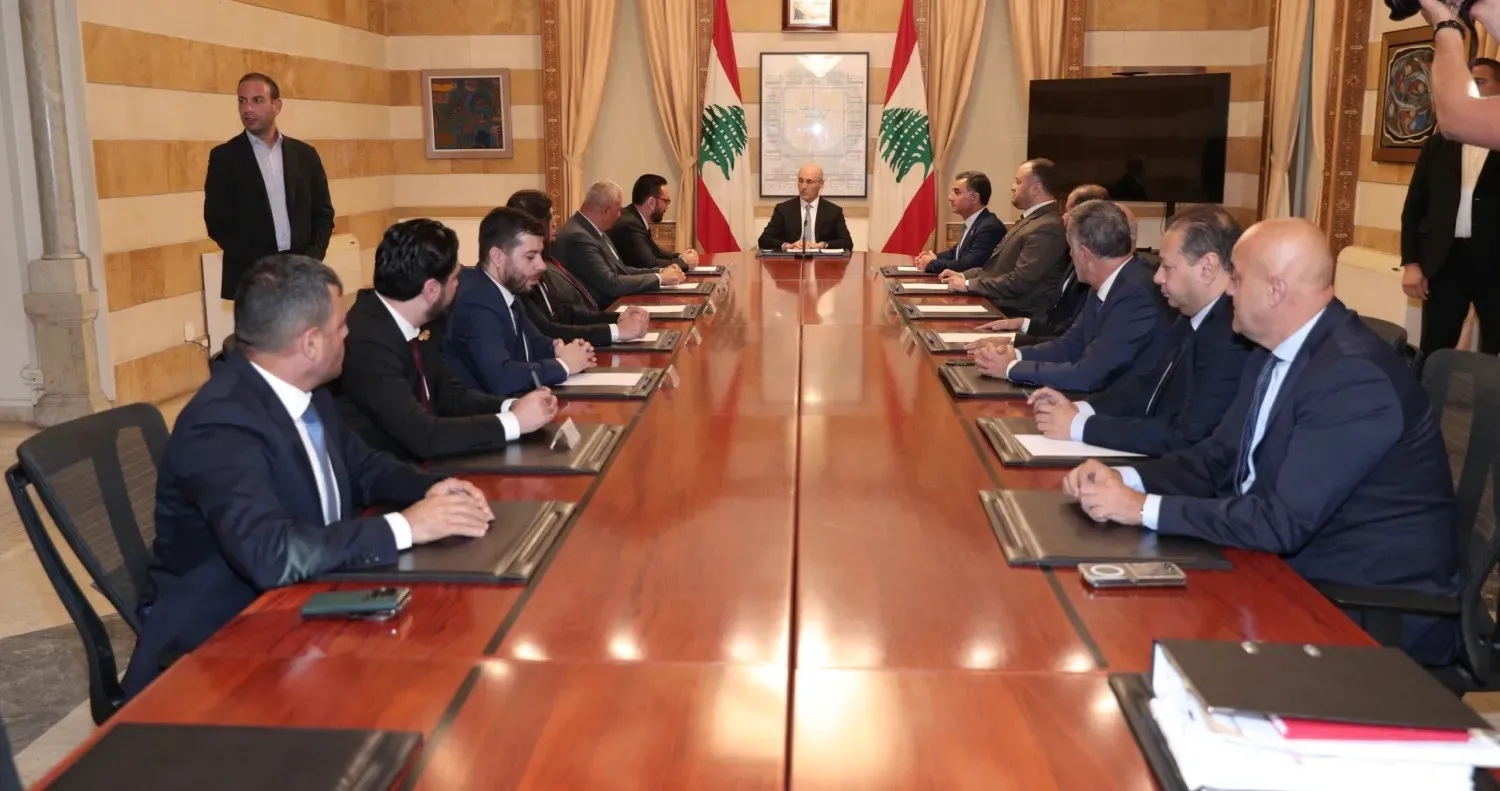
Lebanese Interior Minister Ahmad Al-Hajjar meets with Syrian Deputy Interior Minister Major General Abdel Qader Tahan and his accompanying delegation. (NNA)
TT

Lebanon and Syria Reach Security Agreement to Tighten Border Control and Combat Crime

Lebanese Interior Minister Ahmad Al-Hajjar meets with Syrian Deputy Interior Minister Major General Abdel Qader Tahan and his accompanying delegation. (NNA)

Lebanon and Syria have agreed to deepen security coordination on shared borders, fighting organized crime, and curbing illegal migration. The understanding was reached during a high-level security meeting held in Beirut.

The Syrian delegation was headed by Abdel Qader Tahan, Deputy Minister of Interior, while the Lebanese side was led by Major General Raed Abdallah, Director General of the Internal Security Forces (ISF), and General Security chief Major General Hassan Choucair.

Tahan said the discussions continued the series of bilateral meetings that began in Saudi Arabia and focused on counterterrorism, narcotics control, and illegal migration. He stressed that “any security threat in Lebanon inevitably affects Syria, and vice versa,” underscoring the need for closer coordination.

A Lebanese security source told Asharq Al-Awsat that the talks covered all major security concerns. The Syrian delegation prioritized combating the smuggling of narcotics from Lebanon into Syria and dismantling drug networks operating along the border, proposing concrete steps to address what it described as a growing social and security threat. It also expressed full readiness to exchange intelligence and strengthen field coordination to track and eliminate these networks.

Lebanon, in turn, raised concerns about arms trafficking and the smuggling of individuals through illegal crossings used by outlawed groups to move fugitives between the two countries.

Lebanese officials stressed that direct cooperation with Syrian authorities is essential to maintain security and stability in border regions where smuggling activity has intensified.

Both sides also discussed establishing joint committees to develop mechanisms for intelligence sharing and real-time border monitoring.

The meeting comes as Lebanon intensifies efforts to secure its eastern and northern frontiers, long plagued by the smuggling of goods, fuel, narcotics, and people. The source described the renewed coordination as a “shared necessity,” noting that neither side can manage border challenges unilaterally.

The talks concluded with the Syrian delegation’s visit to Ahmad Al-Hajjar, Lebanon’s Minister of Interior, in the presence of both security chiefs.

Al-Hajjar praised the “deep-rooted Lebanese-Syrian ties,” noting that the meeting builds on recent high-level exchanges, including talks between Presidents Joseph Aoun and Ahmad Al-Sharaa, Prime Minister Nawaf Salam’s visit to Damascus, and the Syrian Foreign Minister’s trip to Beirut.



Iraq's Parliament Elects Al-Halbousi as Its New Speaker

 The new speaker of parliament Haibet Al-Halbousi, center, looks on before the start of their first legislative session in Baghdad, Iraq, Monday, Dec. 29, 2025. (AP Photo/Hadi Mizban)
The new speaker of parliament Haibet Al-Halbousi, center, looks on before the start of their first legislative session in Baghdad, Iraq, Monday, Dec. 29, 2025. (AP Photo/Hadi Mizban)
TT

Iraq's Parliament Elects Al-Halbousi as Its New Speaker

 The new speaker of parliament Haibet Al-Halbousi, center, looks on before the start of their first legislative session in Baghdad, Iraq, Monday, Dec. 29, 2025. (AP Photo/Hadi Mizban)
The new speaker of parliament Haibet Al-Halbousi, center, looks on before the start of their first legislative session in Baghdad, Iraq, Monday, Dec. 29, 2025. (AP Photo/Hadi Mizban)

Iraq's parliament on Monday elected a new speaker following overnight talks to break a political deadlock.

Haibet Al-Halbousi received 208 votes from the 309 legislators who attended, according to The AP news. He is a member of the Takadum, or Progress, party led by ousted speaker and relative Mohammed al-Halbousi. Twenty legislators did not attend the session.

Iraq held parliamentary elections in November but didn’t produce a bloc with a decisive majority. By convention, Iraq’s president is always Kurdish, while the more powerful prime minister is Shiite and the parliamentary speaker is Sunni.

The new speaker must address a much-debated bill that would have the Hashd al-Shaabi, or Popular Mobilization Units become a formal security institution under the state. Iran-backed armed groups have growing political influence.

Al-Halbousi also must tackle Iraq’s mounting public debt of tens of billions of dollars as well as widespread corruption.

Babel Governor Adnan Feyhan was elected first deputy speaker with 177 votes, a development that might concern Washington. Feyhan is a member of the Asaib Ahl al-Haq, or League of the Righteous, a US-sanctioned, Iran-backed group with an armed wing led by Qais al-Khazali, also sanctioned by Washington.


Hamas Armed Wing Confirms Spokesman Killed by Israel in August

FILE Photo of Hamas now late spokesperson Abu Ubaida. (Screengrab from al-Qassam brigades video)
TT

Hamas Armed Wing Confirms Spokesman Killed by Israel in August

FILE Photo of Hamas now late spokesperson Abu Ubaida. (Screengrab from al-Qassam brigades video)

Hamas' armed wing confirmed on Monday the death of its spokesperson, Abu Obeida, months after Israel announced that he had been killed in an air strike in Gaza.

Ezzedine Al-Qassam Brigades released a video statement on its Telegram channel, saying: "We pause in reverence before... the masked man loved by millions... the great martyred commander and spokesperson of the Qassam Brigades, Abu Obeida", AFP reported.

Israel had announced it had killed Abu Obeida in a strike on Gaza on August 30.

Born on February 11, 1985, and raised in the Jabalia refugee camp in northern Gaza, Abu Obeida joined Hamas at an early age before becoming a member of the Ezzedine al-Qassam Brigades.

He later became the group's sole spokesman, delivering video statements in military uniform with his face consistently concealed by a red keffiyeh. He had been the target of multiple Israeli assassination attempts.

According to Hamas officials, Abu Obeida embodied what they describe as "resistance" and was known for fiery and impactful speeches, many of which included threats against Israel or announcements of military operations.

"For many years, only a very small circle of Hamas officials knew his true identity," a Hamas official told AFP.

Israel has decimated Hamas's leadership, saying it seeks to eradicate the group following Hamas's October 7, 2023 attack on Israel, which triggered the war.

The video announcing Abu Obeida's death was delivered by a masked man dressed in the former spokesperson's distinctive style, who said he would adopt his predecessor's name for future statements.

In the same video, he also announced the deaths of four other Hamas commanders in Israeli attacks during the war.


Iraq’s Newly Elected Parliament Holds First Session

A view of the Iraqi Parliament building in Baghdad, Iraq, Monday, Dec. 29, 2025. (AP)
TT

Iraq’s Newly Elected Parliament Holds First Session

A view of the Iraqi Parliament building in Baghdad, Iraq, Monday, Dec. 29, 2025. (AP)

Iraq's newly elected parliament convened ​on Monday for its first session since the November national election, opening the ‌way for ‌lawmakers ‌to begin ⁠the ​process ‌of forming a new government.

Parliament is due to elect a speaker and ⁠two deputies ‌during its first meeting. ‍

Lawmakers ‍must then ‍choose a new president by within 30 days of ​the first session.

The president will subsequently ⁠ask the largest bloc in parliament to form a government, a process that in Iraq typically drags on for ‌months.