

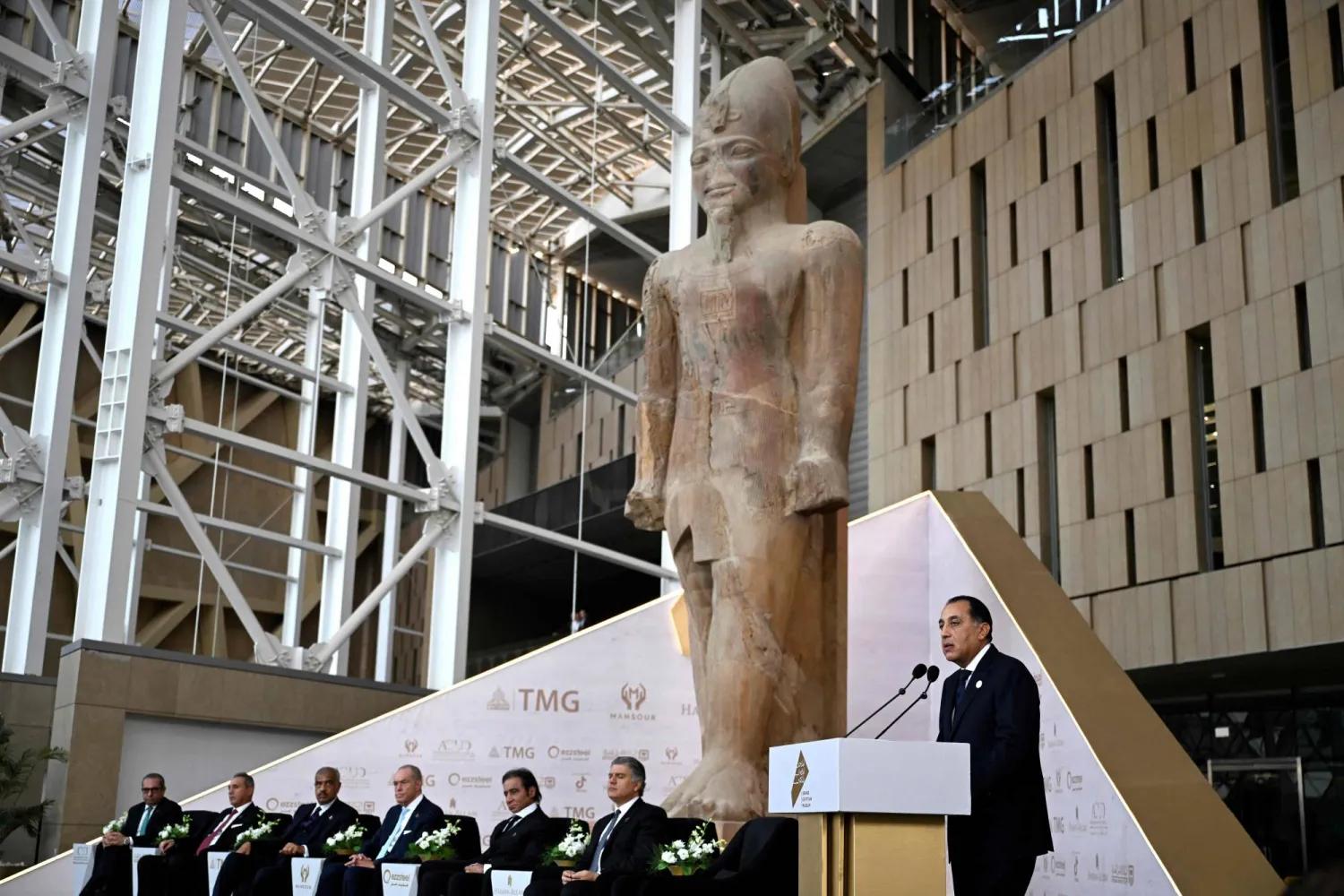

Five Things to Know About the Grand Egyptian Museum

Egyptian Prime Minister Mostafa Madbouli, speaks to the press prior to the official opening of the Grand Egyptian Museum (GEM) in Giza, on the southwestern outskirts of the capital Cairo on November 1, 2025. (AFP)
TT

Five Things to Know About the Grand Egyptian Museum

Egyptian Prime Minister Mostafa Madbouli, speaks to the press prior to the official opening of the Grand Egyptian Museum (GEM) in Giza, on the southwestern outskirts of the capital Cairo on November 1, 2025. (AFP)

Near the ancient Pyramids of Giza just outside Cairo, the Grand Egyptian Museum (GEM) is gearing up for its lavish opening on Saturday after two decades of delays.

Massive statues and historic artifacts from the country's ancient civilization will be on display across the 24,000 square meters (258,000 square feet) of permanent exhibition space.

Here are five things to know about the long-awaited museum, which Egyptian authorities have called "the largest cultural building of the 21st century".

‘Fourth pyramid’

An imitation of the nearby pyramids of Khufu, Khafre and Menkaure, the museum's triangular glass structure was designed by the Irish firm Heneghan Peng Architects.

The state-of-the-art complex -- dubbed the "fourth pyramid" of the Giza Plateau –- houses around 100,000 artifacts from the 30 dynasties of ancient Egypt's pharaohs.

About half of the collection is on display, with the rest kept in storage.

20 years in the making

The towering $1 billion facility, which has been more than 20 years in the making, is expected to draw more than 5 million visitors every year.

The government hopes the museum will play a central role in reviving an Egyptian economy battered by debt and inflation.

Ramses

An 11-meter (36-foot) granite statue of Ramses the Great greets visitors in the vast entrance atrium.

Ramses II -- the third king of the 19th Dynasty -- reigned more than 3,000 years ago (1279-1213 BC) and is among the greatest of all the Egyptian pharaohs.

His statue has toured the world twice, attracting millions of visitors in 1986 and then from 2021 to 2025.

The GEM will be the statue's final home after several relocations since its discovery in 1820 near a temple in ancient Memphis, south of Cairo.

From 1954 to 2006 the statue stood in front of Cairo's main train station.

Boy king

One gallery is dedicated to the 5,000 artifacts from the collection of King Tutankhamun, the most well-known figure of Ancient Egypt.

The full collection is in one place for the first time since British archaeologist Howard Carter discovered the famed pharaoh's tomb in the Valley of the Kings near Luxor in 1922.

The boy king's gold-covered sarcophagus and his burial mask, inlaid with lapis lazuli, will take center stage at Saturday's opening.

After years of debate, genetic tests conducted in the early 2010s suggested malaria and a bone disease led to the pharaoh's death at the age of 19.

A separate building was designed for the 4,600-year-old solar boat of Pharaoh Khufu, one of the largest and oldest wooden artifacts from antiquity.

The 44-meter-long (144-foot) cedar and acacia wooden boat was discovered in 1954 near the Great Pyramid of Khufu -- the largest of the three structures.

Over the next three years, visitors will also be able to watch experts from behind a glass wall as they restore another boat discovered in 1987.

Frequent delays

The museum was partially opened to the public in October 2024.

Launched in 2002 under then-President Hosni Mubarak, its grand opening was delayed by political turmoil after the 2011 uprising, the Covid-19 pandemic and regional conflicts.

The GEM is built around a colossal six-storey staircase lined with mammoth statues and ancient tombs leading to a panoramic window with a view of the nearby pyramids.

Twelve main galleries trace civilization across 5,000 years of history, from prehistoric times to the Roman era.

The complex also includes storage areas open to researchers, laboratories and restoration workshops.

It will open to the public on November 4.



Saudi Heritage Commission Announces Discovery of 20 Rock Engravings in Soudah Peaks Project

The newly identified sites feature inscriptions and rock carvings estimated to be between 4,000 and 5,000 years old. (SPA)
TT

Saudi Heritage Commission Announces Discovery of 20 Rock Engravings in Soudah Peaks Project

The newly identified sites feature inscriptions and rock carvings estimated to be between 4,000 and 5,000 years old. (SPA)

Saudi Arabia’s Heritage Commission, in collaboration with Soudah Development, a Public Investment Fund company, announced on Tuesday the discovery of 20 ancient rock art sites within the Soudah Peaks area.

Spanning more than 636.5 square kilometers across Soudah and parts of Rijal Almaa, the project area is now recognized as home to some of the region’s oldest cultural landmarks. The newly identified sites feature inscriptions and rock carvings estimated to be between 4,000 and 5,000 years old, offering valuable insights into the region’s rich history.

The findings include Thamudic inscriptions, along with vivid depictions of ibex, hyenas, and ostriches, as well as scenes of hunters, dancers, palm trees, and weapons, reflecting the environmental and social practices of the ancient communities that once inhabited the area.

The survey forms part of a memorandum of understanding signed between the Heritage Commission and Soudah Development. Conducted in four scientific phases, the initiative began with data collection and site analysis, concluding with the documentation and classification of high-value archaeological sites in preparation for future development and preservation efforts.

Soudah Development remains committed to protecting and promoting the natural and cultural heritage of the project area. The company continues to work towards creating an integrated cultural and tourism experience that reflects the authenticity and historical richness of the region, in line with its vision to transform Soudah Peaks into a premier luxury mountain destination rooted in heritage.


Ancient Rome Meets Modern Technology as Tourists Visit Restored, Frescoed Home via Livestream Tours

 Colosseum Archeological Park guide Valentina uses a head-mounted device to livestream a guided tour for the press of the newly-restored underground House of Griffins, dated between the II and I century B.C., on the Palatine Hill next to the Colosseum, in Rome, Tuesday, Jan. 13, 2026. (AP)
Colosseum Archeological Park guide Valentina uses a head-mounted device to livestream a guided tour for the press of the newly-restored underground House of Griffins, dated between the II and I century B.C., on the Palatine Hill next to the Colosseum, in Rome, Tuesday, Jan. 13, 2026. (AP)
TT

Ancient Rome Meets Modern Technology as Tourists Visit Restored, Frescoed Home via Livestream Tours

 Colosseum Archeological Park guide Valentina uses a head-mounted device to livestream a guided tour for the press of the newly-restored underground House of Griffins, dated between the II and I century B.C., on the Palatine Hill next to the Colosseum, in Rome, Tuesday, Jan. 13, 2026. (AP)
Colosseum Archeological Park guide Valentina uses a head-mounted device to livestream a guided tour for the press of the newly-restored underground House of Griffins, dated between the II and I century B.C., on the Palatine Hill next to the Colosseum, in Rome, Tuesday, Jan. 13, 2026. (AP)

One of the best-preserved ancient Roman homes on the Palatine Hill is opening to the public for the first time, albeit via a livestreamed tour of its hard-to-reach underground frescoes and mosaics.

The House of the Griffins was first discovered during the excavations in the early 20th century of the Palatine Hill, the verdant hill that rises up from the Roman Forum and dominates views of central Rome today with its striking red brick ruins.

The hill, located just off the Colosseum, was the site of temples and homes of leading citizens during Rome’s Republican era, which is traditionally dated from 509 B.C. to 27 B.C. It became the aristocratic quarter during the Roman Empire that followed, when new palaces were built on top of the older homes.

The House of the Griffins is one of those earlier Republican-era homes, and was hidden to the world underground after the Emperor Domitian built his palace on top of it in the first century A.D.

Now for the first time, the general public can virtually visit the House of the Griffins and its newly restored frescoes, including the decoration that gives the home its name: An arched lunette fresco featuring two griffins — the half-eagle, half-lion mythological creatures.

Visitors won’t actually walk through the home’s intimate rooms, which are only accessible via a perilously steep staircase underground. Rather, visitors above ground will watch as a tour guide wearing a head-mounted smartphone descends into the domus and walks through its rooms, livestreaming the visit and narration.

The live, virtual tour serves multiple purposes: It allows visitors to “see” a domus that, because of its underground location, would otherwise be off-limits. And by limiting the number of people in its rooms, the livestreaming protects the delicate frescoes from too much humidity and carbon dioxide.

Project chief Federica Rinaldi said archaeologists don’t know much about the family who lived there, but said they were clearly well-off. The level of decoration recalls some of the elegant homes of the era in Pompeii: The frescoes feature richly colored faux marble designs, and floor mosaics of three-dimensional cubes.

“Its location at the highest point of the hill, its distribution over several levels that take advantage of the slopes of the Palatine Hill itself, and its preservation make it today an almost textbook reference," she said. “It was certainly a domus of the highest standard.”

Starting on March 3, the livestreamed tours will be held weekly, on Tuesdays, with one in Italian and one in English, though more are foreseen. Groups are limited to a dozen people and require reservations, as well as an additional ticket beyond the typical Colosseum-Palatine Hill entrance fee.

The restoration of the House of the Griffins is one of 10 projects funded by the European Union in the archaeological park and is part of an effort to spread tourists out beyond the must-see Colosseum and Forum, which often get overwhelmed with visitors.

“It’s a great occasion to value the full territory of the park,” said the head of the park, Simone Quilici.


Sudan Recovers 570 Artifacts Looted During War

Artifacts that were recovered after being looted from the National Museum in Khartoum during the country's long-running war, are displayed during an official ceremony in Port Sudan on January 13, 2026. (AFP)
TT

Sudan Recovers 570 Artifacts Looted During War

Artifacts that were recovered after being looted from the National Museum in Khartoum during the country's long-running war, are displayed during an official ceremony in Port Sudan on January 13, 2026. (AFP)

Sudanese authorities displayed ancient figurines, ornate vases and scarab-shaped amulets at a ceremony Tuesday in Port Sudan celebrating the recovery of more than 570 antiquities stolen from the national museum during the country's long-running war.

The artifacts, arranged on large tables under heavy security, were recovered after months of investigation and brought to the wartime capital of Port Sudan.

The National Museum in Khartoum, which housed some of Sudan's most important archaeological collections, was looted and badly damaged after the paramilitary Rapid Support Forces (RSF) seized the capital in the early days of its war with the army, its former ally.

At the time, satellite images showed trucks carrying artifacts west, towards the vast region of Darfur -- now completely under RSF control.

Since then, Sudanese authorities have worked with UNESCO and Interpol to track down the stolen items.

Authorities did not detail on Tuesday exactly how the artifacts were recovered.

"Sudan heritage is not only of national importance, it is a treasure of humanity," said UNESCO's representative in Sudan, Ahmed Junaid, referring to international efforts to combat illicit trafficking of cultural property.

"Many people do not know the value of the objects displayed on the tables, but they reflect the identity of the nation and its history," said Sudan's finance minister Gibril Ibrahim.

Khalid Aleisir, minister of information and culture, announced a "financial reward" for anyone returning antiquities to the authorities, without specifying an amount.

Officials estimate that the recovered items account for about 30 percent of the objects looted from the museum.

Still missing are the contents of the so-called "gold room", the museum's most valuable collection, which included ancient jewellery and 24-carat gold pieces, some nearly 8,000 years old.