


Energy Leaders at ADIPEC: Peak in Oil Demand Not Seen Yet  

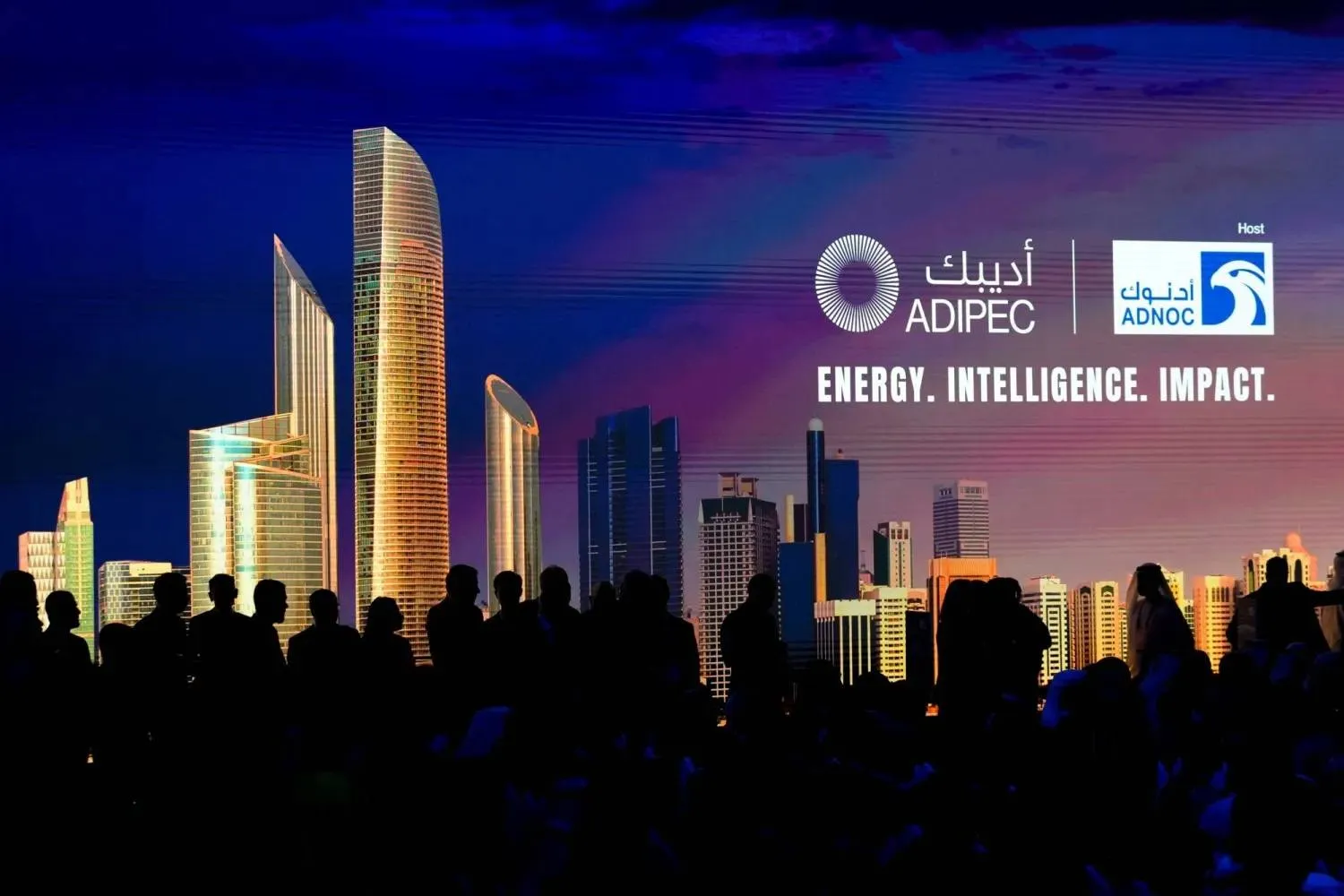
Delegates are silhouetted against a screen as they attend the inaugural session of ADIPEC in Abu Dhabi on Monday. (AP)
TT

Energy Leaders at ADIPEC: Peak in Oil Demand Not Seen Yet  

Delegates are silhouetted against a screen as they attend the inaugural session of ADIPEC in Abu Dhabi on Monday. (AP)

Senior officials in the energy sector agreed Monday during the Abu Dhabi International Petroleum Exhibition and Conference “ADIPEC” that global oil demand has not yet peaked, and that global oil markets are on a positive and stable track.

Leaders attributed this optimism to multiple factors, most notably the balance of supply and demand, the continued growth in global consumption, and the pragmatic policies adopted by major producing countries.

OPEC Secretary-General Haitham Al Ghais said the group was still seeing positive signs for oil demand and did not expect any surprises in the market.

“We are making sure we maintain the supply demand balance,” Ghais added at a panel at ADIPEC, a day after OPEC+ agreed to an additional 137,000 barrels per day (bpd) oil production increase for December and a pause in increases in the first quarter of next year.

Energy security and clean energy

When asked about the possibility of an oil glut in 2026, United Arab Emirates' Energy Minister Suhail al-Mazrouei said: “I am not going to talk about an oversupply scenario. In my view, what we’re seeing right now is growing demand.”

He said the Emirates is cementing its position as a “key player” by pursuing a balanced path while accelerating clean energy.

Al-Mazrouei said UAE is spending AED189 billion ($51.5 billion) on infrastructure and clean energy to reach net-zero by 2050.

It now has 12.4 gigawatts of clean power (over 30% of electricity), three giant single site solar plants, the Barakah Nuclear Power Plant running at full power and the world’s largest solar plus storage project for 24/7 clean electricity, the minister added.

Pragmatic policies

Delivering the keynote address at the opening ceremony of ADIPEC, Dr. Sultan bin Ahmed Al Jaber, Minister of Industry and Advanced Technology and Managing Director and Group CEO of the Abu Dhabi National Oil Company (ADNOC), said the UAE’s pragmatic approach proves how policy grounded in reality builds investor confidence and explained that the country is a model for credible, technology-driven, investment-friendly policy solutions.

“The lesson,” he added, “is that policies should be pragmatic, not performative, based on insight, not ideology, built on first principles, not fleeting popularity. Regulation without realism and legislation without logic, will only weaken economies, stunt societies and drive capital away.”

Noting that $4 trillion annual capital investment is needed in grids, data centers and all sources of energy, Al Jaber said “you can’t run tomorrow’s economy on yesterday’s grid” and went on to highlight the major demand-drivers through 2040.

“Here are the facts: electricity demand will keep surging through 2040, as power for data centers grows four-fold, 1.5 billion people move into cities, and more than 2 billion air conditioners come online. Aviation will also take off, with the global airline fleet doubling from 25,000 to 50,000 planes,” he showed.

Washington: No oil glut in 2026

The US Department of Energy’s deputy secretary, James Danly, said that he does not think there will be an oil glut in 2026.

“We have a demand signal for energy that is going up rapidly,” Danly said at the conference.

Meanwhile, TotalEnergies CEO Patrick Pouyanne said Chinese oil demand growth has slowed since 2020 as the country transitions to greener energy, though he said he was still optimistic long-term due to rising demand in India.

“You have demand growing again steadily, but one thing has changed in the last three or four years: it's the Chinese engine for growth of oil demand, which was really strong between 2000 and 2020,” Pouyanne said. “That engine has slowed down.”


Dar Global and Trump Organization Launch $1 Billion Project in Jeddah

The project, called Trump Plaza Jeddah, will include executive and premium residences, home offices, retail outlets and curated dining offerings. (Asharq Al-Awsat) 
TT

Dar Global and Trump Organization Launch $1 Billion Project in Jeddah

The project, called Trump Plaza Jeddah, will include executive and premium residences, home offices, retail outlets and curated dining offerings. (Asharq Al-Awsat) 

Dar Global and the Trump Organization announced on Monday the official launch of Trump Plaza Jeddah, valued at over $1 billion.

Dar Global, a London-listed luxury real estate developer, said the project marks its third collaboration with the Trump Organization in the Kingdom.

This landmark project, strategically located within the expansive Amaya development along King Abdulaziz Road, is poised to redefine luxury urban living in Jeddah's thriving real estate landscape, following the launch of Trump Tower Jeddah in December 2024.

Dar Global described the project as one of the most integrated urban destinations in Jeddah, saying it includes home offices, retail spaces, dining venues and a private club.

Residential offerings include fully furnished 1, 2, and 3-bedroom Trump Executive Residences; premium 2, 3, and 4-bedroom Trump Park Residences; and exclusive 4-bedroom Trump Townhouses.

Together with thoughtfully designed home offices, premium retail, and curated dining, the project redefines modern living by blending convenience and luxury into a single, connected destination.

Optional rental management services further enhance the appeal for international owners seeking a turnkey ownership experience.

“Expanding our presence in Saudi Arabia with Trump Plaza Jeddah underscores our commitment to world-class quality and iconic design,” said Eric Trump, executive vice president of the Trump Organization. “This project reflects the strength of our relationship with Dar Global and our confidence in Jeddah as a dynamic, globally relevant city.”

Trump affirmed that Trump Plaza Jeddah will set a new benchmark for integrated urban destinations.

For his part, Ziad El Chaar, CEO of Dar Global, said the launch of Trump Plaza Jeddah represents a major milestone in the company’s Saudi portfolio.

“This is not a single-use development, but a carefully curated urban ecosystem designed for global residents who want to live, work, and connect within the best address in Jeddah,” he said.

“Anchored by a private park and supported by world-class amenities, Trump Plaza Jeddah introduces a new model for modern city living in the Kingdom,” El Chaar noted.

The project also features an exclusive 4,000-square-meter Vitality Club, with golf simulators, a spa, sports medicine and recovery facilities, swimming pools, dining, and high-performance wellness spaces.

Destination retail and dining, including Trump Grill, Trump Daily, an artisan bakery, and a fitness pro shop, reinforce its positioning as a district day and night.


Oil Extends Climb on Iran Supply Disruption Concerns

FILE PHOTO: A map showing the Strait of Hormuz and Iran is seen behind a 3D printed oil pipeline in this illustration taken June 22, 2025. REUTERS/Dado Ruvic/Illustration/File Photo
TT

Oil Extends Climb on Iran Supply Disruption Concerns

FILE PHOTO: A map showing the Strait of Hormuz and Iran is seen behind a 3D printed oil pipeline in this illustration taken June 22, 2025. REUTERS/Dado Ruvic/Illustration/File Photo

Oil prices extended gains on Tuesday as heightened concerns surrounding Iran and potential supply disruptions outweighed the prospect of increased crude supply from Venezuela.

Brent futures rose 22 cents, or 0.3%, to $64.09 a barrel by 0430 GMT, hovering near a two-month high struck in the previous session. US West Texas Intermediate crude climbed 23 cents, or 0.4%, to $59.73.

"The price increase comes amid intensifying protests in Iran, raising the possibility of some form of intervention ‌by the US," ING ‌commodities strategists said on Tuesday.

Iran, one of ‌the ⁠biggest producers ‌of the Organization of the Petroleum Exporting Countries, is facing its biggest anti-government demonstrations in years, drawing a warning from US President Donald Trump of possible military action over lethal violence against protesters.

Trump is expected to meet senior advisers on Tuesday to discuss options on Iran, a US official told Reuters.

The US president said on Monday that any country that does business with Iran will be subjected ⁠to a tariff rate of 25% on any business conducted with the United States. Iran exports ‌much of its oil to China.

"With the US ‍and China having reached a trade ‍truce, we question whether the US would want to rock the boat ‍again with additional tariffs on China," the ING strategists said.

The political developments matter for oil markets as Iran is a major sanctioned producer and any escalation could disrupt supply or add a geopolitical risk premium.

"Unrest in Iran has added about $3-4/barrel in geopolitical risk premium in oil prices, in our view," Barclays said in a note.

Markets are also grappling with concerns of additional crude supply ⁠hitting the market due to Venezuela's anticipated return to exports. Following the ouster of President Nicolas Maduro, Trump said last week the government in Caracas is set to hand over as much as 50 million barrels of oil subject to Western sanctions to the US.

Global oil trading houses have emerged as early winners in the race to control Venezuelan crude flows, getting ahead of US energy majors.

Elsewhere, geopolitical tensions escalated as Russian forces launched attacks on Ukraine's two largest cities early on Tuesday, Ukrainian officials said.

In the United States, the Trump administration renewed its attacks on the Federal Reserve, underscoring concerns in markets about the central ‌bank's independence and adding to uncertainty about future economic conditions and oil demand.


Morocco Targets $10 Billion AI Contribution to GDP by 2030

 People wave Morocco's flag in the old town of Rabat, on January 9, 2026 prior the Africa Cup of Nations (CAN) quarter-final football match Morocco v Cameroon. (AFP)
People wave Morocco's flag in the old town of Rabat, on January 9, 2026 prior the Africa Cup of Nations (CAN) quarter-final football match Morocco v Cameroon. (AFP)
TT

Morocco Targets $10 Billion AI Contribution to GDP by 2030

 People wave Morocco's flag in the old town of Rabat, on January 9, 2026 prior the Africa Cup of Nations (CAN) quarter-final football match Morocco v Cameroon. (AFP)
People wave Morocco's flag in the old town of Rabat, on January 9, 2026 prior the Africa Cup of Nations (CAN) quarter-final football match Morocco v Cameroon. (AFP)

Morocco is targeting a 100 billion dirhams ($10 billion) boost to its gross domestic product from artificial intelligence by 2030, the minister in charge of digital transition said on Monday, as the country steps up its investment in training programs, sovereign data centers and cloud services.

Morocco, whose current GDP comes to around $170 billion, plans to invest in artificial intelligence centers linked ‌to universities and ‌the private sector, and ‌to ⁠integrate AI solutions ‌into public administration and industry, Minister Amal El Fallah Seghrouchni told a conference in Rabat.

The GDP boost would largely come from expanding domestic data-processing capacity through sovereign data centers, scaling up cloud and fiber-optic infrastructure, and building an AI-skilled workforce ⁠to support the deployment of AI solutions across industry ‌and government, she said.

Under the ‍plan, Morocco expects ‍to create 50,000 AI-related jobs and train ‍200,000 graduates in AI skills by 2030.

As part of that effort, Seghrouchni on Monday signed a partnership agreement with France's Mistral AI to support the development of generative AI tools in Morocco.

"We want to turn Morocco into ⁠a future excellence hub in AI and data science," Seghrouchni said.

The government is also preparing legislation governing artificial intelligence, according to the minister.

Morocco has earmarked 11 billion dirhams ($1.2 billion) for its digital transformation strategy for 2024–2026, covering AI initiatives and the expansion of fiber-optic infrastructure. It is separately planning a 500-megawatt, renewable energy-powered data center in the southern city of Dakhla ‌to boost the security and sovereignty of national data storage.
