

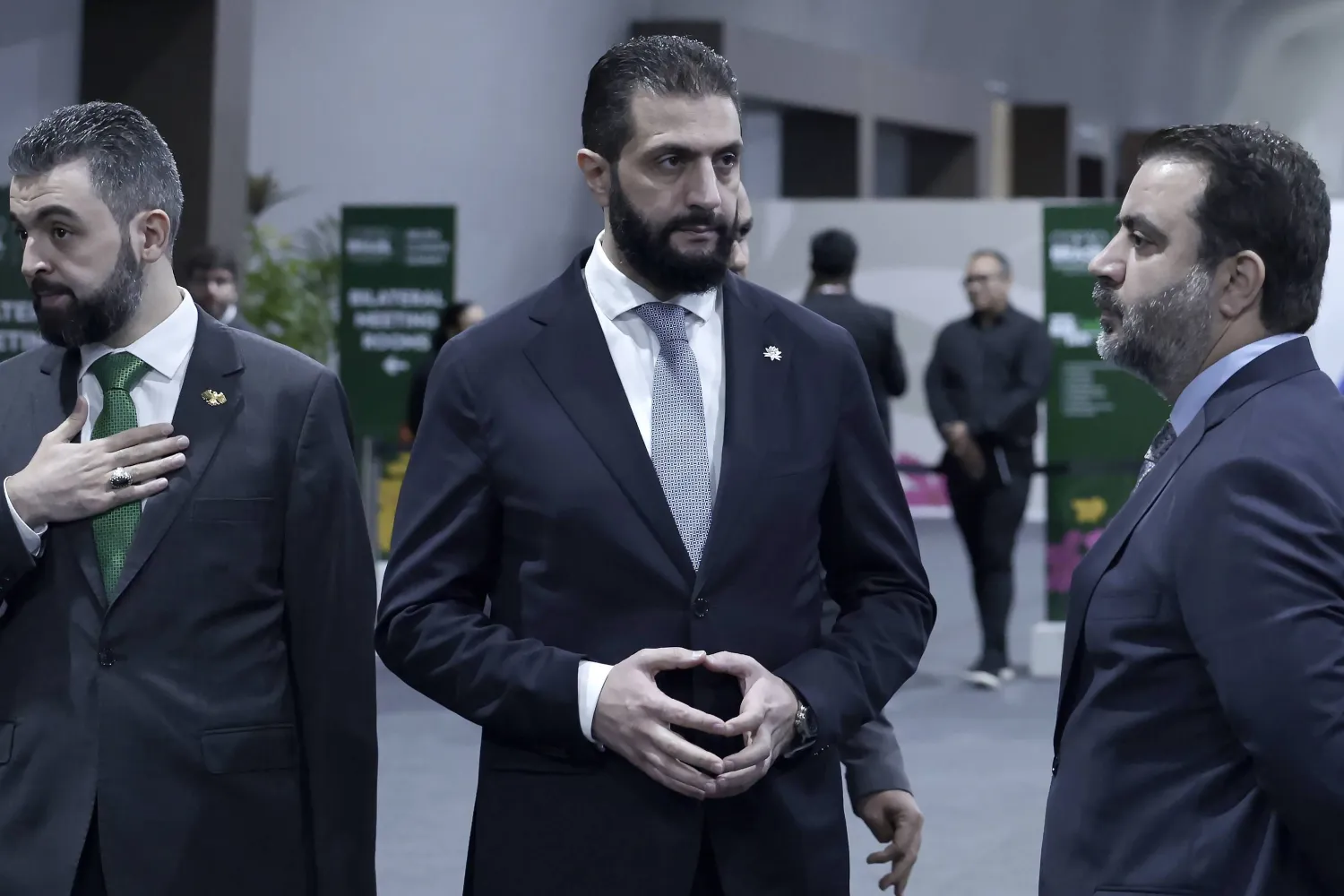

UN Security Council Removes Sanctions on Syria’s President, Interior Minister 

Syrian interim President Ahmed al-Sharaa (C) attends the opening of the COP30 leaders' summit at the Hangar Convention Center in Belem, Brazil, 06 November 2025. (EPA)
TT

UN Security Council Removes Sanctions on Syria’s President, Interior Minister 

Syrian interim President Ahmed al-Sharaa (C) attends the opening of the COP30 leaders' summit at the Hangar Convention Center in Belem, Brazil, 06 November 2025. (EPA)

The United Nations Security Council has removed sanctions on Syrian interim President Ahmed al-Sharaa, who is due to meet US President Donald Trump at the White House on Monday.

The US-drafted resolution on Thursday also lifted sanctions on Syrian Interior Minister Anas Khattab. It received 14 votes in favor, while China abstained.

Washington has been urging the 15-member Security Council for months to ease Syria sanctions. Trump announced a major US policy shift in May when he said he would lift US sanctions on Syria.

"I think he's doing a very good job," Trump said later on Thursday of Sharaa. "It's a tough neighborhood, and he's a tough guy, but I got along with him very well. And a lot of progress has been made with Syria."

"We did take the sanctions off Syria in order to give them a fighting shot," he told reporters in Washington.

After 13 years of civil war, Syria's President Bashar al-Assad was ousted in December in a lightning offensive by opposition forces led by the Hayat Tahrir al-Sham (HTS).

Formerly known as the al-Nusra Front, HTS was al-Qaeda's official wing in Syria until breaking ties in 2016. Since May 2014, the group has been on the UN Security Council's al-Qaeda and ISIS sanctions list.

Russia's UN Ambassador Vassily Nebenzia said Moscow supported the brief, succinct resolution because it "most importantly ... reflects the interests and aspirations of the Syrian people themselves."

Russia diplomatically shielded its ally Assad during the war, casting more than a dozen vetoes at the Security Council, on many occasions backed by China. The council met several times a month throughout the war to discuss Syria's political and humanitarian situation and chemical weapons.

After years of Security Council division, Syria's UN Ambassador Ibrahim Olabi praised the decision on Thursday as a "message of support for Syrian women and men in their effort to rebuild their homeland and restore their lives."

"The new Syria will be a success story. It will be a shining model that proves that the optimal path in international relations is positive engagement and constructive cooperation. If there are concerns, Syria is fully prepared to address them with sincere intent based on mutual respect," he told the council.



Israel Strikes Jamaa Islamiya Group’s HQ in Sidon, South Lebanon

Rescue workers gather in front of the destroyed center of the Jamaa Islamiya group which hit by an Israeli strike, in the southern port city of Sidon, Lebanon, Tuesday, March, 3, 2026. (AP)
TT

Israel Strikes Jamaa Islamiya Group’s HQ in Sidon, South Lebanon

Rescue workers gather in front of the destroyed center of the Jamaa Islamiya group which hit by an Israeli strike, in the southern port city of Sidon, Lebanon, Tuesday, March, 3, 2026. (AP)

Beirut, Lebanon, March 3, 2026 (AFP) - Israel struck a headquarters belonging to the Jamaa Islamiya group, an ally of Hamas and Hezbollah, in the southern Lebanese city of Sidon on Tuesday, state media reported.

"The Israeli enemy carried out an air raid a short while ago, targeting a headquarters of the Jamaa Islamiya" in the coastal city, state media said.

Sidon was largely spared of major Israeli attacks during the last war between Israel and Hezbollah, which a November 2024 ceasefire sought to end.

The strike almost entirely destroyed a seven-storey building, according to an AFP photographer, and ambulances rushed to the scene.

It caused a powerful blast in a densely populated area, as seen on local media.

The Jamaa Islamiya in a statement said no one was killed or wounded in the strike, which it called a "war crime".

The Israeli military then issued an evacuation warning for another building in Sidon, saying it will hit "Hezbollah military infrastructure... in light of its prohibited attempts to rebuild its activities in the area".

The Jamaa Islamiya had previously been the target of Israeli strikes in Lebanon after claiming responsibility for rocket launches towards Israel during the war between Israel and Hezbollah that began in October 2023.

Last month, it accused Israel of seizing one of its officials from a town near the border.

The Israeli military said that it "apprehended a senior terrorist" in the group who was then "transferred for further questioning in Israeli territory".


EU Helping Evacuate Citizens from Middle East

 European Commissioner for Preparedness and Crisis Hadja Lahbib speaks with the media as she arrives for a meeting of EU foreign ministers at the European Council building in Brussels, Monday, Feb. 23, 2026. (AP)
European Commissioner for Preparedness and Crisis Hadja Lahbib speaks with the media as she arrives for a meeting of EU foreign ministers at the European Council building in Brussels, Monday, Feb. 23, 2026. (AP)
TT

EU Helping Evacuate Citizens from Middle East

 European Commissioner for Preparedness and Crisis Hadja Lahbib speaks with the media as she arrives for a meeting of EU foreign ministers at the European Council building in Brussels, Monday, Feb. 23, 2026. (AP)
European Commissioner for Preparedness and Crisis Hadja Lahbib speaks with the media as she arrives for a meeting of EU foreign ministers at the European Council building in Brussels, Monday, Feb. 23, 2026. (AP)

The European Union has begun helping member countries Italy, Austria and Slovakia repatriate their citizens stranded due to the war in the Middle East, the bloc's crisis management chief told AFP Tuesday.

Commissioner Hadja Lahbib said the three countries were the first so far to ask Brussels to assist in funding flights from the region.

Under the EU's "civil protection mechanism" member states can get the bloc's executive to reimburse them for the bulk of the costs.

So far Slovakia has organized two flights in the coming day under the scheme, Austria has asked for space for 90 passengers and Italy is assessing how best to evacuate nationals, Lahbib said.

She said that more countries were expected to activate the mechanism in the coming days.

The US and Israeli attacks on Iran which began on Saturday, followed by Iranian counterattacks on Gulf states and Israel, have led the closure of the airspace of a number of countries.

That has caused the cancellation of at least 12,903 flights between Saturday and Monday, according to Cirium, an aviation data analysis firm, or about 40 percent of planned flights.

Some airlines on Tuesday resumed a limited number of scheduled flights -- but evacuation flights are still set to ferry more stranded passengers out of the region.

A number of EU states have already begun flying out their citizens without asking for assistance from Brussels.

Lahbib estimated that there are a total of some 500,000 EU citizens in the Middle East -- but not all of those were expected to want to leave.


Iraqi Government Seeks to Keep Country Out of Iran War Fallout

Al-Sudani chairs a meeting of the National Security Council (Prime Minister’s Office Media).
TT

Iraqi Government Seeks to Keep Country Out of Iran War Fallout

Al-Sudani chairs a meeting of the National Security Council (Prime Minister’s Office Media).

The government of outgoing Prime Minister Mohammed Shia Al-Sudani is working to distance Iraq from the escalating US-Israel war on Iran.

Tehran has responded to the military operation launched by the US and Israel with missile strikes on Gulf states and other locations, including Iraq, saying it is targeting American bases and interests.

Although Iraq has not been directly drawn into the conflict - unlike during the Iran-Iraq War (1980–1988), the 1990–1991 Gulf War, or the 2003 US-led invasion that toppled Saddam Hussein - fear is mounting as the country risks being caught between Iran and its local allies and the broader confrontation involving Washington and Tel Aviv.

There are also concerns that any disruption to Gulf shipping lanes could significantly curtail Iraq’s oil revenues.

Al-Sudani, who also serves as commander in chief of the armed forces, chaired on Monday an emergency meeting of the Ministerial Council for National Security, according to a statement from his office.

The premier instructed security agencies to prevent any actions that could undermine stability and to ensure that Iraq is not dragged into the conflict. Still, some observers say the government has been unable to stop missile attacks on Iraqi territory.

The government reiterated its commitment to protecting diplomatic missions and critical infrastructure, while affirming that freedom of expression and peaceful assembly remain constitutionally protected rights.

The statement stressed that security forces will continue safeguarding citizens, diplomatic facilities and public and private property, in line with national laws and international obligations.

The remarks appeared to reference attempts Sunday evening by groups linked to Iran-aligned armed factions to approach the US Embassy in Baghdad’s fortified Green Zone. Security forces stopped them from reaching the compound.

The council added that Iraq remains committed to preventing escalation and ensuring its territory is not used for external or internal conflicts, underscoring that decisions on national security and military action lie solely with the state and its constitutional institutions.

The council also reviewed the potential economic fallout of a prolonged and expanding conflict, particularly the risks associated with a possible closure of the Strait of Hormuz. The bulk of Iraq’s oil exports pass through the Gulf en route to the strategic waterway.

Given the country’s heavy dependence on oil income, any sustained disruption to maritime traffic would pose a serious threat to Iraq’s already fragile economy.