


China’s Exports Suffer Worst Downturn Since Feb as Tariffs Hammer US Demand 

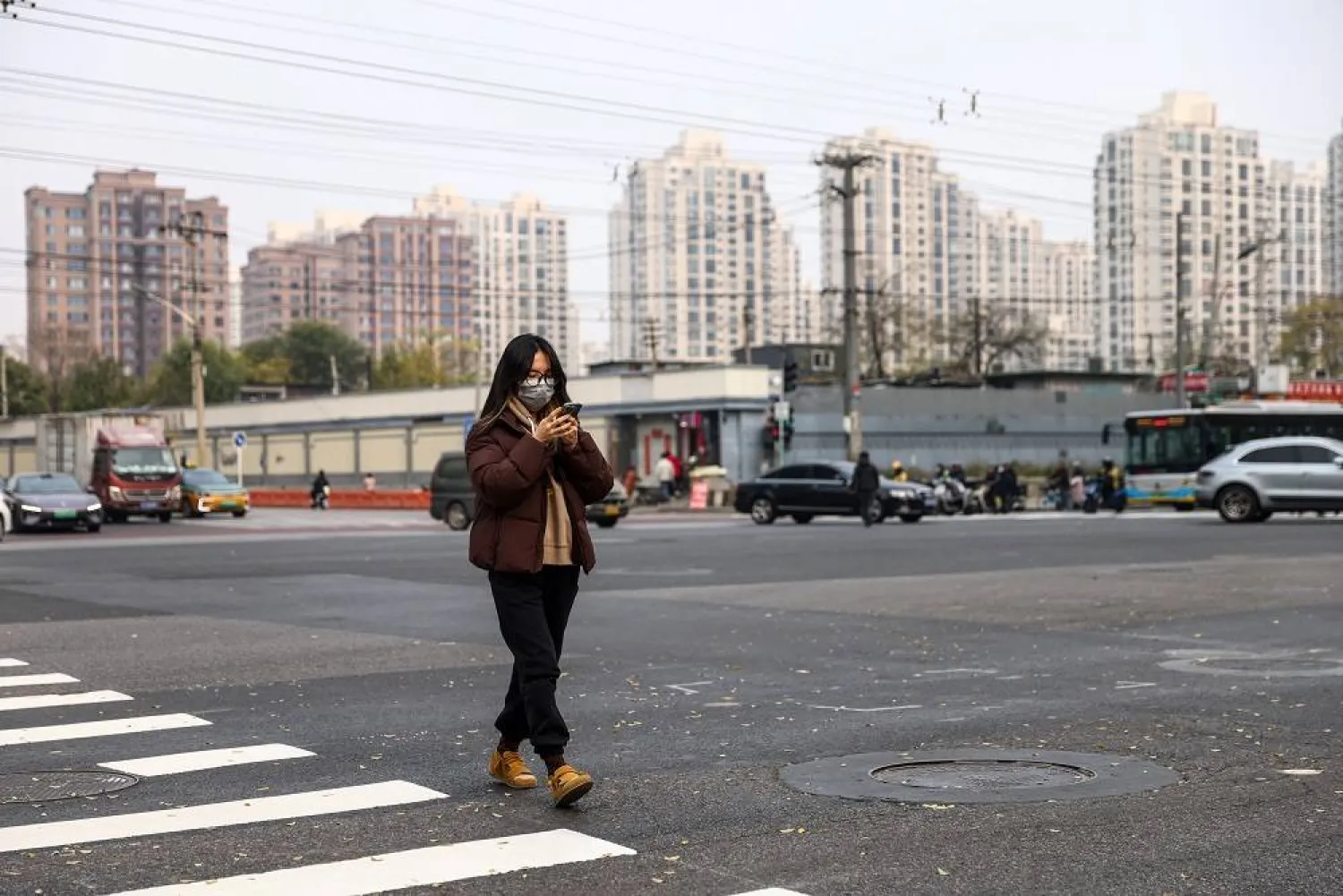
A woman wearing a face mask walks on a street in Beijing, China, 06 November 2025. (EPA)
TT

China’s Exports Suffer Worst Downturn Since Feb as Tariffs Hammer US Demand 

A woman wearing a face mask walks on a street in Beijing, China, 06 November 2025. (EPA)

Chinese exports unexpectedly fell in October after months of front-loading US orders to beat President Donald Trump's tariffs, in a stark reminder of the manufacturing juggernaut's reliance on American consumers even as it woos buyers elsewhere.

The world's second-largest economy has pushed hard to diversify its export markets since Trump won last November's presidential election, bracing for a resumption of the trade war that dominated his first term in office, and seeking closer trade ties with Southeast Asia and the European Union.

But no other country comes close to matching China's sales of more than $400 billion in goods to the US each year, a loss that economists estimate has cut China's export growth by around 2 percentage points, or roughly 0.3% of GDP.

The October customs data on Friday underlined that point, as China's outbound shipments shrank 1.1%, the worst performance since February, reversing from an 8.3% rise in September, and missing a forecast for 3.0% growth in a Reuters poll.

"Last month's weakness was driven by a broad-based slowdown in shipments to non-US markets," said Zichun Huang, China economist at Capital Economics, adding that while shipments to the US fell sharply, a rise in exports to transit hubs such as Vietnam suggested producers were still trying to beat the duties and move inventory to the US.

To be sure, the latest figure was affected by a high base from last October when exports grew at their fastest pace in over two years, as factories began rushing inventory to major markets in anticipation of Trump making a comeback to the White House.

However, most analysts largely agreed Chinese manufacturers had pushed as many goods into the world as possible for now.

"Exports through Vietnam to the US will decelerate once the frontloading is over, and we're there. So I think it's going to be much tougher for China in the fourth quarter, which means it's going to be tougher in the first half of 2026 as well," said Alicia Garcia-Herrero, chief economist for the Asia-Pacific at Natixis.

Chinese exports to the US tumbled 25.17% year-on-year, the data showed, while those to the European Union and Southeast Asian economies - big trading partners with whom policymakers have sought to bolster ties amid tariff tensions with Washington - grew by just 0.9% and 11.0%, respectively.

"I think the PMI was already warning us that Chinese exports cannot continue to grow forever, and it's not only because of the US but because the global economy is slowing," Garcia-Herrero said.

The official purchasing managers' index fell to a six-month low, with factory owners reporting a marked drop in new export orders.

Woei Chen Ho, economist at UOB Singapore, said the US-China trade truce struck by the two leaders earlier this month would stabilize the outlook in the near-term, but forecast that "both countries will try to reduce their interdependence and we're going to see the US share of China trade, especially exports, drop."

Tensions between China and the US unexpectedly spiked in early October, after Trump threatened 100% levies on Chinese goods in response to Beijing dramatically expanding its export controls on rare earth metals.

The mood eased after Trump met with Chinese President Xi Jinping last week in South Korea, when both sides agreed to extend their trade truce - previously scheduled to expire on November 10 - for another year.

Still, US-bound Chinese goods will face an average tariff rate around 45%, above the 35% level that some economists say wipes out Chinese manufacturers' profit margins.

China's trade surplus came in at $90.07 billion in October, from $90.45 billion a month prior, and missing a forecast of $95.6 billion.

WEAK DOMESTIC DEMAND

Insufficient domestic demand remains a hurdle, however.

That was underlined by the data on imports, which expanded at their slowest pace in five months, up 1.0% compared to 7.4% growth in September and a 3.2% forecast rise.

Officials said last month China will aim to raise the percentage of household consumption of GDP "significantly" over the next five years, after a key conclave of the ruling Communist Party's Central Committee mapped out economic and policy goals for 2026-2030.

"Now that export momentum has weakened, China may need to rely more on domestic demand," said Zhang Zhiwei, chief economist at Baoyin Capital Management. "Fiscal policy is expected to be more aggressive in the first quarter of 2026."

China's imports of soybeans, crude oil, and iron ore rose in October from a year earlier, with record soybean purchases from South America attributed to crushers rushing to buy before potential price spikes in Brazil caused by missed China-US shipments, while energy imports were supported by competitive prices.

But copper purchases, key to the construction sector, dropped as consumers shied away from restocking due to high prices for the metal and as a prolonged property downturn continues to crimp demand.



Saudia to Launch Riyadh-Kozhikode Flights in February

Saudi Arabian Airlines plane, is seen at the airport of the Red Sea resort of Sharm el-Sheikh, Egypt, August 9, 2021. Picture taken through a window. REUTERS/Mohamed Abd El Ghany/File Photo
TT

Saudia to Launch Riyadh-Kozhikode Flights in February

Saudi Arabian Airlines plane, is seen at the airport of the Red Sea resort of Sharm el-Sheikh, Egypt, August 9, 2021. Picture taken through a window. REUTERS/Mohamed Abd El Ghany/File Photo

Saudia Airlines has added Kozhikode, India, to its network of scheduled international destinations, marking its seventh destination in the country alongside Bangalore, Mumbai, Kochi, Delhi, Hyderabad, and Lucknow, as part of the airline’s strategy to reach new international markets, connect the Kingdom to the world through its modern fleet, and strengthen its global competitive position, SPA reported.

Flights to Kozhikode will begin on February 1, 2026, with four weekly departures from King Khalid International Airport in Riyadh.

Reservations are available through the airline’s website and mobile applications.

The addition of Kozhikode further expands Saudia's growing operational network, which now covers over 100 destinations across four continents and operates more than 550 domestic and international flights daily.


Egypt Signs Renewable Energy Deals Worth $1.8 Billion

The Wolf Moon, the first supermoon of 2026, lights up the night sky in Cairo, Egypt, January 3, 2026. REUTERS/Mohamed Abd El Ghany
TT

Egypt Signs Renewable Energy Deals Worth $1.8 Billion

The Wolf Moon, the first supermoon of 2026, lights up the night sky in Cairo, Egypt, January 3, 2026. REUTERS/Mohamed Abd El Ghany

Egypt has signed renewable energy deals worth a combined $1.8 billion, state TV reported on Sunday.

Among the deals were contracts with Norwegian renewable energy developer Scatec and China's Sungrow.

Egypt hopes to have renewable energy reach 42% of its electricity generation mix by 2030, but officials say the goal will be ⁠at risk without more international support.

The first project will be the construction by Scatec of a solar energy plant to generate electricity and energy storage stations in Upper Egypt's Minya, ⁠an Egyptian cabinet statement said.

It would have a generation capacity of 1.7 gigawatts supported by battery storage systems with total capacity of 4 gigawatt hours.

A second project will be a Sungrow factory to manufacture energy storage batteries at the Suez Canal Economic Zone. A share of the factory's output ⁠would be supplied to the first project, the cabinet said.

The deals also include power purchase agreements, with Scatec signing a deal for total capacity of 1.95 gigawatts and 3.9 gigawatt hours of battery storage systems, the Norwegian company said in a statement.


Iraq Says Gas Flaring to Reach Zero by End-2028

Iraq’s Prime Minister Mohammed Shia al-Sudani inspects the electricity ministry pavilion at the Iraq Energy Exhibition and Conference
TT

Iraq Says Gas Flaring to Reach Zero by End-2028

Iraq’s Prime Minister Mohammed Shia al-Sudani inspects the electricity ministry pavilion at the Iraq Energy Exhibition and Conference

Iraq’s Prime Minister Mohammed Shia al-Sudani stated on Saturday that the government is moving forward with the development of clean and renewable energy sectors.

Speaking at the opening of the Iraq Energy Exhibition and Conference, al-Sudani said Iraq has made significant progress in capturing associated gas, with the rate of flaring reduced by more than 72%.

He said flaring will be fully eliminated by the end of 2028.

“We have infrastructure projects at the level of the Ministry of Oil that ensure export capacity and the diversification of export outlets,” al-Sudani said, according to the Iraqi News Agency.

He added that Iraq is holding talks with international companies to invest in associated gas and free gas in oil fields and exploration blocks, expressing hope that the conference would help reinforce this direction. He said the government has also moved toward establishing a permanent platform to secure Iraq’s gas needs through imports or future exports.

Al-Sudani stated that the Ministry of Electricity is working to increase power generation under an ambitious plan that exceeds 57,000 megawatts through the Siemens and GE project.

He added that the ministry is also advancing renewable energy projects, both large and small, with a plan at the district and subdistrict levels in Baghdad and other provinces to transition to renewable energy, which is expected to be implemented by next summer.

He said the government is placing strong emphasis on both conventional and renewable energy in a way that ensures sustainable development.

Al-Sudani stated that the exhibition showcases Iraq’s position as a promising market with significant opportunities in the energy sector, through various projects, partnerships, and investment opportunities.

He said the government has made significant progress in boosting energy production through major oil projects in partnership with global companies, including TotalEnergies and BP, adding that talks are ongoing with ExxonMobil, Chevron, and other international firms.

Talks with Chevron

Iraq’s Oil Minister Hayan Abdul Ghani said talks are underway with Chevron regarding the West Qurna 2 oil field, which is operated by Lukoil and represents the company’s largest foreign asset.

Chevron and Exxon Mobil are among the potential bidders for Lukoil’s overseas assets following the imposition of US sanctions on the Russian oil producer.

Speaking to reporters after the opening of the energy exhibition and conference, Abdul Ghani stated that negotiations with Chevron over the West Qurna 2 field in Basra province are ongoing.

He added that Basra Oil Company, the second partner in the field, has not yet taken over operations following Lukoil’s withdrawal.

Al-Sudani opened the 11th edition of the Iraq Energy Exhibition and Conference in Baghdad on Saturday, with the participation of more than 450 local, Arab, and international companies specializing in energy and investment.

The event runs for three days.

The Iraqi Company for Exhibitions and Commercial Services said the conference, held at the Baghdad International Fairgrounds from Jan. 10 to 12, will feature panel discussions, specialized workshops, and meetings aimed at supporting the energy sector and expanding partnership and investment opportunities, with participation from more than 450 companies.

Iranian gas

Iraq’s Ministry of Electricity said there are no indications that Iranian gas supplies will resume soon.

A ministry spokesperson stated that media outlets were notified via a message from Iran on Telegram, which indicated that gas supplies had been halted due to low temperatures and Tehran’s domestic gas needs.

Iraq announced in December that Iranian gas supplies had ceased, resulting in the shutdown of some power generation units and load reductions at others. The Ministry of Electricity said the grid lost between 4,000 and 4,500 megawatts as a result.

Iran supplies between 30% and 40% of Iraq’s gas and electricity needs.

Electricity ministry officials previously stated that peak winter demand in Iraq reaches approximately 48,000 megawatts, while domestic production stands at around 27,000 megawatts, forcing the country to rely on imports to bridge the gap.