


Türkiye Preparing Law to Let PKK Fighters Return under Peace Plan

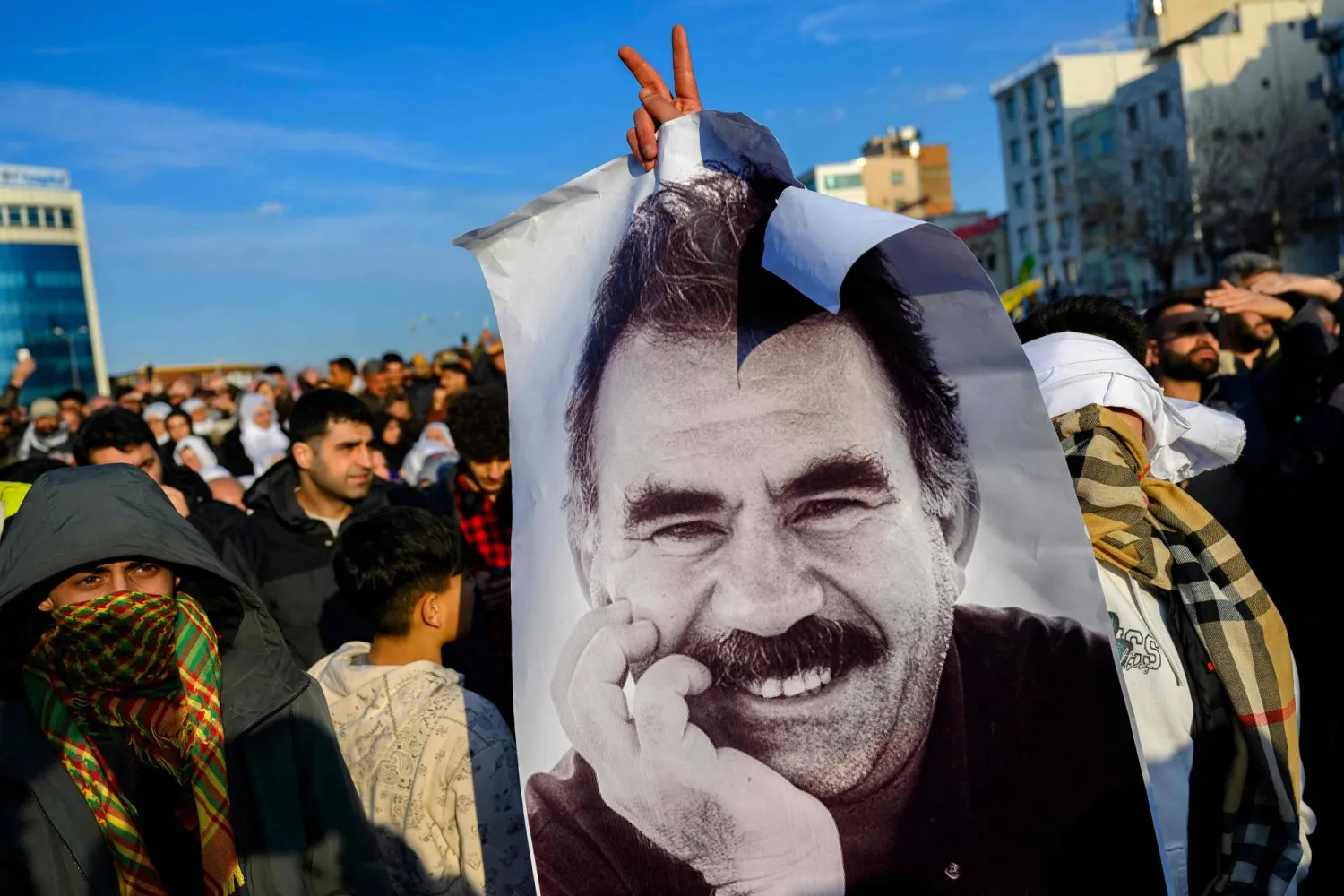
(FILES) Supporters display a poster depicting jailed leader of the Kurdistan Workers' Party (PKK) Abdullah Ocalan, after he called on the Kurdistan Workers' Party (PKK) to disarm and dissolve itself in Diyarbakir, southeastern Türkiye, on February 27, 2025.(Photo by Yasin AKGUL / AFP)
TT

Türkiye Preparing Law to Let PKK Fighters Return under Peace Plan

(FILES) Supporters display a poster depicting jailed leader of the Kurdistan Workers' Party (PKK) Abdullah Ocalan, after he called on the Kurdistan Workers' Party (PKK) to disarm and dissolve itself in Diyarbakir, southeastern Türkiye, on February 27, 2025.(Photo by Yasin AKGUL / AFP)

Türkiye is preparing a law to let thousands of Kurdistan Workers Party (PKK) fighters and civilians return home from hideouts in northern Iraq under negotiations to end generations of war.

A senior Middle East official and a Kurdish political party source in Türkiye said the proposed law would protect those returning home but stop short of offering a general amnesty for crimes committed by former militants. Some militant leaders could be sent to third countries under the plans.

Bringing PKK guerrillas and their families home from their bases in mountainous northern Iraq is seen as one of the final hurdles in a peace process launched a year ago to end a war that has killed 40,000 people.

While officials have spoken publicly about reconciliation efforts in general terms, the sources disclosed details that have not previously been reported, including proposals for returns to take place in separate waves of civilians and fighters, and for commanders to be sent to third countries.

The Middle East official, describing the sensitive negotiations on condition of anonymity, said legislation to allow the returns could come before the Turkish parliament as soon as this month.

PLAN COULD INCLUDE SEPARATE WAVES OF RETURNS

Türkiye‘s intelligence agency MIT, which has led talks with the PKK, did not immediately comment on the proposal. The PKK did not immediately comment.

Since Kurdish militants launched their insurgency in 1984 - originally with the aim of creating an independent Kurdish state - the conflict has exerted a huge economic and social burden on Türkiye and neighboring countries.

Ending it would boost NATO member Türkiye’s political and economic stability, and ease tensions in Iraq where the PKK is based, and Syria where Kurdish fighters have been allied with US forces.

In a major breakthrough, the PKK announced a decision in May to disarm and disband after a call to end its armed struggle from its jailed leader Abdullah Ocalan.

In July the group symbolically burned weapons, and last month it announced it was withdrawing fighters from Türkiye as part of the disarmament process. It called on Ankara to take steps to let its members participate in "democratic politics".

But the terms of reconciliation have been sensitive, with Türkiye wary of offering a wide amnesty for what it considers past crimes of a terrorist organization.

Numan Kurtulmus, who heads a reconciliation commission set up by Türkiye in August, said last week that any legal steps would come only after Türkiye verifies that the PKK has completed its dissolution process.

"Once Türkiye’s security and intelligence units have verified and confirmed that the organiئation has truly laid down its arms and completed its dissolution process, the country will enter a new phase of legal regulations aimed at building a terror-free Türkiye," he said.

According to the senior Middle East official, the proposal now being discussed would see roughly 1,000 civilians and non-combatants return first, followed by about 8,000 fighters after individual screening.

Beyond that, the official said Türkiye had so far rejected taking back around 1,000 senior and mid-level PKK figures, and wants them relocated to a third country, possibly in Europe.

Talks were ongoing on that issue, with some parties involved in the negotiations concerned that excluding PKK top brass from repatriation could eventually fuel a renewed insurgency, the official said.

Legislation to enable returns could come before the Turkish parliament as early as the end of November, the official added.

Tayip Temel, deputy co-chair of the pro-Kurdish DEM Party - which though an opposition party has worked closely with the government on the peace process - said the ongoing negotiations focused on a formula personally emphasiئed by Ocalan.

"Work is underway on a special law for the PKK to enable the democratic and social reintegration of its members," Temel told Reuters.

"The law will cover everyone returning from the PKK, whether civilian or militant. There is no plan for a phased return. The formula being worked on is comprehensive and applies to all."

He confirmed that Türkiye had raised the idea of some PKK figures being sent to third countries, but said this would have to be discussed with the potential hosts.

DIFFERENT PROCEDURES FOR DIFFERENT GROUPS

Another source at DEM, parliament's third-biggest party, said the commission drafting the proposal was working on a single, PKK-specific law that would avoid the language of a general amnesty.

"Different procedures will apply to different groups of returnees," the source said, adding that some returning PKK members will likely face investigations and trials. "Otherwise it will be hard to reach common ground among parties in the commission."

Once the parliamentary commission completes its work, it is expected to recommend the special PKK law to parliament, paving the way for potential legislation.

Human Rights Watch urged lawmakers to use the peace process to reform laws that have long been used to charge and incarcerate non-violent Kurdish activists.

The commission "has a unique opportunity to help shape a post-conflict society and should make bold recommendations to repeal abusive laws used to silence and marginalize people," said Hugh Williamson, Europe and Central Asia director at HRW.


Germany’s Merz Reaffirms Support for Israel During Visit

German Chancellor Friedrich Merz (L) meets with Israeli President Isaac Herzog at the President's residence in Jerusalem, 06 December 2025. (EPA)
TT

Germany’s Merz Reaffirms Support for Israel During Visit

German Chancellor Friedrich Merz (L) meets with Israeli President Isaac Herzog at the President's residence in Jerusalem, 06 December 2025. (EPA)

German Chancellor Friedrich Merz flew into Israel Saturday for his first visit since taking office, and reaffirmed Berlin’s support after traditionally solid ties between the countries were shaken by the Gaza war.

Merz landed at Tel Aviv’s Ben Gurion airport just before 8:00 pm (1800 GMT) and was met by Israeli Foreign Minister Gideon Saar, who called him “a friend of Israel.” Germany, he added, was “an important partner.”

Merz met Israeli President Isaac Herzog in Jerusalem later Saturday.

“I consider it a great honor and a truly great distinction to be here and to reaffirm that standing by this country is and will remain the unchanging core principle of the Federal Republic of Germany’s policy,” said Merz.

Earlier Saturday, Merz held talks with Jordan’s King Abdullah II during a brief stopover there. Their discussions focused largely on the fragile peace process in Israel and the Palestinian territories, he told reporters.

Merz urged more humanitarian aid to flow into Gaza and for Hamas fighters to lay down their weapons, adding that both Jordan and Germany remained committed to a negotiated two-state solution.

“There can be no place for terrorism and antisemitism in this shared future,” Merz said.

Jordan’s royal palace said in a statement that King Abdullah had stressed “the need to commit to implementing all stages of the agreement to end the war and deliver humanitarian aid to all areas of the Strip.”

He warned of “the danger of continued Israeli escalations in the West Bank,” which Israel has occupied since 1967.

Hamas said Saturday it was ready to hand over its weapons in the Gaza Strip to a Palestinian authority governing the territory, provided the Israeli army’s occupation ended.

“We accept the deployment of UN forces as a separation force, tasked with monitoring the borders and ensuring compliance with the ceasefire in Gaza,” Hamas chief negotiator and its Gaza chief Khalil al-Hayya added in a statement.

But he rejected the deployment of any international force in the Strip whose mission would be to disarm it.

Ties shaken

In Jerusalem on Sunday, Merz is scheduled to visit the Yad Vashem Holocaust memorial before meeting Prime Minister Benjamin Netanyahu.

Given the dark legacy of Nazi Germany’s industrial-scale murder of Jews, German leaders have long seen unflinching support for Israel as a bedrock of the country’s foreign policy.

But Israeli-German ties were shaken during the Gaza war set off by the October 7, 2023 Hamas attack on Israel which resulted in the deaths of 1,221 people, mostly civilians, according to an AFP tally based on official Israeli figures.

Merz, who took power in May, has repeatedly criticized Israel’s relentless military campaign, which has killed more than 69,000 Palestinians, according to the health ministry in the territory, figures the United Nations considers credible.

In August, he also moved to restrict sales of weapons for use in Gaza.

Since a fragile US-backed ceasefire and hostage deal ended full-scale fighting, Germany has lifted those export restrictions.

Despite the ceasefire, more than 350 Palestinians have been killed in Gaza, according to local health authorities, as well as three Israeli soldiers.

“The actions of the Israeli army in Gaza have posed some dilemmas for us (and) we have responded to them,” Merz said Saturday.

But, he added: “Israel has the right to defend itself.”

Defense deals

Although Merz’s public criticism of Israel was unusual for a German leader, it was measured by international standards.

Merz recently offered Israel full-throated support as European broadcasters considered whether to exclude the country from the annual Eurovision Song Contest, calling such a possibility “scandalous.”

Thursday’s decision to include Israel in the upcoming Eurovision event was warmly welcomed in Berlin.

Nevertheless, German officials have said there are currently no plans to invite Netanyahu to Berlin.

The Israeli leader faces an arrest warrant for alleged war crimes in Gaza from the International Criminal Court (ICC).

Earlier this year however, Merz vowed to invite the Israeli leader and told him he would not be arrested.

Nor have any tensions disrupted key military ties. Germany last week put into operation the first phase of the Israeli-made Arrow missile defense shield.

The $4.5-billion deal was reportedly the largest arms export agreement in Israeli history.

Before leaving Berlin on Saturday, Merz spoke with Palestinian Authority (PA) president Mahmoud Abbas.

A spokesman said Merz underscored German support for a two-state solution but urged Abbas to push through “urgently necessary reforms” of the PA in order to play a “constructive role” in the postwar order.


China and Russia Hold Third Joint Anti-missile Drills on Russian Territory

Russian President Vladimir Putin shakes hands with Chinese President Xi Jinping during a meeting at the Belt and Road Forum in Beijing, China, October 18, 2023. Sputnik/Sergei Guneev/Pool via REUTERS
TT

China and Russia Hold Third Joint Anti-missile Drills on Russian Territory

Russian President Vladimir Putin shakes hands with Chinese President Xi Jinping during a meeting at the Belt and Road Forum in Beijing, China, October 18, 2023. Sputnik/Sergei Guneev/Pool via REUTERS

China and Russia held their third round of joint anti-missile drills on Russian territory in early December, China's defense ministry said late on Saturday.

The exercises were not targeted at any third party or in response to any current international situations, according to a post on the ministry's website.

The two countries held talks on missile defense and strategic stability last month and held artillery and anti-submarine drills in the Sea of Japan in August, according to Reuters.

Russia and China signed a "no-limits" strategic partnership shortly before Russia invaded Ukraine in 2022, pledging to conduct regular military exercises to rehearse coordination between their armed forces.

Both countries have expressed concern over US President Donald Trump's plans to build a "golden dome" missile shield and his stated intention to resume nuclear weapons testing after a break of more than 30 years.


Hong Kong Heads to the Polls after Deadly Fire

Hong Kong leader John Lee urged the public to head to the polls. Peter PARKS / AFP
TT

Hong Kong Heads to the Polls after Deadly Fire

Hong Kong leader John Lee urged the public to head to the polls. Peter PARKS / AFP

Hong Kong began voting on Sunday to choose new lawmakers under Beijing's "patriots only" rules, though government efforts to drive turnout have been overshadowed by the city's deadliest fire in decades.

Beijing revamped Hong Kong's electoral system in 2021 following the city's huge and sometimes violent pro-democracy protests, but the first contest under those rules saw a record low turnout of 30 percent, said AFP.

The voter turnout just before noon Sunday stood at 10.33 percent, while the comparable figure in the last election was 9.35 percent.

Hong Kong leader John Lee again urged the public to head to the polls.

"(Your) vote represents a vote that pushes forward reform, and a vote to protect those affected by the disaster," Lee told reporters after casting his vote.

Political campaigning was abruptly paused after a blaze tore through the housing blocks of Wang Fuk Court in northern Hong Kong in late November, killing at least 159 people.

A woman surnamed Poon, whose home went up in flames, said the fire must be "thoroughly investigated", adding that she believed the government responded promptly.

"Whoever is at fault must be held responsible," Poon told AFP outside the polling station closest to the charred buildings.

She said the next batch of lawmakers "should monitor the government".

Jacky Lam, a 56-year-old teacher who lived in the affected Tai Po district, said the government's top priority should be proper resettlement.

"(Lawmakers) ought to regularly meet with residents and collect their views," Lam added.

The government will propose a bill at the first meeting of the new Legislative Council to discuss relief and rebuilding efforts.

City leader Lee had earlier announced a judge-led "independent committee" to investigate the fire, which devastated seven apartment blocks undergoing renovations.

As of late Wednesday, police have arrested 15 people from various construction companies on suspicion of manslaughter.

Police also reportedly arrested at least three people for sedition in the wake of the fire, including 24-year-old student Miles Kwan who handed out flyers calling for government accountability. AFP later saw Kwan leaving the police station.

Turnout in spotlight

Legislature elections in Hong Kong used to feature boisterous clashes between pro-Beijing and pro-democracy camps, with the latter often winning around 60 percent of the popular vote.

But in 2020, Beijing imposed a sweeping national security law after the city was roiled by huge and sometimes violent pro-democracy protests.

Beijing overhauled Hong Kong's electoral system in 2021 to ensure only "patriots" could hold office, and slashed the number of directly elected seats.

Some pro-democracy lawmakers have been jailed -- including as part of a subversion case that concluded last year -- while others resigned or fled Hong Kong.

Authorities extended voting times with Sunday's polls opening at 7:30 am (2330 GMT Saturday), an hour earlier than in the previous election.

The race will once again be devoid of the two largest pro-democracy parties: the Civic Party disbanded in 2023 and the Democratic Party, which is winding down.

Before the fire, authorities had blanketed much of the city in promotional material and extended the operating hours of polling stations.

Trains will also extend services on election day, while some businesses have promised to give employees a half-day off if they head to the polls.

Around a third of the outgoing cohort of lawmakers, including veterans such as Regina Ip and legislature president Andrew Leung, are not seeking another term.

Newcomers include Olympic champion fencer Vivian Kong, who is contesting a seat in the tourism functional constituency -- where the winner is determined by industry representatives, not popular vote.