


Rare Footage Shows Sucker Fish as They Whale-surf in the Ocean's Wildest Joyride

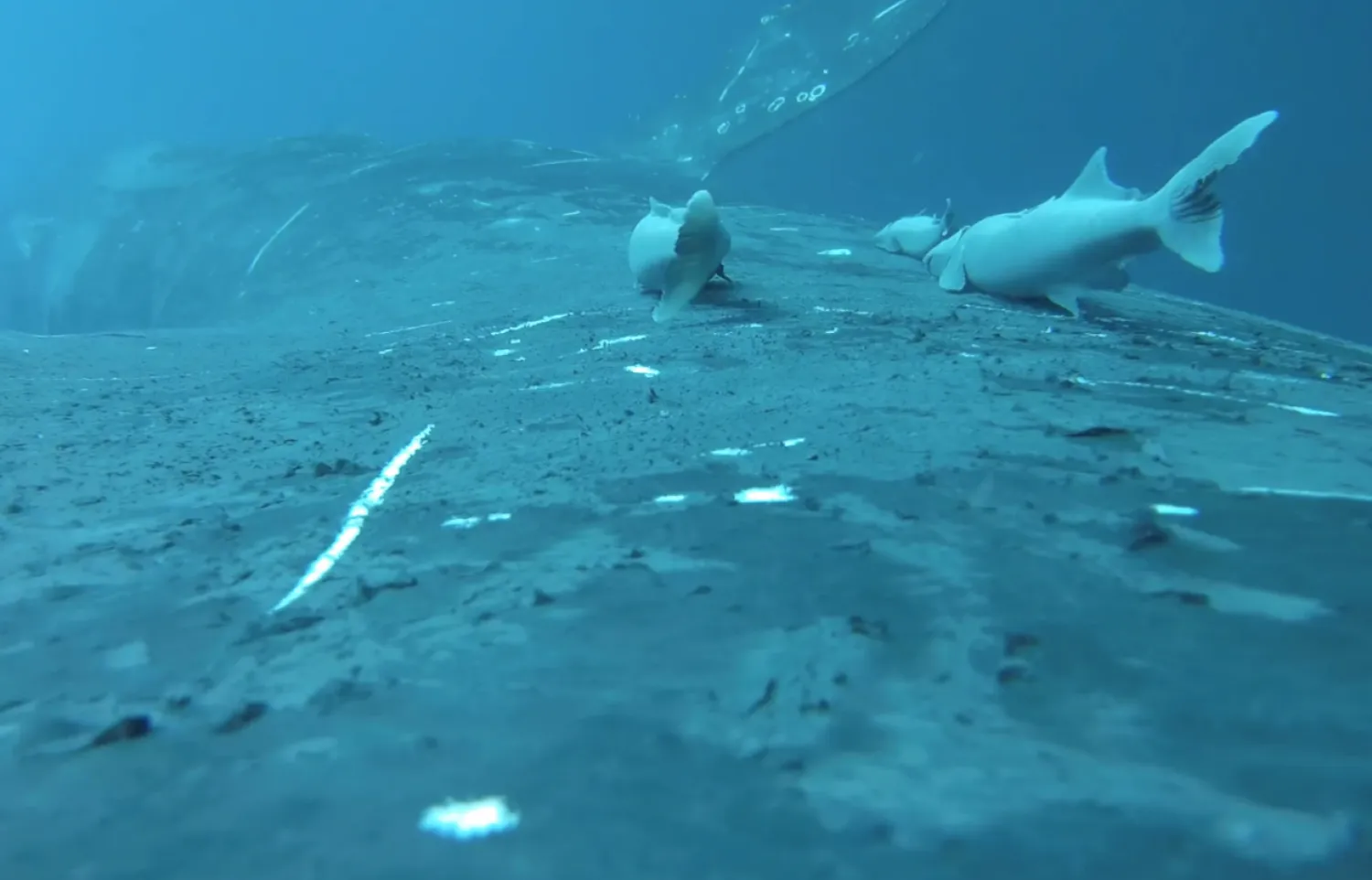
In this image made from video remora fish ride a humpback whale off the coast of south-east Queensland, Australia, on June 15, 2024. (Olaf Meynecke/Whales and Climate Program via AP)
TT

Rare Footage Shows Sucker Fish as They Whale-surf in the Ocean's Wildest Joyride

In this image made from video remora fish ride a humpback whale off the coast of south-east Queensland, Australia, on June 15, 2024. (Olaf Meynecke/Whales and Climate Program via AP)

There are easier ways to cross an ocean, but few are as slick or stylish as the remora’s whale-surfing joyride.

Scientists tracking humpbacks off the coast of Australia have captured rare footage that shows clutches of the freeloading fish peeling away from their host in what looks like a high-speed game of chicken, just moments before the whale breaches.

As the humpback plunges back below the surface the remoras, also known as sucker fish, return to the whale, sticking their landings with the timing and precision of Olympic gymnasts. It’s elegant work for a hitchhiking fish that lives upside-down and survives on dead skin flakes, The AP news reported.

Remora australis spend their lives aboard whales or other large marine mammals, which they ride like giant cruise ships, breeding and feeding their way across stretches of ocean. The species has an adhesive plate on its head that helps to create a kind of vacuum seal, allowing the fish to grab a whale and hang on for the ride.

On whale cams, clingy fish steal the show The marine scientist who recorded the accidental close-ups of the remoras’ high-speed whale surfing had placed suction-cup cameras on humpbacks during their annual migration from Antarctica to the waters off Australia’s Queensland state. Olaf Meynecke planned to study whale behavior, but his video feeds regularly filled with dozens of photobombing remoras, which rode in groups of up to 50 as they clung to the same spots where his cameras were attached.

“Whenever the whale was breaching and doing in particular fast movements it appears that the sucker fish were responding very quickly to the movements,” said Meynecke, from the Whales and Climate Research Program at Griffith University. “They knew exactly when to let go of the body of the whale before it was breaching the surface of the water and then returned to the same spot only seconds later.”

A hitchhiker with good instincts Remoras are harmless to the 40-metric ton (44-U.S. ton) giants of the ocean, feeding on the whales’ dead skin and sea lice in a mutually beneficial arrangement — or at least that’s what scientists say. Meynecke said his footage suggested the whales found their hangers-on annoying.

“We’ve had individuals with high numbers of these remoras and they were continually breaching and there were no other whales that they were communicating with,” he said. “It appeared that they’re trying to just get rid of some of these remoras and they were checking whether they had less after they breached.”

The journey’s end remains a mystery Australia’s so-called humpback highway is a migratory corridor traversed by 40,000 of the mammals, bringing them close to the country’s eastern coastlines for months each year as they move from icy Antarctic waters to the balmy seas off the coast of Queensland and back. How long much of the 10,000-km (6,000-mile) journey is undertaken by the freeloading fish, which only live for about two years, is still a puzzle, Meynecke said.

“I suspect that the majority would probably leave at some point, maybe in temperate waters, but then where do they go?” he said. “Do they find other species that they can then use as a host and wait until the humpback whales have come back?”

In the absence of whales, sucker fish avoid predators by seeking other large creatures to latch onto, including manta rays, dolphins and unlucky scuba divers.

“Much to the annoyance of the divers, of course,” Meynecke said. “They’re not easy to get rid of.”



Hundreds of Thousands without Power After Storm Lashes France 

A man walks along a flooded street of Saint-Germain de Confolens as severe flooding hits western France amid storm Nils, Thursday, Feb. 12, 2026. (AP)
TT

Hundreds of Thousands without Power After Storm Lashes France 

A man walks along a flooded street of Saint-Germain de Confolens as severe flooding hits western France amid storm Nils, Thursday, Feb. 12, 2026. (AP)

Around 450,000 households in southern France were without power on Friday, operator Enedis said, a day after a storm tore through the region, ripping up trees and flooding roads.

High winds and hard rain brought chaos across southern France, northern Spain and parts of Portugal on Thursday, forcing cancellations of flights, trains and ferries and disruption on roads.

French officials said a truck driver was killed when a tree smashed through his windscreen, while dozens were injured in weather-related incidents in Spain and a viaduct in Portugal partially collapsed because of flooding.

French forecasters said the storm, named Nils, was "unusually strong" and France's electricity distributor said it had mobilized around 3,000 as it battled to reconnect households to the grid.

"Enedis has restored service to 50 percent of the 900,000 customers who were without electricity," it wrote around 6:00 am (0500 GMT).

"Flooding complicates repairs because the fields are waterlogged and some roads are blocked," Enedis crisis director Herve Champenois said during a press briefing on Thursday.

Residents across the south of France were shocked at the storm's ferocity.

"I've never seen anything like it," Ingrid, a florist in the city of Perpignan, told AFP. "A tree almost fell on my car -- two seconds more and it would have."

"During the night, you could hear tiles lifting, rubbish bins rolling down the street -- it was crazy," said Eugenie Ferrier, 32, from the village of Roaillan near Bordeaux in the southwest.

Forecasters said the storm had moved eastwards away from French territory during Thursday, though some areas were still on alert for flooding.


Thailand Uses Birth Control Vaccine to Curb Elephant Population Near Expanding Farms

This photo released by Thailand Department of National Parks, Wildlife and Plant Conservation shows a wild elephant after it received an elephant contraception vaccine in the Trat province of Thailand, Tuesday, Jan. 27, 2026. (Thailand Department of National Parks, Wildlife and Plant Conservation via AP)
TT

Thailand Uses Birth Control Vaccine to Curb Elephant Population Near Expanding Farms

This photo released by Thailand Department of National Parks, Wildlife and Plant Conservation shows a wild elephant after it received an elephant contraception vaccine in the Trat province of Thailand, Tuesday, Jan. 27, 2026. (Thailand Department of National Parks, Wildlife and Plant Conservation via AP)

Thailand has begun using a birth control vaccine on elephants in the wild to try and curb a growing problem where human and animal populations encroach on each other — an issue in areas where farms spread into forests and elephants are squeezed out of their natural habitat.

The initiative is part of efforts to address confrontations that can turn deadly. As farmers cut down forests to make more farmland, elephants are forced to venture out of their shrinking habitats in search of food.

Last year, wild elephants killed 30 people and injured 29 in Thailand, according to official figures, which also noted more than 2,000 incidents of elephants damaging crops.

Sukhee Boonsang, director of the Wildlife Conservation Office, recently told The Associated Press that controlling the wild elephant population has become necessary as numbers of elephants living near residential areas rises sharply, increasing the risk of confrontations.

The office obtained 25 doses of a US-made vaccine and conducted a two-year trial on seven domesticated elephants — using up seven doses of the vaccine — which yielded promising results, he said. He explained the vaccine doesn't stop female elephants from ovulating but prevents eggs from being fertilized.

Then, in late January, the vaccine was administered to three wild elephants in eastern Trat province, he said, adding that authorities are now determining which areas to target next as they prepare to use up the remaining 15 doses.

The vaccine can prevent pregnancy for seven years and the elephants will be able to reproduce again if they don’t receive a booster after that time expires. Experts will closely monitor the vaccinated elephants throughout the seven-year period.

The vaccination drive has drawn criticism that it might undermine conservation efforts.

Thailand has a centuries-old tradition of using domesticated elephants in farming and transportation. Elephants are also a big part of Thailand’s national identity — and have been officially proclaimed a symbol of the nation.

Sukhee said the program targets only wild elephants in areas with the highest rates of violent human-elephant conflict. Official statistics show a birth rate of wild elephants in these regions at approximately 8.2% per year, more than double the national average of around 3.5%.

About 800 out of the nation’s approximately 4,400 wild elephants live in these conflict-prone areas, Sukhee said.

“If we don’t take action, the impact on people living in these areas will continue to grow until it becomes unmanageable,” he said.

In addition to the contraception vaccine, authorities have implemented other measures to reduce conflict, Sukhee said, such as creating additional water and food sources within the forests where elephants live, constructing protective fencing, and deploying rangers to guide elephants that stray into residential areas back into the wild.

A court-ordered operation earlier this month to remove wild elephants that have repeatedly clashed with locals in northeastern Khon Kaen province sparked a public outcry after one elephant died during the relocation process.

An initial autopsy revealed that the elephant died from choking after anesthesia was administered ahead of the move, officials said.

The Department of National Parks, Wildlife and Plant Conservation carried out the relocation effort, and its director general, Athapol Charoenshunsa, expressed regret over the incident while insisting that protocol was followed properly. He said an investigation was underway to prevent such incidents from happening again.


Informed Source: Two Louvre Staff Arrested over Ticket Fraud

(FILES) Tourists stand next to barriers blocking the plaza with the Louvre Pyramid. (Photo by Martin LELIEVRE / AFP)
TT

Informed Source: Two Louvre Staff Arrested over Ticket Fraud

(FILES) Tourists stand next to barriers blocking the plaza with the Louvre Pyramid. (Photo by Martin LELIEVRE / AFP)

French police have dismantled a "large-scale" ticket fraud network at the Louvre in Paris, the museum said Thursday, while a source following the case said two staff had been arrested.

The operation took place on Tuesday following "a report from the Louvre museum", a spokeswoman for the world-famous institution told AFP.

"Based on the information available to the museum, we suspect the existence of a network organizing large-scale fraud," she added.

She said the world's most visited museum was facing "a rise and diversification in ticketing fraud" and has, in response, implemented a "structured" anti-fraud plan in cooperation with its staff and the police.

According to a source following the case, the suspected fraud scheme was launched in the summer of 2024.

French daily Le Parisien said nine people were arrested, including two museum employees and two tour guides. The Chinese community was believed to be particularly targeted by the scam, the newspaper said.

Louvre bosses have been under huge pressure after four thieves carried out a brazen robbery in October, making off with jewelry worth an estimated $102 million.

Authorities have arrested all four alleged members of the heist crew but have not found the stolen jewels.

In recent months trade unions have launched several days of strikes at the Louvre, pressing for more recruitment, more pay and better maintenance of the vast former royal palace.