

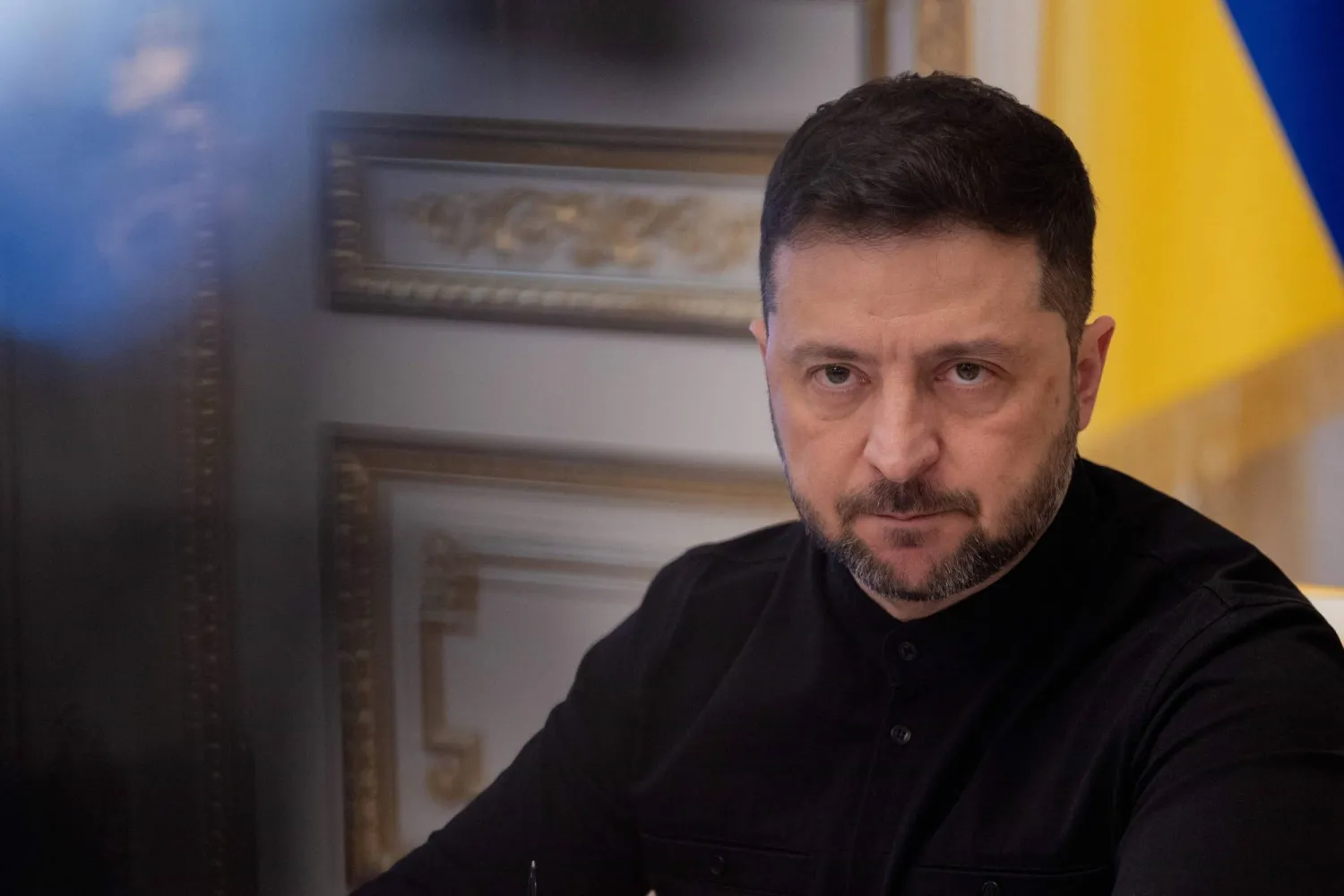

Zelensky Seeks Patriot Systems from US to Counter Russia's Power Grid Attacks

Ukraine's President Volodymyr Zelensky listens during a press conference in Kyiv on October 31, 2025, amid the Russian invasion of Ukraine. (Photo by Tetiana DZHAFAROVA / AFP)
TT

Zelensky Seeks Patriot Systems from US to Counter Russia's Power Grid Attacks

Ukraine's President Volodymyr Zelensky listens during a press conference in Kyiv on October 31, 2025, amid the Russian invasion of Ukraine. (Photo by Tetiana DZHAFAROVA / AFP)

President Volodymyr Zelensky said Monday he wants to order 25 Patriot air defense systems from the United States, as Ukraine desperately tries to fend off relentless Russian aerial attacks that have brought rolling blackouts across Ukraine on the brink of winter.

Zelensky acknowledged that the Patriot systems are expensive and that such a large batch could take years to manufacture. But he said European countries could give their Patriots to Ukraine and await replacements, stressing that “we would not like to wait.”

Combined missile and drone strikes on the power grid have coincided with Ukraine’s frantic efforts to hold back a Russian battlefield push aimed at capturing the eastern stronghold of Pokrovsk. Meanwhile, international peace efforts appear to have dissipated, nearly four years after Russia invaded its neighbor.

Zelensky said Ukraine recently received more Patriot systems from Germany. It is not known how many Patriot systems are in Ukraine. But on the whole air defenses remain stretched thin across wide expanses of Ukrainian territory, and the threat to the provision of heating and running water in the bitter winter is acute.

NATO is coordinating regular deliveries of large weapons packages to Ukraine. European allies and Canada are buying much of the equipment from the United States. The Trump administration is not giving any arms to Ukraine, unlike the previous Biden administration.

Russia’s attacks on energy infrastructure have grown more effective. It launches hundreds of drones, some equipped with cameras to improve targeting, that overwhelm Ukraine’s air defenses, especially in regions where protection is weaker. Also, this year it is striking region by region, hitting local switchyards and substations, instead of taking aim at the centralized national grid.

Ukraine’s Energy Ministry said Monday that Russian attacks caused more damage to its power infrastructure, resulting in scheduled blackouts in most of the country’s regions. It urged Ukrainians to rationalize their use of electricity, especially during peak consumption hours in the mornings and evenings.

Meanwhile, the two sides were locked in a battle for control of Pokrovsk, in Ukraine’s eastern Donetsk region where Zelensky says Russia has assembled 170,000 troops for a renewed push.

There has been a relative lull in fighting in recent days, according to reports gathered by the Institute for the Study of War. But the Washington-based think tank said it expected Russian forces to quicken the tempo of their attacks in coming days as they move more troops into the city.


Sirens Heard at Incirlik Air Base, Key NATO Facility in South Türkiye

İncirlik Air Base in Adana, southern Türkiye (AFP)
TT

Sirens Heard at Incirlik Air Base, Key NATO Facility in South Türkiye

İncirlik Air Base in Adana, southern Türkiye (AFP)

Sirens were heard early on Friday at Türkiye’s Incirlik airbase, a key NATO facility where US troops are stationed near the southeastern city of Adana, state news agency Anadolu reported.

There was no immediate official comment on the incident, which took place four days after NATO air defenses shot down a ballistic missile in Turkish airspace that was fired from Iran, the second in five days.

Residents of Adana, which lies 10 kilometers (six miles) away from the base, were woken at around 3:25 am (0025 GMT) by sirens, which sounded for around five minutes, according to the Ekonomim business news website.

It said a red alert sounded at the base.

Several people posted mobile phone footage on social media of a glowing image flying through the sky, suggesting it could be a missile heading for the airbase, it said.

Across the city, sirens from fire engines and the security forces could be heard for a long time, it added.

NATO said it shot down a second ballistic missile fired from Iran on Monday, prompting a stern warning from Türkiye to Tehran not to take "provocative steps".

The announcement came shortly after Washington said it was closing down its consulate in Adana, urging all American citizens to leave southeastern Türkiye.

Since the US-Israeli war against Iran started, Tehran has launched strikes across the Middle East. Türkiye had appeared to have been spared.

As well as Incirlik airbase, US troops are also stationed at Kurecik, another Turkish base that is a NATO facility in the center of the country, where a Patriot missile defense system was deployed on Tuesday.

A first missile had been intercepted by NATO defenses in Turkish air space on March 4.


Iran War Disrupts Energy Supplies as Iran's New Leader Resolves to Keep Fighting

FILE - A thick plume of smoke rises Sunday, March 8, 2026, from an oil storage facility struck overnight in Tehran, Iran. (AP Photo/Vahid Salemi, File)
TT

Iran War Disrupts Energy Supplies as Iran's New Leader Resolves to Keep Fighting

FILE - A thick plume of smoke rises Sunday, March 8, 2026, from an oil storage facility struck overnight in Tehran, Iran. (AP Photo/Vahid Salemi, File)

Iran’s secretive new leader issued his first public statements Thursday, resolving to keep fighting and threatening to open “other fronts” in a war that has already disrupted world energy supplies, the global economy and international travel.

Early Friday, US President Donald Trump issued a new threat online to Iran, writing: “Watch what happens to these deranged scumbags today.” Trump tallied the damage inflicted on Iran and its leaders and called it a “great honor” to be responsible for it.

The remarks by Supreme Leader Mojtaba Khamenei came as Israeli Prime Minister Benjamin Netanyahu said his country's attacks were creating conditions for the Iranian population to topple the government, The Associated Press reported.

“It is in your hands,” Netanyahu said at a news conference, addressing the Iranian people. “We are creating the optimal conditions for the fall of the regime.”

Since the start of the war, US and Israeli strikes have targeted security checkpoints in Iran to undermine the government’s ability to suppress dissent, according to Armed Conflict Location and Event Data, the US-based independent monitoring group known as ACLED.

Intense airstrikes hit early Friday around Iran’s capital, Tehran, as well as outlying areas. It was not immediately clear what had been targeted.

Netanyahu denounces Iranian leader

Netanyahu denounced Khamenei as a “puppet of the Revolutionary Guards."

Khamenei is close to Iran’s paramilitary Revolutionary Guard and is widely seen as even less compromising than his father, Ali Khamenei.

Khamenei said in a statement read by a state TV news anchor that he was keeping a “file of revenge.” He did not appear on camera and has not been seen since his father and wife were killed in the war’s opening salvo, which also wounded him, according to an Iranian ambassador.

Oil prices spiral again and stocks sink

The war continued to escalate on its 13th day as oil prices spiraled up again to $100 per barrel, and stocks sank worldwide over fears that the conflict could drag on longer than hoped.

To relieve the surge in prices, the US Treasury Department announced it was further easing sanctions on Russian oil by granting a license that authorizes the delivery and sale of some Russian crude oil and petroleum products for the next month.

Trump signaled earlier this week that he would take more action to address the squeeze on oil flows. The move follows the administration’s decision to grant temporary permission for India to buy Russian oil.

The new exemption applies only to Russian oil already at sea. Last week, analysts estimated there were about 125 million barrels loaded on tankers. To put that in perspective, about 20 million barrels of oil per day usually pass through the Strait of Hormuz, according to the International Energy Agency.

Iran has made clear it plans to keep up attacks on energy infrastructure across the region and use the effective closure of the strait as leverage against the United States and Israel. A fifth of the world’s traded oil flows through the waterway leading from the Arabian Gulf toward the Indian Ocean.

At a news conference Thursday, Iran’s ambassador to Tunisia, Mir Masoud Hosseinian, said Iranian naval forces “have established full control” over the strait and “carried out precise strikes in response to attacks on our oil infrastructure.”

“Global energy security is contingent on respect for Iran’s sovereignty,” he said.

The pinch was being felt worldwide. South Korea reinstated government-set caps on oil prices for the first time in three decades as it sought to calm soaring fuel costs. The two-week caps, which took effect Friday, set maximum prices for petroleum products supplied by refiners to gas stations and other businesses.

Iranian leader calls for the shutdown of US bases

Hosseinian told The Associated Press the new supreme leader was wounded in the attack on his family’s home, but “it is not serious.” The hope is he will attend the massive, state-organized Eid prayer next week that his father traditionally led. However, Khamenei remains a target for the Israelis, who have vowed to kill him.

Hosseinian said Iran’s strikes on Gulf nations have been strategic. “Even when we targeted hotels, we had precise information that they were hosting American and Israeli soldiers,” he said.

Khamenei called on Gulf Arabs to “shut down” US bases in the region, saying protection promised by Washington was “nothing more than a lie.”

He also said Iran has studied “opening other fronts in which the enemy has little experience and would be highly vulnerable” if the war continues. He did not elaborate, but Iran has been linked to previous attacks on US, Israeli and Jewish targets around the world.


Mojtaba Khamenei Says Closure of Strait of Hormuz Should be Used as 'Leverage'

(FILES) In this picture obtained from Iran's ISNA news agency, Mojtaba Khamenei (C), son of Iran's supreme leader Ayatollah Ali Khamenei, walks along a street in Tehran on May 31, 2019. (Photo by Hamid FOROUTAN / ISNA / AFP)
TT

Mojtaba Khamenei Says Closure of Strait of Hormuz Should be Used as 'Leverage'

(FILES) In this picture obtained from Iran's ISNA news agency, Mojtaba Khamenei (C), son of Iran's supreme leader Ayatollah Ali Khamenei, walks along a street in Tehran on May 31, 2019. (Photo by Hamid FOROUTAN / ISNA / AFP)

Iran’s Supreme Leader Mojtaba Khamenei issued his first statement on the war on Thursday, saying that the leverage of closing the Strait of Hormuz should be used.

Khamenei called on people in Gulf countries to “shut down” US bases, saying promised US protection is “nothing more than a lie.”

Khamenei did not appear on camera. Israeli intelligence assessed that he was likely wounded in the war’s opening salvo, which he said also killed his wife, one of his sisters, his niece and his father, Supreme Leader Ali Khamenei.

US President Donald Trump has promised to “finish the job,” even as Iran is “virtually destroyed.” The first week of the war cost the United States $11.3 billion, according to the Pentagon.

“One point I must emphasize is that, in any case, we will obtain compensation from the enemy,” Khamenei said.

“If it refuses, we will take from its assets to the extent we deem appropriate, and if that is not possible, we will destroy its assets to the same extent.”
