


Large-Scale Israeli Exercise in West Bank Simulates October 7 Attack 

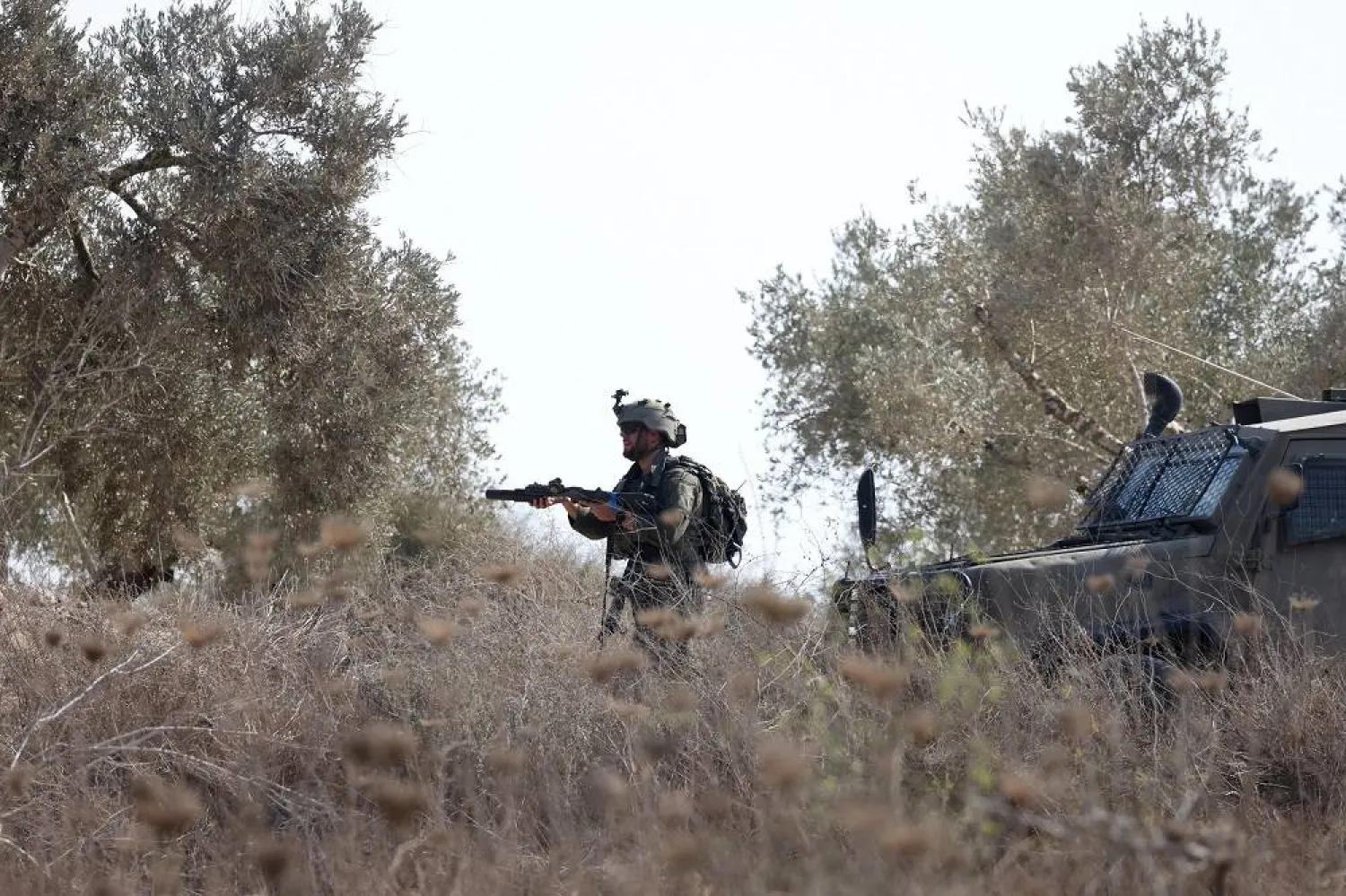
An Israeli soldier takes position during clashes with Palestinian farmers and international activists after they try to reach olive farms outside the village of Beit Led and close to an Israeli settler outpost, near the West Bank city of Qalqilya, 07 November 2025. (EPA)
TT

Large-Scale Israeli Exercise in West Bank Simulates October 7 Attack 

An Israeli soldier takes position during clashes with Palestinian farmers and international activists after they try to reach olive farms outside the village of Beit Led and close to an Israeli settler outpost, near the West Bank city of Qalqilya, 07 November 2025. (EPA)

The Israeli Army kicked off on Monday large-scale multi-branch military exercises across the West Bank and Jordan Valley to boost readiness and simulate events similar to the Oct. 7, 2023 in the Gaza Strip.

The three-day “Lion's Roar” exercise involves forces of the army’s Central Command, as well as “special units,” the air force, the army Technology and Logistics Directorate and other military branches and security forces, according to an army spokesperson.

A military statement said drones and various weapons will be used during the drill, and “increased movement of security forces and aircraft will be felt in the area.”

The drill is taking place as part of the Operations Directorate’s training schedule, aimed at training and implementing operational plans with a multi-arena perspective. This exercise was preplanned as part of the Army’s annual training program for 2025, the army statement said.

Renewed calls for annexation

The exercises come while Israeli transportation Minister Miri Regev said her ministry is already enforcing “de facto sovereignty” over the occupied West Bank through a network of state-funded infrastructure projects, effectively implementing annexation on the ground.

Speaking on Israel’s Channel 12 News, Regev described road construction and transportation development in the territory as practical acts of sovereignty, reflecting a broader governmental strategy to integrate settlements into Israel’s national infrastructure grid.

Her statements appear to challenge the decision of US President Donald Trump, who said last month he will now allow Israel to annex the West Bank.

Israel plans to annex 82% of the West Bank to prevent the establishment of a Palestinian state.

The Oslo Accords have divided the West Bank into three areas: A, B, and C, each with a different level of Palestinian and Israeli control.

Area A (18% of the West Bank) is under full Palestinian Authority (PA) civil and security control.

Area B (21% of the West Bank) is under PA civilian control with Israeli security control while Area C (61% of the West Bank) is under full Israeli civil and military control.

Although Trump has said he will not allow Israel to annex the West Bank, Israel has pushed for large-scale settlement projects and has given settlers a free hand to control more areas of the West Bank.

According to Palestinian figures, there are 200 Israeli settlements, 243 settlement outposts and 129 farm outposts in the West Bank.



Syria to Start Currency Swap on January 1st, Central Bank Governor Says

Syrian pounds are pictured inside an exchange currency shop in Azaz, Syria February 3, 2020. Picture taken February 3, 2020. REUTERS/Khalil Ashawi/File Photo
TT

Syria to Start Currency Swap on January 1st, Central Bank Governor Says

Syrian pounds are pictured inside an exchange currency shop in Azaz, Syria February 3, 2020. Picture taken February 3, 2020. REUTERS/Khalil Ashawi/File Photo

Syria will start swapping old banknotes for new ones under a ​plan to replace Assad-era notes starting from January 1, 2026, Central Bank Governor Abdelkader Husrieh said on Thursday.

Husrieh announced the introduction of the new Syrian currency, saying the decree "sets January ‌1, 2026, ‌as the start date ‌for ⁠the ​exchange ‌process". Sources familiar with the matter told Reuters in August that the country will issue new banknotes, removing two zeros from its currency in an attempt to restore ⁠public confidence in the severely devalued pound.

The ‌step is intended ‍to strengthen ‍the Syrian pound after its purchasing ‍power collapsed to record lows following a 14-year conflict that ended with President Bashar al-Assad's ouster in December.

Husrieh ​said the operation will take place through a smooth and orderly ⁠swap - a move bankers hope will ease fears that the new currency could fuel inflation and further erode the purchasing power of Syrians already reeling from high prices.

He added that a press conference will soon outline the exact regulations and mechanisms.


Türkiye Begins Black Box Analysis of Jet Crash That Killed Libyan Military Chief and 7 Others

Libyan national flags fly at half-mast in Tripoli on December 24, 2025, after the head of Libya's armed forces and his four aides died in a plane crash in Türkiye. (AFP)
TT

Türkiye Begins Black Box Analysis of Jet Crash That Killed Libyan Military Chief and 7 Others

Libyan national flags fly at half-mast in Tripoli on December 24, 2025, after the head of Libya's armed forces and his four aides died in a plane crash in Türkiye. (AFP)

The technical analysis of the recovered black boxes from a jet crash that killed eight people, including western Libya’s military chief, began as the investigation proceeded in cooperation with Libyan authorities, the Turkish Ministry of Defense said Thursday.

The private jet with Gen. Muhammad Ali Ahmad al-Haddad, four other military officials and three crew members crashed on Tuesday after taking off from Türkiye’s capital, Ankara, killing everyone on board. Libyan officials said the cause of the crash was a technical malfunction on the plane.

The high-level Libyan delegation was on its way back to Tripoli after holding defense talks in Ankara aimed at boosting military cooperation between the two countries.

The wreckage was scattered across an area covering 3 square kilometers (more than a square mile), complicating recovery efforts, according to the Turkish Interior Minister Ali Yerlikaya.

A 22-person delegation, including five family members, arrived from Libya early on Wednesday to assist in the investigation.


Lebanese President: We are Determined to Hold Parliamentary Elections on Time

President Joseph Aoun between Prime Minister Nawaf Salam and Speaker Nabih Berri (Lebanese Presidency file photo)
TT

Lebanese President: We are Determined to Hold Parliamentary Elections on Time

President Joseph Aoun between Prime Minister Nawaf Salam and Speaker Nabih Berri (Lebanese Presidency file photo)

Lebanese President Joseph Aoun reiterated on Thursday that the country’s parliamentary elections are a constitutional obligation that must be carried out on time.

Lebanon’s state-run National News Agency quoted Aoun as saying that he, alongside Prime Minister Nawaf Salam and Parliament Speaker Nabih Berri, is determined to hold the elections on schedule.

Aoun also emphasized that diplomatic efforts have continued unabated to keep the specter of war at bay, noting that "things are heading in a positive direction".

The agency also cited Berri reaffirming that the elections will take place as planned, with "no delays, no extensions".

The Lebanese parliamentary elections are scheduled for May next year.