


Iran Nuclear Stalemate Drives Escalation with Israel, No End in Sight

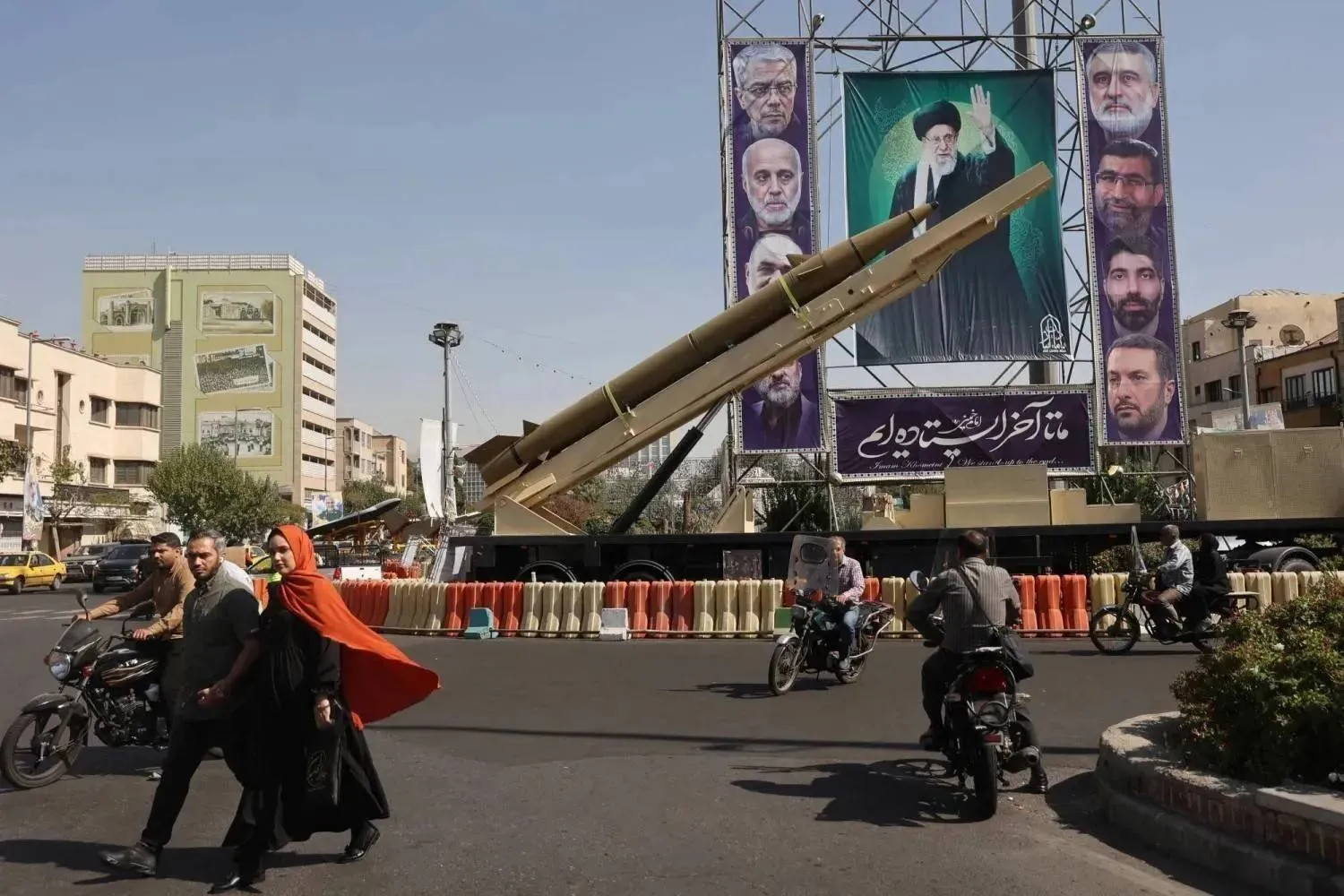
Iranian ballistic missile displayed next to a banner showing Supreme Leader Ali Khamenei and Revolutionary Guard leaders killed in Israeli strikes on a Tehran street (Reuters file photo)
TT

Iran Nuclear Stalemate Drives Escalation with Israel, No End in Sight

Iranian ballistic missile displayed next to a banner showing Supreme Leader Ali Khamenei and Revolutionary Guard leaders killed in Israeli strikes on a Tehran street (Reuters file photo)

With no direct negotiations or meaningful international monitoring of Iran’s nuclear program, and growing uncertainty over the size of its stockpile of enriched material, fears are rising across the region that a fresh confrontation between Iran and Israel has become a matter of time.

Although the likelihood of war appears high, most analysts say the moment has not yet arrived, as both sides continue rebuilding their military capabilities at a rapid pace amid unprecedented diplomatic paralysis.

Farzin Nadimi, a senior fellow at the Washington Institute for Near East Policy, says the chance of a new war between Iran and Israel is very high, but adds that indicators do not point to it being imminent.”

He told Asharq Al-Awsat that both sides will likely try to delay the inevitable through limited diplomatic efforts to contain escalation, while frantically rebuilding their arsenals.

Escalation and denial of mediation with Washington

Iran continues to issue threats while insisting on its conditions for any future talks, projecting a sense of confidence that has been reflected in statements by several Iranian officials.

They have stressed their readiness to respond “with greater force” to any Israeli attack, while denying that Tehran has sent messages or shown willingness to negotiate with Washington. Some of these warnings, analysts say, have even been channeled through outlets operating from within the US capital itself.

Ali Larijani, secretary of Iran’s Supreme National Security Council, denied that Tehran had sought to lift sanctions through any mediation or correspondence with the US administration, insisting that Iran “will not surrender to American hegemonic tendencies even if that means facing a new confrontation.”

Larijani said “the American narrative about Iran’s weakness is ridiculous,” adding that the country “has chosen the path of resistance despite economic hardships,” and “will not burden itself with empty talk from any government.”

Nadimi says Iran’s hardened rhetoric in recent weeks reflects “growing confidence within the regime,” whose leaders believe their performance during the last twelve-day war with Israel was “successful” and earned them domestic momentum.

Iran, he says, “believes it can perform even better in any future confrontation after reactivating its missile and drone production lines around the clock.”

Nuclear stalemate and absence of international oversight

Analysts say the region has entered a phase of “dangerous stagnation” following the collapse of the 2015 nuclear deal and the return of strict US sanctions, as Iran continues to bar International Atomic Energy Agency inspectors from accessing suspected enrichment sites, including the new facility under the Pickaxe mountain.

According to IAEA Director General Rafael Grossi, Iran still holds about 400 kilograms of uranium enriched to 60 percent, a quantity nearing weapons-grade levels that has heightened Israeli concern that Tehran is approaching a “red line.”

Some warn that continued uncertainty over Iran’s nuclear capabilities “may push Israel to act again to complete what it sees as an unfinished mission during the last war.”

Iran, however, appears increasingly willing to deter such action, arguing that any new attack would offer an opportunity to restore balance and shed the image of weakness left by the previous conflict.

Since the end of the brief military confrontation between Iran and Israel last summer, regional power dynamics have shifted markedly.

Iran now appears more isolated than at any time since the 2003 US invasion of Iraq, while several Arab states have strengthened their influence in Washington through close economic and strategic ties with President Trump’s administration, which continues to support Israel politically and militarily.

Even so, these states are working to keep communication channels open with Tehran to avoid a full-scale regional war. They do not want another conflict, but recognize that Iran, despite its relative weakness, remains capable of sowing turmoil through its regional proxies.

This vulnerability, Nadimi says, “may make Iran more dangerous because it could resort to reckless options in an attempt to restore its regional stature.”

No alternative to force

On the Israeli side, the government does not hide its intention to resume military operations against Iran “the moment it moves closer to producing a nuclear weapon.”

Tel Aviv believes containing Iran’s nuclear program “will not be achieved through negotiations, but through preemptive strikes,” even as Arab states increase pressure on Washington to rein in any uncalculated Israeli escalation.

Chances of returning to the negotiating table now appear almost nonexistent, particularly after Iran’s Supreme Leader Ali Khamenei declared that “America’s arrogant nature accepts nothing but surrender,” signaling rejection of any talks under US terms.

Most assessments converge on the view that any future confrontation between Iran and Israel, if it occurs, will be broader and bloodier than previous rounds.

Tehran is preparing to use its missile and drone arsenal on an unprecedented scale, while Israel continues to deliver precision strikes on sites believed to house secret enrichment facilities.



Man Arrested after Pepper Spray Attack in London's Heathrow Airport Parking Garage

File photo: A plane prepares ahead of taking-off, after radar failure led to the suspension of outbound flights across the UK, at Heathrow Airport in Hounslow, London, Britain, July 30, 2025. (Reuters)
TT

Man Arrested after Pepper Spray Attack in London's Heathrow Airport Parking Garage

File photo: A plane prepares ahead of taking-off, after radar failure led to the suspension of outbound flights across the UK, at Heathrow Airport in Hounslow, London, Britain, July 30, 2025. (Reuters)

Police arrested a man in London on Sunday after a group of people were assaulted with pepper spray in a parking garage at Heathrow Airport.

The victims were taken to the hospital by ambulance but their injuries were not believed to be serious, the Metropolitan Police said.

The incident in the Terminal 3 garage occurred after an argument escalated between two groups who knew each other. It was not being investigated as terrorism, police said.

One man was arrested on suspicion of assault and held in custody. Police were searching for the other suspects who left the scene.


US Envoy Kellogg Says Ukraine Peace Deal Is Really Close

A Ukrainian serviceman walks near apartment buildings damaged by a Russian military strike, amid Russia's attack on Ukraine, in the frontline town of Kostiantynivka in Donetsk region, Ukraine November 15, 2025. (Oleg Petrasiuk/Press Service of the 24th King Danylo Separate Mechanized Brigade of the Ukrainian Armed Forces/Handout via Reuters)
TT

US Envoy Kellogg Says Ukraine Peace Deal Is Really Close

A Ukrainian serviceman walks near apartment buildings damaged by a Russian military strike, amid Russia's attack on Ukraine, in the frontline town of Kostiantynivka in Donetsk region, Ukraine November 15, 2025. (Oleg Petrasiuk/Press Service of the 24th King Danylo Separate Mechanized Brigade of the Ukrainian Armed Forces/Handout via Reuters)

US President Donald Trump's outgoing Ukraine envoy said a deal to end the Ukraine war was "really close" and now depended on resolving two main outstanding issues: the future of Ukraine's Donbas region and the Zaporizhzhia nuclear power plant.

Russia invaded Ukraine in February 2022 after eight years of fighting between Russian-backed separatists and Ukrainian troops in the Donbas, which is made up of the Donetsk and Luhansk regions.

The Ukraine war is the deadliest European conflict since World War Two and has triggered the biggest confrontation between Russia and the West since the depths of the Cold War.

US Special Envoy for Ukraine Keith Kellogg, who is due to step down in January, told the Reagan National Defense Forum that efforts to resolve the conflict were in "the last 10 meters" which he said was always the hardest.

The two main outstanding issues, Kellogg said, were on territory - primarily the future of the Donbas - and the future of Ukraine's Zaporizhzhia nuclear power plant, Europe's largest, which is under Russian control.

"If we get those two issues settled, I think the rest of the things will work out fairly well," Kellogg said on Saturday at the Ronald Reagan Presidential Library and Museum in Simi Valley, California. "We're almost there."

"We're really, really close," said Kellogg.

Kellogg, a retired lieutenant general who served in Vietnam, Panama and Iraq, said the scale of the death and injuries caused by the Ukraine war was "horrific" and unprecedented in terms of a regional war.

He said that, together, Russia and Ukraine have suffered more than 2 million casualties, including dead and wounded since the war began. Neither Russia nor Ukraine disclose credible estimates of their losses.

Moscow says Western and Ukrainian estimates inflate its losses. Kyiv says Moscow inflates estimates of Ukrainian losses.

Russia currently controls 19.2% of Ukraine, including Crimea, which it annexed in 2014, all of Luhansk, more than 80% of Donetsk, about 75% of Kherson and Zaporizhzhia, and slivers of the Kharkiv, Sumy, Mykolaiv and Dnipropetrovsk regions.

A leaked set of 28 US draft peace proposals emerged last month, alarming Ukrainian and European officials who said it bowed to Moscow's main demands on NATO, Russian control of a fifth of Ukraine and restrictions on Ukraine's army.

Those proposals, which Russia now says contain 27 points, have been split up into four different components, according to the Kremlin. The exact contents are not in the public domain.

Under the initial US proposals, the Zaporizhzhia nuclear plant, whose reactors are currently in cold shutdown, would be relaunched under the supervision of the International Atomic Energy Agency, and the electricity produced would be distributed equally between Russia and Ukraine.

Ukrainian President Volodymyr Zelenskiy said on Saturday that he had had a long and "substantive" phone call with Trump's special envoy Steve Witkoff and Trump's son-in-law Jared Kushner.

The Kremlin said on Friday it expected Kushner to be doing the main work on drafting a possible deal.


7.0 Earthquake Hits in Remote Wilderness Along Alaska-Canada Border

 Hubbard Glacier, located near Yakutat, Alaska, is seen on Aug. 1, 2024. (AP)
Hubbard Glacier, located near Yakutat, Alaska, is seen on Aug. 1, 2024. (AP)
TT

7.0 Earthquake Hits in Remote Wilderness Along Alaska-Canada Border

 Hubbard Glacier, located near Yakutat, Alaska, is seen on Aug. 1, 2024. (AP)
Hubbard Glacier, located near Yakutat, Alaska, is seen on Aug. 1, 2024. (AP)

A powerful, magnitude-7.0 earthquake struck in a remote area near the border between Alaska and the Canadian territory of Yukon on Saturday. There was no tsunami warning, and officials said there were no immediate reports of damage or injury.

The US Geological Survey said it struck about 230 miles (370 kilometers) northwest of Juneau, Alaska, and 155 miles (250 kilometers) west of Whitehorse, Yukon.

In Whitehorse, Royal Canadian Mounted Police Sgt. Calista MacLeod said the detachment received two 911 calls about the earthquake.

“It definitely was felt,” MacLeod said. “There are a lot of people on social media, people felt it.”

Alison Bird, a seismologist with Natural Resources Canada, said the part of Yukon most affected by the temblor is mountainous and has few people.

“Mostly people have reported things falling off shelves and walls,” Bird said. “It doesn’t seem like we’ve seen anything in terms of structural damage.”

The Canadian community nearest to the epicenter is Haines Junction, Bird said, about 80 miles (130 kilometers) away. The Yukon Bureau of Statistics lists its population count for 2022 as 1,018.

The quake was also about 56 miles (91 kilometers) from Yakutat, Alaska, which the USGS said has 662 residents.

It struck at a depth of about 6 miles (10 kilometers) and was followed by multiple smaller aftershocks.