

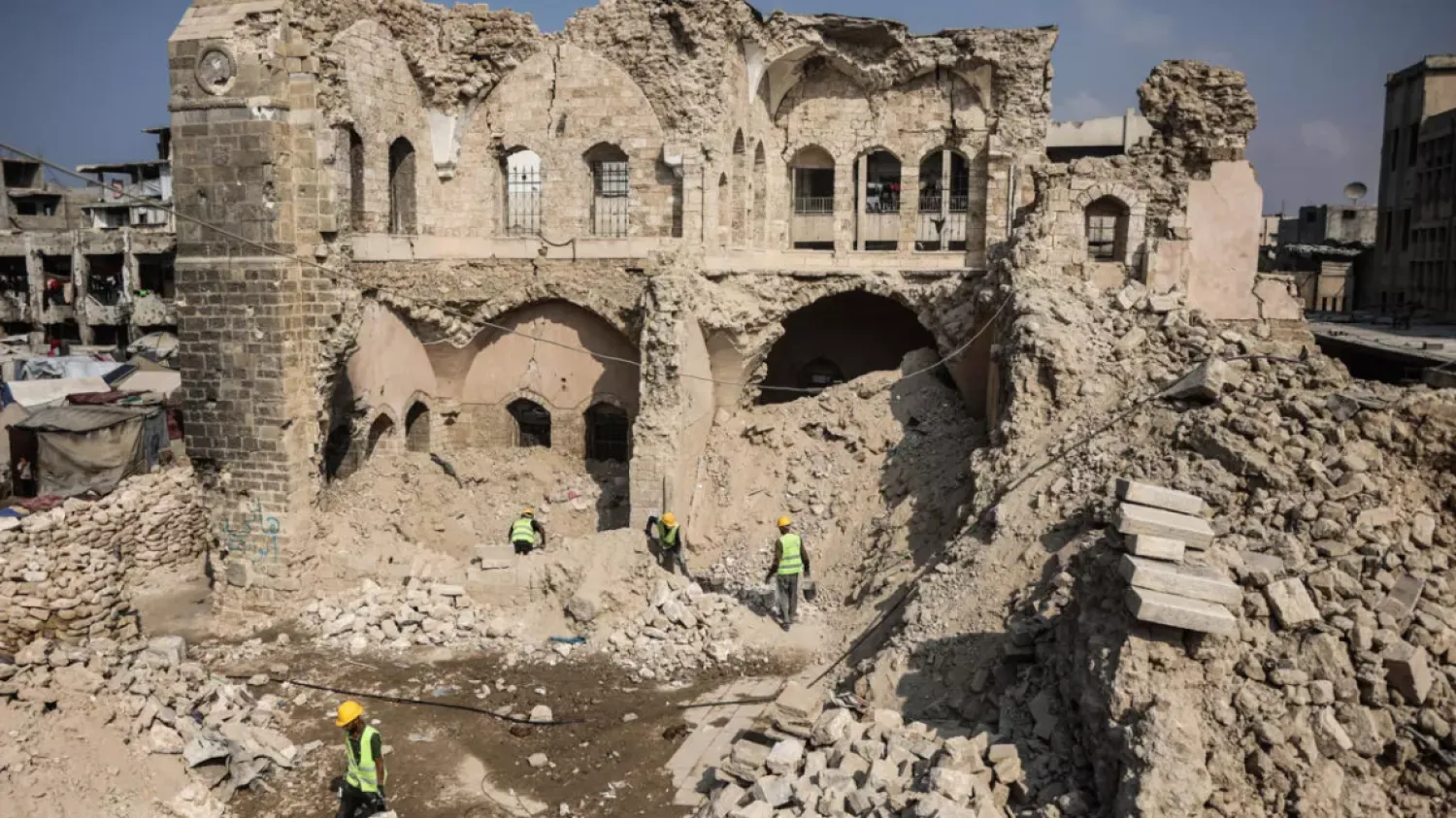

Gazans Begin to Restore Historic Fort Damaged in War

Work has begun to rehabilitate the Pasha's Palace Museum a former fort turned heritage site housing 40,000 artifacts representing the succession of civilizations in Gaza © Omar AL-QATTAA / AFP
TT

Gazans Begin to Restore Historic Fort Damaged in War

Work has begun to rehabilitate the Pasha's Palace Museum a former fort turned heritage site housing 40,000 artifacts representing the succession of civilizations in Gaza © Omar AL-QATTAA / AFP

One bucket at a time, Palestinian workers cleared sand and crumbling mortar from the remains of an former medieval fortress turned museum in Gaza City, damaged by two years of fighting between Israel and Hamas.

A dozen workers in high visibility jackets worked by hand to excavate the bombarded buildings that remain of the Pasha Palace Museum -- which reputedly once housed Napoleon Bonaparte during a one-night stay in Gaza -- stacking stones to be reused in one pile, and rubble to be discarded in another.

Overhead, an Israeli surveillance drone buzzed loudly while the team toiled in silence.

"The Pasha Palace Museum is one of the most important sites destroyed during the recent war on Gaza City," Hamouda al-Dahdar, the cultural heritage expert in charge of the restoration works, told AFP, adding that more than 70 percent of the palace's buildings were destroyed.

As of October 2025, the UN's cultural heritage agency, UNESCO, had identified damage at 114 sites since the start of the war in Gaza on October 7, 2023, including the Pasha Palace.

Other damaged sites include the Saint Hilarion Monastery complex -- one of the oldest Christian monasteries in the Middle East -- and Gaza City's Omari Mosque.

Issam Juha, director of the Center for Cultural Heritage Preservation, the nonprofit organization in the Israeli-occupied West Bank who is helping coordinate the castle's restoration at a distance, said the main issue was getting materials into Gaza.

"There are no more materials and we are only managing debris, collecting stones, sorting these stones, and have minimal intervention for the consolidation," Juha told AFP.

Israel imposed severe restrictions on the Gaza Strip at the start of the war, causing shortages of everything including food and medicine.

After a US-brokered ceasefire deal came into effect in October, aid trucks began flowing in greater numbers, but each item crossing into Gaza must be approved by strict Israeli vetting, humanitarian organizations say.

Juha said the ceasefire had allowed workers to resume their excavations.

Before, he said, it was unsafe for them to work and "people were threatened by drones that were scanning the place and shooting".

Juha said that at least 226 heritage and cultural sites were damaged during the war, arguing his number was higher than UNESCO's because his teams in Gaza were able to access more areas.

Juha's organization is loosely affiliated with the Ramallah-based Palestinian Authority's ministry of antiquities, he said.

"Our cultural heritage is the identity and memory of the Palestinian people," Dahdar said in Gaza City.

"Before the war, the Pasha's Palace contained more than 17,000 artefacts, but unfortunately all of them disappeared after the invasion of the Old City of Gaza," he said.

He added that his team had since recovered 20 important artefacts dating back to the Roman, Byzantine and Islamic eras.

Gaza's history stretches back thousands of years, making the tiny Palestinian territory a treasure trove of archaeological artefacts from past civilizations including Canaanites, Egyptians, Persians and Greeks.

"We are... salvaging the archaeological stones in preparation for future restoration work, as well as rescuing and extracting any artefacts that were on display inside the Pasha Palace," Dahdar said.

As the pile of excavated rubble already several metres high grew, one craftsman carefully restored a piece of stonework bearing a cross mounted with an Islamic crescent.

Another delicately brushed the dust off stonework bearing Islamic calligraphy.

"We are not talking about just an old building, but rather we are dealing with buildings dating back to different eras," said Dahdar.



Saudi Pavilion at Makkah's Global Village Showcases the Kingdom’s Culture

Saudi Pavilion at Makkah's Global Village Showcases the Kingdom’s Culture
TT

Saudi Pavilion at Makkah's Global Village Showcases the Kingdom’s Culture

Saudi Pavilion at Makkah's Global Village Showcases the Kingdom’s Culture

The Saudi pavilion at Global Village in Makkah, part of the Makkah winter season, reflects the richness and uniqueness of the Kingdom's culture and heritage.

It features interactive and engaging sections that introduce visitors to the Kingdom’s cultural heritage, including live demonstrations of traditional handicrafts and artwork inspired by the local environment, SPA reported.

The pavilion’s presence at Global Village reflects ongoing efforts to highlight the nation’s cultural heritage, promote its civilizational legacy, and strengthen its cultural presence at major events.


Culinary Arts Commission Joins 17th Klija Festival in Buraidah as Strategic Partner

Culinary Arts Commission Joins 17th Klija Festival in Buraidah as Strategic Partner
TT

Culinary Arts Commission Joins 17th Klija Festival in Buraidah as Strategic Partner

Culinary Arts Commission Joins 17th Klija Festival in Buraidah as Strategic Partner

The Culinary Arts Commission is participating as a strategic partner in the 17th Klija Festival, held in the city of Buraidah and running until January 17, under the patronage of Qassim Region Governor Prince Dr. Faisal bin Mishaal.

The commission’s involvement comes as part of its strategy to support events and festivals specializing in Saudi culinary arts by highlighting national and regional dishes and showcasing the Kingdom’s culinary and cultural diversity, SPA reported.

The festival features several zones and interactive activities aimed at supporting families working in the cottage industry and local artisans who produce Klija, while introducing visitors to its history and authenticity as a regional dish of Qassim, in addition to offering live demonstrations and unique interactive experiences.

During the festival, the commission is also presenting a selection of books available for viewing and purchase.


Jeddah’s Red Sea Museum Announces January Cultural Program

The program's themes span traditional architecture, historical photography, music, travel literature, and the history of navigation and public health in the Red Sea. (SPA)
TT

Jeddah’s Red Sea Museum Announces January Cultural Program

The program's themes span traditional architecture, historical photography, music, travel literature, and the history of navigation and public health in the Red Sea. (SPA)

Jeddah's Red Sea Museum announced the launch of its public program for January 2026, featuring a series of artistic workshops, cultural talks, live performances, and family activities. The program aims to connect the Red Sea's cultural heritage with contemporary creative practices, catering to various segments of society.

The program's themes span traditional architecture, historical photography, music, travel literature, and the history of navigation and public health in the Red Sea. These activities are presented through a cultural and educational agenda held across the museum's facilities and venues in Historic Jeddah.

The program begins on Tuesday, with a workshop titled "Junior Cartographers" in the Discovery Room, where children aged 6 to 12 will explore the art of mapmaking and the fundamentals of navigation through an engaging, interactive approach. On January 15, the "Alchemy of Light: Albumen Prints" workshop will be held at the auditorium, highlighting the historical albumen printing technique using egg whites and silver salts, and exploring 19th-century photography aesthetics through a contemporary perspective.

On January 17, a talk about Historic Jeddah will discuss traditional architecture and its relationship to heritage and modernity. This will be followed on January 18, by the "Navigation from Past to Present" workshop at the auditorium, offering an interactive experience that explores the evolution of navigation methods through hands-on artistic and practical activities.

On January 22, the program includes the screening of the animated film "The Menace from Above" at the auditorium. Later that evening, Bab Al-Bunt Courtyard will host the Al Nour Wal Amal Orchestra, the world's only musical ensemble composed entirely of blind female musicians who perform using Braille musical notation, in a performance celebrating art, resilience, and diversity.

On January 23, an artist talk titled "The Gate of Gates" will be held in Historic Jeddah, documenting the transformations of the Bab Al-Bunt building and the human stories connected to this historic space. On January 28, the auditorium will host a talk titled "Encounters: Travel Literature," exploring journeys to Andalusia and Sicily and how Islamic heritage continues to live on through people and places.

The program concludes on January 31, with a lecture examining the development of quarantine systems and public health monitoring in the Red Sea, highlighting the historical role of Bab Al-Bunt as a quarantine center for pilgrims.

The Red Sea Museum's activities serve as a cultural and knowledge platform dedicated to documenting the Red Sea's tangible, intangible, and natural heritage, and presenting it through educational and interactive programs that foster dialogue between the past and the present, linking heritage with contemporary creative contexts from its headquarters in Historic Jeddah.