


Why Did the US Delegation Exclude Lebanon’s Shiite Officials?

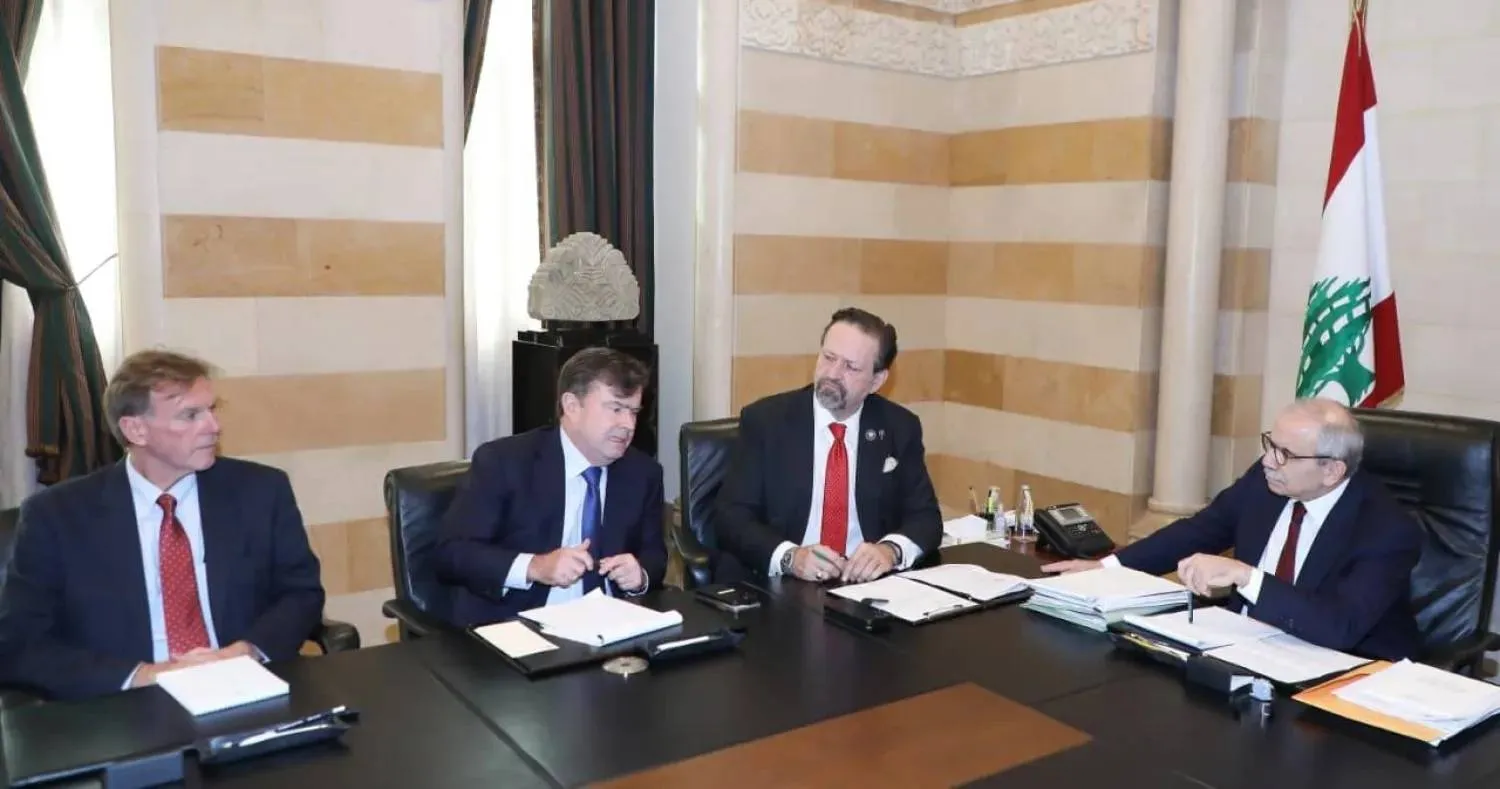
Lebanese Prime Minister Nawaf Salam meets US Treasury delegation in Beirut on Monday (Lebanese Government Presidency)
TT

Why Did the US Delegation Exclude Lebanon’s Shiite Officials?

Lebanese Prime Minister Nawaf Salam meets US Treasury delegation in Beirut on Monday (Lebanese Government Presidency)

Political observers in Lebanon have taken note of the US Treasury delegation’s decision to exclude Shiite officials from its meetings in Beirut earlier this week.

The exclusion came even though some of the Shiite officials are directly involved, by virtue of their positions, in implementing Washington’s demands that Lebanon curb Hezbollah’s financing channels and enforce the state’s monopoly on arms through legislation and executive measures.

US delegation meets top Lebanese officials

The American delegation, led by Deputy Assistant to the President and Senior Director for Counterterrorism Sebastian Gorka, included Undersecretary of the Treasury for Terrorism and Financial Intelligence (TFI) John Hurley and White House National Security Council counterterrorism specialist Rudolph Atallah.

During their visit to Beirut, they met President Joseph Aoun, Prime Minister Nawaf Salam, Justice Minister Adel Nassar, Interior Minister Ahmad Hajjar, and Central Bank Governor Karim Souaid.

The delegation also met Kataeb Party leader and lawmaker Sami Gemayel, and attended a dinner hosted by MP Fouad Makhzoumi with a group of parliamentarians.

However, the delegation notably excluded Shiite officials. It did not meet Parliament Speaker Nabih Berri — the country’s second-highest official, a key Hezbollah ally and the group’s long-time interlocutor with foreign delegations — nor Finance Minister Yassin Jaber.

No Shiite figures were present at any of the official meetings, including First Vice Governor of the Central Bank Wassim Mansouri, who was absent from the session held with Governor Souaid.

‘No boycott,’ says Shiite bloc

Sources familiar with the visit’s schedule said most meetings were held privately between the delegation and Lebanese officials, including Central Bank Governor Souaid, who met the visitors alone without the presence of senior banking oversight officials, in what they described as an effort to downplay any sectarian undertones.

Sources from the Shiite political alliance known as the “duo” — Hezbollah and the Amal Movement — also dismissed the idea of a boycott. “The delegation met with officials relevant to its mission,” one source told Asharq Al-Awsat.

“The claim of a boycott is inaccurate, as the delegation met Finance Minister Yassin Jaber during the dinner hosted by MP Makhzoumi, which was also attended by another Shiite MP. That confirms there was no boycott.”

Symbolism and political messages

Yet, political analysts say the exclusion carried symbolic weight, noting that the delegation did not seek an appointment with Speaker Berri as visiting US officials typically do, nor did it request a meeting with the finance minister at his office.

That, according to some Lebanese officials following the visit, suggested a political message — one directed at Iran, Hezbollah’s main backer.

“The exclusion signals that the Americans are deliberately avoiding all Shiite officials, regardless of political affiliation,” one ministerial source told Asharq Al-Awsat.

“This was met with a quick response from Iran through Hezbollah Secretary-General Naim Qassem, who on the same day rejected any new negotiations with Israel and refused to discuss surrendering weapons north of the Litani River, saying the agreement applies only to the south.”

Lebanon as a messaging arena

According to the same sources, the issue is “not about boycotting the Shiites, but rather that Lebanon has become a stage for message exchanges — with Washington sending signals and Tehran responding through Hezbollah.”

The sources said this dynamic is not new: “The United States has long sought to push Iran out of Lebanon and force it to relinquish its influence here. Lebanese officials first heard this stance during Donald Trump’s first presidential term in 2017, when the White House insisted Iran must come to the table to discuss its regional role. Ten years later, the message is the same: Washington wants Iran’s hand lifted off Lebanon.”

US-Berri contacts persist

Since the last decade, when pressure mounted on Iran and Hezbollah, Washington has drawn a line between Lebanese Shiites as citizens and Hezbollah as an organization.

US sanctions have targeted individuals it views as part of Hezbollah’s financial or military apparatus, while communication channels with Lebanese officials remained open — particularly through Parliament’s Foreign Affairs Committee.

Speaker Berri himself has sent parliamentary delegations to Washington since 2015 for meetings with members of Congress, maintaining an official dialogue that continues to this day.

Finance Minister Yassin Jaber has also made at least two visits to Washington since joining the cabinet, most recently last month, when he met representatives of the US Treasury Department. In Beirut, he has received multiple American, IMF, and World Bank delegations.

According to parliamentary sources who attended Makhzoumi’s dinner, Jaber delivered a 10-minute briefing to the US delegation outlining the government’s and parliament’s measures to “stabilize the monetary economy, tighten customs controls at airports, seaports, and land borders with Syria, and enhance supervision of money transfer companies.”

He also stressed that “executive reforms are progressing,” while the political aspects of implementation “remain under discussion with the president.”


Israeli Reservist Rams Vehicle into Palestinian Man Praying in West Bank

Israeli security forces secure a street as they leave the Palestinian village of Bizariya, in the occupied West Bank, where Israeli authorities demolished the house of a Palestinian man killed in July after he and another man reportedly killed an Israeli settler on the same day, on December 24, 2025. (AFP)
TT

Israeli Reservist Rams Vehicle into Palestinian Man Praying in West Bank

Israeli security forces secure a street as they leave the Palestinian village of Bizariya, in the occupied West Bank, where Israeli authorities demolished the house of a Palestinian man killed in July after he and another man reportedly killed an Israeli settler on the same day, on December 24, 2025. (AFP)

An Israeli reservist soldier rammed his vehicle into a Palestinian man as he prayed on a roadside in ​the occupied West Bank on Thursday, after earlier firing shots in the area, the Israeli military said.

"Footage was received of an armed individual running over a Palestinian individual," it said in a statement, adding the individual was a reservist ‌and his ‌military service had ‌been terminated.

The ⁠reservist ​acted "in severe ‌violation of his authority" and his weapon had been confiscated, the military said.

Israeli media reported that he was being held under house arrest.

The Israeli police did not immediately respond to a Reuters request for comment.

The ⁠Palestinian man went to hospital for checks after ‌the attack, but was unhurt ‍and is now ‍at home.

Video which aired on Palestinian ‍TV shows a man in civilian clothing with a gun slung over his shoulder driving an off-road vehicle into a man praying on ​the side of the road.

This year ​was one of the most violent on ⁠record for Israeli civilian attacks against Palestinians in the West Bank, according to United Nations data that shows more than 750 injuries.

More than a thousand Palestinians were killed in the West Bank between October 7, 2023 and October 17, 2025, mostly in operations by security forces and some by settler violence, according to the UN In ‌the same period, 57 Israelis were killed in Palestinian attacks.


Deadly Blast Hits Mosque in Syria’s Homs, Saraya Ansar al-Sunna Claims Responsibility

Syrian security forces stand inside a damaged mosque after several people were killed in an explosion at a mosque as the Syrian Arab News Agency (SANA) said, in Homs, Syria December 26, 2025. REUTERS/Ali Ahmed al-Najjar
TT

Deadly Blast Hits Mosque in Syria’s Homs, Saraya Ansar al-Sunna Claims Responsibility

Syrian security forces stand inside a damaged mosque after several people were killed in an explosion at a mosque as the Syrian Arab News Agency (SANA) said, in Homs, Syria December 26, 2025. REUTERS/Ali Ahmed al-Najjar

A bombing at a mosque in Syria during Friday prayers killed at least eight people and wounded 18 others, authorities said.

Images released by Syria’s state-run Arab News Agency showed blood on the mosque’s carpets, holes in the walls, shattered windows and fire damage. The Imam Ali bin Abi Talib Mosque is located in Homs, Syria's third-largest city.

SANA, citing a security source, said that preliminary investigations indicate that explosive devices were planted inside the mosque. Authorities were searching for the perpetrators, who have not yet been identified, and a security cordon was placed around the building, Syria’s Interior Ministry said in a statement.

In a statement on Telegram, the Saraya Ansar al-Sunna said its fighters "detonated a number of explosive devices" in the mosque.

The same group had previously claimed a suicide attack in June in which a gunman opened fire and then detonated an explosive vest inside a Greek Orthodox church in Dweil’a, on the outskirts of Damascus, killing 25 people as worshippers prayed on a Sunday.

Several countries, including Saudi Arabia, Jordan and Lebanon, condemned the attack. 


Fuel Shortage Forces Gaza Hospital to Suspend Most Services

The sun sets behind a makeshift tent camp for displaced Palestinians set up in an area of al-Bureij camp, in the central Gaza Strip, Wednesday, Dec. 24, 2025. (AP)
TT

Fuel Shortage Forces Gaza Hospital to Suspend Most Services

The sun sets behind a makeshift tent camp for displaced Palestinians set up in an area of al-Bureij camp, in the central Gaza Strip, Wednesday, Dec. 24, 2025. (AP)

A major Gaza hospital has suspended several services because of a critical fuel shortage in the devastated Palestinian territory, which continues to face a severe humanitarian crisis, it said.

Devastated by more than two years of war, the Al-Awda Hospital in the central Gaza district of Nuseirat cares for around 60 in-patients and receives nearly 1,000 people seeking medical treatment each day.

"Most services have been temporarily stopped due to a shortage of the fuel needed for the generators," said Ahmed Mehanna, a senior official involved in managing the hospital.

"Only essential departments remain operational: the emergency unit, maternity ward and pediatrics."

To keep these services running, the hospital has been forced to rent a small generator, he added.

Under normal conditions, Al-Awda Hospital consumes between 1,000 and 1,200 liters of diesel per day. At present, however, it has only 800 liters available.

"We stress that this shutdown is temporary and linked to the availability of fuel," Mehanna said, warning that a prolonged fuel shortage "would pose a direct threat to the hospital's ability to deliver basic services".

He urged local and international organizations to intervene swiftly to ensure a steady supply of fuel.

Despite a fragile truce observed since October 10, the Gaza Strip remains engulfed in a severe humanitarian crisis.

While the ceasefire agreement stipulated the entry of 600 aid trucks per day into Gaza, only 100 to 300 carrying humanitarian assistance can currently enter, according to the United Nations and non-governmental organizations.

The remaining convoys largely transport commercial goods that remain inaccessible to most of Gaza's 2.2 million people.

- Health hard hit -

On a daily basis, the vast majority of Gaza's residents rely on aid from UN agencies and international NGOs for survival.

Gaza's health sector has been among the hardest hit by the war.

During the fighting, the Israeli miliary repeatedly struck hospitals and medical centers across Gaza, accusing Hamas of operating command centers there, an allegation the group denied.

International medical charity Doctors Without Borders now manages roughly one-third of Gaza's 2,300 hospital beds, while all five stabilization centers for children suffering from severe malnutrition are supported by international NGOs.

The war in Gaza was sparked on October 7, 2023, following an unprecedented Hamas attack on Israel that resulted in the deaths of 1,221 people, most of them civilians, according to an AFP tally based on official Israeli figures.

In Israel's ensuing military campaign in Gaza, at least 70,942 people - also mostly civilians - have been killed, according to the health ministry in the Hamas-run territory.
