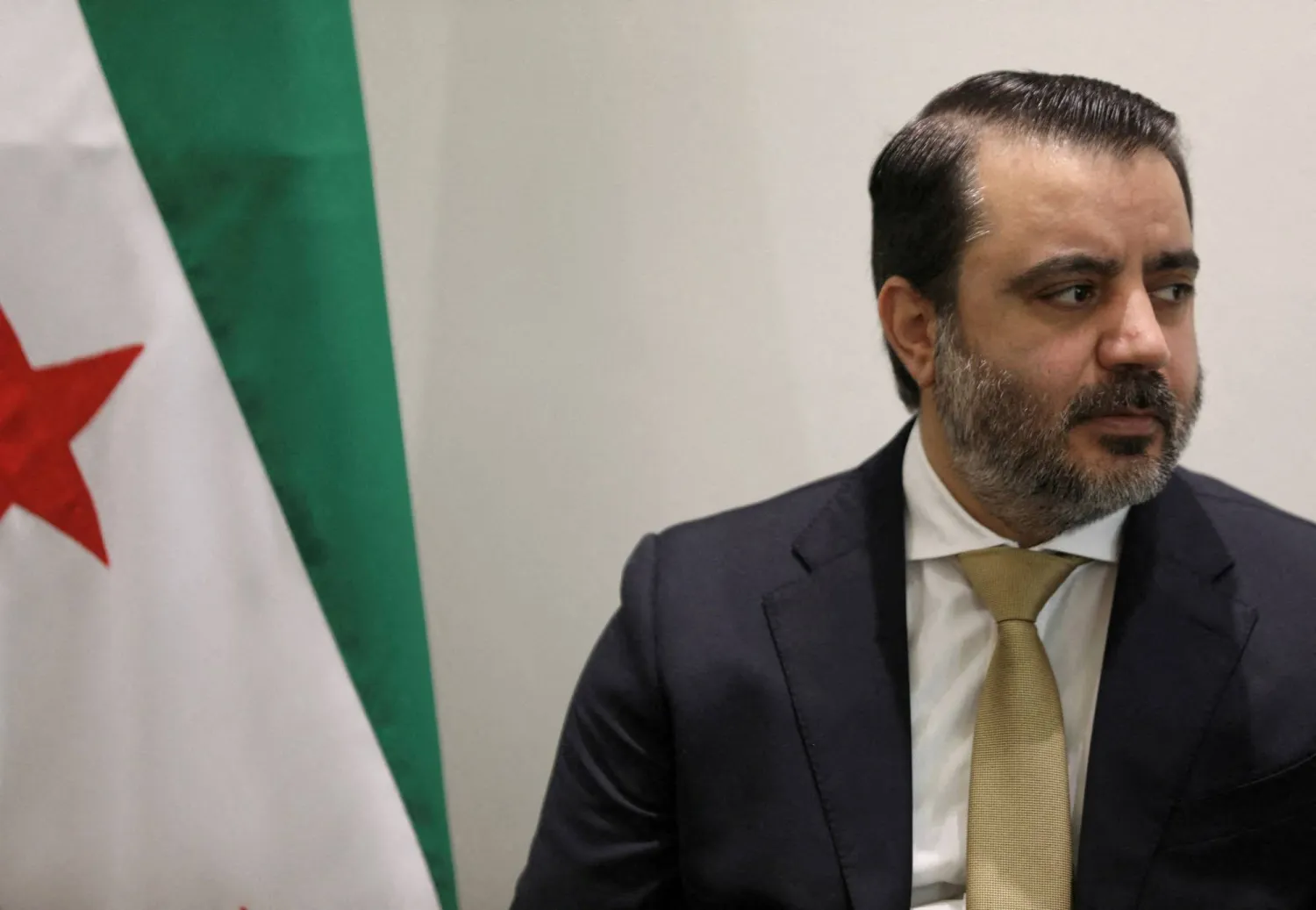
Syria Reopens Embassy in London after More than a Decade

FILE PHOTO: Syrian Foreign Minister Asaad Hassan al-Shibani looks on during a meeting with Jordanian Foreign Minister Ayman Safadi in Amman, Jordan August 12, 2025. REUTERS/Alaa Al Sukhni/File Photo
TT

Syria Reopens Embassy in London after More than a Decade

FILE PHOTO: Syrian Foreign Minister Asaad Hassan al-Shibani looks on during a meeting with Jordanian Foreign Minister Ayman Safadi in Amman, Jordan August 12, 2025. REUTERS/Alaa Al Sukhni/File Photo

Syria’s foreign minister officially reopened the country’s embassy in London on Thursday after more than a decade-long closure, the latest step in Syria's reintegration into the international community after the ouster of former President Bashar Assad.

The visit by Foreign Minister Asaad al-Shibani to the United Kingdom came after a historic visit to Washington by interim President Ahmad al-Sharaa, the first by a president from Syria since the country’s independence in 1946.

Al-Shibani, speaking at an event held by the London-based Chatham House international affairs think tank, said that his meeting with his British counterpart, Foreign Secretary Yvette Cooper, was “successful.”

“Relations between Syria and Britain are advanced relations and we are not talking about opening a new page — we are talking about deepening these relations,” he said.

Following Assad’s fall, al-Sharaa said that “the United Kingdom had a progressive position compared to other countries.”

“It removed sanctions early and opened relations with the new Syrian government quickly,” he said. “It supported us in the (UN) Security Council and also supported us in several thorny issues.”


Gaza’s Damaged Buildings Face Growing Risk of Collapse as Winter Approaches

Palestinian Umm Iyad Azzam sits with her two grandchildren who survived the collapse of the Al-Saada building in Gaza (Asharq Al-Awsat) 
TT

Gaza’s Damaged Buildings Face Growing Risk of Collapse as Winter Approaches

Palestinian Umm Iyad Azzam sits with her two grandchildren who survived the collapse of the Al-Saada building in Gaza (Asharq Al-Awsat) 

When 69-year-old Umm Iyad Azzam heard that the Al-Saada building in the Al-Sinaa area of southwest Gaza City had collapsed, she rushed from the tent where she was staying, about 400 meters away, searching for her daughter-in-law and grandchildren.

There, she learned that her daughter-in-law, Islam, and grandson Rizq had been killed. Residents and Civil Defense crews managed to rescue two other grandchildren, along with dozens of people trapped beneath the rubble.

Reeling from her loss, Azzam then hurried to Al-Shifa Medical Complex, itself heavily damaged by the Israeli war, to bid farewell to those who had died and check on those who survived.

Her relatives were among dozens of casualties in the collapse of the six-story Al-Saada building about a week ago. The building had been damaged during the Israeli war after being struck in earlier raids and a series of heavy bombardments at the start of the conflict in October 2023.

Gaza officials estimate that around 2,000 inhabited buildings across the territory are at risk of collapse.

Recalling the first moments after the disaster, Azzam told Asharq Al-Awsat that her eldest son, Iyad, was away from his family when he received a call about the collapse. He immediately headed there without alarming her. A short time later, another daughter-in-law told Azzam that the building housing Iyad’s family had fallen on its occupants.

“There is no safety in Gaza. No one can feel secure about their life,” Azzam said. “Danger threatens everyone, wherever they are, in a tent, a house or a building at risk of collapse.”

“Every home is in mourning, and if it isn’t today, it will be tomorrow,” she added. “We’ve had enough suffering and massacres. We want a solution.”

Twenty-one Palestinians were killed in the Al-Saada building collapse, while 45 others were injured and rescued. About 35 escaped after leaving the building before it fell.

Dozens of tents housing displaced people surround the site, alongside another damaged residential building at risk of collapse, fueling fears that the disaster could be repeated.

Mahmoud Basal, spokesman for Gaza’s Civil Defense, warned that structurally unsafe buildings posed a major threat across the territory. More than 2,000 were at risk of collapse and all were inhabited by civilians, he told Asharq Al-Awsat. Even the least crowded building houses around 10 people, while some accommodate more than 100.

Nowhere else to go

Aref Fura, 57, a displaced resident of the same area who himself lives in a damaged building, explained that those sheltering in Al-Saada had lost their homes, property, savings and livelihoods during the war.

With nowhere else to go, they remained there until the last moment despite signs that the building might collapse.

Their response, Fura recalled, was always the same: “Where will we go? Where can we go? There is nowhere else.”

More than two million Palestinians were now crowded into around 70 square kilometers after Israel occupied about 70 percent of the Gaza Strip, Fura said, arguing that this had pushed residents into thousands of buildings at risk of collapse.

Displaced from Gaza City’s Shujaiya neighborhood, he witnessed the first moments of the Al-Saada disaster.

“We held our breath after the building buried its residents beneath the rubble, without being able to do anything,” he recalled.

Now the approaching winter is deepening fears among those living in Gaza’s damaged buildings, with rainfall expected to heighten the risk of further collapses.

“People have no real options for dealing with the current reality, especially with winter approaching and the genuine threat it poses to those in buildings at risk of collapse and even those living in tents,” Fura warned.

“I personally live in a dangerous building. All of Gaza is living under a similar threat, and even those in tents are living beside buildings at risk of collapse, so their lives are in danger too.”

He appealed to the world to find solutions for Gaza’s residents, who he said faced a genuine threat. “All they want is to live safely, nothing more.”

‘We are forced to sleep on chairs’

For Bassam Naseer, 48, displaced from Beit Hanoun, danger is part of daily life.

Naseer described living in humiliating and difficult conditions, fearing that the roof sheltering his family could collapse. He shares a small room and an empty, damaged storefront near the site of the Al-Saada rubble with his family of eight. His son-in-law and his six-member family live with them.

The structure could collapse at any moment, Naseer told Asharq Al-Awsat, but the only alternatives were a tent or the street.

“No one knows who will live and who will die, because every winter this place floods, and we are forced to sleep on chairs,” he said.

He noted that several airstrikes, as well as the collapse of Al-Saada about 150 meters away, had worsened cracks and structural damage in the roof of the storefront.

“We can’t live like this. There are no solutions or options, and no one tells us we can live with dignity, because dignity is gone,” Naseer said. “Things are extremely difficult for us. There are no tarpaulins, tents or caravans. We cover ourselves with scraps of worn fabric.”

For Naseer and hundreds of thousands of other displaced people, the hardship extends beyond winter and unsafe shelter.

Rodents force him to stay awake at night to keep them away from his children, while mosquitoes and other insects leave him and his wife struggling to sleep as they try to protect their family.

“This is not a life,” he said. “Let the officials come and see how we live.”

Winter brings greater danger

Gaza’s Civil Defense has warned of the risk of further collapses.

In the 24 hours from Saturday afternoon to Sunday afternoon following the Al-Saada disaster, crews responded to several incidents involving homes previously hit by Israeli strikes and classified as uninhabitable but occupied by displaced residents because no alternative housing was available.

Several families were rescued after partial collapses in buildings and homes across Gaza City, including in the Zeitoun and Sheikh Radwan neighborhoods.

Civil Defense prevention and safety teams also inspected several cracked homes and told residents of four to evacuate and move to safer accommodation.

Basal explained that Civil Defense repeatedly urges residents to leave unstable buildings, only to receive the same response: “What is the alternative?”

He argued that addressing the problem was the responsibility of the international community, calling for intervention to evacuate residents and provide safe alternatives.

“Tents are not fit to live in, either in summer or winter,” Basal warned. “We are already living through difficult conditions, and now winter is approaching. It has become the nightmare and the great danger facing Gaza’s residents — those living in buildings at risk of collapse, those in tents and those living anywhere in Gaza.”

“The lives of all Gaza’s residents are threatened by the coming winter,” he added, urging the international community and international organizations to intervene immediately to protect civilians and provide a safe environment.

Such intervention, he continued, would allow residents to move from dangerous areas to safer ones and “provide them with a dignified life instead of the danger that accompanies them all the time.”



Aoun Rejects Any Settlement at Lebanon’s Expense as Salam Rallies Int’l Support

Lebanese President Joseph Aoun speaks during an interview with AFP at the Presidential Palace in Baabda on September 15, 2026. (Photo by JOSEPH EID / AFP)
TT

Aoun Rejects Any Settlement at Lebanon’s Expense as Salam Rallies Int’l Support

Lebanese President Joseph Aoun speaks during an interview with AFP at the Presidential Palace in Baabda on September 15, 2026. (Photo by JOSEPH EID / AFP)

Lebanese President Joseph Aoun has stressed the need to strengthen national unity in the face of the challenges confronting Lebanon, saying any political settlement must not come at the expense of the country and its national interests.

Aoun warned on Tuesday against “seeking support from abroad against one another at home in ways that serve Lebanon’s enemies.”

“Let us instead draw strength from one another in dealing with the outside world,” he said.

Aoun stressed that Lebanon cannot be built by a single group, sect, or political party, calling for efforts to overcome divisions and enhance dialogue and communication among Lebanese citizens as the gateway to building trust and ensuring stability.

He said Lebanon can recover whenever its people place the national interest above all other considerations, urging greater engagement between generations and a move away from grudges and divisions.

Salam Mobilizes Support in New York

In New York, Prime Minister Nawaf Salam held a series of meetings on the sidelines of the United Nations General Assembly, stressing Lebanon’s priorities in discussions with UN Secretary-General Antonio Guterres, Jordan’s King Abdullah II, Turkish President Recep Tayyip Erdogan, Finnish President Alexander Stubb, Qatari Prime Minister and Foreign Minister Sheikh Mohammed bin Abdulrahman Al Thani, Iraqi Prime Minister Ali al-Zaidi, Bahraini Foreign Minister Abdullatif bin Rashid Al-Zayani, and US Senator Jeanne Shaheen.

During these meetings, Salam stressed the need for Israel to fully withdraw from Lebanese territory and cease its attacks, strengthen the capabilities of the Lebanese Army, and ensure a continued international presence in southern Lebanon following the end of UNIFIL’s mandate.
He also emphasized extending state authority across the country and ensuring that weapons remain solely under state control.

Salam sought support for Lebanon’s recovery, reconstruction, and rehabilitation efforts, as well as for the continuation of government reforms and the expansion of cooperation and investment, particularly in energy, transportation, and regional connectivity.

Meeting with the UN Secretary-General

In his meeting with Guterres, Salam stressed the importance of maintaining a UN-backed international presence in southern Lebanon after the conclusion of UNIFIL’s mission, arguing that such a presence would support stability and help extend state authority.

He also discussed the humanitarian situation, noting that approximately 329,000 people remain displaced, and highlighted the need to shift from emergency response measures toward supporting returns, recovery efforts, and the restoration of essential services.

Regional Consultations

With King Abdullah II of Jordan, discussions focused on supporting Lebanon and its institutions, particularly the Lebanese Army, continuing coordination to reduce tensions, and mobilizing international support for arrangements that would prevent a security vacuum in the south.

In talks with Erdogan, Salam discussed strengthening Lebanese-Turkish relations and expanding cooperation in trade, investment, energy, and infrastructure, in addition to electricity and railway connectivity projects and support for recovery and reconstruction in southern Lebanon.

Salam to the Lebanese Diaspora: Difficult Decisions and Reforms

Addressing members of the Lebanese community in New York, Salam said that despite the difficult circumstances, the government had not abandoned its course. Instead, it had taken “difficult decisions” and launched a serious reform agenda aimed at changing the country's trajectory and building a state in which Lebanese citizens can regain confidence.

On the issue of weapons, Salam stressed that the government remains committed to implementing its decisions so that the state alone exercises authority across Lebanon, holds exclusive control over decisions of war and peace, and entrusts responsibility for citizens’ security to the Lebanese Army and legitimate security institutions.

He linked these efforts to achieving an Israeli withdrawal, securing the return of residents to southern Lebanon, and launching a broader recovery and reconstruction process, emphasizing that stability is an essential prerequisite for economic revival and investment.


Iraqi-American Understanding on ‘Disarmament’ by Mid-2027

Iraqi Prime Minister Ali al-Zaidi during his meeting on Monday with US Secretary of State Marco Rubio in New York (government media)
TT

Iraqi-American Understanding on ‘Disarmament’ by Mid-2027

Iraqi Prime Minister Ali al-Zaidi during his meeting on Monday with US Secretary of State Marco Rubio in New York (government media)

Iraqi Prime Minister Ali al-Zaidi renewed his government's commitment to restricting the possession of weapons to state institutions, a policy that has become known as the "disarmament of armed factions.”

The statement came during al-Zaidi's meeting with US Secretary of State Marco Rubio in New York on Monday, on the sidelines of the 81st session of the United Nations General Assembly.

According to a statement from the Iraqi Prime Minister's Office, al-Zaidi told Rubio that his government is working to strengthen Iraqi-American relations and elevate the level of strategic partnership between the two countries through constructive economic cooperation that expands areas of joint work and enhances mutual interests.

Al-Zaidi also reaffirmed the government's determination to complete its sovereign obligations and move forward with measures to ensure that arms remain exclusively in the hands of the state, in accordance with constitutional and legal principles.

The government statement quoted Rubio as expressing US support for Iraq in consolidating and sustaining internal stability, meeting the aspirations of Iraqis for economic development and greater engagement with the world, and supporting government measures aimed at strengthening state institutions and promoting stability and economic growth.

Following the meeting between al-Zaidi and Rubio, Tom Barrack, the US Presidential Special Envoy for Iraq, told reporters on Tuesday that an agreement had been reached to place all weapons under the control of the Iraqi state and to fully resolve the issue by the end of June 2027. This partially aligns with remarks al-Zaidi made to The New York Times.

Al-Zaidi outlined his government's plan to disarm armed factions and integrate their members, beginning with a 90-day preliminary phase during which the factions would halt their attacks in exchange for not being targeted by US strikes.

This may indicate that al-Zaidi succeeded in persuading Washington to grant additional time to settle the issue of disarming armed factions.

Previously, his government had adhered to a September 30 deadline, which coincides with the withdrawal of the US-led international coalition forces from Iraq.

Barrack has been quoted by the media as saying that the weapons of all armed groups in Iraq would be brought under control by 2027, with the state becoming the country’s sole armed authority.