


Gaza Stabilization Force: Will UN Talks Yield a Breakthrough?

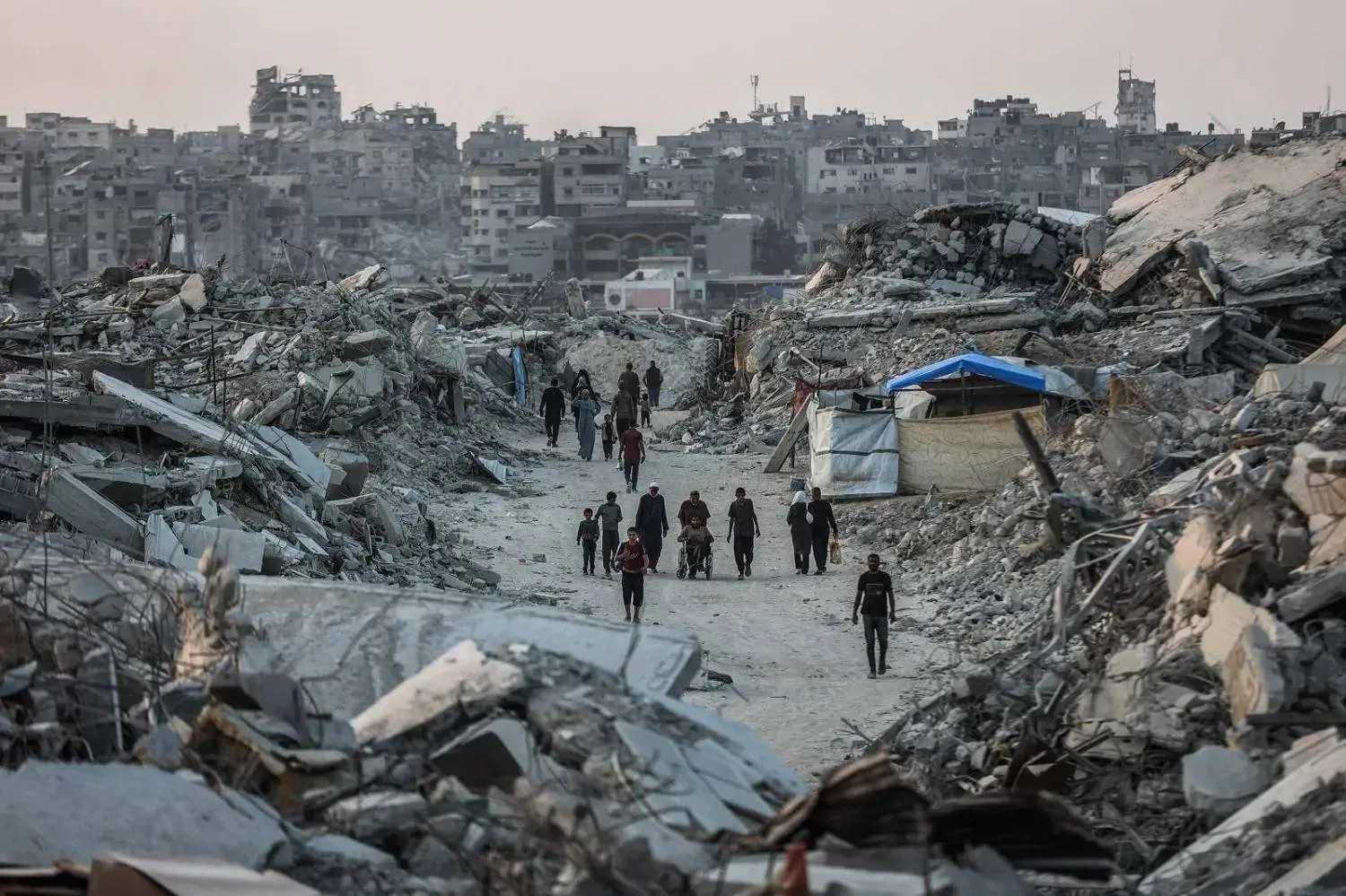
Palestinians amid rubble of destroyed buildings in Jabalia, northern Gaza Strip (AFP)
TT

Gaza Stabilization Force: Will UN Talks Yield a Breakthrough?

Palestinians amid rubble of destroyed buildings in Jabalia, northern Gaza Strip (AFP)

New developments have emerged in UN Security Council consultations on deploying a “stabilization force in the Gaza Strip,” after Arab and Islamic states signaled support for a US draft resolution, a day after Moscow circulated a similar proposal, amid fears that the effort could collapse under a Russian or Chinese veto.

Experts told Asharq Al-Awsat that the Arab-Islamic backing, which followed Egyptian talks with Palestine, Pakistan and the United States over the text expected to be put to a vote on Monday, is likely to remain suspended between a potential breakthrough driven by Arab-Islamic alignment with Washington’s proposal and the chance of winning Russian support, and a possible collapse if Moscow rejects any US influence and seeks to use the issue as a bargaining chip in the Russia–Ukraine crisis.

The second phase of the Gaza ceasefire agreement, which has yet to begin, includes establishing an international security force in Gaza, disarming Hamas, an additional Israeli withdrawal from the Strip and the appointment of an administration to run the territory.

A source familiar with the talks told Asharq Al-Awsat that the Arab-Islamic group “leaned toward supporting the US draft because Washington is the only party capable of enforcing its resolution on the ground and pressuring Israel to implement it.”

The source said there is “firm American intent to deploy forces soon, even if that requires sending a multinational force should Moscow use its veto.”

Egyptian Foreign Minister Badr Abdelatty discussed the draft resolution on Saturday in separate phone calls with his Pakistani counterpart Ishaq Dar and Palestinian Vice President Hussein al-Sheikh, according to two statements from the Egyptian Foreign Ministry.

The United States, Saudi Arabia, Qatar, Egypt, the United Arab Emirates, Indonesia, Pakistan, Jordan and Türkiye said in a joint statement on Friday that they “jointly support” the US resolution, which would authorize the creation of an international stabilization force, among other provisions. They expressed hope it would be adopted “swiftly.”

The diplomatic activity comes ahead of Monday’s Security Council vote on the draft, which has been under discussion for about a week, diplomatic sources told Agence France Presse on Friday.

The resolution would allow member states to form a “temporary international stabilization force” working with Israel, Egypt and newly trained Palestinian police to help secure border areas and remove weapons from Gaza. Unlike earlier drafts, it also refers to the possibility of a future Palestinian state, according to the AFP report.

Ambassador Mohamed Orabi, former Egyptian foreign minister and head of the Egyptian Council for Foreign Affairs, said the draft “faces difficulties,” adding that he hoped it would not “cement the division of the Strip.”

He noted that Arab support grew after US amendments that included moving toward a political track for the establishment of a Palestinian state.

Palestinian political analyst Dr. Ayman al-Raqab said the Arab-Islamic group’s support for the US draft, despite a competing Russian proposal, suggests the possibility of understandings and amendments, including references to future talks on a Palestinian state. He described the development as a cautious opening, given the continued risk of a Russian veto.

The US proposal challenges a rival Russian draft circulated to Council members on Thursday.

According to the text seen by AFP on Friday, the Russian draft does not call for establishing a peace council or for the immediate deployment of an international force in Gaza. It welcomes the initiative that led to the ceasefire.

The Russian resolution calls on the UN secretary-general to “identify options for implementing the provisions” of the peace plan and to report immediately, including on the feasibility of deploying an international stabilization force in Gaza.

US Ambassador to the United Nations Mike Waltz wrote in The Washington Post that any refusal to support this resolution is a vote to continue Hamas rule or to return to war with Israel, condemning the region and its people to perpetual conflict.

He added that any deviation from this path, whether by those seeking to play political games or revive the past, will come at a real human cost.

Obstacles may not come from a Russian veto alone.

According to Yedioth Ahronoth on Friday, key elements alarming Israel in the latest draft include language paving the way toward “Palestinian self-determination,” an expanded UN role in overseeing aid distribution and broader powers for the proposed “transitional governing authority” for Gaza.

Security Council resolutions require at least nine votes in favor and no veto from Russia, China, the United States, Britain or France.

Orabi said the Russian draft is more aligned with Palestinian aspirations but ultimately cannot compel Israel to implement anything.

He predicted that despite efforts to secure a UN mandate, Russia may veto the US text and China may abstain as part of broader tensions with Washington, prompting the United States to move toward deploying a multinational force.

Such an approach, he said, aligns with Israel’s preference to avoid implementing UN resolutions.

Al-Raqab said that if Moscow insists on using its veto to block any US influence or to employ the proposal as leverage in the Ukraine crisis, Washington would move immediately to create a multinational force without Security Council authorization.



Sudan PM Announces Govt Return to Khartoum from Wartime Capital

File Photo: Some shops reopen despite extensive damage (Asharq Al-Awsat)
TT

Sudan PM Announces Govt Return to Khartoum from Wartime Capital

File Photo: Some shops reopen despite extensive damage (Asharq Al-Awsat)

Sudan's Prime Minister Kamil Idris announced on Sunday the government's return to Khartoum, after nearly three years of operating from wartime capital of Port Sudan, AFP reported.

"Today, we return, and the Government of Hope returns to the national capital," Idris told reporters in Khartoum, ravaged by the war between the army and the Rapid Support Forces.

"We promise you better services, better healthcare and the reconstruction of hospitals, the development of educational services... and to improve electricity, water and sanitation services," he said.


Iran Protest Death Toll Rises as Alarm Grows over Crackdown 'Massacre'

Smoke rises as protesters gather amid evolving anti-government unrest at Vakilabad highway in Mashhad, Razavi Khorasan province, Iran, released on January 10, 2026, in this screen grab obtained from a social media video. SOCIAL MEDIA/via REUTERS
TT

Iran Protest Death Toll Rises as Alarm Grows over Crackdown 'Massacre'

Smoke rises as protesters gather amid evolving anti-government unrest at Vakilabad highway in Mashhad, Razavi Khorasan province, Iran, released on January 10, 2026, in this screen grab obtained from a social media video. SOCIAL MEDIA/via REUTERS

At least 192 protesters have been killed in Iran's biggest movement against the Islamic republic in more than three years, a rights group said Sunday, as warnings grew that authorities were committing a "massacre" to quell the demonstrations.

The protests, initially sparked by anger over the rising cost of living, have now become a movement against the theocratic system in place in Iran since the 1979 revolution and have already lasted two weeks.

The mass rallies are one of the biggest challenges to the rule of supreme leader Ali Khamenei, 86, coming in the wake of Israel's 12-day war against the Islamic republic in June, which was backed by the United States.

Protests have swelled in recent days despite an internet blackout that has lasted more than 60 hours, according to monitor Netblocks, with activists warning the shutdown was limiting the flow of information and the actual toll risks being far higher.

"Since the start of the protests, Iran Human Rights has confirmed the killing of at least 192 protesters," the Norway-based non-governmental organization said, warning that the deaths "may be even more extensive than we currently imagine".

Videos of large demonstrations in the capital Tehran and other cities over the past three nights have filtered out despite the internet cut that has rendered impossible normal communication with the outside world via messaging apps or even phone lines.

Video verified by AFP showed large crowds taking to the streets in new protests on Saturday night in several Iranian cities including Tehran and Mashhad in the east, where images showed vehicles set on fire.

Several circulating videos, which have not been verified by AFP, allegedly showed relatives in a Tehran morgue identifying bodies of protesters killed in the crackdown.

The US-based Center for Human Rights in Iran (CHRI) said it had received "eyewitness accounts and credible reports indicating that hundreds of protesters have been killed across Iran during the current internet shutdown".

"A massacre is unfolding in Iran. The world must act now to prevent further loss of life," it said.

It said hospitals were "overwhelmed", blood supplies were running low and that many protesters had been shot in the eyes in a deliberate tactic.


- 'Significant arrests' -


The US-based Human Rights Activists News Agency said it had confirmed the deaths of 116 people in connection with the protests, including 37 members of the security forces or other officials.

State TV on Sunday broadcast images of funeral processions for security forces killed in recent days, as authorities condemned "riots" and "vandalism".

National police chief Ahmad-Reza Radan said authorities made "significant" arrests of protest figures on Saturday night, without giving details on the number or identities of those arrested, according to state TV.

Iran's security chief Ali Larijani drew a line between protests over economic hardship, which he called "completely understandable", and "riots", accusing them of actions "very similar to the methods of terrorist groups", Tasnim news agency reported.

Iran's President Masoud Pezeshkian said "rioters" must not distrupt Iranian society.

"The people (of Iran) should not allow rioters to disrupt society. The people should believe that we (the government) want to establish justice," he told state broadcaster IRIB.

In Tehran, an AFP journalist described a city in a state of near paralysis.

The price of meat has nearly doubled since the start of the protests, and while some shops are open, many others are not.

Those that do open must close at around 4:00 or 5:00 pm, when security forces deploy in force.


- 'Legitimate targets' -


Reza Pahlavi, the exiled son of the ousted shah, who has played a prominent role in calling for the protests, called for new actions later Sunday.

"Do not abandon the streets. My heart is with you. I know that I will soon be by your side," he said.

US President Donald Trump has spoken out in support of the protests and threatened military action against Iranian authorities "if they start killing people".

Israel's Foreign Minister Gideon Saar urged the European Union on Sunday to designate Iran's Revolutionary Guards Corps as a "terrorist organization" over the suspected violence against protesters.

He also said Israel supports the Iranian people's "struggle for freedom".

Iran's parliament speaker Mohammad Bagher Ghalibaf said Iran would hit back if the US launched military action.

"In the event of a military attack by the United States, both the occupied territory and centers of the US military and shipping will be our legitimate targets," he said in comments broadcast by state TV.

He was apparently also referring to Israel, which the Islamic republic does not recognize and considers occupied Palestinian territory.


Israeli Fire Kills Three People in Gaza, Tension Rises

Palestinians attend an anti-war protest and against Hamas in a rare show of public anger against the group that rules the territory, in Beit Lahiya, northern Gaza Strip, Wednesday, March 26, 2025. (AP)
TT

Israeli Fire Kills Three People in Gaza, Tension Rises

Palestinians attend an anti-war protest and against Hamas in a rare show of public anger against the group that rules the territory, in Beit Lahiya, northern Gaza Strip, Wednesday, March 26, 2025. (AP)

Israeli fire killed at least three Palestinians in two separate incidents across ​the enclave, local health authorities said, as tension rises over continued violence.

Medics said one Palestinian was killed in the Tuffah neighborhood in Gaza City, in an area under ‌Palestinian control, while ‌two others ‌were ⁠killed ​in ‌the town of Bani Suhaila east of Khan Younis, an area Israel still occupies, Reuters reported.

There was no comment from the Israeli military on the two incidents.

Fighting ⁠has largely abated since Israel and ‌Palestinian militant group Hamas ‍agreed to ‍a ceasefire in October, two ‍years into the war, but it has not stopped entirely. Israel and Hamas have traded blame over ​the violations of the deal.

A Hamas official told Reuters ⁠on Sunday that the group urged mediators to intervene to stop "daily Israeli killings that aim to derail the ceasefire deal."

More than 440 Palestinians, most of them civilians according to Gaza health officials, have been killed since the truce, ‌as well as three Israeli soldiers.