


Oil Prices Ease After Loadings Resume at Russian Export Hub

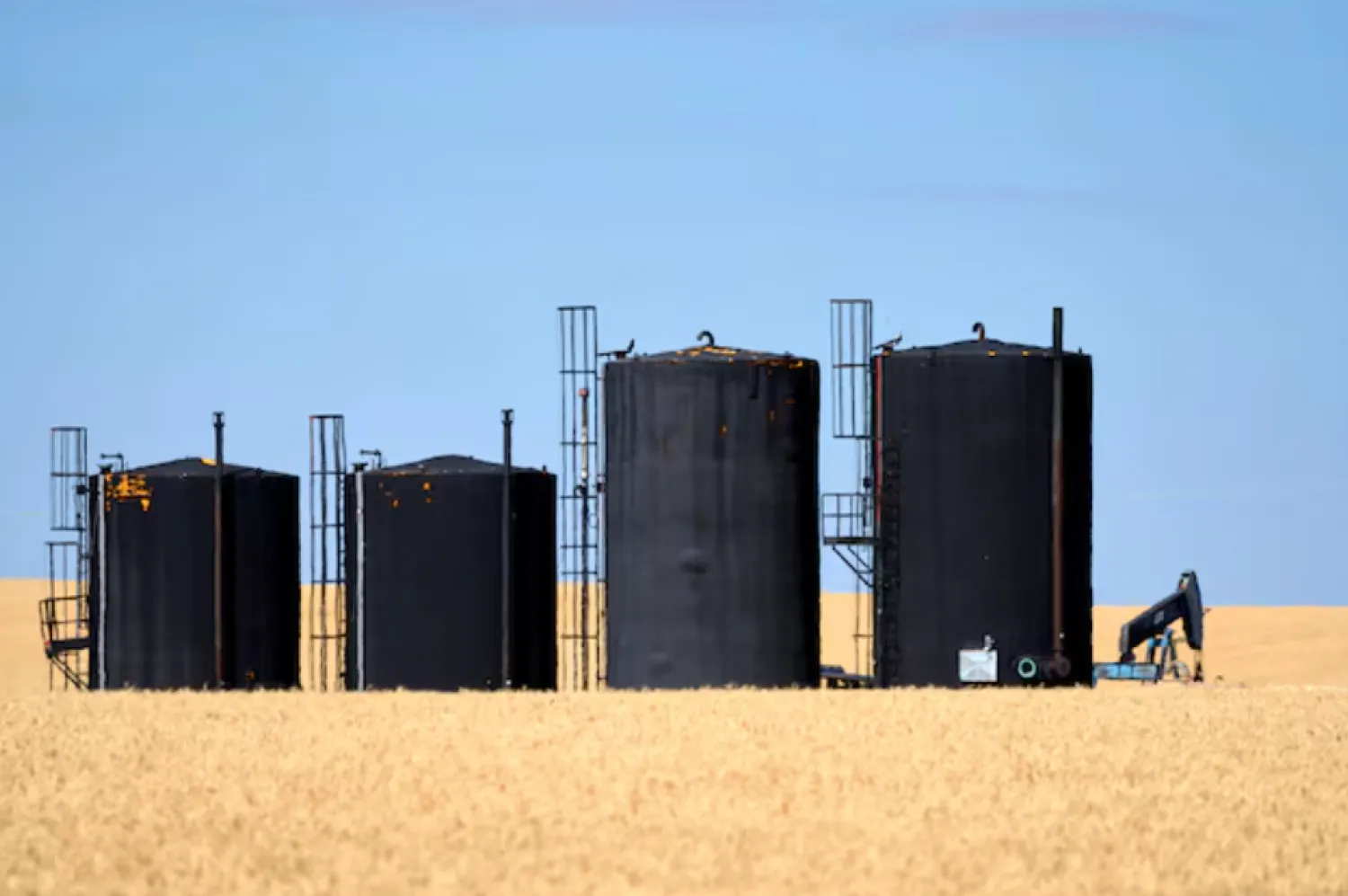
Oil pumpjacks and tanks are pictured in a farmer’s field near Kindersley, Saskatchewan, Canada September 5, 2024. REUTERS/Todd Korol
TT

Oil Prices Ease After Loadings Resume at Russian Export Hub

Oil pumpjacks and tanks are pictured in a farmer’s field near Kindersley, Saskatchewan, Canada September 5, 2024. REUTERS/Todd Korol

Oil prices dipped slightly on Monday as loadings resumed at Russia's Novorossiysk export hub after a two-day suspension at the Black Sea port that had been hit by a Ukrainian attack.

Brent crude was down 5 cents at $64.34 a barrel by 1254 GMT. US West Texas Intermediate (WTI) crude lost 8 cents to $60.01.

Both benchmarks rose more than 2% on Friday to end the week with a modest gain after exports were suspended at Novorossiysk and a neighbouring Caspian Pipeline Consortium terminal, affecting the equivalent of 2% of global supply, Reuters reported.

Novorossiysk resumed oil loadings on Sunday, according to two industry sources and LSEG data. However, Ukraine's attacks on Russian oil infrastructure remain in focus.

Ukraine's military said on Saturday that it hit Russia's Ryazan oil refinery, and Kyiv's General Staff said on Sunday that the Novokuibyshevsk oil refinery in Russia's Samara region had also been struck.

"Investors are trying to gauge how Ukraine's attacks will affect Russia's crude exports in the long term," said Fujitomi Securities analyst Toshitaka Tazawa.

Investors are also monitoring the impact of Western sanctions on Russian supply and trade flows. The United States imposed sanctions banning deals with Russian oil companies Lukoil and Rosneft after November 21 to try to push Moscow towards peace talks over Ukraine.

US President Donald Trump said on Sunday that Republicans are working on legislation that will impose sanctions on any country doing business with Russia, adding that Iran could be added to that list.

OPEC+ this month agreed to increase December output targets by 137,000 barrels per day, the same as for October and November. It also agreed to a pause in increases in the first quarter of next year.

An ING report said that the oil market was expected to remain in a large surplus through 2026. But it warned of rising supply risks from Ukraine drone attacks on Russian energy facilities while also flagging Iran's seizure of a tanker in the Gulf of Oman after it transited the Strait of Hormuz, an important route for about 20 million bpd of global oil flows.

Latest positioning data shows that speculators increased net long positions in ICE Brent by 12,636 lots over the past reporting week to 164,867 lots as of last Tuesday.

ING said this was driven predominantly by short-covering and suggested that some participants were reluctant to be short amid supply risks related to sanctions uncertainty.

Meanwhile, UBS analyst Giovanni Staunovo expects oil prices to remain supported.

"Rising oil-on-water levels have not yet led to an increase in on-land inventories," Staunovo said in a note. "While we expect prices to dip to the lower part of the trading range over the coming months, we hold a more constructive outlook for the second half of 2026."



Iraq’s Oil Minister Says Talks Ongoing with Chevron on West Qurna 2 Oilfield

A Chevron logo at the Chevron building in Houston, Texas, US August 19, 2025. (Reuters)
TT

Iraq’s Oil Minister Says Talks Ongoing with Chevron on West Qurna 2 Oilfield

A Chevron logo at the Chevron building in Houston, Texas, US August 19, 2025. (Reuters)

Iraq's oil minister said on Saturday that talks were ‌ongoing ‌with ‌US ⁠major Chevron regarding ‌the Lukoil-operated West Qurna-2 field, the Russian company's ⁠largest foreign ‌asset.

Chevron ‍and ‍Exxon Mobil ‍are among potential bidders for Lukoil's overseas assets following US ⁠sanctions on the Russian oil producer.


China’s Consumer Inflation Scales 3-Year High but Deflation Battle Far from Over

 Chinese girls dressed in Qing Dynasty attire take pictures outside the Forbidden City in Beijing, China, Wednesday, Jan. 7, 2026. (AP)
Chinese girls dressed in Qing Dynasty attire take pictures outside the Forbidden City in Beijing, China, Wednesday, Jan. 7, 2026. (AP)
TT

China’s Consumer Inflation Scales 3-Year High but Deflation Battle Far from Over

 Chinese girls dressed in Qing Dynasty attire take pictures outside the Forbidden City in Beijing, China, Wednesday, Jan. 7, 2026. (AP)
Chinese girls dressed in Qing Dynasty attire take pictures outside the Forbidden City in Beijing, China, Wednesday, Jan. 7, 2026. (AP)

China's annual consumer price inflation accelerated to a 34-month high in December, but the full-year rate slumped to the lowest in 16 years while producer deflation persisted, backing market expectations for more stimulus to shore up soft demand.

Imbalances in the $19 trillion economy have worsened over the past year even as growth is on course to meet Beijing's target of "around 5%" for 2025, buoyed by policy support and resilient goods exports.

US President Donald Trump's global trade war has added to persistently soft consumer demand, which has remained a drag on confidence and growth for years amid a prolonged property crisis.

The December consumer price index (CPI) rose 0.8% from the same month in 2024, National Bureau of Statistics (NBS) data showed on Friday, matching expectations in a Reuters poll and perking up from the 0.7% increase in November.

The rise was mainly driven by food prices, especially those of fresh vegetables and beef, which expanded 18.2% ‌and 6.9% respectively, Dong ‌Lijuan, a statistician at NBS, said in a statement. Pre-New Year holiday shopping ‌and ⁠supportive policies also helped ‌boost consumer prices, Dong added.

Chinese policymakers have repeatedly pledged to support a rebound in prices with monetary policy and have cracked down on excessive competition. They have also vowed to boost people's income to unleash consumption potential and better align the country's supply and demand.

Yet, the underlying demand impulse in the economy remains weak.

"Despite expectations of a recovery, inflation remains relatively low and should not preclude further monetary easing this year," said Lynn Song, ING's chief economist for Greater China.

Zichun Huang, China economist at Capital Economics, said the elevated headline CPI was not due to the government campaign to curb so-called "involution", adding that overcapacity and deflationary pressures will persist in the coming ⁠years in the absence of stronger demand-side measures.

WHERE HAS INFLATION GONE?

Indeed, for the entire 2025, consumer price growth was flat, well below the "around 2%" goal policymakers were ‌aiming for, a sign that stimulus measures, such as a consumer goods trade-in scheme, ‍have yielded only modest results in lifting sentiment and containing ‍deflationary pressure.

Prices of gold jewellery surged 68.5%, NBS data showed.

Core inflation, ‍which excludes volatile prices of food and fuel, rose 1.2% year-on-year last month, unchanged from November.

Goldman Sachs economists estimate that core price gauge excluding gold prices edged down in December from the prior month.

Annual growth in China's consumer prices has for years failed to meet policymakers' targets as the economy struggled to recover from the pandemic.

A prolonged property market crisis and a weak job market have contributed to lackluster household demand as well as overcapacity and price competition among producers.

On a monthly basis, CPI climbed 0.2% in December, compared with a 0.1% dip the previous month and a forecast for a 0.1% rise.

The producer ⁠price index (PPI) fell 1.9% year-on-year in December, remaining in a deflationary funk for more than three years even as it eased from a 2.2% drop in November. The gauge was expected to have fallen 2% in the Reuters poll.

NBS's Dong attributed the moderation in factory-gate deflation to both global commodity prices, including rising prices of non-ferrous metals, and policies for controlling capacity in key industries.

Capital Economics' Huang, however, said there hasn't been "any fundamental improvement in overcapacity."

"Prices of consumer durables continued to fall at a faster pace than during the depths of the global financial crisis, highlighting that the issue of excess supply remains unresolved in much of the manufacturing sector," she said.

For the whole year, PPI fell 2.6%.

Given the slowdown in economic momentum in the second half of last year, the market is watching for signs of additional government support measures in 2026 as top leaders have committed to pursuing a more proactive macroeconomic policy framework.

The central government has allocated 62.5 billion yuan ($8.95 billion) from special treasury bond proceeds to local governments to ‌keep funding the consumer goods trade-in scheme in 2026.

The government has also pledged to flexibly use monetary policy tools, such as cuts to interest rates and banks' reserve requirement ratio, to keep liquidity ample and spur growth.


Business-Friendly Climate Draws 123,000 New Commercial Registrations in Saudi Arabia

 Employees at the Saudi Business Center (SPA). 
 Employees at the Saudi Business Center (SPA). 
TT

Business-Friendly Climate Draws 123,000 New Commercial Registrations in Saudi Arabia

 Employees at the Saudi Business Center (SPA). 
 Employees at the Saudi Business Center (SPA). 

Saudi Arabia’s business environment attracted 123,000 new commercial registrations in the fourth quarter of 2025, pushing the total number of active registrations past 1.8 million by year-end. Foreign investment in the healthcare sector surged by nearly 560 percent over the past three years, highlighting strong international confidence in the Saudi market.

According to a recent report by the Ministry of Commerce, reviewed by Asharq Al-Awsat, the number of active sole proprietorship registrations reached 1.26 million by the end of 2025, reflecting 20 percent growth over the past five years.

Active limited liability companies (LLCs) totaled 571,000, with a sharp 183 percent increase over five years. Meanwhile, the number of joint-stock companies grew 50 percent over the same period to 4,733 active registrations.

Regional and Sectoral Performance

Riyadh led the Kingdom in new commercial registrations during the final quarter of 2025 with 45,600 records, followed by the Eastern Province with more than 20,000, and Makkah Region with 19,200.

The construction sector topped all industries, with more than 66,000 registrations issued during the quarter. It was followed by wholesale and retail trade with 24,900, and manufacturing industries with 23,700, while the remainder was spread across other activities.

The report also highlighted a strong rise in e-commerce sales conducted via Mada cards in October, which hit a record SAR 30.7 billion ($8.1 billion) - a 68 percent year-on-year increase, up SAR 12.4 billion ($3.3 billion) from October 2024, according to data from the Saudi Central Bank (SAMA).

Healthcare Sector Momentum

The Ministry of Commerce said Saudi Arabia continues to roll out development projects aimed at improving healthcare quality and capacity by strengthening national talent, adopting innovative digital solutions, and upgrading medical facilities.

The Kingdom ranks first regionally in healthcare investment, with agreements signed at the recent Global Health Exhibition in Riyadh valued at about SAR 133 billion ($35.4 billion). Foreign investment in the sector has expanded by more than 560 percent in three years, with healthcare contributing 5 percent of GDP.

Healthcare-related activities saw strong growth in the fourth quarter, including medical laboratories (+33%), pharmaceutical manufacturing (+31%), physiotherapy centers (+31%), and telemedicine and remote care services (+30%).

E-Commerce and High-Growth Sectors

Active e-commerce registrations rose 9 percent year-on-year to 43,800 by the end of the fourth quarter, up from 40,000 in the same period of 2024. Strengthening the e-commerce ecosystem is a key objective of the National Transformation Program, with Saudi Arabia ranked among the world’s top 10 fastest-growing e-commerce markets.

Promising sectors highlighted by the report include artificial intelligence, gaming, cybersecurity, health software, and electric vehicle charging stations. AI-related registrations grew 34 percent to more than 19,000, while gaming rose 27 percent to 841 registrations. UI/UX design activities climbed 28 percent to 18,900.

Cybersecurity registrations increased 27 percent to 9,700, while health and medical software surged 85 percent to 4,300. Power generation and distribution activities grew 27 percent, and EV charging station operations expanded 26 percent to 4,300 registrations.

Investment Deals and Forums

The report cited the success of the Biban Forum, recently held in Riyadh, which generated agreements and launches exceeding SAR 38 billion ($10.1 billion). Investment deals worth SAR 22.2 million ($5.9 million) benefited 55 startups, with participation from 1,021 companies across 66 countries.

It also highlighted the Northern Borders Forum, which offered more than 240 investment opportunities valued at SAR 40 billion ($10.6 billion) across sectors including livestock, food, mining and energy, tourism, environment, and logistics.