
Netanyahu Applauds UN Adoption of Trump’s Gaza Plan and Hamas Rejects It

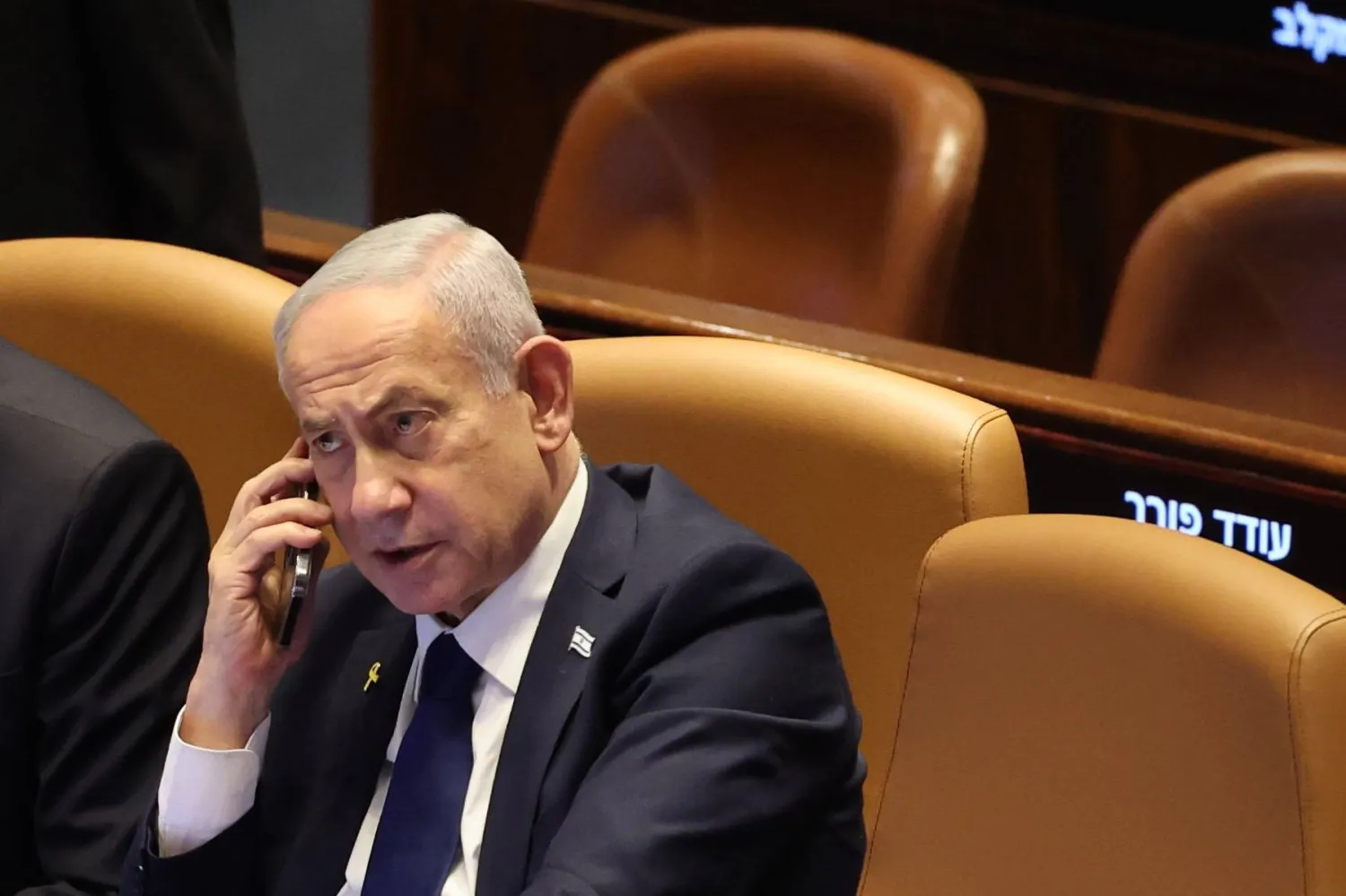
Israel's Prime Minister Benjamin Netanyahu attends a plenary session at the Knesset, the Israeli parliament in Jerusalem, 10 November 2025. EPA/ABIR SULTAN
TT

Netanyahu Applauds UN Adoption of Trump’s Gaza Plan and Hamas Rejects It

Israel's Prime Minister Benjamin Netanyahu attends a plenary session at the Knesset, the Israeli parliament in Jerusalem, 10 November 2025. EPA/ABIR SULTAN

Israeli Prime Minister Benjamin Netanyahu on Tuesday applauded the United Nations' approval of the Trump administration’s blueprint to secure and govern Gaza, while Hamas rejected the plan as a foreign instrument of control. 

The resolution that passed the UN Security Council on Monday authorizes an international stabilization force to provide security in war-devastated Gaza, approves a transitional authority called the Board of Peace to be overseen by President Donald Trump and envisions a possible future path to an independent Palestinian state, The Associated Press said. 

“We believe that President Trump‘s plan will lead to peace and prosperity because it insists upon full demilitarization, disarmament and the deradicalization of Gaza,” Netanyahu’s office wrote on X Tuesday. 

The resolution provides a wide mandate for the international force, including overseeing the borders, providing security and demilitarizing Gaza. Authorization for the board and force expire at the end of 2027. 

Hamas rejects plan  

The US plan calls for the stabilization force to ensure "the permanent decommissioning of weapons from non-state armed groups.” It authorizes the force “to use all necessary measures to carry out its mandate” in compliance with international law, which is UN language for the use of military force. 

Hamas said Monday that the force's mandate including disarmament “strips it of its neutrality, and turns it into a party to the conflict in favor of the occupation.” It said the resolution did not “meet the level of our Palestinian people’s political and humanitarian demands and rights." Hamas demanded that any international force be under UN supervision, deploy only at Gaza’s borders to monitor the ceasefire and operate exclusively with Palestinian institutions. 

Palestinian Authority welcomes resolution after statehood is included The Palestinian Authority welcomed the resolution and said it was ready to immediately implement it on the ground. It said it would cooperate with the US, the UN, and other Arab and European states. 

Palestinians largely view the PA, which governs semiautonomous zones in the Israeli-occupied West Bank, as weak and corrupt. The authority's security coordination with Israel is extremely unpopular, and many Palestinians see it as a subcontractor of the occupation. 

The UN vote came about following nearly two weeks of negotiations, when Arab nations and the Palestinians pressed the United States to strengthen language about Palestinian self-determination. The proposal still gives no timeline or guarantee for an independent state, only saying it’s possible after advances in the reconstruction of Gaza and reforms of the Palestinian Authority. 

The US revised the resolution to say that after those steps, “the conditions may finally be in place for a credible pathway to Palestinian self-determination and statehood.” 

“The United States will establish a dialogue between Israel and the Palestinians to agree on a political horizon for peaceful and prosperous coexistence,” it adds. 

Resolution gains support from Muslim-majority and Arab countries  

A key to the resolution’s adoption was support from Arab and other Muslim nations that had been critical for the ceasefire and potentially could contribute to the international force. The US mission to the United Nations distributed a joint statement Friday with Qatar, Egypt, the United Arab Emirates, Saudi Arabia, Indonesia, Pakistan, Jordan and Türkiye calling for “swift adoption” of the US proposal. 

Both Indonesia, the world’s most populous Muslim-majority nation, and Türkiye said they would work toward a two-state solution, which Netanyahu has opposed. 

Turkish officials have previously said Türkiye is ready to contribute to an international force in Gaza despite Israeli opposition to a Turkish presence. 

The vote shores up hopes that Gaza’s fragile ceasefire will be maintained following a war set off by Hamas’ surprise attack on southern Israel on Oct. 7, 2023, which killed about 1,200 people. Israel’s offensive has killed over 69,000 Palestinians, according to the Gaza Health Ministry, which doesn’t distinguish between civilians and combatants but says the majority are women and children. 

UK Foreign Secretary Yvette Cooper said Tuesday that the international community needed to “work together to take forward the 20 point plan and to turn it into a just and lasting peace.” Cooper called for “urgent action to open all the crossings, lift restrictions and flood Gaza with aid.” 

What else the US proposal says Trump said the members of the Board of Peace will be named in the coming weeks, along with “many more exciting announcements.” 

The plan calls for the stabilization troops to secure Gaza border areas, along with a Palestinian police force that they have trained and vetted. The force will coordinate with other countries to secure the flow of humanitarian assistance, and should closely consult and cooperate with neighboring Egypt and Israel. 

As the international force establishes control, the resolution says Israeli forces will withdraw from Gaza “based on standards, milestones, and time frames linked to demilitarization.” These must be agreed to by the stabilization force, Israeli forces, the US and the guarantors of the ceasefire, it says. 


Syria Imposes Night Curfew on Port City of Latakia

People watch as Syrian Security forces are deployed after clashes erupted during a protest in the city of Latakia, Syria, 28 December 2025. EPA/AHMAD FALLAHA
TT

Syria Imposes Night Curfew on Port City of Latakia

People watch as Syrian Security forces are deployed after clashes erupted during a protest in the city of Latakia, Syria, 28 December 2025. EPA/AHMAD FALLAHA

Syrian authorities imposed an overnight curfew in the coastal city of Latakia on Tuesday.

Authorities announced a "curfew in Latakia city, effective from 5:00pm (1400 GMT) on Tuesday, December 30, 2025, until 6:00am (0300 GMT) on Wednesday, December 31, 2025".


Jailed Turkish Kurd Leader Calls on Government to Broker Deal for Syrian Kurds

(FILES) Supporters display a poster depicting jailed leader of the Kurdistan Workers' Party (PKK) Abdullah Ocalan, after he called on the Kurdistan Workers' Party (PKK) to disarm and dissolve itself in Diyarbakir, southeastern Türkiye, on February 27, 2025. (Photo by Yasin AKGUL / AFP)
TT

Jailed Turkish Kurd Leader Calls on Government to Broker Deal for Syrian Kurds

(FILES) Supporters display a poster depicting jailed leader of the Kurdistan Workers' Party (PKK) Abdullah Ocalan, after he called on the Kurdistan Workers' Party (PKK) to disarm and dissolve itself in Diyarbakir, southeastern Türkiye, on February 27, 2025. (Photo by Yasin AKGUL / AFP)

Jailed Turkish Kurd leader Abdullah Ocalan said Tuesday that it was "crucial" for Türkiye’s government to broker a peace deal between the Kurdish-led Syrian Democratic Forces (SDF) and the Damascus government.

Clashes between Syrian forces and the SDF have cast doubt over a deal to integrate the group's fighters into the army, which was due to take effect by the end of the year, reported AFP.

Ocalan, founder of the Kurdistan Workers' Party (PKK) group, called on Türkiye to help ensure implementation of the deal announced in March between the SDF and the Syrian government.

"It is essential for Türkiye to play a role of facilitator, constructively and aimed at dialogue," he said in a message released by Türkiye's pro-Kurdish DEM party.

"This is crucial for both regional peace and to strengthen its own internal peace," Ocalan, who has been jailed for 26 years, added.

"The fundamental demand made in the agreement signed on March 10 between the SDF and the government in Damascus is for a democratic political model permitting (Syria's) peoples to govern together," he added.

"This approach also includes the principle of democratic integration, negotiable with the central authorities. The implementation of the March 10 agreement will facilitate and accelerate that process."

The backbone of the US-backed SDF is the YPG, a Kurdish group seen by Türkiye as an extension of the PKK.

Türkiye and Syria both face long-running unrest in their Kurdish-majority regions, which span their shared border.

In Türkiye, the PKK agreed this year at Ocalan's urging to end its four-decade armed struggle.

In Syria, Sharaa has agreed to merge the Kurds' semi-autonomous administration into the central government, but deadly clashes and a series of differences have held up implementation of the deal.

The SDF is calling for a decentralized government, which Sharaa rejects.

Turkish Foreign Minister Hakan Fidan, whose country sees Kurdish fighters across the border as a threat, urged the SDF last week not to be an "obstacle" to stability.

Syrian Kurdish leader Mazloum Abdi said Thursday that "all efforts" were being made to prevent the collapse of talks.


Yemen's PLC Imposes No Fly-Zone, Sea and Ground Blockade on All Ports and Crossings

Chairman of Yemen's Presidential Leadership Council Dr. Rashad al-Alimi. (Saba)
TT

Yemen's PLC Imposes No Fly-Zone, Sea and Ground Blockade on All Ports and Crossings

Chairman of Yemen's Presidential Leadership Council Dr. Rashad al-Alimi. (Saba)

Chairman of Yemen's Presidential Leadership Council Dr. Rashad al-Alimi declared on Tuesday a state of emergency throughout the country in wake of the "internal strife caused by the military rebellion in eastern provinces aimed at dividing the republic."

He called for all military formations and forces in the Hadhramaut and Al-Mahra governorates to coordinate completely with the Coalition to Restore Legitimacy in Yemen, represented by Saudi Arabia, and to immediately return to their original positions without a fight. They should cede their positions in the two governorates to the National Shield forces.

Al-Alimi said the state of emergency will last 90 days, which can be extended. He also imposed a no fly-zone, sea and ground blockade on all ports and crossings for 72 hours.

The move also stems from "the commitment to the unity of Yemen, its sovereignty, independence, and territorial integrity and the need to confront the Houthi coup that has been ongoing since 2014," he stressed.

Moreover, al-Alimi called on "all United Arab Emirates forces to leave the country within 24 hours."

"We will firmly deal with any rebellion against state institutions," he warned.

He called on the Southern Transitional Council to "return to reason and quickly and unconditionally withdraw its forces from Hadhramaut and Al-Mahra."

Al-Alimi announced the state of emergency shortly after the Saudi-led Arab coalition carried out a "limited" airstrike targeting a military shipment that had arrived in Yemen's Al-Mukalla port.

In a statement, coalition spokesman Major General Turki al-Malki said the forces detected on Saturday and Sunday the arrival of two vessels from the Port of Fujairah to Mukalla without obtaining any permits from the Joint Forces Command.

Saudi Arabia expressed on Tuesday its disappointment in the United Arab Emirates for pressuring the STC to carry out military operations on the Kingdom's southern borders in Hadhramaut and Al-Mahra.

A Saudi Foreign Ministry statement said: "The steps taken by the UAE are considered highly dangerous, inconsistent with the principles upon which the Coalition to Restore Legitimacy in Yemen was established, and do not serve the coalition's purpose of achieving security and stability for Yemen."

"The Kingdom stresses that any threat to its national security is a red line, and the Kingdom will not hesitate to take all necessary steps and measures to confront and neutralize any such threat," it declared.