

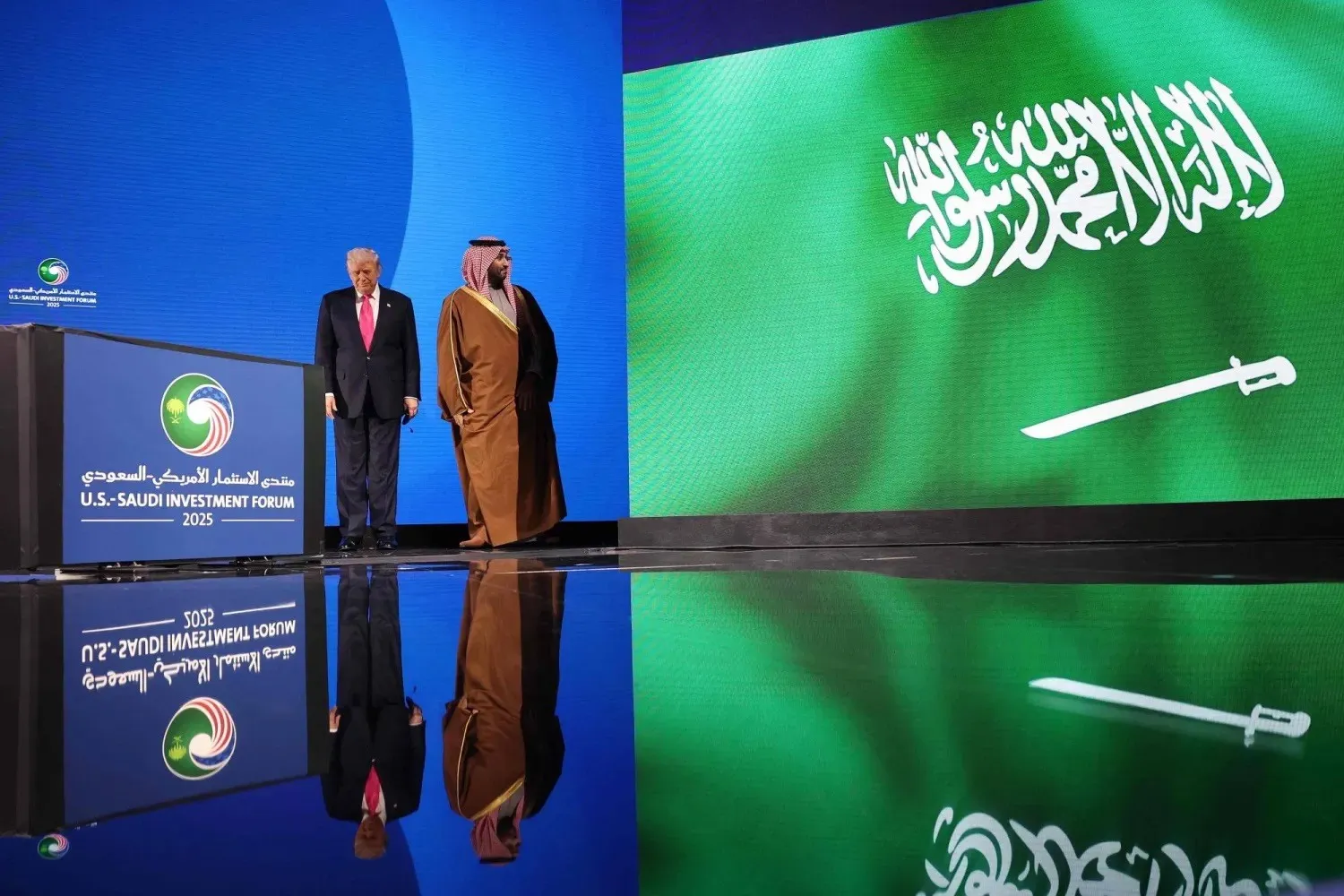

Trump Hails Crown Prince as ‘Great Leader,’ Describes Saudi Arabia as Top US Ally Beyond NATO

The Crown Prince and Trump during the holding of the US–Saudi Investment Forum (AFP). 
TT

Trump Hails Crown Prince as ‘Great Leader,’ Describes Saudi Arabia as Top US Ally Beyond NATO

The Crown Prince and Trump during the holding of the US–Saudi Investment Forum (AFP). 

US President Donald Trump hailed Saudi Arabia as America’s “largest ally outside NATO” and described Crown Prince Mohammed bin Salman as “one of the greatest leaders in the world,” during the US–Saudi Investment Forum in Washington on Wednesday. The forum marked a high point in the Crown Prince’s historic visit to the US capital, witnessing the announcement of wide-ranging strategic agreements.

The event, titled “From Riyadh to Washington: The Partnership that Powers Progress,” brought together top government officials and global business leaders from both countries. Announcements revealed that new deals across defense, energy, artificial intelligence, rare minerals, and finance could reach 270 billion dollars in value.

Crown Prince Mohammed bin Salman emphasized the importance of building on the momentum created earlier in the year when he hosted Trump in Riyadh.

He said: “We meet six months after the Saudi–American Forum in Riyadh during your visit, Mr. President (Trump), where we laid the foundations of a partnership based on growth, economic diversification and innovation, and we signed the Strategic Economic Partnership document between our two countries in a historic step to anchor economic cooperation.”

He underscored the significance of the newly announced agreements and their mutual economic impact, saying: “Today we are pleased to sign new investment agreements and projects that include the defense, energy, artificial intelligence, rare minerals and financial sectors, which will contribute to providing job opportunities and economic growth in our two countries.”

The Crown Prince also expressed his wish that the forum would enhance the historic ties between Washington and Riyadh, develop investment relations, and meet the ambitions of both nations. He concluded by thanking President Trump “for his interest in strengthening the economic partnership.”

For his part, Trump praised the evolving alliance, describing the Crown Prince as “a bold leader committed to the relations between our two countries,” and stressed that their joint efforts have made the partnership “stronger than ever.” Trump said the current stage represents “the best nine months the Saudi–US relationship has ever seen.”

Turning to domestic economic policy, Trump linked the forum’s investment announcements to his administration’s industrial strategy. He reiterated his commitment to supporting US energy production, and asserted that the United States is ahead of China in the fields of artificial intelligence and nuclear technology. He added that Washington is ready to help its partners in the semiconductor sector.

The US president also revealed that Crown Prince Mohammed bin Salman had asked him to help resolve the conflict in Sudan, prompting him to engage in the issue.

He stated: “We will work with Saudi Arabia, United Arab Emirates, Egypt, and other Middle Eastern partners to get these atrocities to end, while at the same time stabilizing Sudan.”

The Investment Forum

The forum’s sessions brought together prominent figures shaping global markets. In the Energy Leaders session, Saudi Aramco CEO Amin Nasser, ACWA Power Chairman Mohammad Abunayyan, and Chevron CEO Michael Wirth discussed the future of energy between the two nations.

The session underscored that hydrocarbons continue to make up 80 percent of the global energy mix, with expectations of rising demand beyond 2050. Speakers warned that underinvestment could lead to future supply shortages. Saudi executives also highlighted the Kingdom’s growing role in clean energy and hydrogen, predicting that Saudi Arabia is positioned to become a global hub for clean electricity and hydrogen, capable of powering advanced technologies including artificial intelligence.

Finance and investment leaders, including Saudi National Bank CEO Tareq Al Sadhan and Saudi Tadawul Chair Sarah Al Suhaimi, discussed the attraction of growing foreign investment in the Kingdom, noting that US investors account for a large share of the nearly 100 billion dollars held by foreign entities in the Saudi market. They stressed that the United States and Saudi Arabia are entering a historic era of mutual capital flows.

Artificial intelligence featured prominently in the forum’s closing sessions. Jensen Huang, CEO of NVIDIA, summarized the company’s strategic focus in the Kingdom by stating: “We are working with Saudi Arabia to build future data foundations.”

He highlighted plans to lay the digital infrastructure required for the next wave of AI-driven global growth.

Meanwhile, Elon Musk, CEO of Tesla, SpaceX, and xAI, announced a landmark joint Saudi–American project to build a 500-megawatt artificial intelligence computing center in the Kingdom, in partnership with NVIDIA and Saudi entities. Musk explained that the initiative is part of a broader plan and emphasized that the Kingdom has both the energy capacity and the speed needed to execute it.



President of Türkiye Arrives in Riyadh

28 May 2025, Azerbaijan, Lachin: Türkiye's President Recep Tayyip Erdoğan speaks during Lachin's trilateral summit of Azerbaijani, Turkish and Pakistani leaders. (Turkish Presidency/dpa)
TT

President of Türkiye Arrives in Riyadh

28 May 2025, Azerbaijan, Lachin: Türkiye's President Recep Tayyip Erdoğan speaks during Lachin's trilateral summit of Azerbaijani, Turkish and Pakistani leaders. (Turkish Presidency/dpa)

Turkish President Recep Tayyip Erdoğan arrived in Riyadh on Tuesday on an official vsit to the Kingdom.

He was welcomed at King Khalid International Airport by Deputy Governor of Riyadh Region Prince Mohammed bin Abdulrahman bin Abdulaziz upon his arrival.

Also present were Mayor of Riyadh Prince Faisal bin Abdulaziz bin Ayyaf and Minister of Commerce Majid Al-Kassabi, the accompanying minister.


Enayati to Asharq Al-Awsat: Saudi Arabia is a Pivotal Partner, Relations Are ‘Shielded’

The Saudi Crown Prince during his reception of the Secretary General of Iran’s Supreme National Security Council in September (SPA)
TT

Enayati to Asharq Al-Awsat: Saudi Arabia is a Pivotal Partner, Relations Are ‘Shielded’

The Saudi Crown Prince during his reception of the Secretary General of Iran’s Supreme National Security Council in September (SPA)

The Iranian ambassador to Riyadh said relations with Saudi Arabia are “shielded” and cannot be undermined, stressing that both countries share a commitment to regional security and stability, and to avoiding escalation that could unsettle the region.

In remarks to Asharq Al-Awsat, Alireza Enayati said there is ongoing coordination between the two countries, including visits and meetings, some public and others conducted away from the spotlight.

“We must recognize the sensitivity of the current situation amid recurring threats facing the region and the risk of sliding into unprecedented escalation,” Enayati said.

“The Islamic Republic of Iran believes that regional stability serves the interests of all countries. This has been repeatedly affirmed during our meetings and discussions with Saudi officials.”

A senior Saudi official had told Asharq Al-Awsat on Saturday that reports circulated by some media outlets about a shift in the Kingdom’s stance on regional escalation were inaccurate.

The official said Saudi Arabia supports efforts to reach peaceful solutions to all outstanding issues between the United States and Iran through dialogue and diplomacy, stressing the Kingdom’s rejection of the use of its airspace or territory for any military action against Iran.

Saudi Arabia as a Pivotal State

The Iranian diplomat emphasized that Tehran considers Saudi Arabia a pivotal and influential country in the region, noting that cooperation between the two sides on issues of mutual interest contributes to strengthening regional security and stability.

He said Iran and Saudi Arabia are keen on maintaining the region’s security and stability and stress the importance of avoiding escalation that could disturb regional calm.

He added that consultations are underway, based on a strategic conviction shared by both sides that serves their respective interests and those of the region as a whole.

According to Enayati, the Kingdom views Iran as a reliable partner, while Iran regards Saudi Arabia as an important and effective regional actor. Cooperation between the two countries on shared concerns, he said, helps reinforce regional security and stability.

“Shielded” Relations

Enayati said these relations are shielded and cannot be compromised, thanks to the leaderships of both countries and their understanding of the inevitability and importance of maintaining and developing these ties, with positive implications for all parties.

He recalled Saudi Arabia’s supportive stance toward Iran during the recent Israeli war, saying Tehran welcomed the Kingdom’s position, which strongly condemned the Israeli aggression. The diplomat added that any harm to Iran affects the security of the entire region, a reality reflected in constructive regional positions, including that of Saudi Arabia.

Negotiating Framework with Washington

On reports of a negotiating framework taking shape between Iran and the United States, Enayati said Iran entered negotiations in 2015 and again in 2025 with full seriousness, but that Washington withdrew and handled the process inconsistently.

“If the United States is serious about an equal dialogue without preconditions, Iran welcomes that,” he said, adding that Iranian officials have repeatedly affirmed this position.

He noted that while recent statements suggest work is ongoing on a framework for talks, negotiations cannot begin with predetermined outcomes. Results, he said, must emerge from the negotiating process itself, not be imposed in advance.

Last week, Saudi Crown Prince Mohammed bin Salman reaffirmed during a phone call with Iranian President Masoud Pezeshkian the Kingdom’s support for efforts to resolve differences through dialogue in a way that enhances regional security and stability.

The Crown Prince stressed Saudi respect for Iran’s sovereignty and its refusal to allow the use of Saudi airspace or territory for any military actions against Iran.

Pezeshkian, in turn, thanked the Kingdom for its firm stance on respecting Iran’s sovereignty and territorial integrity and praised the Crown Prince’s efforts to promote regional security and stability.


Islamic Military Counter Terrorism Coalition Launches ‘Idmaj’ Rehabilitation Initiative in Pakistan

Officials are seen at the launch ceremony in Islamabad on Monday. (IMCTC)
TT

Islamic Military Counter Terrorism Coalition Launches ‘Idmaj’ Rehabilitation Initiative in Pakistan

Officials are seen at the launch ceremony in Islamabad on Monday. (IMCTC)

The Islamic Military Counter Terrorism Coalition (IMCTC) launched in Islamabad on Monday the Rehabilitation and Social Reintegration Initiative for Individuals with Extremist Ideologies and Terrorist Behavior, known as Idmaj.

The ceremony was attended by Khawaja Muhammad Asif, Pakistan’s Minister of Defense, and Mohammed Al-Moghedi, Secretary General of the Coalition, alongside a number of military, security, and diplomatic officials.

In his address, Al-Moghedi said the Idmaj initiative represents a core pillar of the Coalition’s work in the intellectual domain, stressing that rehabilitation and reintegration programs constitute the first line of defense against extremist thought.

Addressing extremism cannot be limited to security and military measures alone, but requires integrated intellectual and social approaches aimed at rebuilding awareness, rehabilitating individuals, and reintegrating them into society in a positive and sustainable manner, he stressed.

The initiative aims to rebuild the lives of individuals involved in terrorism-related crimes by extracting them intellectually, psychologically, and socially from the grip of extremist and terrorist groups, he explained.

The program aims to transform them into constructive members of their families and communities, prevent their continued exploitation by terrorist leaders, and facilitate their return to serving their countries across humanitarian and civic fields, Al-Moghedi went on to say.

For his part, Asif praised the IMCTC's efforts and its partnership with Pakistan in combating extremism and terrorism. He said hosting the Idmaj initiative reflects Pakistan’s commitment to strengthening international cooperation and exchanging expertise in intellectual rehabilitation and reintegration.

The initiative includes specialized scientific modules covering concepts of rehabilitation and reintegration, model frameworks for rehabilitation programs, program design principles, the nature of terrorist crime, social care foundations, and challenges related to reintegration. These are delivered through training sessions and panel discussions led by experts and specialists.
