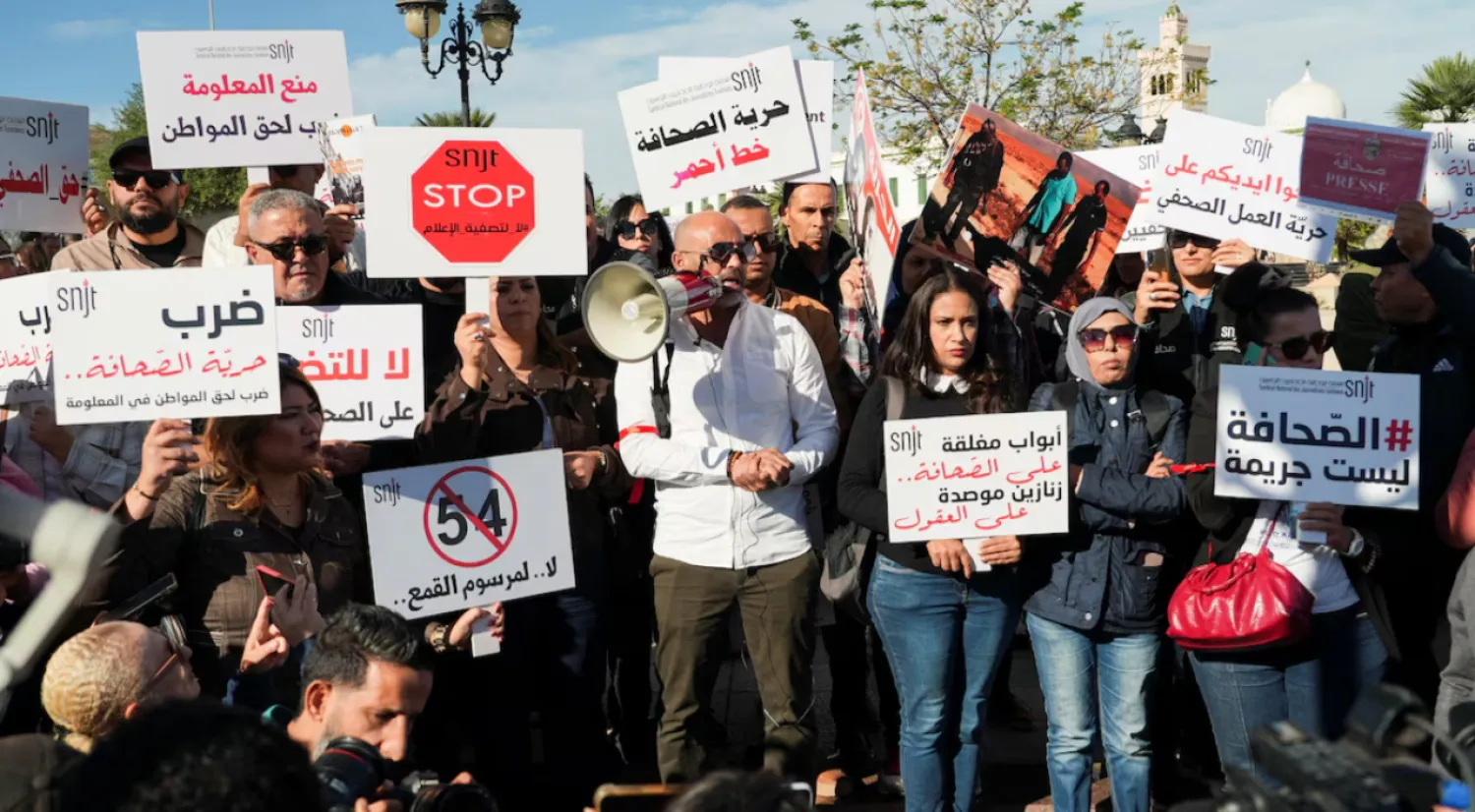
Tunisian Journalists Protest, Demand End to Restrictions on Reporters

Tunisian journalists rally near the government's office, holding signs to protest press restrictions- REUTERS/Jihed Abidellaoui
TT

Tunisian Journalists Protest, Demand End to Restrictions on Reporters

Tunisian journalists rally near the government's office, holding signs to protest press restrictions- REUTERS/Jihed Abidellaoui

Tunisian journalists protested on Thursday near government offices, demanding an end to restrictions on reporters and the release of jailed colleagues, and vowing that the widening crackdown will not silence them.

The protests confirmed growing fears of unprecedented threats to free speech since Kais Saied seized power in 2021.

Hundreds of reporters waved press cards, chanting "Journalism is not a crime" and "Freedom for Tunisian media".

Free speech had flourished following the 2011 uprising that toppled autocrat Zine El Abidine Ben Ali and sparked the “Arab Spring", and President Saied has denied targeting press freedom, Reuters reported.

Critics, however, say his 2021 power grab and subsequent decrees have dismantled democratic safeguards and allowed authorities to pursue journalists for committing offences which are not clearcut.

The Tunisian Journalists’ Syndicate (SNJT) said the escalating pressure was aimed at silencing strong free voices and subjugating the media.

"The situation is sounding the alarm. There is a systematic killing of journalism. We cannot cover government or parliament activities, nor events in the streets," said Nourredine Ahmed, a freelance journalist said.

Amira Mohamed, who works for Mosaique Radio, said the situation was "very bleak", and that dozens of journalists are being prosecuted while others are behind bars.

They have complained about not receiving their 2025 press cards, while foreign journalists said filming permits had been suspended, leaving them vulnerable to police obstruction and long periods of detention.

At least five journalists are in prison, while others face judicial investigations over social media posts or critical reporting.

The Minister of Justice, Laila Jaffal, said this week that there had been no prosecutions over freedom of expression, but rather for defamation.


Drone Strikes Continue to Claim Civilian Lives in Sudan

Two damaged tanks outside the central bank building in Khartoum during fighting. File photo: Reuters
TT

Drone Strikes Continue to Claim Civilian Lives in Sudan

Two damaged tanks outside the central bank building in Khartoum during fighting. File photo: Reuters

Two civilians were killed, and several others were wounded, when a drone struck a fuel station in Rabak, the capital of White Nile state in southern Sudan, as drones continued to hit El-Obeid in North Kordofan on Thursday morning, part of a growing wave of drone attacks across the country.

Local sources said drones hit a fuel station inside Rabak on Thursday morning, killing two civilians and wounding others. The injured were taken to health facilities, while authorities sealed off the area, began assessing the damage and opened an investigation into the attack.

Witnesses said the strike spread panic among residents. Ambulance teams and relevant authorities rushed to the site to deal with the aftermath and secure the area.

At the same time, El-Obeid, the capital of North Kordofan, remained under repeated drone attacks believed to have been carried out by the Rapid Support Forces (RSF). Witnesses said drones launched a fresh raid on the city on Thursday morning. Authorities have not yet announced an official casualty toll.

Several cities in central and western Sudan have seen drone attacks rise since the start of the war. The strikes have expanded and intensified in recent months and weeks, during the fourth year of fighting between the army and the RSF.

El-Obeid has been a frequent target in recent weeks of attacks attributed to the RSF. Rabak and Kosti in White Nile state, as well as Kadugli and Dilling in South Kordofan, have also been hit by similar attacks from time to time.

The Sudanese army, meanwhile, continues to carry out drone strikes on sites in areas held by the RSF. The two sides rarely announce the results or targets of drone raids they launch.

The latest strikes came two days after a drone attack on Tuesday hit the market in the town of al-Siyah in North Darfur. Local reports said the attack killed one person, wounded several civilians and sparked fires that destroyed part of the market, damaging crops and foodstuffs worth millions of Sudanese pounds.

The al-Siyah market serves more than 70 villages. It lies about 60 km north of Mellit, near the border with Libya, and about 100 km northeast of El-Fasher. Witnesses said the attack coincided with the presence of RSF combat vehicles around the market, suggesting the drone may have belonged to the Sudanese army, which has not commented on the incident.

Drones have become a key weapon in the war between the army and the RSF in recent months. Their use has expanded to attacks on military sites and vital facilities in areas controlled by both sides, after fighting had previously centered on direct front lines.

The strikes usually target military bases and headquarters, weapons and ammunition depots, combat vehicles, infrastructure facilities, fuel stations and forces from both sides.

With many military sites located inside cities, and forces from both sides deployed in populated areas, civilians have borne the highest cost. The strikes often kill and wound civilians and damage homes, civilian facilities and basic services.

Since the war erupted in Sudan in April 2023, both sides have widened their use of drones, reaching cities far from the front lines. That has increased civilian losses and deepened humanitarian suffering in targeted areas.

The Associated Press reported on June 15, citing UN High Commissioner for Human Rights Volker Türk, that more than 1,000 civilians were killed in drone attacks in Sudan during the first five months of 2026.

According to the report, Türk said his office had recorded more than 1,000 civilian deaths from drone strikes between January and May this year.

There are no official figures for the number of civilians killed in the war. But the Armed Conflict Location & Event Data Project, known as ACLED, said in its latest reports that at least 59,000 people have been killed during the conflict, and that the true toll is likely far higher because of the difficulty of documenting victims in several combat zones.


Palestinian Health Ministry: Israeli Forces Kill Man in West Bank

A Palestinian kicks away a teargas cyclinder fired by Israeli security forces guarding bulldozers demolishing the home and shops belonging to the al-Atrash family just south of the Israeli-occupied West Bank city of Hebron on June 23, 2026. (Photo by HAZEM BADER / AFP)
TT

Palestinian Health Ministry: Israeli Forces Kill Man in West Bank

A Palestinian kicks away a teargas cyclinder fired by Israeli security forces guarding bulldozers demolishing the home and shops belonging to the al-Atrash family just south of the Israeli-occupied West Bank city of Hebron on June 23, 2026. (Photo by HAZEM BADER / AFP)

Israeli forces fatally shot a Palestinian man in the occupied West Bank on Thursday, the Palestinian health ministry said, with the Israeli military confirming troops had fired at someone "throwing objects" at soldiers.

The shooting is the latest fatal incident to occur as violence surges in the occupied Palestinian territory.

In a statement, the Palestinian health ministry announced the death of 32-year-old Mustafa Taha Mustafa Al-Khatib "at dawn today after being shot by Israeli occupation forces in Salfit.”

It added that his death brought the number of Palestinians killed since the beginning of the year to 72, including 17 children, five women, and two elderly people.

When asked by AFP about the incident, the Israeli military said that "during IDF soldiers' operational activity in the area of Sarta, a terrorist threw objects at the soldiers."

"The soldiers initiated standard suspect apprehension procedures, which included warning shots into the air. After the terrorist continued attacking the soldiers and throwing objects in a manner that posed a threat to them, they responded with fire toward him," the military said, adding that "hits were identified."

A day earlier, Israeli forces killed a Palestinian man during a house raid in a town in the northern West Bank who the military described as a "terrorist.”


Israel Says will Only Withdraw Troops from Lebanon after Hezbollah Disarmed

A man with a Hezbollah flag drives past a damaged building following a ceasefire between Israel and Hezbollah in the town of Nabatiyeh, southern Lebanon, Monday, June 22, 2026. (AP Photo/Mohammed Zaatari)
TT

Israel Says will Only Withdraw Troops from Lebanon after Hezbollah Disarmed

A man with a Hezbollah flag drives past a damaged building following a ceasefire between Israel and Hezbollah in the town of Nabatiyeh, southern Lebanon, Monday, June 22, 2026. (AP Photo/Mohammed Zaatari)

Israel said Thursday that it would only withdraw its forces from southern Lebanon after Hezbollah was disarmed, as the two countries engaged in US-mediated talks in Washington.

"We will not withdraw our forces from southern Lebanon as long as Hezbollah remains a threat, are not disarmed and are not demilitarised," David Mencer, a government spokesman, said in a briefing to journalists.

Under US pressure, Lebanese officials began direct talks in April with Israel in Washington. The latest three-day round of talks is due to wrap up on Thursday, Reuters reported.

Commenting on the negotiations, US Secretary of State Marco Rubio said the two neighbors were close to making a "commitment of intent".

Asked about the talks, Mencer said: "We are making extremely clear that our responsibility is to our northern citizens and to the whole of Israel, and we will not allow any terrorist force anywhere near our border -- which means that any redeployment of - Israeli - forces comes after, not before, but after the demilitarisation of southern Lebanon and the disarming of Hezbollah."

"We've already been in this situation in 2024," he added. "Hezbollah were supposed to be disarmed. They weren't."

Meanwhile, Senior Israeli and Lebanese officials denied on Thursday that there had been any Israeli withdrawal from occupied southern Lebanon, after a US official said Israel had pulled some troops back in a good faith gesture toward Lebanon's government.

A US State Department official said that "Israel has already taken a concrete step by pulling back from a part of its buffer zone". The so-called buffer zone is a vast area of southern Lebanon that Israeli forces are occupying north of the Israeli border.

The official described the move as "a significant demonstration of good faith toward Lebanon's legitimate government."

"The (Lebanese Armed Forces) should now move in and verifiably clear out terrorist weapons and infrastructure. This model will be repeated across South Lebanon, enabling the safe return of displaced families, reconstruction of the south, and the restoration of full Lebanese sovereignty," the official added.

A senior Israeli defense official denied there had been any kind of pullback or withdrawal by Israeli forces, and said Israel would not be withdrawing from its buffer zone.

Another Israeli military official told Reuters on Wednesday that the military had not received orders to hand over any position to the Lebanese army and that, for now, it would not permit the Lebanese army or civilians to cross into the buffer zone.

"We will not allow the Lebanese army to go south from the security line," the official said.