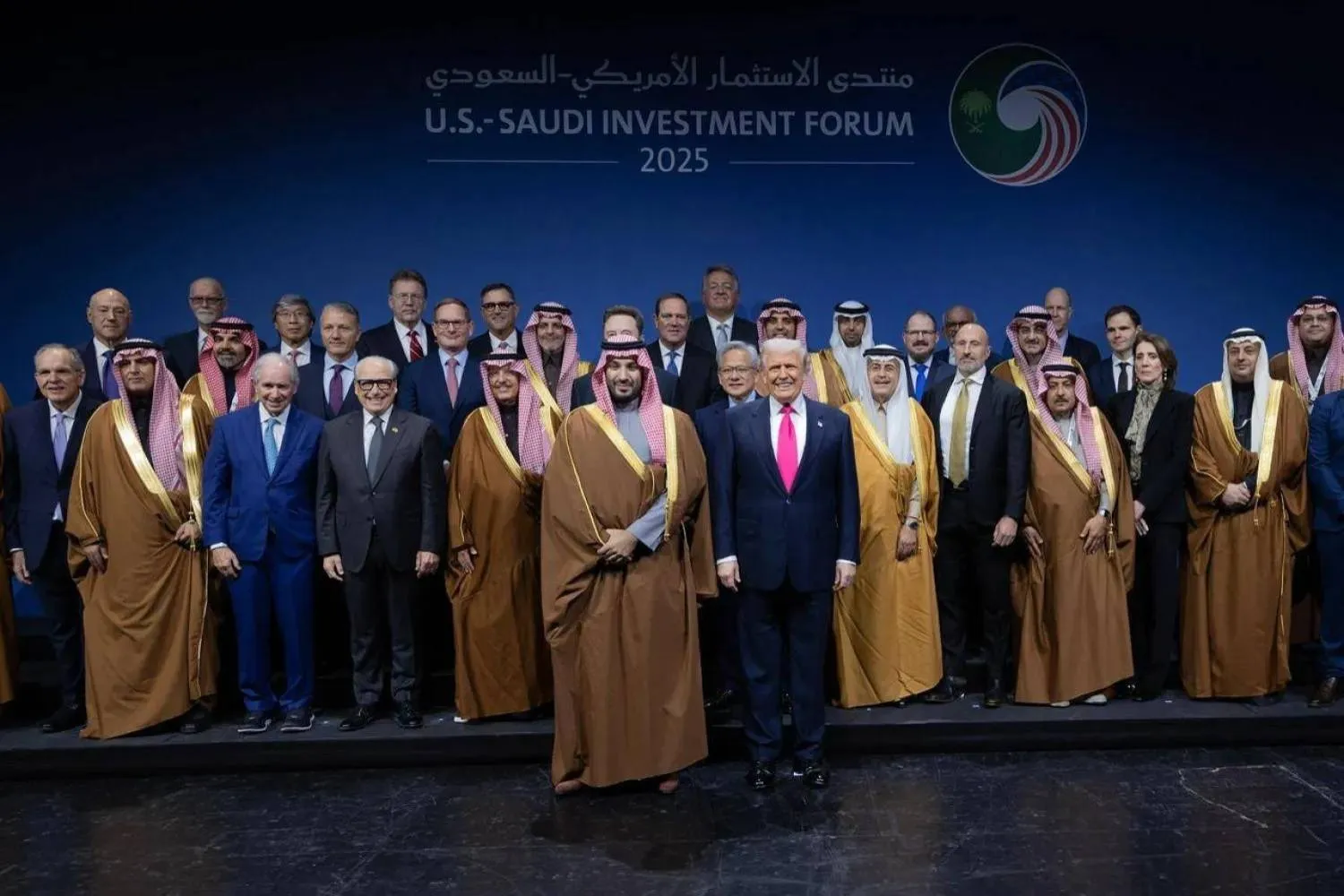

Over an intensive 48 hours, Washington became the stage for launching a new phase in the strategic alliance between Saudi Arabia and the United States, an alliance intended to bind the interests of both countries for decades to come.
The move coincided with the visit of Crown Prince Mohammed bin Salman, the Saudi Prime Minister, and built on the foundations set during President Donald Trump’s visit to Riyadh in May.
The meetings were not a mere display of existing ties, but a platform to unveil a strategic economic partnership framework whose pillars were laid during Trump’s trip to Riyadh. The document pushes bilateral cooperation to unprecedented levels of technological and financial integration.
The Crown Prince expressed confidence that this partnership with the US will grow at an unprecedented pace in the coming years, urging both sides to seize the promising opportunities it offers, opportunities driven by economic growth, diversification and innovation.
The Crown Prince said the signing of investment agreements and projects in sectors including defense, energy, artificial intelligence, rare minerals and finance will create substantial employment opportunities in both countries.
One of the longest economic partnerships
Total investments and agreements between American and Saudi companies reached 575 billion dollars, according to Saudi Investment Minister Khalid Al-Falih, strengthening what he described as “one of the longest and most dynamic economic partnerships in the world.”
This includes 307 billion dollars announced during Trump’s visit to Riyadh in May, additional bilateral commitments that followed, and 267 billion dollars in new deals unveiled at the 2025 US-Saudi Investment Forum.
Beyond the signing of a massive package of agreements exceeding 575 billion dollars, the most significant signal was the Crown Prince’s pledge to increase Saudi investment plans in the United States to 1 trillion dollars.
Trump described the financial commitment as evidence of the strength of the strategic alliance, saying it reinforces the relationship as a balanced partnership between the world’s largest economy and the Arab world’s largest economy, and marks a shift toward strategic investments in the sectors of the future.
Axes of the visit
The historic visit produced three main pillars:
First, artificial intelligence
The signing of the Strategic Artificial Intelligence Partnership between Saudi Arabia and the US marked a pivotal turning point in the nature of the bilateral relationship. The partnership is no longer limited to commercial cooperation, it lays the groundwork for a new phase of comprehensive and long term economic security.
A joint statement by the foreign ministers of the two countries said the understanding reflects a firm commitment to boosting innovation and technological progress, and to using advanced and emerging technologies to deepen shared security objectives.
This places artificial intelligence at the core of the security umbrella, making the stability of data and chip supply chains inside the Kingdom an integral part of US strategic interests.
The White House said the agreements will give the Kingdom access to world leading US systems while protecting US technology from foreign influence.
The partnership aims to cement the Kingdom’s position as a global computing hub, capitalizing on leading American technology.
Technological enablement: The partnership expands Saudi access to advanced US systems, reflected in the Commerce Department’s approval to export cutting edge Nvidia Blackwell chips, removing the biggest constraint on sector growth.
Infrastructure development: The partnership supports plans to build massive supercomputing hubs in the Kingdom. Companies such as Elon Musk’s firms and Nvidia announced large scale projects and high capacity computing centers of 500 megawatts or more, citing Saudi Arabia’s competitive advantages in energy, land availability and geographic location, which position it as a global center for cloud computing and AI services.
Digital sovereignty: Financial market cooperation includes a memorandum of understanding on education and training, signaling the Kingdom’s focus on building local knowledge and human capacity to secure “computational sovereignty” and lead future AI applications.
HUMAIN at the center: The shift is embodied in the prominent role of HUMAIN, the Saudi Public Investment Fund owned AI company that featured in many joint announcements.
Alongside the joint project announced by Elon Musk between his company xAI, Nvidia and HUMAIN to develop a 500 megawatt artificial intelligence computing center in the Kingdom, Nvidia CEO Jensen Huang praised HUMAIN’s “massive” expansion in the six months since its establishment, saying he is working with Saudi Arabia to train advanced robots and build supercomputers.
HUMAIN is also partnering with US chipmakers AMD and Cisco to develop data centers in the Middle East, beginning with a 100 megawatt facility in the Kingdom to serve Luma AI, a California based generative video producer. HUMAIN led a 900-million-dollar funding round for Luma AI, deepening the Kingdom’s efforts to build what is being described as the “Hollywood of artificial intelligence.”
HUMAIN also announced collaborations with Adobe and Qualcomm to develop Arabic language AI, and a partnership with Global AI to build a data center campus in the US, highlighting its two-way global expansion.
Amazon Web Services and HUMAIN said they will expand their strategic partnership to deploy up to 150,000 AI accelerators inside a major facility in Riyadh known as the Artificial Intelligence Zone.
Second, energy and minerals
The strategic significance of the visit extended beyond artificial intelligence to major advances in energy and minerals, with agreements designed to secure critical supply chains and safeguard future energy sources.
Civil nuclear cooperation: The announcement of the completion of negotiations on civil nuclear energy cooperation, known as the 123 Agreement, was the most important milestone.
The White House said the agreement establishes the legal foundation for a multibillion dollar nuclear partnership spanning decades and supports the Kingdom’s strategic goal of diversifying clean energy sources. The statement said US companies will be the Kingdom’s preferred partner in this field.
Critical minerals: The two sides also signed a “Strategic Framework for Cooperation on Securing Uranium, Metals, Permanent Magnets and Critical Minerals Supply Chains.”
The framework anchors the partnership in economic security, directly linking US interests to Saudi geological resources.
It aims to strengthen global supply chain resilience through projects such as establishing a rare earth refinery with US company MP Materials, the Department of Defense and Saudi mining firm Maaden.
The White House said the critical minerals framework will deepen cooperation and align strategies for diversifying critical mineral supply chains, adding that the agreement builds on similar deals secured by Trump with other trading partners to ensure the resilience of the US supply chain for essential minerals.
Aramco investments: Aramco announced 17 new agreements worth 30 billion dollars, bringing total cooperation with US companies to 120 billion dollars, including expansions into liquefied natural gas and advanced services.
Third, investment and financial markets
The economic and financial dimension was central in reinforcing the depth of the partnership, supported by the Crown Prince’s pledge to raise Saudi investments in the US to nearly 1 trillion dollars.
Investment facilitation: The two sides signed the strategic framework for facilitating procedures to accelerate Saudi investments and the Financial and Economic Partnership Arrangements.
These ensure that investment commitments flow smoothly into US growth sectors, including infrastructure and technology, creating high paying American jobs and supporting shared prosperity.
The US Treasury Department and the Saudi Finance Ministry signed agreements to strengthen cooperation on financial markets, standards and regulatory frameworks. The step is intended to integrate and streamline capital flows, bolstering the resilience of the global financial system.
The two countries also agreed to intensify efforts on trade issues, including reducing trade barriers and recognizing US federal vehicle safety standards, a direct gain for American manufacturers and exporters that supports the Kingdom’s sector modernization at the same time.
Financial markets and trade integration: The visit also produced agreements on cooperation in the financial markets sector aimed at improving governance and regulatory standards.
Dr. Abdullah Al-Jassar, a member of the Saudi Economic Association and the International Association for Energy Economics, told Asharq Al-Awsat that the agreements signed during the Crown Prince’s visit to Washington represent a new phase in the economic relationship between the two countries, particularly in energy, investment and advanced technologies.
He said the deals open the door to high value investments and help develop national skills in advanced fields, supporting economic diversification and strengthening the Kingdom’s position in global energy markets.
“We are looking at long term partnerships that contribute to building a more balanced and sustainable economy,” he said.
In the end, the agenda of the Washington visit was not just a successful diplomatic tour, it was a formal launch of a high stakes partnership for the new era. The agreements place Saudi Arabia and the US on a path toward deep strategic integration.