



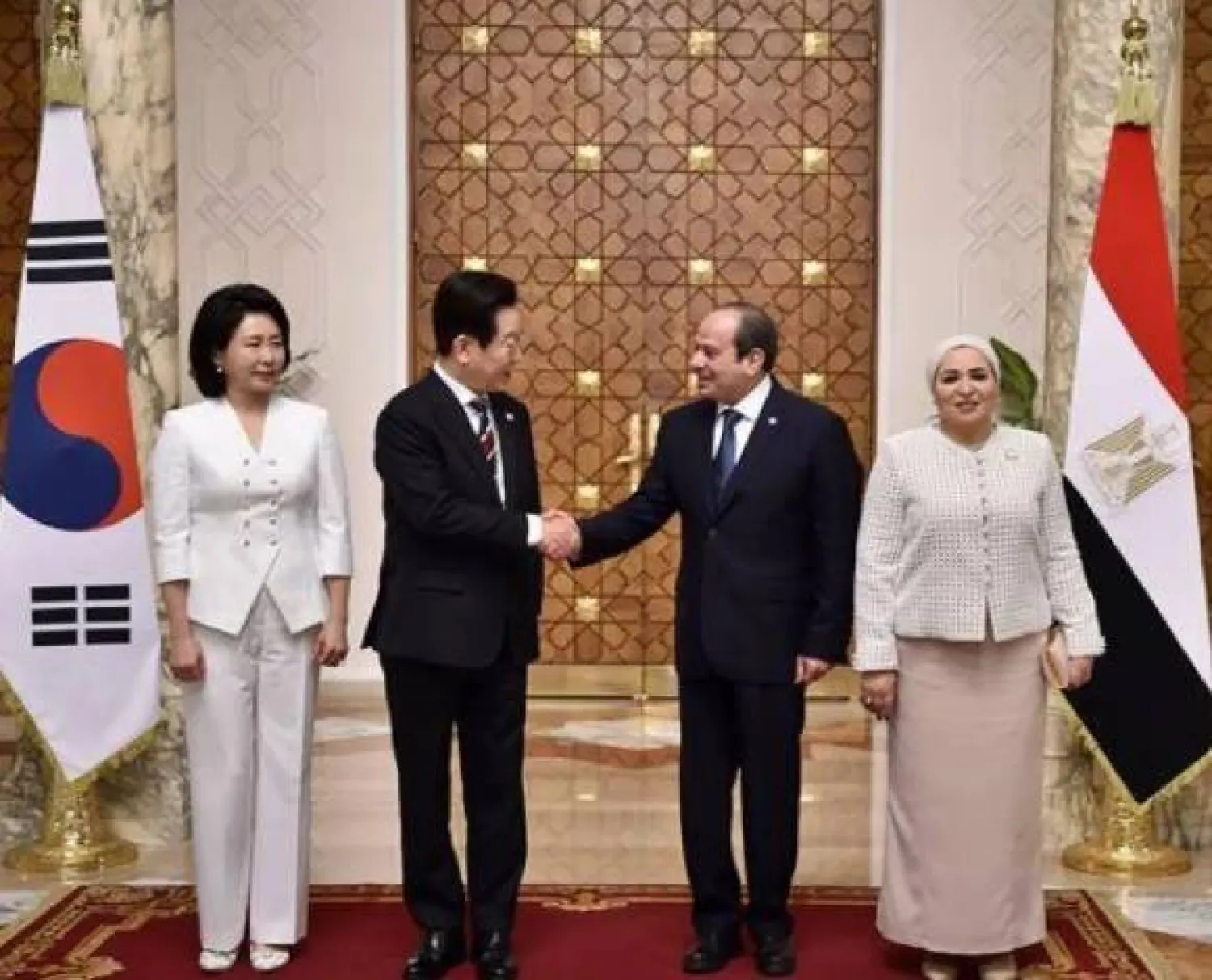

Egyptian President Abdel Fattah El-Sisi on Thursday discussed with his South Korean counterpart, Lee Jae Myung, strengthening bilateral relations in addition to regional issues, including stability in the Korean Peninsula.
During talks at the Ittihadiya Palace in Cairo, El-Sisi stressed the importance of further strengthening the distinguished bilateral relations with South Korea in all fields, particularly economic, investment, cultural, and educational sectors.
This is Lee’s first visit to Egypt since assuming office in June 2025.
El-Sisi lauded the Korean development experience and said Egypt looked forward to increasing the scope of Korean companies' business and investments across various priority sectors, especially communications and information technology, automotive manufacturing, shipbuilding, Artificial Intelligence, petrochemicals, and mining.
Lee said his country was keen on developing cooperation with Egypt across all fields and praised the achievements Egypt has made over the past decade, the most recent of which was the opening of the Grand Egyptian Museum.
Lee’s visit coincides with the 30th anniversary of the establishment of diplomatic relations between the two countries.
The talks in Cairo also addressed regional issues of mutual interest.
El-Sisi reviewed Egypt's efforts to implement the ceasefire agreement in Gaza and the relevant UN Security Council resolution and stressed Egypt's unwavering position that the two-state solution is the only way to achieve lasting peace and stability in the Middle East.
His Korean counterpart commended Cairo’s pivotal role in achieving peace and supporting stability in the Middle East, particularly the President's efforts that led to stopping the war in the Gaza Strip and the hosting of the Sharm El-Sheikh Peace Summit, noting his country's support for the two-state solution and Egypt's related efforts.
The two presidents also exchanged views on the situation in several countries in the region and stressed the need to preserve the unity and sovereignty of states, reach comprehensive political settlements to their crises, and safeguard the capabilities of their people.
“Lee’s visit comes to strengthen mutual cooperation between the two countries after decades of diplomatic relations,” Former Egyptian Assistant Foreign Minister Gamal Bayoumi told Asharq Al-Awsat.
He said Egypt aims to attract Far East countries, especially South Korea, China and Japan, to invest and take advantage of the opportunities offered in the economic zone of the Suez Canal, which facilitates trade between the Far East and Europe.
Dr. Eman Zahran, an expert in international relations, said the visit carries geopolitical, security, and economic dimensions, telling Asharq Al-Awsat that Egypt's mediation between Iran and the International Atomic Energy Agency (IAEA) has enhanced Cairo's standing as a regional and international mediator capable of dealing with multi-dimensional, highly complex and sensitive files, including the proliferation of weapons of mass destruction.
Therefore, she noted, the South Korean leadership is aware of Egypt's important role as a regional power that is active in all conflict and cooperation files.
Last Tuesday, South Korea’s Foreign Minister Cho Hyun said a Korean Peninsula without nuclear weapons is an “imperative” that should not be abandoned, committing to ensure the peninsula does not become a flashpoint of armed conflict.
He referred to the government’s goal of the phased denuclearization of the peninsula.


