


Washington's Abandoned Embassies Have Stories to Tell

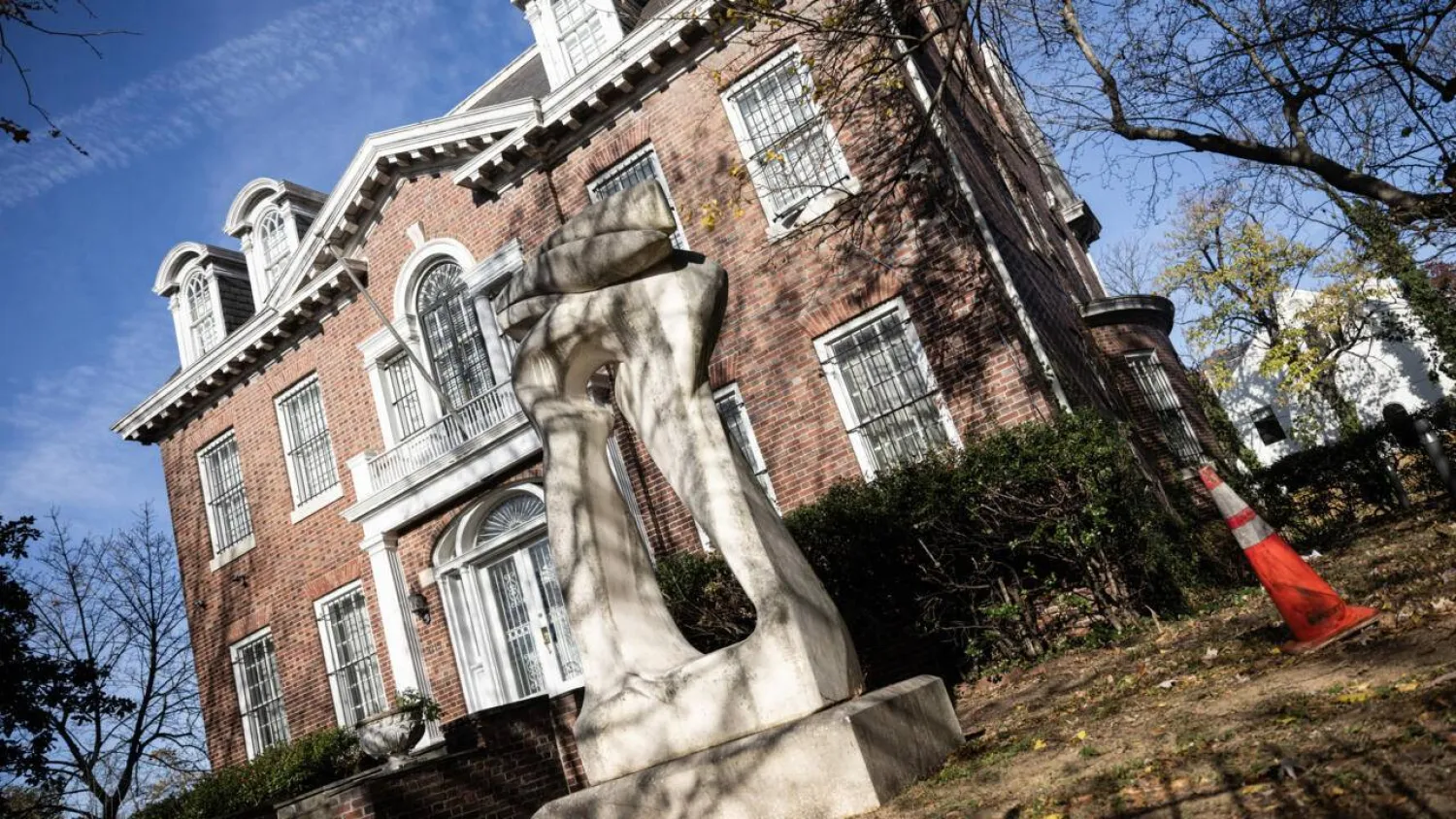
The Syrian embassy is seen behind locked gates in Washington, DC on November 14, 2025. ANDREW CABALLERO-REYNOLDS / AFP
TT

Washington's Abandoned Embassies Have Stories to Tell

The Syrian embassy is seen behind locked gates in Washington, DC on November 14, 2025. ANDREW CABALLERO-REYNOLDS / AFP

In Washington's embassy district, years' worth of wildly overgrown vegetation outside an empty building was finally pruned away in September as the flag of Syria was raised.

The symbolic reopening of the compound after 11 years of closure serves as a reminder that a number of buildings in the area of Washington called Kalorama are in a state of sad abandon, thanks to the violent jolts of world diplomacy.

Since the embassy of Afghanistan closed a few months after the Taliban returned to power in 2021, its mailbox outside has been filled with yellowing newspapers.

And not far away, weeds grow in the parking lot of a mansion that used to house the Russian trade delegation in Washington. The State Department ordered it closed in reprisal for Russia's alleged attempt to interfere in the 2016 US presidential election.

The Syrian Embassy was shut down by the US government in 2014 after three years of civil war. Now, in principle at least, it can reopen.

The Trump administration announced this on November 10 after a White House visit by Syria's new president Ahmed al-Sharaa, who led the ouster of Assad in late 2024.

Angry neighbors

But the building is in such bad shape it could take years to get it up and running again, former Syrian diplomat Bassam Barabandi told AFP.

Barabandi left his post in 2013 after it emerged that he had secretly made passports for people opposed to the Assad regime.

He recalled that even back then, before he left, areas of the building had been partially condemned.

"So, just imagine," he said, of its state now.

Down the street, the overgrown hedges outside the abandoned ambassador's residence were sometimes trimmed by gardeners employed by wealthy neighbors irked by the unsightliness.

A utility company notice of gas being cut off still hangs from the front door knob.

A few buildings away, near a mansion owned by Barack and Michelle Obama, the embassy of Afghanistan stands.

"So one day it was there. The next day it just was, it was gone," said US postal worker Trina Thompson, who has done rounds in the neighborhood for 25 years.

That was in March 2022 and then-deputy ambassador Abdul Hadi Nejrabi watched it all. It was he who handed the keys to the embassy back to the US government.

Kabul had fallen to the Taliban seven months earlier and Hadi Nejrabi and his diplomatic colleagues represented a government that no longer existed.

Soon their bank accounts were frozen and they were no longer paid.

The embassy was still offering consular services to Afghan citizens but "we reached a point the State Department officially asked us to close the embassy and just hand over the keys," Hadi Nejrabi told AFP.

A team from the State Department's Office of Foreign Missions went to the embassy to oversee the closure.

"We checked every room, and then we just came out and we locked the door and I just gave the key," the former diplomat said.

It is this State Department section which is responsible for the upkeep of other countries' embassies.

Under the Vienna Convention on Diplomatic Relations, states are supposed to respect and protect other countries' embassies in cases where diplomatic relations are severed.

'Border on theft'

The State Department lists 29 such buildings which it is supposed to be looking after: three associated with Afghanistan, six with Venezuela, and 11 with Iran -- these three countries have no relations with the United States now. But the list also features three buildings for China and six Russian ones.

The buildings now off limits to the Russians include consulates in San Francisco and Seattle and a massive compound in Maryland.

They were closed in a spat of tit for tat reprisals after the 2016 election won by Donald Trump.

The Russian Embassy told AFP these closures are illegal under the Vienna Convention and "border on theft."

"While property rights of the Russian Federation for these six objects are recognized and have not been challenged by the US side, continuously denying access for Russian diplomats even to inspect the grounds and buildings is preposterous, cementing the bilateral relations' 'toxic legacy' of previous years."

Elsewhere in Kalorama the embassy of Iran has stood empty since 1980, after the Iranian revolution that ousted the US-backed shah.

The squat, blue-domed building used to host fancy receptions for the Washington diplomatic crowd. But unlike the Syrian embassy, it looks far from reopening as US-Iran tensions remain fierce.



Saudi Arabia Participates in 65th Session of Legal Subcommittee of the Committee on Peaceful Uses of Outer Space

File photo of the Saudi flag/AAWSAT
TT

Saudi Arabia Participates in 65th Session of Legal Subcommittee of the Committee on Peaceful Uses of Outer Space

File photo of the Saudi flag/AAWSAT

Represented by a delegation from the Communications, Space and Technology Commission (CST) and the Saudi Space Agency (SSA), the Kingdom of Saudi Arabia participated in the 65th session of the Legal Subcommittee of the Committee on the Peaceful Uses of Outer Space (COPUOS), held in the United Nations’ office for Outer Space Affairs in Vienna, SPA reported.

The meetings addressed regulatory issues aimed at tackling legal challenges associated with space activities. Discussions focused on developing and establishing legal frameworks to explore and utilize space resources, as well as managing and coordinating space traffic. The meetings also examined mechanisms to enhance the long-term sustainability of activities in outer space and to mitigate space debris.

The Saudi delegation provided many contributions to support the development of flexible international regulations that enables a sustainable and safe environment for space innovation, it also highlighted the Kingdom’s efforts in regulating and advancing the space sector.

The Committee on the Peaceful Uses of Outer Space (COPUOS) was set up by the General Assembly of the United Nations in 1958 in Vienna, Austria. The committee was established with 24 state members and has currently grown to include 110 members, making it one of the largest committees of the United Nations; while the United Nations Office for Outer Space Affairs (UNOOSA) has acted as the secretariat to the committee.


Final Talks Begin on Missing Piece for Pandemic Treaty

Tedros Adhanom Ghebreyesus, Director-General of the World Health Organization (WHO), speaks during a news conference in Geneva, Switzerland, Dec. 20, 2021. (Reuters)
TT

Final Talks Begin on Missing Piece for Pandemic Treaty

Tedros Adhanom Ghebreyesus, Director-General of the World Health Organization (WHO), speaks during a news conference in Geneva, Switzerland, Dec. 20, 2021. (Reuters)

An extra week of negotiations to complete an international agreement on handling future pandemics kicked off in Geneva on Monday, with sharp divisions holding up an accord.

Wealthy countries and developing nations are at loggerheads in the talks at the World Health Organization over how the pandemic treaty, adopted last year, will work in practice.

The agreement's Pathogen Access and Benefit-Sharing (PABS) system deals with sharing access to pathogens with pandemic potential, then sharing benefits derived from them such as vaccines, tests and treatments.

"The world cannot afford to lose this opportunity and risk being unprepared for the next pandemic," WHO chief Tedros Adhanom Ghebreyesus said at the start of the talks.

"It will not be perfect; no agreement ever is. But it can be fair; it can be functional," he told negotiators.

In May 2025, WHO members adopted a landmark agreement on tackling future health crises, after more than three years of negotiations sparked by the shock of Covid-19.

The accord aims to prevent a repeat of the disjointed international response that surrounded the coronavirus crisis, by improving global coordination, surveillance and access to vaccines.

PABS, the heart of the treaty, was left out to get the bulk of the deal over the line.

- 'Blame is shared' -

"Developing countries are voicing their mistrust, fearing they will share their viruses without any guarantees of equitable access to vaccines in the event of a crisis," WHO chief scientist Sylvie Briand told AFP.

Other countries are asking whether the pharmaceutical industry has the capacity and motivation to contribute to a pandemic agreement "without a guarantee of return on investment", she said.

Countries have until Friday to negotiate PABS so it can be approved during the World Health Assembly of WHO member states, which opens on May 18.

"Progress has been slow" and finding compromise "will be very hard", though the European Union was now "making an effort to demonstrate some flexibility", said Jean Karydakis, a diplomat at Brazil's mission in Geneva.

The pathogen sharing clauses are considered crucial by developing states, particularly in Africa, where many countries felt cut adrift in the scramble for Covid-19 vaccines.

While NGOs have criticized wealthy nations' obduracy, a western diplomat, speaking on condition of anonymity, said there were also "excessive demands from some developing countries", and thus "the blame is shared" for the deadlock.

- Anonymous access? -

The treaty already says participating pharmaceutical companies should make available 20 percent of their production of vaccines, tests and treatments to the WHO for redistribution -- with at least half as a donation and the rest "at affordable prices".

However, the terms and conditions remain to be defined, as does access to health data and tools outside pandemics.

NGOs and developing countries want to impose mandatory rules for laboratories to ensure poor countries receive vaccines.

"During the Ebola outbreaks, samples from African patients led to treatments developed without such obligations," said Olena Zarytska of the medical charity Doctors Without Borders (MSF).

The result, she said, was limited supplies in Africa and stockpiles in the United States, which under President Donald Trump has withdrawn from the WHO.

Developing countries also want a user registration and tracking system for the PABS database, while developed countries, "basically Germany, Norway and Switzerland, advocate for maintaining anonymous access", said K. M. Gopakumar, senior researcher with the Third World Network.

Anonymous access would make it "impossible" to track who is using pathogen information and whether they are sharing the benefits, 100 non-governmental organizations, including Oxfam, said in a joint letter to the WHO.

"In practice, this means that genetic resources originating in developing countries can be accessed, commercialized, and exploited with complete impunity," the letter said.


Steep Mountainside Offers Respite for Daring Afghans

An Afghan boy enjoys rolling down a steep and sandy mountainside on a weekend at the Sayad area of Reg-e-Rawan in Kapisa province on April 24, 2026. (AFP)
TT

Steep Mountainside Offers Respite for Daring Afghans

An Afghan boy enjoys rolling down a steep and sandy mountainside on a weekend at the Sayad area of Reg-e-Rawan in Kapisa province on April 24, 2026. (AFP)

Backflipping down a steep and sandy mountainside, Afghan teenager Imran Saeedi wows the crowds of men who gather each springtime to unwind beside breathtaking views.

Hundreds of visitors travel each weekend to Reg-e-Rawan -- "the moving sands" in Dari -- to practice parkour or roll down the honey-colored sand in Kapisa province.

"I feel afraid when I'm going for a flip or a jump, and of course I can get injured," said 16-year-old Saeedi, who nonetheless loves the thrill.

"When the week starts, I'm just waiting for the weekend so I can come to Reg-e-Rawan to have fun again," said the high school student.

Men and boys clapped in admiration as he ran down the hill and flipped forwards, then backwards, while his friends filmed on their phones.

Less daring onlookers sat atop rocks surrounding the mountain, picnicking together and enjoying the scenery.

Reg-e-Rawan is off limits to women and girls, who are banned by the Taliban authorities from recreational spots such as parks.

Families with women were turned away when AFP journalists visited, while officials under the Ministry for the Propagation of Virtue and the Prevention of Vice patrolled the area.

- 'Humans need nature' -

Mirwais Kamran, a 48-year-old businessman, had driven three hours north from the capital Kabul with some of his 12 children.

"I feel joy when I come here with my children and friends," said Kamran, who climbed up the slope but stopped short of rolling down.

Nusratullah Nusrat, the provincial head of tourism at the Kapisa Department of Information and Culture, said the site dates back thousands of years.

"The unique feature of this place is that the sand never decreases despite people climbing up and sliding down," he told AFP.

Some people believe rolling in the sand also helps treat rheumatism, added Nusrat.

For visitors such as Nohzatullah Ahmadzai, who travelled from Kabul with a group of friends, Reg-e-Rawan lifts his mood.

"I'm someone who gets depressed when I'm sad, so visiting such places erases that feeling," said the 22-year-old, who works for a cargo firm.

Climbing the slope takes about an hour, rewarding visitors with views over green fields dotted with villages.

"We humans need nature," said Ahmadzai. "When we feel stressed, we can visit natural places for relaxation or relief."