
Rural Greece Struggles to Cope with Predator Comeback

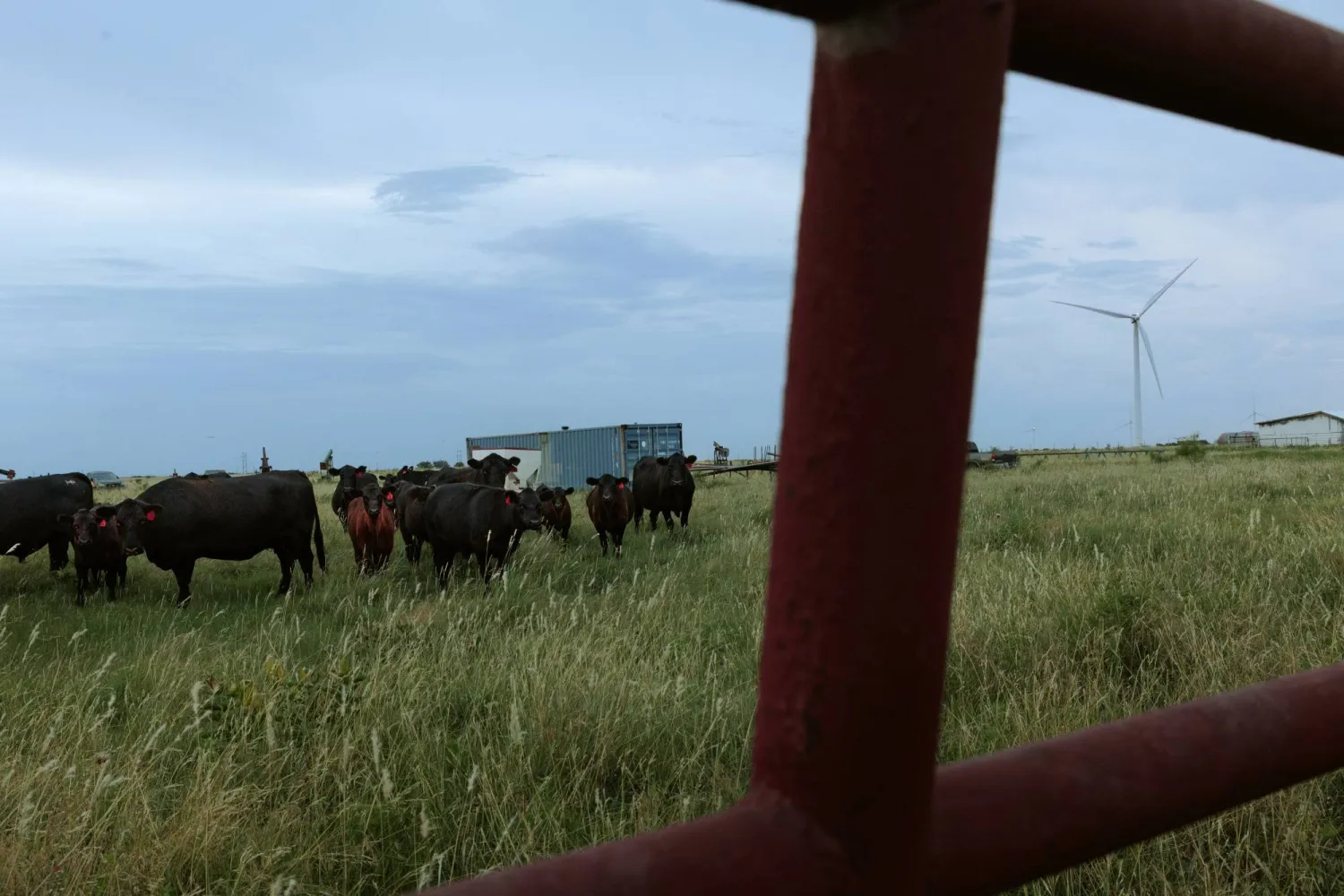
Cows graze near the Trinity Hills wind farm near Olney, Texas on June 26, 2025. (Shelby Tauber/The Texas Tribune via AP)
TT

Rural Greece Struggles to Cope with Predator Comeback

Cows graze near the Trinity Hills wind farm near Olney, Texas on June 26, 2025. (Shelby Tauber/The Texas Tribune via AP)

It was a shocking sight for the farmer — three of his sheep lying dead on the ground, signs of their mauling unmistakable. The large paw prints in the earth left no doubt they had been killed by a bear, a once rare but now increasingly frequent visitor in this part of northwestern Greece.

“It was a bear, a very big one, and they come often now. I wasn’t the only one, it struck elsewhere too,” said Anastasios Kasparidis, adding that another farmer had lost some chickens and pigs. He decided to move the rest of his small flock into a sheep pen near his house for protection.

“Because in the end I wouldn’t have any sheep," The Associated Press quoted Kasparidis as saying. "The bears would eat them all.”

Environmentalists have welcomed the rebound of bear and wolf populations in Greece thanks to the protected species designation that banned them being hunted.

But some farmers and residents of rural areas say they now fear for their livelihoods and, in some cases, their safety. They are calling for greater protection in a phenomenon playing out elsewhere in Europe, with some arguing conservation has gone too far and pushing to roll back restrictions.

Bears, wolves and boars Brown bears, Greece’s largest predator, have made a remarkable comeback. Their numbers have increased roughly fourfold since the 1990s, said Dimitris Bakaloudis, a professor at the Aristotle University of Thessaloniki who specializes in wildlife management and conservation.

Up to an estimated 870 brown bears roam the forests of northern Greece, according to the most recent survey by Arcturos, an environmental organization set up in 1992 that provides a sanctuary for rescued bears and wolves.

And it's not just bears. Wolves also have seen their numbers rise. While wolves could only be found as far south as central Greece in 2010, they have now spread to the outskirts of Athens and into the Peloponnese in southern Greece, Bakaloudis said.

Their recovery has been sustained in part by the also increasing population of wild boars, which is unrelated to conservation efforts. Rather, a combination of a number of factors, including a reduction of hunting, milder winters and cross-breeding with domestic pigs have led them to reproduce at a faster rate, Bakaloudis explained.

Viewed by many as pests that destroy crops, the sight of a dozen or more boars trotting along sidewalks or snuffling through backyards are no longer uncommon in many parts of Greece.

The larger number of wild animals has also resulted in more contact with humans — the vast majority of whom are unfamiliar with how to behave during an encounter.

Lack of familiarity has led to fear in some communities, particularly following a small number of serious incidents this year: a child bitten by a wolf, an elderly man injured by a bear in his yard, a hiker bitten by a bear and another hiker who died after falling into a ravine during a bear encounter.

In Levea, a village of about 660 people surrounded by fields in northwestern Greece, several bear encounters were reported in October, while boars frequently roam through the village, said community president Tzefi Papadopoulou. The bears especially had frightened residents.

“As soon as they heard a dog bark, they were ready to go out with the gun,” she said.
It's similar in the nearby village of Valtonera, 170 kilometers west of Greece’s second largest city, Thessaloniki.

“The village used to be without wild animals. In the past, a wolf would appear once in a while,” said Konstantinos Nikolaidis, community president. Now, wild boars, foxes, bears or wolves roam around or even inside the village, he noted.

“This has caused concern among all residents. It’s now difficult for a person to walk around outside at night,” he said.

The burgeoning wild boar population, meanwhile, has led to calls for the hunting season to be extended.

Giorgos Panagiotidis, deputy mayor of the nearby small town of Amyntaio, said boars had been increasingly encroaching on houses. In May, he asked authorities for hunters to be allowed to shoot boars out of season to tackle the problem.

It’s an issue that isn’t unique to Greece. In a victory of farmers over environmentalists, European Union lawmakers voted in May to reduce protections for wolves across the EU’s 27 member states. The movement even gained support from European Commission President Ursula von der Leyen, whose pony Dolly was killed by a wolf three years ago.

Solutions Experts note it isn't just the larger number of wild animals that has led to encroachment on urban areas. Many factors are at play, they say, from loss of habitat due to wildfires, to noise disturbances from wind turbines and recreational vehicles, and animals emboldened by dwindling human populations in villages.

“There is of course fragmentation of the bears’ habitat, frequently there is drought, there’s a lack of food in the natural environment, there’s a desertification of villages which makes inhabited areas more attractive to bears, so they approach and find food,” said Panos Stefanou, communications officer at Arcturos.

Measures to keep wolves and bears at bay have been developed and approved by scientists, said Bakaloudis, the Thessaloniki university professor, including using lights around property, proper disposal of trash and dead livestock and avoiding feeding strays.

In exceptional circumstances more invasive methods are used, he said, such as in the case of the wolf attack on the child in northern Greece, where authorities decided to capture and remove the animal.

With so many factors contributing to increasing encounters between wild animals and humans, Stefanou cautioned against overly simplistic solutions.

“Killing the animals is not what will solve the problem,” he said.


Olympic Tourists in Cortina Can Explore the Dolomites with the New ‘Uber Snowmobile’ Service

 The peaks of the Dolomites are seen from the Cortina Sliding Centre during the Milano Cortina 2026 Winter Olympic Games in Cortina d'Ampezzo on February 5, 2026. (AFP)
The peaks of the Dolomites are seen from the Cortina Sliding Centre during the Milano Cortina 2026 Winter Olympic Games in Cortina d'Ampezzo on February 5, 2026. (AFP)
TT

Olympic Tourists in Cortina Can Explore the Dolomites with the New ‘Uber Snowmobile’ Service

 The peaks of the Dolomites are seen from the Cortina Sliding Centre during the Milano Cortina 2026 Winter Olympic Games in Cortina d'Ampezzo on February 5, 2026. (AFP)
The peaks of the Dolomites are seen from the Cortina Sliding Centre during the Milano Cortina 2026 Winter Olympic Games in Cortina d'Ampezzo on February 5, 2026. (AFP)

The peaks of the Dolomites are seen from the Cortina Sliding Centre during the Milano Cortina 2026 Winter Olympic Games in Cortina d'Ampezzo on February 5, 2026. (AFP)

For one month starting on Saturday, Olympic spectators keen for a side trip to a UNESCO World Heritage Site can use Uber to reserve a ride on a snowmobile along the snow-covered road to the base of the Three Peaks of Lavaredo.

The dramatic, jagged limestone pinnacles stand just 23 kilometers (14.3 miles) from the Cortina venues where athletes are competing in the 2026 Winter Olympics and Paralympics.

One of the Olympic torchbearers, Giulia Baffetti, runs snowmobiling tours through Cortina-based winter activities outfit Snowdreamers. The company partnered with Uber, the official ride-hailing sponsor for the Games, to offer free tours on the weekends in February to people in town.

"Uber Snowmobile" tours, which can only be booked through Uber, include a ride in an Uber transfer bus for up to eight people from Cortina to the spot where riders mount their snowmobiles for departure. Tourgoers then follow the instructor, who leads the line of snowmobiles.

The first slots offered went fast, but Uber spokesperson Caspar Nixon said Friday that it planned to add more.

The three peaks are a magical place, Baffetti said, and this is a way for more people to experience it. Hikers and climbers flock there in the warmer months. In the winter, it’s a prime spot for cross-country skiing, snowshoeing and sledding. Snowmobiling is allowed in a limited area in order to protect the environment.

"We want to give an experience to the tourists, so they can feel the mountains in a different way," she said.

The Associated Press took the one-hour tour on Thursday, ahead of the Saturday launch, along with one other person. Helmets are essential, while heated handgrips are a most welcome feature. And that red button? Passengers can push it to stop the snowmobile if it veers off course or they feel unsafe.

The adrenaline-filled ride reaches speeds up to 40 kph (25 mph) when zooming past snow-covered trees, and drivers are instructed to slow when coming upon cross-country skiers and sledders. Deer and wolves are sometimes seen along the 7-kilometer (4.3-mile) route up to the base of the peaks.

Also visible on Thursday was the southernmost of the three Lavaredo peaks, rising sharply out of the fog. While the Dolomites are breathtaking from Cortina — and on Friday, the sun shone and the view was clear from town — they are even more impressive up close.

The route back includes a short loop around Lake Antorno. Before traversing all the ups and downs, the snowmobile instructor leading the tour offers a reminder about that red button.

Saher Deeb, an Israeli tourist, was along for the ride Thursday, one day after his 29th birthday. It was his first time on a snowmobile, and he was all smiles as he climbed off at the end.

"It was perfect," he said.


French Duo Finish Walking from France to Shanghai After 1.5 Years

 Performers throw molten iron to create sparks during a performance on the Bund promenade along the Huangpu river, ahead of the upcoming Lunar New Year of the Horse in Shanghai on February 2, 2026. (AFP)
Performers throw molten iron to create sparks during a performance on the Bund promenade along the Huangpu river, ahead of the upcoming Lunar New Year of the Horse in Shanghai on February 2, 2026. (AFP)
TT

French Duo Finish Walking from France to Shanghai After 1.5 Years

 Performers throw molten iron to create sparks during a performance on the Bund promenade along the Huangpu river, ahead of the upcoming Lunar New Year of the Horse in Shanghai on February 2, 2026. (AFP)
Performers throw molten iron to create sparks during a performance on the Bund promenade along the Huangpu river, ahead of the upcoming Lunar New Year of the Horse in Shanghai on February 2, 2026. (AFP)

Two French adventurers reached the end of an epic walk from France to Shanghai on Saturday, after nearly a year and a half crossing 16 countries almost entirely on foot.

Loic Voisot and Benjamin Humblot embraced as they stood by the river on the Bund promenade, the financial hub's distinctive skyline glittering in the background.

Voisot and Humblot set off from Annecy in September 2024.

"We were thinking about this moment almost every day for more than a year now, so it's a really strong feeling," Humblot said of reaching their destination.

Hanging out after work one day, the two friends realized they both yearned for a "great adventure".

They wanted to visit China -- but without flying, which they believe is too harmful to the environment.

A plan to set out on foot was hatched, and except for a stretch in Russia which was done by bus for safety reasons, 518 days and around 12,850 kilometers (7,980 miles) later they took the last steps to completing it.

Around 50 people gathered at the start point for the last 10km stretch of their odyssey, many local people who have been following them on social media.

Along the way their numbers swelled, as media, French residents of Shanghai and others joined.

"If your dreams are crazy, just take it step by step and sometimes you will not succeed, but sometimes you will," said Voisot.

Asked what he would do first now the walk was over, he joked: "Sleep a lot!"


Annual Orchids Show Brings Vivid Color to Chicago Winter

Orchids adorn a Volkswagen Beetle as finishing touches are placed on the 12th annual Chicago Botanic Garden Orchid Show, Friday, Feb. 6, 2026, in Glencoe, Ill. (AP)
TT

Annual Orchids Show Brings Vivid Color to Chicago Winter

Orchids adorn a Volkswagen Beetle as finishing touches are placed on the 12th annual Chicago Botanic Garden Orchid Show, Friday, Feb. 6, 2026, in Glencoe, Ill. (AP)

A soft layer of white snow blankets the grounds of the Chicago Botanic Garden. The air is chilly, the sky gray.

Inside, however, the air is warm and lights illuminate more than 10,000 vividly colored orchids. Staff members move in and out of greenhouses, preparing to open the garden’s 12th annual Orchid Show on Saturday.

This year’s theme is “Feelin’ Groovy" with several installations calling back to the 1970s, including a yellow Volkswagen Beetle filled with orchids.

“It’s just a really great way to get out of the winter cold and come into our greenhouses,” said Jodi Zombolo, associate vice president of visitor events and programs. “I think people are really looking for something to kind of bring happiness and something that they will enjoy and find whimsy in.”

The orchid family is one of the largest in the plant world and some of the species in the show are rare, exhibits horticulturist Jason Toth said. One example is the Angraecum sesquipedale, also known as Darwin’s orchid, on display in the west gallery.

Toth said the orchid led Darwin to correctly conclude that pollinators have adapted in order to reach down the flower's very long end.

"It has a great story and it’s quite remarkable-looking,” said Toth.

Elsewhere, massive, gnarly roots dangle from purple, pink and yellow Vanda orchids in the south greenhouse. These epiphytic orchids grow on the surface of trees instead of in soil.

“I think everyone’s tired of the winter,” said Toth. “So having some kind of flower show at this point is what we’re all craving. And 'Orchids' fits the bill.”

The show is expected to draw 85,000 visitors this year.