


Beirut, Damascus Lay Groundwork for a New Relationship

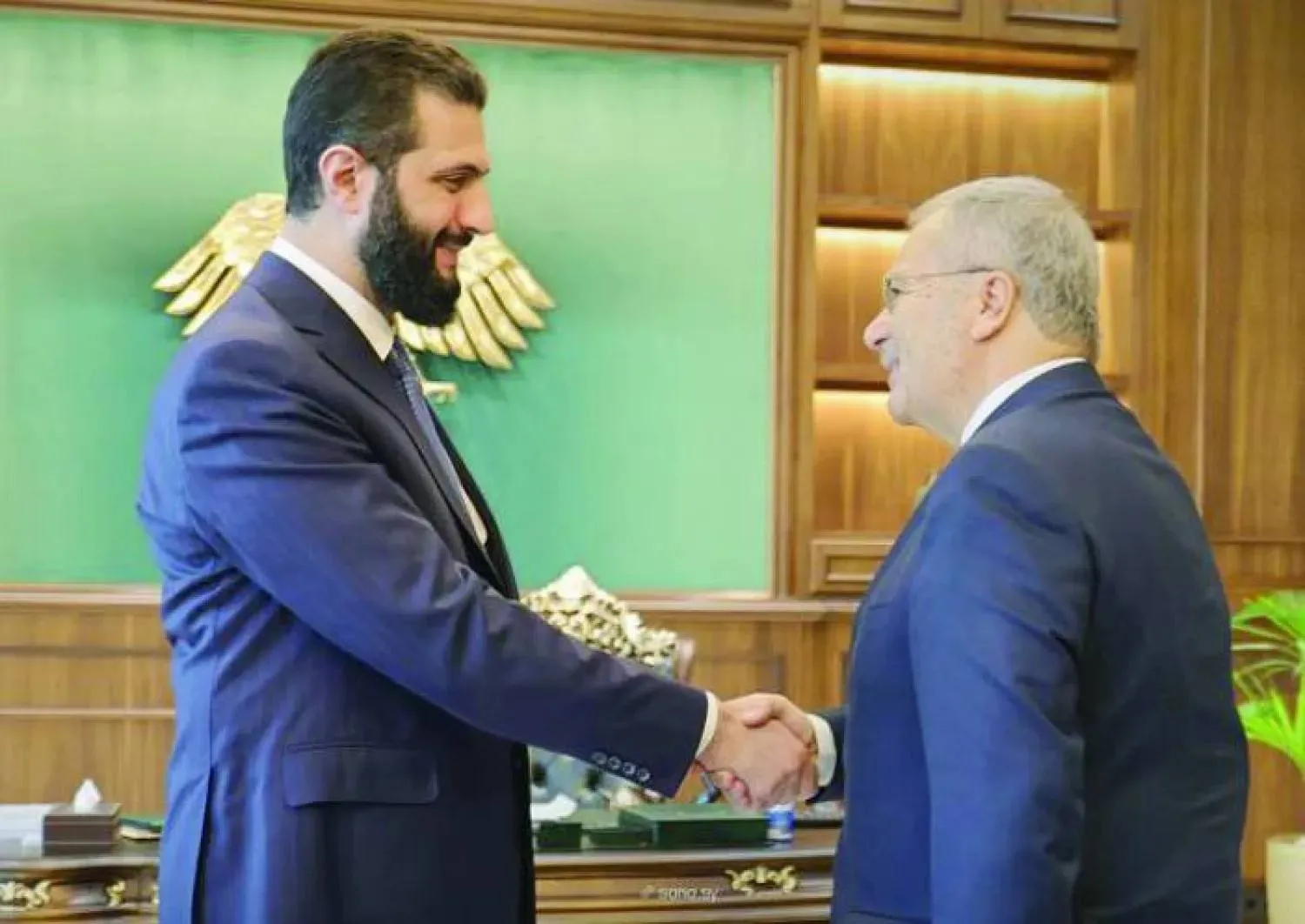
Syrian President Ahmed al-Sharaa receiving Lebanese Deputy Prime Minister Tarek Mitri at the People’s Palace (SANA)
TT

Beirut, Damascus Lay Groundwork for a New Relationship

Syrian President Ahmed al-Sharaa receiving Lebanese Deputy Prime Minister Tarek Mitri at the People’s Palace (SANA)

Lebanon’s Deputy Prime Minister Tarek Mitri returned from Damascus with what officials described as significant results, after meeting Syrian President Ahmed al-Sharaa and several ministers.

The visit marked a shift in bilateral ties from tension and caution to a more open and aligned track, reinforcing a joint Lebanese Syrian approach to turn the page on a painful past and establish firmer, long term partnership at a time of regional turmoil, according to sources familiar with the talks.

A clearer picture of the emerging rapprochement is expected soon.

Mitri voiced strong satisfaction with the outcome of his trip, saying meaningful cooperation between the two countries had begun about four months ago and that his meetings in Damascus were meant to build on what had been achieved and to strengthen a path based on transparency, clarity and mutual respect.

Mitri told Asharq Al-Awsat that al-Sharaa had been explicit in his desire to avoid reopening old wounds and to look to the future as the only route to stability, a message Mitri described as a clear political declaration aimed at ending years of mistrust and friction.

Strategic cooperation

Mitri said al-Sharaa laid out a long term vision for strengthening bilateral relations.

He said the Syrian president raised issues on building strategic cooperation in energy, water and security, as well as leveraging each country’s international ties in ways that serve the other’s interests.

Mitri said al-Sharaa recalled positions he had voiced in meetings abroad, including in Washington, where he stressed the importance of consolidating Lebanese-Syrian ties and rebuilding trust.

He also cited a speech he gave two months ago urging both sides to rise above past grievances. Syria, he said, is now convinced that Lebanon has human and economic capacities that can play a key role in Syria’s reconstruction phase.

Political and administrative meetings

Mitri’s mission in Damascus focused on two tracks, the political track centered on his extended meeting with al-Sharaa, and the second - technical, administrative and security - required talks with the ministers of foreign affairs, justice, finance, telecommunications and social affairs.

Mitri said his talks with Syrian ministers delved into sensitive files, including control of the shared border and the demarcation of land and maritime boundaries, particularly with updated maps and reports now available to facilitate the process.

He said both sides agreed to a practical approach based on direct cooperation.

The disputed Shebaa Farms stayed off the negotiating table. Mitri hinted that both sides viewed the issue as highly sensitive, especially because it remains under Israeli occupation, making it unhelpful politically or practically to address it at this time.

Detainee files

Alongside border matters, the issue of Syrian detainees in Lebanon and missing Lebanese in Syria took up a significant portion of the talks.

Mitri said he discussed the complicated file with Syria’s justice minister, adding that Damascus understood the legal procedures followed in Lebanon.

He said both sides agreed on the need to keep working together to find fair solutions and focused on concluding a judicial agreement governing the transfer of Syrian detainees and convicts held in Lebanese prisons.

Mitri said Lebanese Syrian relations now stand at the threshold of a fundamentally different phase from previous years, one based on a shared recognition that stability in Lebanon is inseparable from stability in Syria and that cooperation can no longer be postponed.

He said security and economic pressures, the burden of displacement and overlapping crises make coordination more necessary than ever.



Israel Clears Final Hurdle to Start Settlement Construction That Would Cut West Bank in Two

Construction cranes tower above a construction site in Givat HaMatos, an Israeli settlement suburb of Israeli-annexed east Jerusalem on January 2, 2026. (AFP)
TT

Israel Clears Final Hurdle to Start Settlement Construction That Would Cut West Bank in Two

Construction cranes tower above a construction site in Givat HaMatos, an Israeli settlement suburb of Israeli-annexed east Jerusalem on January 2, 2026. (AFP)

Israel has cleared the final hurdle before starting construction on a controversial settlement project near Jerusalem that would effectively cut the West Bank into two, according to a government tender. 

The tender, seeking bids from developers, would clear the way to begin construction of the E1 project. 

The anti-settlement monitoring group Peace Now first reported the tender. Yoni Mizrahi, who runs the group’s settlement watch division, said initial work could begin within the month. 

Settlement development in E1, an open tract of land east of Jerusalem, has been under consideration for more than two decades, but was frozen due to US pressure during previous administrations. 

The international community overwhelmingly considers Israeli settlement construction in the West Bank to be illegal and an obstacle to peace. 

The E1 project is especially contentious because it runs from the outskirts of Jerusalem deep into the occupied West Bank. Critics say it would prevent the establishment of a contiguous Palestinian state in the territory. 

Israeli Finance Minister Bezalel Smotrich, a far-right politician who oversees settlement policy, has long pushed for the plan to become a reality. 

“The Palestinian state is being erased from the table not with slogans but with actions,” he said in August, when Israel gave final approval to the plan. “Every settlement, every neighborhood, every housing unit is another nail in the coffin of this dangerous idea.” 

The tender, publicly accessible on the website for Israel’s Land Authority, calls for proposals to develop 3,401 housing units. Peace Now says the publication of the tender “reflects an accelerated effort to advance construction in E1.” 


Three Killed in Aleppo Attacks, Syrian Government, SDF Trade Blame

Syrian forces are seen during a military parade in Aleppo marking a year since the ouster of the Assad regime in December 2025. (Syrian Defense Ministry)
TT

Three Killed in Aleppo Attacks, Syrian Government, SDF Trade Blame

Syrian forces are seen during a military parade in Aleppo marking a year since the ouster of the Assad regime in December 2025. (Syrian Defense Ministry)

At least three people were killed and several others wounded in Syria's northern city of Aleppo, state news agency SANA said on Tuesday, citing Aleppo's health director, after deadly attacks for which Syrian government forces and the Kurdish-led Syrian Democratic Forces traded blame.

Syria's defense ministry said in a statement that the SDF had continued its "escalation" by targeting army positions and residential areas in Aleppo. The SDF denied its responsibility, saying that the ‌casualties were caused by "indiscriminate" ‌artillery and missile shelling by ‌factions ⁠aligned with ‌the Damascus government.

The violence came days after a meeting between senior officials from the SDF and the Damascus government on implementing a deal agreed nearly 10 months ago that aimed to fully integrate the semi-autonomous Kurdish region into the central Syrian government.

The agreement was ⁠meant to be implemented by the end of 2025, but ‌the two sides have made ‍little progress, each accusing ‍the other of stalling or acting in bad ‍faith.

The SDF is reluctant to give up autonomy it won as the main US ally during the war, which left it with control of ISIS prisons and rich oil resources.

Integrating the SDF into Syria's army would mend Syria's deepest remaining fracture, ⁠but failing to do so risks an armed clash that could derail the country's emergence from 14 years of war and potentially draw in Türkiye, which has threatened an incursion against Kurdish fighters it views as terrorists.

As progress falters, several rounds of fighting have broken out. On December 22, Syrian government forces and SDF agreed to de-escalate in the northern city of Aleppo, after a wave ‌of attacks that left at least two civilians dead and several wounded.


African Union Calls for Immediate Revocation of Somaliland’s Recognition by Israel

Somalis burn the Israel flag and an image depicting Israeli Prime Minister Benjamin Netanyahu during a demonstration, after Israel became the first country to formally recognize the self-declared Republic of Somaliland, at the Mogadishu Stadium in Warta Nabada district of Mogadishu, Somalia December 30, 2025. (Reuters)
TT

African Union Calls for Immediate Revocation of Somaliland’s Recognition by Israel

Somalis burn the Israel flag and an image depicting Israeli Prime Minister Benjamin Netanyahu during a demonstration, after Israel became the first country to formally recognize the self-declared Republic of Somaliland, at the Mogadishu Stadium in Warta Nabada district of Mogadishu, Somalia December 30, 2025. (Reuters)

The African Union's Political Affairs Peace and Security council called on Tuesday for the "immediate revocation" of Israel's recognition ‌of Somaliland.

Israeli ‌Foreign ‌Minister ⁠Gideon Sara ‌visited Somaliland on Tuesday on a trip that was denounced by Somalia, 10 ⁠days after Israel ‌formally recognized the ‍self-declared ‍republic as ‍an independent and sovereign state.

"The (AU) Council strongly condemns, in the strongest terms, the unilateral recognition of ⁠the so-called 'Republic of Somaliland' by Israel," it said in a post on X after a ministerial meeting.