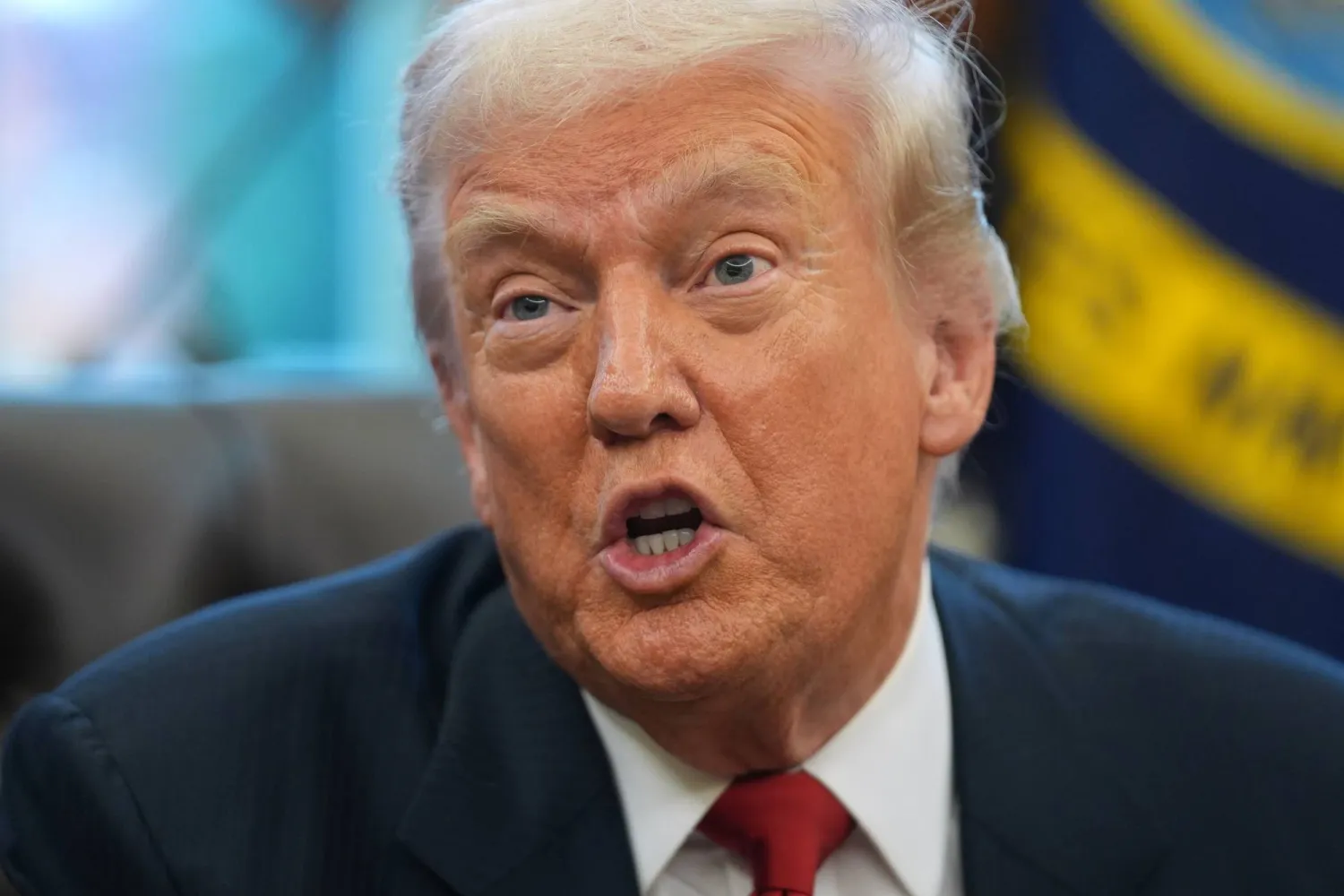
Trump to End Temporary Protected Status for Somalis in Minnesota

President Donald Trump talks after meeting with New York City Mayor-elect Zohran Mamdani in the Oval Office of the White House, Friday, Nov. 21, 2025, in Washington. (AP Photo/Evan Vucci)
TT

Trump to End Temporary Protected Status for Somalis in Minnesota

President Donald Trump talks after meeting with New York City Mayor-elect Zohran Mamdani in the Oval Office of the White House, Friday, Nov. 21, 2025, in Washington. (AP Photo/Evan Vucci)

US President Donald Trump on Friday said he was immediately terminating temporary deportation protections for Somalis living in Minnesota, accelerating the end of a program that began in 1991 under another Republican president.

"Somali gangs are terrorizing the people of that great State, and BILLIONS of Dollars are missing," Trump said in a late-night post on Truth Social, without providing any further explanation or evidence.

"I am, as President of the United States, hereby terminating, effective immediately, the Temporary Protected Status (TPS Program) for Somalis in Minnesota," Reuters quoted him as saying.

Trump called Minnesota a "hub of fraudulent money laundering activity" under Democratic Governor Tim Walz, an apparent response to unverified media reports, shared by several Republican lawmakers, that the Al-Shabaab militant group in Somalia had benefited from fraud committed in Minnesota.

Walz responded on X, saying, "It’s not surprising that the President has chosen to broadly target an entire community. This is what he does to change the subject." The TPS program for Somalis was launched by then-President George H.W. Bush in September 1991. It grants government protection to eligible foreign-born individuals who cannot return home safely due to civil war or natural disasters.

Seventeen countries are eligible, but the Trump administration has announced it is terminating TPS designations for several, including Venezuela and Nicaragua.

The administration of Trump's Democratic predecessor, Joe Biden, extended the eligibility for Somalis through March 17, 2026. Most of the Somalis in Minnesota are US citizens, and there are only 705 Somali-born individuals nationwide who have TPS status, according to a report by the non-partisan Congressional Research Service.

By comparison, over 330,000 Haitians have TPS status, along with over 170,000 people from El Salvador.

Jaylani Hussein, executive director of the Council on American-Islamic Relations in Minnesota, said Trump's decision was disappointing given that the Somalis in question were legal migrants, adding that Trump's move could tear families apart.

"These are legal immigrants and they should not suffer as a consequence of a political football that's being played against the Muslim community. These individuals have been following the law," he said.

Abshir Omar, a political strategist who endorsed Trump in the 2024 presidential election, said he expected the decision to be challenged in court. He said it could harm the long-term economic and strategic relationship with Somalia, which in March offered the US exclusive control of air bases and ports, and has expressed interest in partnerships with US firms to explore its large oil reserves.


Israeli Defense Minister Says Iran Developing Chemical Weapons

Israeli Foreign Minister Israel Katz waits for his British and French counterparts ahead of a meeting, amid the conflict between Israel and Hamas, in Jerusalem August 16, 2024. (Reuters)
TT

Israeli Defense Minister Says Iran Developing Chemical Weapons

Israeli Foreign Minister Israel Katz waits for his British and French counterparts ahead of a meeting, amid the conflict between Israel and Hamas, in Jerusalem August 16, 2024. (Reuters)

Israeli Defense Minister Israel Katz said on Tuesday that Iran is developing chemical weapons, and vowed to stop Tehran from obtaining them.

"Iran is in the process of developing chemical weapons," Katz said in a briefing to Israeli reporters, according to public broadcaster KAN and other national outlets.

"The State of Israel will not allow them to reach that capability."


Eisenkot Backs Netanyahu Opponents: No Urgent Need to Attack Iran Now

Former military chief Gadi Eisenkot, leader of the Yashar party arrives to speak at the Knesset, Israel's parliament in Jerusalem, November 23, 2026. REUTERS/Ronen Zvulun
TT

Eisenkot Backs Netanyahu Opponents: No Urgent Need to Attack Iran Now

Former military chief Gadi Eisenkot, leader of the Yashar party arrives to speak at the Knesset, Israel's parliament in Jerusalem, November 23, 2026. REUTERS/Ronen Zvulun

Israeli military and security chiefs, who believe a third war with Iran is only a matter of time, have gained support from Gadi Eisenkot, leader of the Yashar party and the politician tasked with forming Israel's next government, as well as senior figures in his political camp.

Their backing has strengthened the security establishment's position against outgoing caretaker Prime Minister Benjamin Netanyahu, with Eisenkot arguing that another war with Iran is not an urgent necessity.

The disagreement over Iran spilled into the media after Netanyahu and Eisenkot clashed over a potential strike against Tehran.

Netanyahu accused his political rival of downplaying the security threats facing Israel for political reasons after Eisenkot openly questioned whether Iran posed an immediate threat.

Netanyahu

Speaking at a Likud faction meeting in the Knesset, Netanyahu said: "Our ability to ensure the existence of the state in the face of the major threats surrounding us depends on our unity. Anyone who mocks or downplays these threats is doing so for political reasons."

His remarks came amid reports that he is pushing to resume military operations against Iran, a move opposed by military and security officials who believe he wants to trigger a confrontation to delay the formation of a new government.

Eisenkot

Eisenkot openly backed military and security leaders, telling a meeting of his Yashar faction that he saw no immediate Iranian threat requiring military action before the new government is sworn in.

He argued that rather than conducting further military operations, Israel should focus on Iran's stockpile of enriched uranium.

"The gravest threat from Iran is the 440 kilograms of enriched uranium that have still not been destroyed or removed. We must focus on that," he said.

The dispute between Netanyahu and Eisenkot reflects part of the broader political and security debate in Israel.

Israeli public broadcaster Kan reported that while Netanyahu is pushing for war with Iran, the security establishment believes alternatives remain available.

These include the possibility of reaching an agreement, maintaining the blockade and economic pressure, or undertaking military action in coordination with the United States.

An informed source told Kan that US President Donald Trump is not inclined to make such a decision at present, as Iran's economic difficulties have strengthened the position of those advocating continued economic pressure rather than war.

A second reason Trump and others oppose an immediate war is the assessment that another strike would not bring down the government in Tehran.

Beyond Eisenkot, other figures in Israel's pro-change political camp have criticized Netanyahu and warned against taking the country into another war, particularly with Iran.

Lieberman

The Maariv newspaper quoted Yisrael Beytenu leader Avigdor Lieberman as saying during a closed meeting of the Knesset Foreign Affairs and Defense Committee's intelligence subcommittee, attended by military Chief of Staff Eyal Zamir and Knesset Speaker Matan Kahana, that any war against Iran at this stage would be driven by political and personal considerations.

"Reports have emerged that Iran is seeking to acquire chemical weapons. If true, this constitutes a serious threat, but it neither requires nor justifies immediate unilateral action without American involvement," Lieberman said.

"The concern is that Netanyahu may see an attack on Iran as his last political way out. If he decides to attack Iran alone, without cooperation with the United States, that would clearly be an illegal act," he added.

Golan

Yair Golan, leader of the left-wing Democrats party, also joined those accusing Netanyahu of attempting to drag Israel into another war with Iran for political reasons.

Netanyahu's position is based on alleged developments in Iran's chemical weapons program, which Mossad chief Roman Gofman reportedly presented to American officials during a visit to Washington approximately two weeks ago.

Eisenkot and military commanders, however, believe the current Iranian threat does not warrant immediate action.

Mossad

Divisions over Iran have also emerged within Mossad.

According to Haaretz, researchers within the intelligence agency concluded during recent discussions that there was no immediate need for military action against Iran.

Their assessment contrasts with the position of Mossad chief Roman Gofman, Netanyahu's former military secretary, who is reportedly advocating renewed strikes against the Islamic Republic.

Military Experts

Experts in Israel estimate that it could take Iran two years or more to develop a system capable of delivering chemical weapons to Israel.

Writing in Maariv on Tuesday, military commentator Avi Ashkenazi said the Israeli military remains on high alert, both defensively and in its preparations for potential offensive operations.

According to Ashkenazi, the military believes it could be called upon to launch an offensive under one of three scenarios.

The first would involve Iran initiating military action. The second would see Trump ordering the start of a military campaign in the near future. The third, considered the least realistic, would involve Israel launching a military campaign on its own.

"At present, there is a consensus within the Israeli military and security establishment that there is no urgent need to enter into a confrontation with Iran alone," Ashkenazi wrote.

He added that a confrontation would eventually come, as Israel would have to undertake military action to inflict cumulative damage capable of destabilizing the Iranian government, setting back its offensive capabilities and weakening it militarily, economically and politically.

He emphasized that Israel would prefer to enter such a confrontation alongside the Americans.

Ashkenazi also argued that Trump is in no hurry to act because the blockade and sanctions are producing results.

With winter approaching and Iran facing an energy crisis, the situation is likely to become increasingly complicated, he said.

"The paradox is that the party most eager for war to break out at this stage is the Iranian regime itself, which sees war as a dual opportunity to remove the noose from around its neck," Ashkenazi concluded.



Iran Insists No Talks with the US Until Its Conditions Are Met

 Vessels at the Strait of Hormuz, as seen from Musandam, Oman, November 23, 2026. (Reuters)
Vessels at the Strait of Hormuz, as seen from Musandam, Oman, November 23, 2026. (Reuters)
TT

Iran Insists No Talks with the US Until Its Conditions Are Met

 Vessels at the Strait of Hormuz, as seen from Musandam, Oman, November 23, 2026. (Reuters)
Vessels at the Strait of Hormuz, as seen from Musandam, Oman, November 23, 2026. (Reuters)

Iran repeated Tuesday that there'll be no talks with the United States to end the conflict unless several conditions are met.

Iran’s chief negotiator and parliament speaker Mohammad Bagher Qalibaf said Tehran wouldn't negotiate with the US "until Iran’s seven conditions are met,” according to Iranian state television.

Iranian authorities haven't publicly stated what those conditions are. But Iranian state media have said they include the lifting of sanctions, the ending of the US naval blockade of Iranian ports and the release of seized Iranian assets.

He also warned that Iran would “shift the geographical scope of the conflict should the enemy make a mistake.”

Meanwhile, the naval arm of Iran’s Revolutionary Guard said the three oil tankers struck the naval mines because they were “in violation of regulations” regarding passage through the Strait of Hormuz.

The Guard’s navy said in a post on Telegram Monday that the strait “is not a place to test unauthorized routes or to disregard maritime warnings.”

It said the tankers were “engulfed in flames” after hitting the mines despite being under US aerial escort.