


Malaysian Scientists Recruit Bed Bugs as Crime Scene Sleuths 

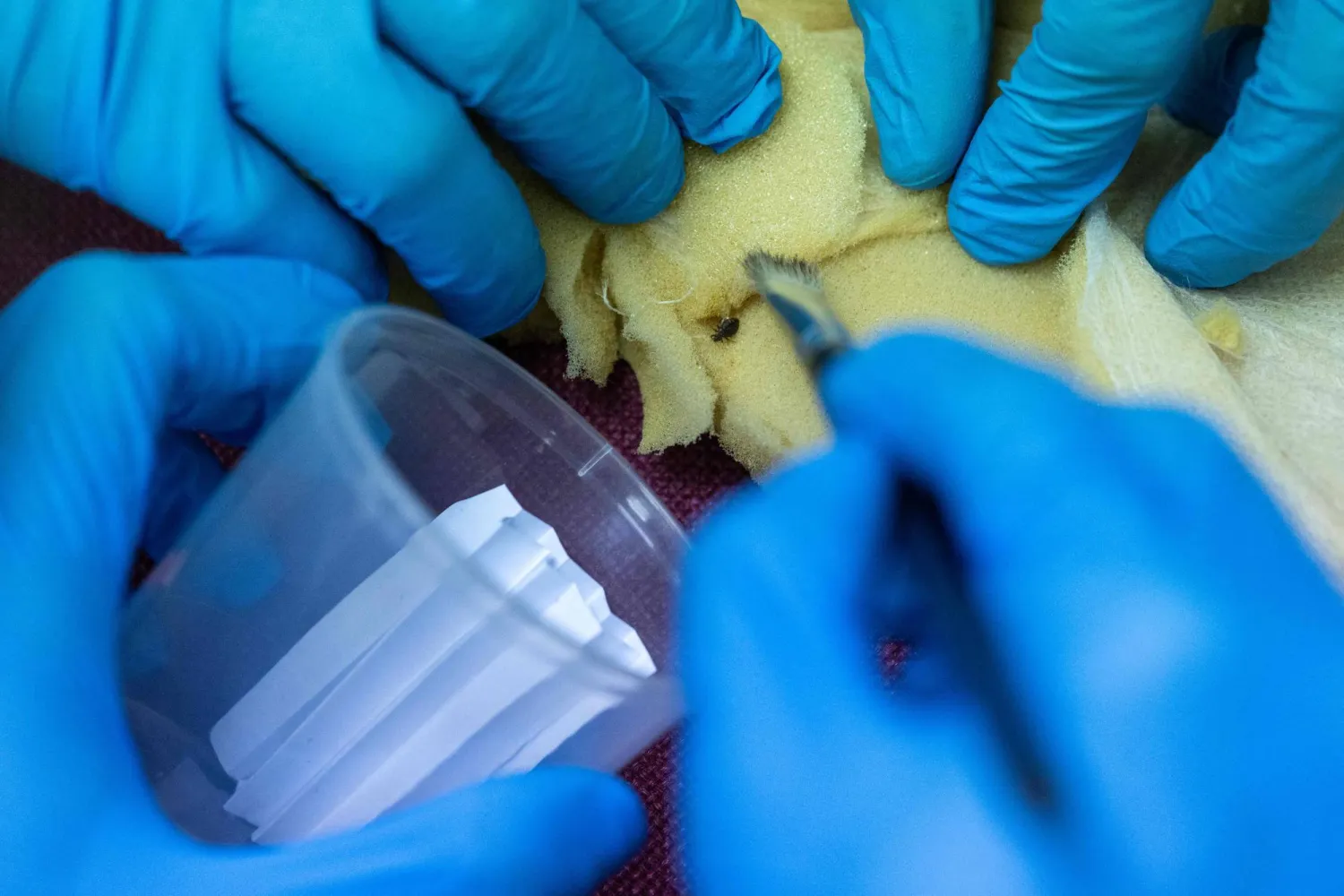
This photo taken on October 8, 2025, shows researchers collecting a bed bug crawling on a mattress at a laboratory of the Science University of Malaysia (USM) in George Town, on Penang island. (AFP)
TT

Malaysian Scientists Recruit Bed Bugs as Crime Scene Sleuths 

This photo taken on October 8, 2025, shows researchers collecting a bed bug crawling on a mattress at a laboratory of the Science University of Malaysia (USM) in George Town, on Penang island. (AFP)

Under glaring laboratory lights, a research assistant extends his forearm and carefully inverts a mesh-topped container onto his skin to allow a wriggling mass of bed bugs to feed on his blood, all in the name of science.

Long-loathed as itchy household pests, the blood-sucking insects have revealed a darker, more intriguing potential as Malaysian scientists have discovered they can be turned into unlikely crime-busting allies.

A team from the Science University of Malaysia (USM) in northern Penang has found that tropical bed bugs can retain DNA from human prey for up to 45 days after snacking on an unwary victim.

This makes the tiny critters, who love to lurk in headboard cracks, mattress seams and pillow covers, ideal evidence resources when it comes to pinpointing suspects at crime scenes.

From a speck of blood, police investigators may one day be able to piece together the full profile of an offender, if the critters are present at a crime scene.

Analyzing the insects could reveal gender, eye color, hair and skin color, entomologist Abdul Hafiz Ab Majid told AFP.

"We call bed bugs the 'musuh dalam selimut' (Malay for 'the enemy in the blanket')," Hafiz said, adding that "they can also be spies" to help solve crimes.

- DNA profiling -

In a laboratory tucked deep inside USM's School of Biological Sciences, Hafiz and postdoctoral researcher Lim Li have spent nearly half a decade studying tropical bed bugs.

The bloodsuckers, scientific name Cimex hemipterus, are the most common species found in Malaysia and the tropics.

The bugs are reared in containers under a laboratory bench, each wrapped in black plastic to mimic conditions the insects thrive in.

"We place folded pieces of paper inside the small containers so the bed bugs have something to climb on," Hafiz said.

With the lab's temperature kept at a constant 23C to 24C, the insects suck up 1.5 to 5.3 microliters of blood at each feeding, an "amount less than a droplet", Hafiz explained.

Researchers found DNA extracted from bed bugs that had fed on human blood could recover basic "phenotypic profiling", a person's observable traits, as well as gender for up to 45 days.

Using so-called STR (Short Tandem Repeat) and SNP (Single Nucleotide Polymorphism) markers, specific DNA sequences extracted from the blood, researchers can determine the gender, eye, hair and skin color of potential suspects, long after they have fled the scene.

The USM study called "Human profiling from STR and SNP analysis of tropical bed bug, Cimex hemipterus", was published in Nature's Scientific Reports two years ago.

It was the first documented forensic use involving tropical bed bugs.

- 'Perfect' forensic tool -

Unlike mosquitoes and flies, bed bugs cannot fly, and once they have fed, "become engorged and can't move around that much", Hafiz said, adding that they can only move within 20 feet (six meters) of where they've fed.

"That's what makes them unique. We can say they are perfect to use as a forensic tool compared to mosquitoes that... fly away," Hafiz added.

The bugs are particularly useful at crime scenes, where fluids have been wiped away to destroy evidence, as the critters are often well-hidden.

Back in the lab, researcher Lim did not hesitate to demonstrate a feeding session, even joking that she had been a "willing victim" for science.

"I let them feed on my blood when I wanted to test how long (it would take) the human DNA to degrade," she said.

Lim insisted that the inconspicuous bugs are "misunderstood creatures" and do not spread diseases -- even though their bite leaves an itchy rash that can last for weeks.

"Maybe we can try educating people because the bed bugs are not actually vectors. So even if you get bitten, they can't transmit diseases to you," she said.

While the researchers imagined a future where tiny bed bugs at crime scenes could lead investigators to murder suspects, Hafiz said the insects weren't a magic fix.

Bed bugs have their limits, especially when it comes to cracking cold cases, said Hafiz.

"It only gives investigators a time frame of 45 days to use bed bugs as evidence -- and only if they are available at the crime scene," he said.




Annual Orchids Show Brings Vivid Color to Chicago Winter

Orchids adorn a Volkswagen Beetle as finishing touches are placed on the 12th annual Chicago Botanic Garden Orchid Show, Friday, Feb. 6, 2026, in Glencoe, Ill. (AP)
TT

Annual Orchids Show Brings Vivid Color to Chicago Winter

Orchids adorn a Volkswagen Beetle as finishing touches are placed on the 12th annual Chicago Botanic Garden Orchid Show, Friday, Feb. 6, 2026, in Glencoe, Ill. (AP)

A soft layer of white snow blankets the grounds of the Chicago Botanic Garden. The air is chilly, the sky gray.

Inside, however, the air is warm and lights illuminate more than 10,000 vividly colored orchids. Staff members move in and out of greenhouses, preparing to open the garden’s 12th annual Orchid Show on Saturday.

This year’s theme is “Feelin’ Groovy" with several installations calling back to the 1970s, including a yellow Volkswagen Beetle filled with orchids.

“It’s just a really great way to get out of the winter cold and come into our greenhouses,” said Jodi Zombolo, associate vice president of visitor events and programs. “I think people are really looking for something to kind of bring happiness and something that they will enjoy and find whimsy in.”

The orchid family is one of the largest in the plant world and some of the species in the show are rare, exhibits horticulturist Jason Toth said. One example is the Angraecum sesquipedale, also known as Darwin’s orchid, on display in the west gallery.

Toth said the orchid led Darwin to correctly conclude that pollinators have adapted in order to reach down the flower's very long end.

"It has a great story and it’s quite remarkable-looking,” said Toth.

Elsewhere, massive, gnarly roots dangle from purple, pink and yellow Vanda orchids in the south greenhouse. These epiphytic orchids grow on the surface of trees instead of in soil.

“I think everyone’s tired of the winter,” said Toth. “So having some kind of flower show at this point is what we’re all craving. And 'Orchids' fits the bill.”

The show is expected to draw 85,000 visitors this year.


UK Zoo Says Tiny Snail ‘Back from Brink’ of Extinction

This photo taken on February 2, 2026 shows a greater Bermuda snail, which is part of a breeding program, sitting under a microscope at Chester Zoo in Chester, north-west England. (AFP)
TT

UK Zoo Says Tiny Snail ‘Back from Brink’ of Extinction

This photo taken on February 2, 2026 shows a greater Bermuda snail, which is part of a breeding program, sitting under a microscope at Chester Zoo in Chester, north-west England. (AFP)

A minuscule snail once thought to have disappeared has been saved from the edge of extinction, a British zoo said Saturday.

The greater Bermuda land snail had not been spotted for years until a cluster of shells was caught slithering through an alleyway in the capital Hamilton in 2014.

Some were flown to Chester Zoo, where experts spent years building up the population before they released thousands back into the wild in 2019.

Unique to Bermuda, this type of snail traces its lineage back over a million years -- a relic of the island's ancient ecosystem.

Now "we can officially say the species is back from the brink", said Chester Zoo in a statement sent to AFP.

The snail "once thought lost has officially been saved from extinction by experts in Chester Zoo, London Zoo, and Bermuda," it said.

They confirmed this after a study in the Oryx biodiversity conservation journal found that six colonies of the re-wilded snails had settled successfully on the archipelago.

"The fact that the snails are firmly established in six areas is massive," said Gerardo Garcia, animal and plant director at Chester Zoo.

From specially designed pods in northwest England, they are now breeding and roaming freely in Bermuda, he said.

"Being able to say that the snails are now safe from extinction is amazing ... and something that conservationists might get to say once or maybe twice in their whole career."

At one point, keeper Katie Kelton said the zoo housed around 60,000 snails.

It was "a lot of snails to look after ... a lot of chopping lettuce, sweet potato and carrot," she told AFP.

- Conservation 'success' story -

The snails faced many threats, including habitat loss, pesticide use, and the cannibalistic "wolf snail".

They were rescued in a process Garcia described as "a war game" with growing numbers tracked by flags pinned across a map of Bermuda.

While they cannot say the species is safe forever, he noted they now knew how to rebuild the population quickly and effectively.

But long-term recovery, he said, would go hand in hand with nature regeneration projects carried out by the Bermudian government.

Chester Zoo has now turned its attention to the lesser Bermuda land snail -- even smaller and much harder to breed.

These snails, which can reach about 23 millimeters (0.9 inches) in length, may now be extinct in the wild.

"We're considering things like seasonality, how long it takes a colony to establish and the complexity of their environments," said expert Iri Gill.

But their experience with the greater Bermuda snail should point them "in the right direction", she said.

"These snails are tiny, but this has been one of the biggest success stories in conservation."


SpaceX Delays Mars Plans to Focus on 2027 Moon Landing

FILE PHOTO: SpaceX headquarters is shown in Hawthorne, California, US June 5, 2025. REUTERS/Daniel Cole/File Photo
TT

SpaceX Delays Mars Plans to Focus on 2027 Moon Landing

FILE PHOTO: SpaceX headquarters is shown in Hawthorne, California, US June 5, 2025. REUTERS/Daniel Cole/File Photo

Elon Musk's SpaceX told investors it will prioritize going to the moon first and attempt a trip to Mars at a later time, the Wall Street Journal reported on Friday, citing sources.

The company will target March 2027 ‌for a ‌lunar landing without ‌astronauts ⁠on board, the ‌report added. The news comes after SpaceX agreed to acquire xAI in a deal that values the rocket and satellite company at $1 trillion and the artificial intelligence outfit ⁠at $250 billion.

SpaceX did not immediately respond ‌to a Reuters request ‍for comment. Musk said ‍last year that he aimed ‍to send an uncrewed mission to Mars by the end of 2026.

SpaceX is developing its next-generation Starship rocket, a stainless steel behemoth designed to be fully reusable and ⁠serve an array of missions including flights to the moon and Mars.

The United States faces intense competition this decade from China in its effort to return astronauts to the moon, where no humans have gone since the final US Apollo mission in ‌1972.