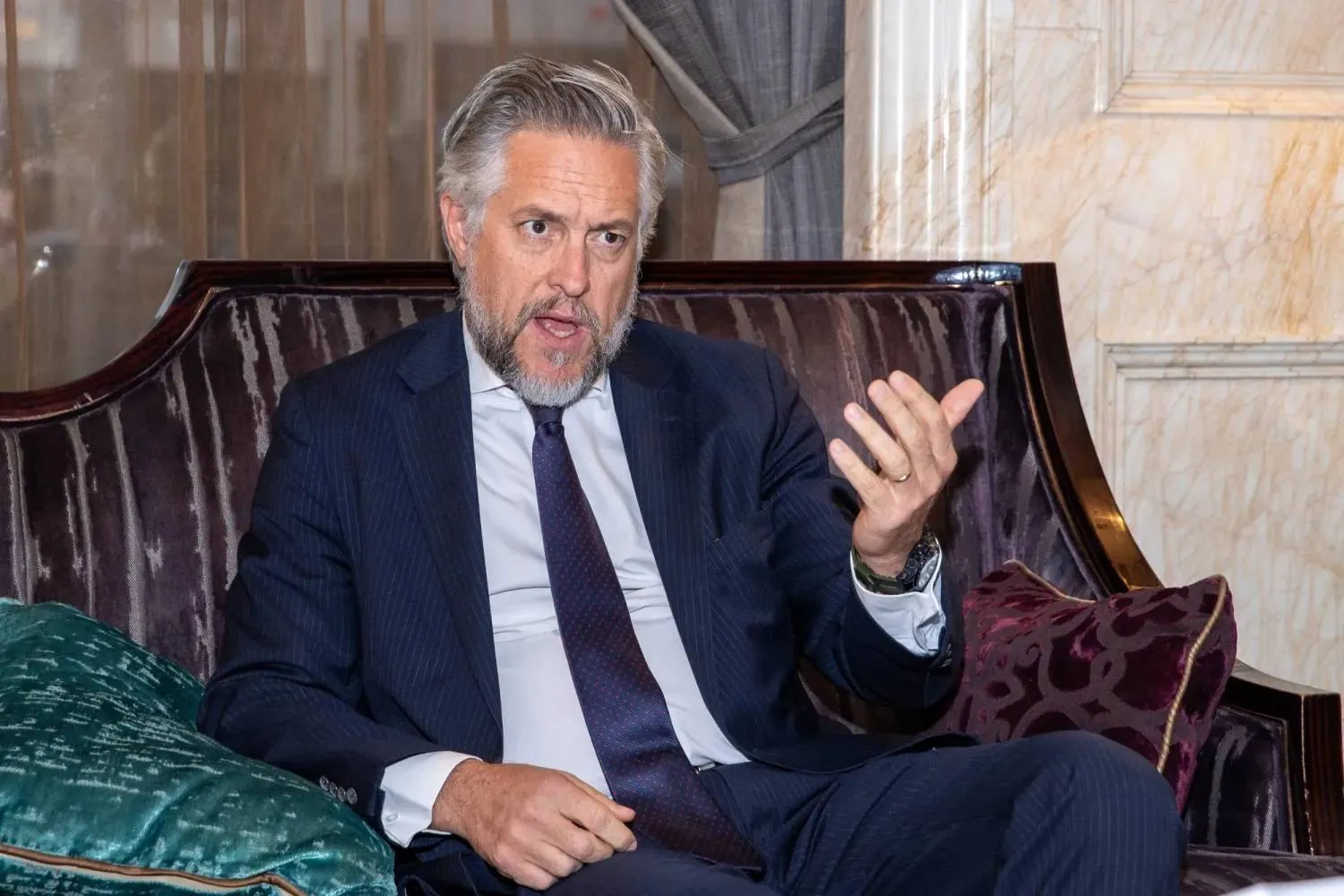

Whenever claims resurfaces that Europe is being lenient with the Houthis, the same question reemerges over whether the European Union is easing its stance. Patrick Simonnet, head of the EU Delegation to Yemen, rejects that view, insisting that Brussels maintains a firm position.
Simonnet told Asharq Al-Awsat that the priority remains bringing the parties back to the negotiating table.
On whether the EU is considering designating the group as a terrorist organization, he said discussions are taking place within EU institutions on the available options, while stressing that there has been no tolerance to begin with.
According to Yemeni analysts, the European stance has undergone what they describe as a positive shift.
They say the EU had previously shown a degree of leniency, approaching the Yemen crisis through a purely humanitarian lens without sufficiently addressing the political context that drove the humanitarian catastrophe.
Simonnet says the EU is committed to supporting the United Nations led peace process and is looking for tangible progress on the UN roadmap. He adds that the European strategy centers on backing the Yemeni government and the Presidential Leadership Council, enabling both to provide essential services that restore public confidence and credibility.
He describes Saudi Arabia’s role in Yemen, particularly its development and humanitarian work, as highly positive. He notes that Riyadh and Brussels share a very close assessment of Yemen and the Red Sea challenges, adding that the current phase requires a collective approach, which the EU is working to advance.
Relations with the Yemeni Government
Simonnet, the EU ambassador to Yemen, says ties with the Yemeni government are clear and straightforward. He reiterates the EU’s commitment to peace, continued support for the UN led political process and strengthened backing for the UN envoy. He expresses hope for visible progress on the proposed UN roadmap that would revive serious political engagement.
He notes that the European strategy is built on two main pillars. The first is support for the Yemeni government, and the second is support for the Presidential Leadership Council. He says the EU’s aim is to enhance their effectiveness and credibility by helping them deliver basic services, which he considers a core part of the EU’s approach to Yemen.
Economic Reforms
Simonnet praises the economic reforms adopted by the Presidential Leadership Council, describing them as essential for strengthening financial stability, improving transparency and unlocking the country’s economic potential. He says the EU is ready to support the implementation of these reforms, particularly the transfer of local revenues to the central authority so the government can perform its duties, while ensuring a fair division of powers and resources with local levels.
He confirms that the EU supports adjusting the customs exchange rate, saying that any step that restores Yemen’s economic function would be beneficial. He acknowledges the political complications but stresses that the current moment is favorable for political forces to unite behind the economic reform path.
Unity of the Presidential Leadership Council
The unity of the Presidential Leadership Council has become increasingly important amid differences over the economic reforms. Simonnet calls for avoiding excessive concern about political disagreements in the Yemeni scene, saying such differences are normal in all countries.
He adds that Yemen is a diverse country with multiple viewpoints, and that this is understandable. However, he believes the moment calls for political unity and joint action focused on national interests. With positive momentum behind economic reforms, he says political actors should rally together, since the priority must be the economy, and rapid implementation of reforms remains the key challenge.
On whether the EU has been lenient with the Houthis or plans to designate the group as a terrorist organization, Simonnet says the question is legitimate. He stresses, however, that Brussels is not showing any leniency and never has. He explains that EU institutions are holding internal discussions on various available options and that the overall priority remains bringing the parties back to the negotiating table.
He says the EU’s condemnation of attacks on maritime navigation is unequivocal, describing such actions as harmful to collective interests. He adds that the EU is active in Yemen and hopes other international partners will show the same level of commitment.
Simonnet says his presence in Riyadh is part of ongoing and constructive talks with Saudi partners. He notes that both sides have a very close view of developments in Yemen and the Red Sea and that the current period requires a collective approach to address these issues.
He declines to go into details on whether the EU is currently in contact with the Houthis, saying only that all parties clearly understand the EU’s positions, which are announced publicly. He adds that the EU has multiple tools to support peace efforts, through diplomatic channels and other means, and that all options remain on the table.
Shift in the European Position
Marwan Noman, a researcher at the Washington Center for Yemeni Studies at the United Nations, says the European stance has undergone a positive shift. He argues that the EU had previously shown a degree of leniency by focusing on humanitarian concerns without adequately addressing the political drivers of the crisis.
Noman says some European circles believed intensified diplomatic engagement could push the Houthis toward a political path. He cites the visit of the EU ambassador to Sana’a in 2018 and her meetings with Houthi leaders, along with reduced political pressure and the absence of strong condemnation of abuses against Yemenis.
He believes the European position began shifting after October 7, 2023, when the Houthis escalated attacks on international shipping in the Red Sea. This was followed by a wave of arbitrary detentions targeting UN staff and what he describes as unlawful and unjust rulings against them.
Yemeni writer Saleh Al Beidhani also sees a marked change in the EU’s approach after what he calls irrefutable evidence showing the Houthis had no intention of pursuing peace. He says the group’s recent escalation, particularly attacks on commercial shipping in the Red Sea and Gulf of Aden, has exposed it as a military arm of the Iranian regime, with decisions linked to Iran’s Islamic Revolutionary Guard Corps.
Noman, a former deputy ambassador of Yemen to the UN, says the EU now needs to take a more serious stance, including designating the Houthis as a terrorist organization along the lines of the United States, Canada, Australia and New Zealand. He also calls for more effective steps to curb weapons smuggling to the group.
Al Beidhani says the accumulation of events has stripped the Houthis of any pretense of peaceful intentions, leading to new international conclusions. He hopes this will push the EU toward a firmer and more decisive policy.
Saudi Role Seen as Positive
Simonnet describes Saudi Arabia as a highly important partner for the EU, saying ties between the two sides are strong and coordination is continuous on challenges and opportunities linked to the Yemen file. He says his visit to Hadramout allowed him to witness projects implemented by Saudi Arabia and that there is wide room for joint work.
He says Saudi Arabia’s role in Yemen, both in humanitarian relief and development efforts, is extremely positive, and he underscores the EU’s desire to deepen cooperation with Riyadh in this area.
Humanitarian and Development Support
Simonnet explains that European humanitarian assistance covers all essential life saving sectors. He notes that the EU launched an air bridge last summer to deliver humanitarian supplies amid serious concerns about the spread of cholera. He says the aim is not only to provide funding but also to ensure aid reaches all parts of Yemen, which he describes as a unique contribution.
He says the EU has provided one billion euros in humanitarian and development support since 2015. The assistance goes beyond relief to include economic activities, including microfinance in Hadramout and reopening export markets for fish, onions, dates and other products.
He highlights EU support for cultural projects. He says he recently visited the UNESCO assisted restoration project in Shibam, which saved about one third of the historic city over four years of work.
On the UN envoy’s performance, Simonnet says the EU fully supports him. He acknowledges the complexity of the mission but says the envoy is doing excellent work. The envoy’s message, he adds, is clear, that there is no military solution and that the only viable path is a political and sustainable one.
Simonnet says talk of a window for peace remains valid, expressing cautious optimism. He stresses that if peace is the goal, all parties must work toward it, and both the United Nations and the EU remain committed to supporting that effort.