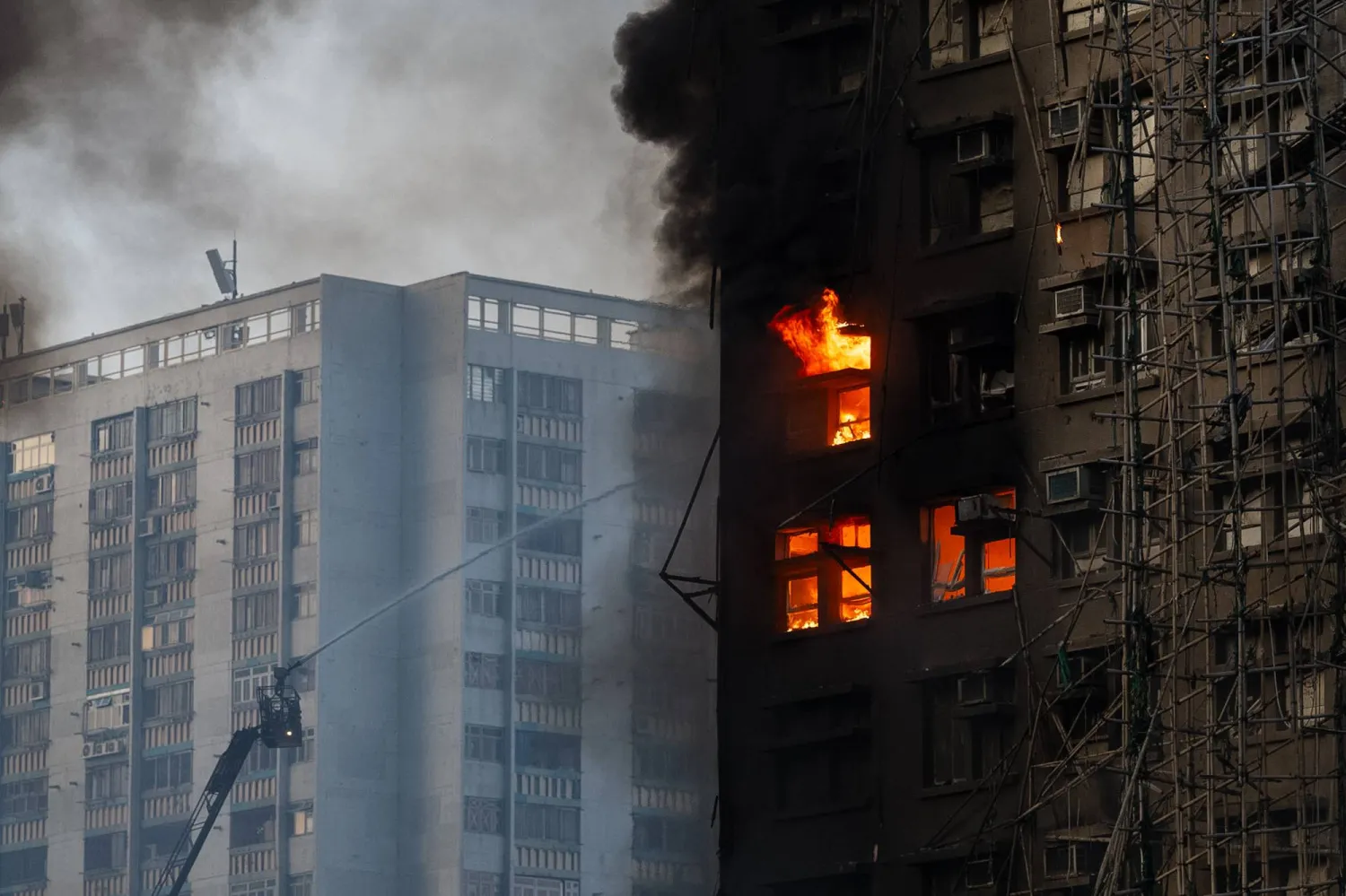
'Very Worried': Hong Kong Fire Survivors Hunt for the Missing

Firefighters work the scene of a fire at Wang Fuk Court, a residential estate in the Tai Po district of Hong Kong's New Territories, on Wednesday, Nov. 26 2025. (AP Photo/Chan Long Hei)
TT

'Very Worried': Hong Kong Fire Survivors Hunt for the Missing

Firefighters work the scene of a fire at Wang Fuk Court, a residential estate in the Tai Po district of Hong Kong's New Territories, on Wednesday, Nov. 26 2025. (AP Photo/Chan Long Hei)

The morning after saving her elderly neighbor from Hong Kong's deadliest fire in decades, retiree Kwok was trawling through social media groups looking for signs other missing residents were safe on Thursday.

The day before, as roaring flames edged closer, the 69-year-old had run through her apartment block looking for her neighbor, who she knew lived alone and used a wheelchair, said AFP.

She got her outside before the inferno engulfed their residential estate, killing at least 44 people and leaving hundreds missing.

On Thursday, Kwok and others in her community were mobilizing to track down the hundreds authorities said were still missing, creating WhatsApp groups and an app to try to locate those unaccounted for.

"I saw (the flames) draw closer, it was burning red and my heart was burning too," said Kwok, describing how she had rushed through the building knocking on doors to warn people.

She said she had not heard a fire alarm at any point during the ordeal.

As the sun rose over the smoldering towers of Wang Fuk Court on Thursday, displaced residents had already spontaneously begun organizing themselves to deal with the aftermath.

"I saw (the flames) draw closer, it was burning red and my heart was burning too," said Kwok, describing how she had rushed through the building knocking on doors to warn people.

She said she had not heard a fire alarm at any point during the ordeal.

"I'm so worried, I kept calling but it didn't connect," said Leung, who was among those evacuated as a precaution and spent the night in a temporary shelter.

"I came back at five in the morning because I couldn't sleep," she added as she joined the crowd watching the fire, the smell of smoke lingering in the air.

Volunteers gave firefighters bananas and energy drinks, and provided clothes, chargers, food and hot water bottles to those displaced.

Some residents formed human chains in the early hours of Thursday to transport supplies hand-to-hand, according to local media.

Dozens of people gathered at an open-air podium -- usually a favorite spot for the elderly to spend a leisurely afternoon -- to organize donated clothing.

A 24-year-old student surnamed Zhang said she had travelled more than an hour by train to volunteer.

"I felt terrible (watching the news)," she told AFP as she folded clothes.

"Having one more person to help is always better, maybe this is to soothe my sense of pain."


A 60-Day Deadline Could Pressure Trump on Ending the Iran War

US Air Force personnel perform maintenance on bomber at UK's RAF Fairford (EPA)
TT

A 60-Day Deadline Could Pressure Trump on Ending the Iran War

US Air Force personnel perform maintenance on bomber at UK's RAF Fairford (EPA)

Washington - Robert Jimison

Over nearly eight weeks of war in Iran, Republicans in Congress have turned back repeated efforts by Democrats to halt the operation and force US President Donald Trump, who began the conflict without congressional authorization, to consult with lawmakers on the military campaign.

But some Republicans have signaled that a key statutory deadline in the coming weeks could be an inflection point when they will expect the president to either wind down the conflict or seek congressional approval to continue it.

Democrats have tried and failed several times to invoke a provision of the 1973 War Powers Resolution, a law aimed at curbing a president’s ability to wage war without congressional approval, to challenge the conflict in Iran.

The latest defeat came on Wednesday, when Senate Republicans blocked such a measure for the fifth time since the war began.

Yet the law also establishes a set of deadlines, the first of which is coming on May 1, that could increase the pressure on the Trump administration in the coming days. Here is what the law says about how long a president can continue to direct US forces in a conflict without congressional approval.

The 60-Day Mark

When the United States began joint strikes with the Israeli air force on Feb. 28, the president said he was acting under his authority as commander in chief to protect US bases in the Middle East, and to “advance vital United States national interests.”

He said the action was taken in “collective self-defense of our regional allies, including Israel.”

Many Democrats disputed that justification and have continued to argue that Trump acted illegally.

White House officials and most Republicans on Capitol Hill say he is operating within the bounds of the war powers statute, which sets a 60-day clock for a president to remove American forces from hostilities without congressional authorization to use military force.

Although the war began at the end of February, Trump formally notified Congress of the operation on March 2, starting the 60-day period that ends on May 1.

Some Republicans have already signaled they will not support any extension beyond 60 days.

Senator John Curtis, Republican of Utah, wrote in an opinion essay earlier this month that he “will not support ongoing military action beyond a 60-day window without congressional approval.”

Other Republicans, including Representative Brian Mast of Florida, who chairs the Foreign Affairs Committee, warned that the president could lose significant support if the conflict continued into May.

Moments after Republicans just barely blocked a war powers resolution in the House last week, Mast said there could be “a different vote count after 60 days,” alluding to the May 1 deadline.

A 30-Day Extension

Under the statute, once the initial 60-day deadline passes, the president’s options for continuing a military campaign without congressional approval become limited.

At that point, Trump would effectively have three choices: seek congressional authorization to continue the campaign, begin winding down US involvement or give himself an extension.

The law allows a one-time, 30-day extension of the deployment if the president certifies in writing that additional time is necessary to facilitate the safe withdrawal of US forces, but it does not grant authority to continue waging an offensive campaign.

Congress Can Authorize the War

Lawmakers also have the option at any time of granting explicit permission for Trump to continue the operation by passing an authorization for the use of military force.

Such measures have become the primary way Congress approves military campaigns short of a formal declaration of war, something that has not been done since World War II.

While Republicans have largely united in blocking Democrats’ attempts to halt the war, it is unclear whether the same unity exists when it comes to affirmatively authorizing the conflict.

Senator Lisa Murkowski, Republican of Alaska, has said she is working with a group of senators on a formal authorization for the use of military force against Iran, but has yet to introduce the resolution.

Congress has not voted in favor of using military force since 2002, when lawmakers authorized it against Iraq.

Murkowski was an early critic of the administration’s lack of transparency around the objectives, costs and timeline for the war, and said that her goal with an authorization vote would be to reassert congressional authority and require the administration to be held to firm parameters for the operation.

Why Trump Might Ignore the Deadlines

Administrations led by presidents of both parties have long argued that the Constitution gives broad authority to the commander in chief, meaning that the limits the war powers law places on the president are unconstitutional.

In 2011, President Barack Obama continued a military engagement in Libya beyond the 60-day mark, arguing that the law did not apply because “US operations do not involve sustained fighting or active exchanges of fire with hostile forces, nor do they involve US ground troops.”

Though that prompted bipartisan backlash at the time, some lawmakers anticipate that the Trump administration could make a similar argument about Iran.

During his first term, Trump similarly balked at the law in 2019 when he vetoed a bipartisan resolution both chambers had passed that sought to end American military involvement in Yemen’s civil war. He argued then that the measure was an “unnecessary, dangerous attempt to weaken my constitutional authorities.”

Still, ignoring the deadline could pose a political problem for Republicans, which so far has given the administration broad latitude to carry out the war without congressional involvement, including any formal oversight.

“Many Republicans are on record having set the 60-day mark as somehow legally important,” said Senator Chris Murphy of Connecticut, who has been among the Democrats offering resolutions aimed at limiting the president’s ability to continue the war without congressional authorization. “So I do think it will be harder for Republicans to continue to look the other way once we are out of the 60 days.”

The New York Times


Iran's Mojtaba Khamenei 'Gravely Wounded' but 'Mentally Sharp'

A member of the Iranian security forces stands guard in front of a billboard showing Iranian Supreme Leader Mojtaba Khamenei and Iranian military commanders during a rally to mark International Quds Day in Tehran, Iran, 13 March 2026. EPA/ABEDIN TAHERKENAREH
TT

Iran's Mojtaba Khamenei 'Gravely Wounded' but 'Mentally Sharp'

A member of the Iranian security forces stands guard in front of a billboard showing Iranian Supreme Leader Mojtaba Khamenei and Iranian military commanders during a rally to mark International Quds Day in Tehran, Iran, 13 March 2026. EPA/ABEDIN TAHERKENAREH

Iran's new supreme leader Mojtaba Khamenei was seriously wounded in the US-Israeli airstrike that killed his father and predecessor Ali Khamenei but is mentally sharp, the New York Times reported on Thursday.

Citing several Iranian officials which it did not name, the Times said Mojtaba Khamenei had “at least for now” delegated decision-making to generals in the Revolutionary Guards army.

Khamenei has not appeared in public since succeeding his father and only issued written statements, creating speculation over his condition and if he is still alive, according to AFP.

Although Mojtaba Khamenei was “gravely wounded (in the February 28 airstrike), he is mentally sharp and engaged,” the NYT report said.

“One leg was operated on three times, and he is awaiting a prosthetic. He had surgery on one hand and is slowly regaining function. His face and lips have been burned severely, making it difficult for him to speak,” it cited the officials as saying, adding that “eventually, he will need plastic surgery.”

Access for security reasons is extremely limited to Khamenei, who remains in hiding, with only handwritten messages passed on, it said.

Guards commanders do not visit him but President Masoud Pezeshkian, who is also a heart surgeon, has been involved in his care, it said.

The report said the generals from the Guards viewed the war with the US and Israel “as a threat to the regime's survival” that has now been contained.

They have also been in charge of military strategy, including the blockade of the Strait of Hormuz.


France, UK Eye 'Real Progress' in Hormuz Plan

Britain's Defense Secretary John Healey (R) and Chief of Joint Operations (CJO) Lieutenant General Nick Perry attend a 'Strait of Hormuz Military Planning Conference' at the Permanent Joint Headquarters at Northwood, north-west London on April 23, 2026. (Photo by Alastair Grant / POOL / AFP)
TT

France, UK Eye 'Real Progress' in Hormuz Plan

Britain's Defense Secretary John Healey (R) and Chief of Joint Operations (CJO) Lieutenant General Nick Perry attend a 'Strait of Hormuz Military Planning Conference' at the Permanent Joint Headquarters at Northwood, north-west London on April 23, 2026. (Photo by Alastair Grant / POOL / AFP)

Britain and France Thursday voiced hope that military plans to secure the Strait of Hormuz were coming together and would succeed in restoring trade flows through the vital passage.

At a two-day meeting in London, military planners discussed the practicalities of a multinational mission led by the UK and France to protect navigation in the key waterway following a sustainable ceasefire, top defense officials said.

The aim is to form a "defensive, multinational mission that will strengthen the confidence of commercial shipping, and, if necessary, clear mines and protect vessels when the hostilities end", AFP quoted British defense minister John Healey as saying.

The British ministry said the meeting involved more than 44 countries from every continent.

Healey and French counterpart Catherine Vautrin said in a joint statement they were "confident that real progress can be made".

"International trade, energy, and economic stability for all our nations depend on freedom of navigation" in the strait, Healey told those attending.

He called for "practical military plans", saying "millions of people" were relying on a successful outcome from the meeting.

"We can't let them down," he said.

British Prime Minister Keir Starmer has said more than a dozen countries have agreed to participate in the mission to free up navigation in Hormuz.

Iran said on Wednesday it would not reopen the Strait of Hormuz as long as the United States continued to blockade Iranian ports.

While strikes around the region have mostly stopped since the start of a ceasefire, the US and Iran have continued to exert pressure around the trade route.

Before the war started on February 28, about a fifth of the world's oil was shipped through the Strait.