



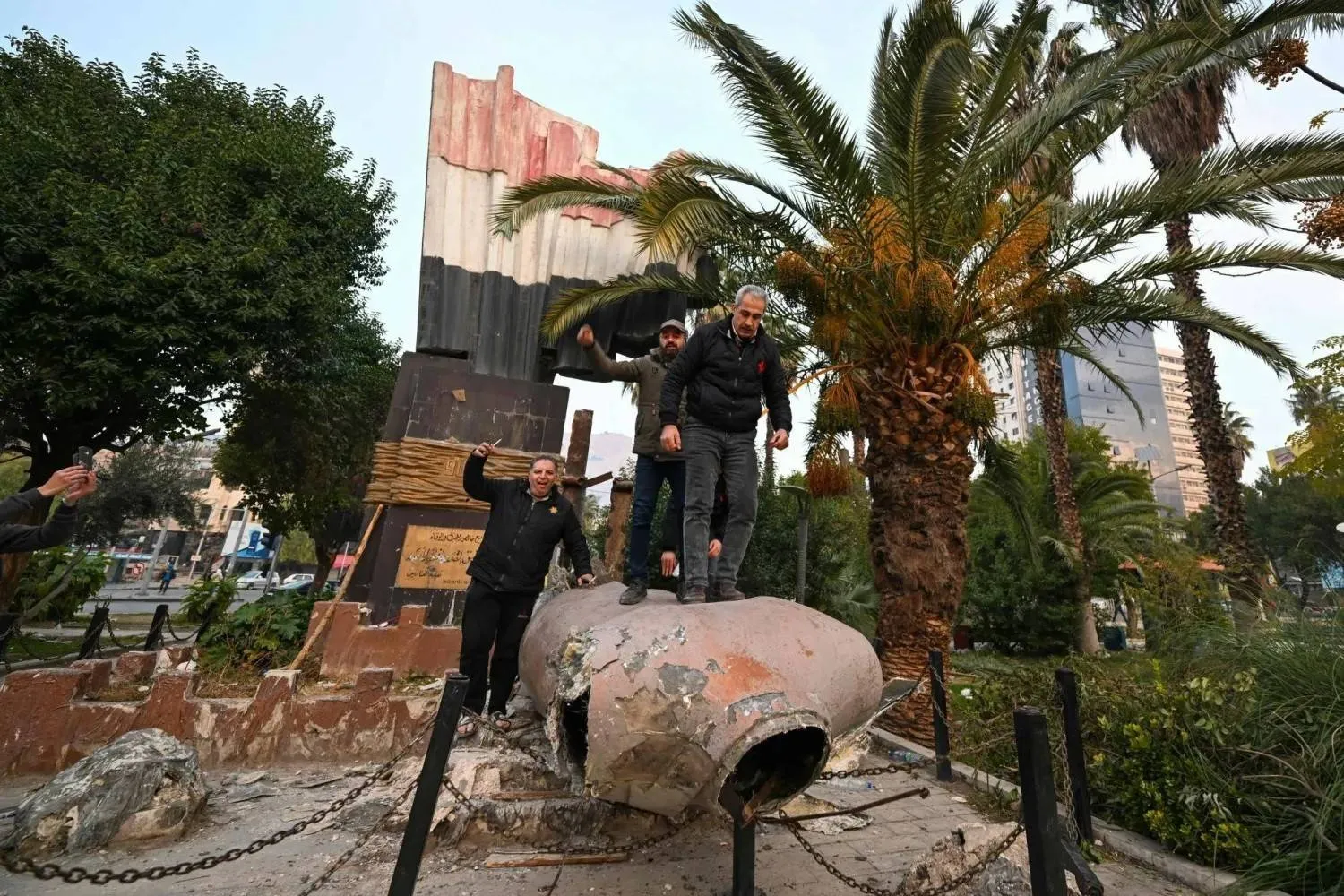

With the dawn of November 27, 2024, Syria and its people were confronted with the opposition’s “Deterrence of Aggression” offensive, the first spark of a military and political shift that ended an era of repression, injustice, killing and torture.
The campaign returned the initiative to Syrians and opened the door to a new beginning they had long hoped for since their uprising began in March 2011.
The “Deterrence of Aggression” operation, launched by armed opposition factions operating under the Military Operations Administration led by Hayat Tahrir al-Sham, began in western rural Aleppo.
It came in response to heavy artillery bombardment by the former regime’s army and its allies on opposition areas in Idlib, a strike that killed dozens of civilians.
During the first two days, the offensive drew attention as opposition forces seized most of western rural Aleppo, numerous villages in the southern countryside of the city and parts of eastern Idlib countryside.
Their advance culminated in the full recapture of Aleppo amid a continuous collapse of president Bashar al-Assad’s forces and widespread defections in their ranks.
Assurances from “Deterrence of Aggression” forces that residents of all backgrounds would be protected in their homes and livelihoods helped dispel fears that the former regime had long cultivated.
Most Syrians welcomed the advance with widespread elation.
The rapid shift in control in just two days, an unprecedented scene since the start of the Syrian uprising, left Syrians at home and abroad closely watching the course of the battle.
Twelve days after the operation began, it resulted in the fall of the Assad government.
At the outset, Syrians were struck by how quickly regime forces crumbled, despite being backed by dozens of Iran-linked militias, including Lebanon’s Hezbollah, as well as Russian forces.
Ministry of Defense
Brig. Gen. Hassan Abdel-Ghani of the Syrian Arab Army said in remarks carried by the Syrian Arab News Agency that the “Deterrence of Aggression” campaign “freed the Syrian people from the system of injustice and terrorism”
He said “the Syrian Arab Army today protects every inch of the homeland,” urging Syrians to rally around it and work to rebuild the country.
Abdel-Ghani added: “People of free Syria, our noble families, in these days, after the triumphs, victories and achievements our beloved country has witnessed in all fields, and as we closely follow what is unfolding on all fronts, the Ministry of Defense declares with unwavering will and unbreakable resolve the passing of one year since the launch of the ‘Deterrence of Aggression’ operation.”
“Twelve months have passed since we repelled the system of injustice and terrorism and freed our people from death, bombardment and suffering, and the displaced have returned to their homes after the end of darkness.”
The decisive moment in the operation
Syrian military and strategic expert Ismat al-Absi said the launch of the “Deterrence of Aggression” operation marked a military and political turning point that ended the era of repression and returned the initiative to the Syrian people.
“In just twelve days, the frontlines moved from the liberation of Aleppo to the heart of Damascus, and the regime’s defenses collapsed despite Syrian and Russian airstrikes attempting to slow the advance,” he said.
Al-Absi told Asharq Al-Awsat that the timing of the offensive came shortly after a ceasefire between Israeli forces and Hezbollah in Lebanon went into effect.
“This reduced pressure on the northern front and created an operational opening for rapid progress. The planning and command were local, under a new structure known as the Military Operations Administration led by Hayat Tahrir al Sham, with factions from the National Front and the Syrian National Army operating in coordination across multiple axes.”
The operational expectation for the first day, he said, was to break the initial defensive lines and sever key supply routes within 24 hours, which would trigger a rapid collapse of the regime’s defensive structure around Aleppo.
He noted “broad popular support from the first hours, with a priority placed on protecting civilians and opening the way for displaced families to return, which boosted morale and facilitated the initial breakthroughs. Aleppo became the clearest sign that the initiative had returned to Syrians, serving as a logistical base for the continued advance south.”
Al-Absi estimated that the force that launched the “Deterrence of Aggression” offensive numbered between 18,000 and 25,000 fighters across western rural Aleppo and eastern Idlib.
They were deployed in assault groups, engineering units, reconnaissance teams and drone operators, with Red Band units operating behind enemy lines. A reserve force of eight to twelve thousand fighters was positioned for reinforcement and consolidation.
He estimated the number of Iran-backed militia fighters and allied groups present in Aleppo at the outset of the offensive at between 15,000 and 25,000.
They operated in defensive and fire support formations and included a mix of ideological groups and local loyalist units, with engineering teams and artillery and short-range missile crews, reflecting the presence of “dozens of sectarian militias” on the battlefield.
The decisive moment on the first day of the battle, according to al-Absi, was “the breaching of initial defensive lines and the rapid capture of key sites such as Regiment 46 and Sheikh Aqil, alongside simultaneous advances toward southern rural Aleppo and eastern Idlib. This severed the Damascus Aleppo highway and disrupted redeployment. Behind enemy lines, Red Band shock units carried out operations after six weeks of reconnaissance, mine clearing and opening the major breach that enabled armored vehicles and forward units to push through.”
He said the first day ended with “a new and unprecedented map of control since 2011 that cemented the course of the regime’s subsequent collapse.”
Weapons and decisive impact
Al-Absi said that the use of Shaheen drones to paralyze movement and establish tactical control of the air with precise fire direction and support “significantly hindered the regime’s ability to maneuver around Aleppo.”
“Engineering units cleared mines and opened routes while specialized night combat units provided tactical superiority in the early decisive hours,” he revealed.
He said the regime’s response consisted of intense Syrian Russian airstrikes and attempts to provide air cover to slow the advance, “but these efforts failed to regain the initiative amid severed routes, collapsing defenses and rapid changes in the map of control.”
“The regime sought Russian cover and deterrence signals, yet the pace of events exposed its inability to absorb the shock, ending with its fall within twelve days,” affirmed al-Absi.


