

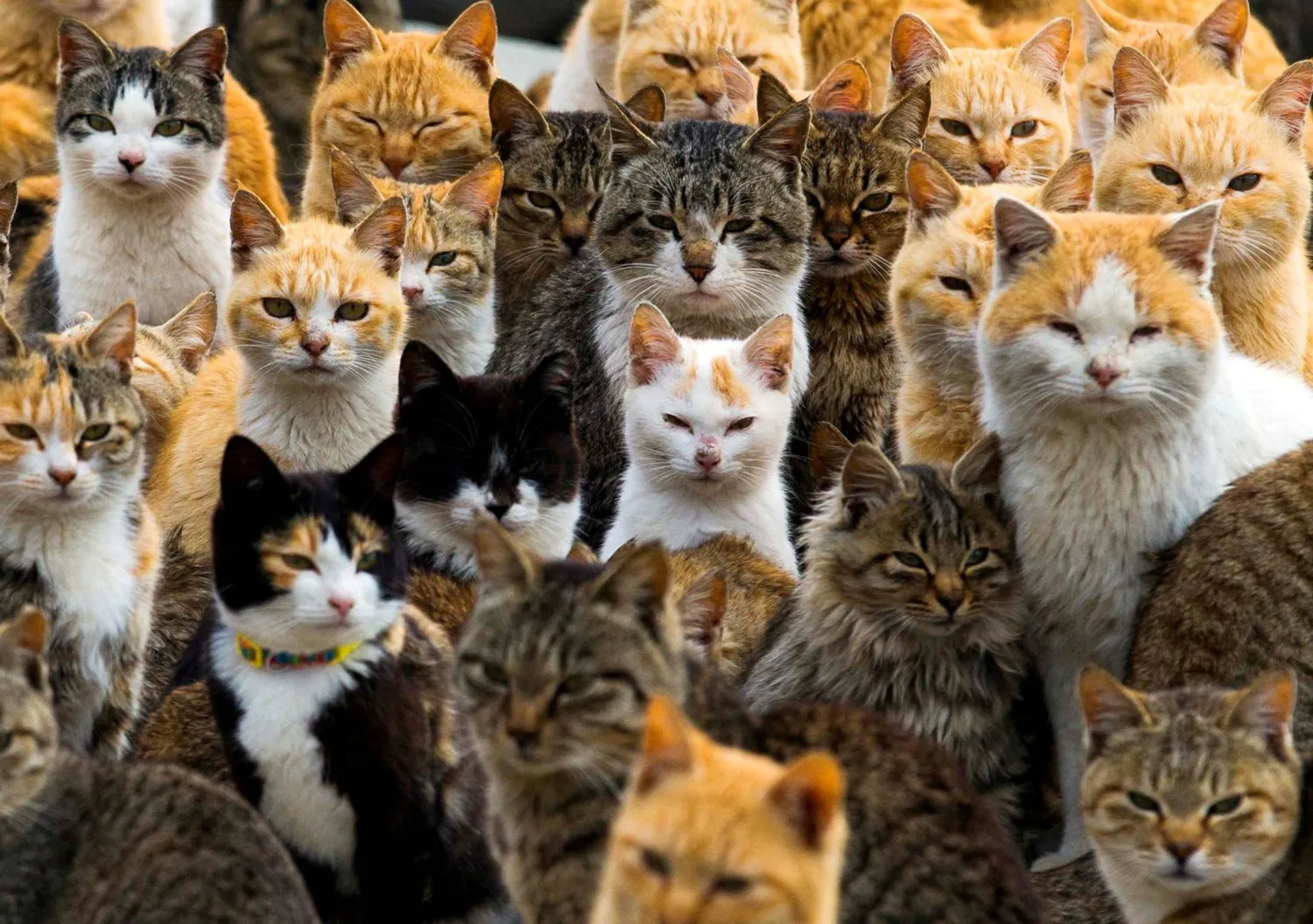

Genome Study Reveals Milestone in History of Cat Domestication

FILE PHOTO: Cats crowd the harbour on Aoshima Island in the Ehime prefecture in southern Japan February 25, 2015. Picture taken February 25, 2015. REUTERS/Thomas Peter/File Photo
TT

Genome Study Reveals Milestone in History of Cat Domestication

FILE PHOTO: Cats crowd the harbour on Aoshima Island in the Ehime prefecture in southern Japan February 25, 2015. Picture taken February 25, 2015. REUTERS/Thomas Peter/File Photo

Whether they are a Siamese, Persian, Maine Coon, or Domestic Shorthair, there are hundreds of millions of cats living with people around the world. But despite their popularity as pets, the history of cat domestication has remained difficult for scientists to decipher.

A new genome study is providing some insight into the matter by determining the timing of a key milestone in feline domestication - the introduction of domestic cats into Europe from North Africa.

Domestic cats pounced into Europe roughly 2,000 years ago in early imperial Roman times, the researchers found, probably thanks to maritime trade. Some of these furry trailblazers may have been brought by sailors to hunt mice on ships that plied the Mediterranean carrying grain from the fertile fields of Egypt to ports serving Rome and other cities in the sprawling Roman Empire.

The findings contradict a long-held idea that domestication occurred in prehistoric times, perhaps 6,000 to 7,000 years ago, as farmers from the ancient Near East and Middle East first moved into Europe, bringing cats with them.

"We show that the earliest domestic cat genomes in Europe are found from the Roman imperial period onwards," starting in the first century AD, said paleogeneticist Claudio Ottoni of the University of Rome Tor Vergata, lead author of the study published on Thursday in the journal Science.

The study used genetic data from feline remains from 97 archaeological sites across Europe and the Near East as well as from present-day cats. The researchers analyzed 225 bones of cats - domestic and wild - ranging from about 10,000 years ago to the 19th century AD, and generated 70 ancient feline genomes.

The researchers found that cat remains from prehistoric sites in Europe belonged to wildcats, not early domestic cats.

Dogs were the first animal domesticated by people, descended from an ancient wolf population separate from modern wolves. The domestic cat came later, descended from the African wildcat.

"The introduction of the domestic cat to Europe is important because it marks a significant moment in their long-term relationship with humans. Cats aren't just another species arriving on a new continent. They're an animal that became deeply integrated into human societies, economies and even belief systems," University of Rome Tor Vergata paleogeneticist and study co-author Marco De Martino said, according to Reuters.

The genome data identified two introductions of cats to Europe from North Africa.

Roughly 2,200 years ago, people brought wildcats from northwestern Africa to the island of Sardinia, whose present-day wildcat population descended from these migrants.

But those were not domestic cats. It was a separate dispersal from North Africa about two centuries later that formed the genetic basis of the modern domestic cat in Europe.

The study's findings suggest that there was not a single core region of cat domestication, but that several regions and cultures in North Africa played a role, according to zooarchaeologist and study co-author Bea De Cupere of the Royal Belgian Institute of Natural Sciences.

"The timing of the genetic waves of introduction from North Africa coincides with periods when trade around the Mediterranean intensified strongly. Cats likely traveled as efficient mouse hunters on grain ships but possibly also as valued animals with religious and symbolic significance," De Cupere said.

Cats, for example, were important in ancient Egypt, whose pantheon included feline deities and whose royalty kept pet cats, sometimes mummifying them for burial in elaborate coffins.

The ancient Roman army, with outposts arrayed across Europe, and its entourage played an instrumental role in the dispersal of domestic cats throughout the continent, as attested to by feline remains discovered at the sites of Roman military camps.

The earliest domestic cat in Europe identified in the study - one genetically similar to present-day domestic cats - dated to between 50 BC and 80 AD from the Austrian town of Mautern, site of a Roman fort along the Danube River.

The study, however, does not unravel the timing and location of the initial feline domestication.

"Cat domestication is complex," Ottoni said, "and what we can tell now is the timing of the introduction of domestic cats to Europe from North Africa. We can't really say much what happened before and where."



US Weather to Go Nuts with Blizzard, Polar Vortex, Heat Dome, Atmospheric River All at Once

People spend time at Ha‘ena Beach Park, Monday, March 2, 2026, in Haena, Hawaii. (Noelle Fujii-Oride/Hawaii Civil Beat via AP)
TT

US Weather to Go Nuts with Blizzard, Polar Vortex, Heat Dome, Atmospheric River All at Once

People spend time at Ha‘ena Beach Park, Monday, March 2, 2026, in Haena, Hawaii. (Noelle Fujii-Oride/Hawaii Civil Beat via AP)

Nearly every part of the United States is getting walloped by wild weather or just about to be.

Days of downpours have begun in Hawaii. The Southwest will soon bake with day after day of record 100-degree-plus (38 Celsius-plus) heat. Two storms will dump snow by the foot over northern Great Lakes states. And the dreaded polar vortex will again invade the Midwest and East with soul-crushing Arctic chill.

This forecast of extremes comes as weather whiplash already hit much of the East. On Wednesday, Washington, D.C. residents walked around in shorts in record-breaking 86 degrees Fahrenheit (about 30 Celsius). On Thursday, it snowed, The Associated Press reported.

“All of the country, even if you’re not necessarily seeing extremes, are going to see generally changing from cold to warm, or warm to cold to warm,” said meteorologist Marc Chenard of the weather service’s Weather Prediction Center in Maryland.

Former National Oceanic and Atmospheric Administration chief scientist Ryan Maue said he expects extreme weather in all 50 states.

Triple-digit heat persists in Southwest A heat dome will form early next week and park over the Southwest, baking temperatures to triple digits that haven't been seen this early in the year, Maue and Chenard said.

Some forecasts see 98 (almost 37 Celsius) in Phoenix on Tuesday, followed by 103, 105 and two days of 107 (almost 42 C). In 137 years of record-keeping, Phoenix never hit 100 before March 26 and usually hit its first 100-degree day in early May, according to the weather service, which warned people: “Since we are not acclimated to this level of heat this early in the year, it will be more impactful than usual.”

It has already started in Los Angeles with unusual 90-degree March weather that had people in shorts and tank tops seeking shade anywhere they could get it, even if it was as slender as a light post.

Shane Dixon, 40, usually runs about 5 miles near his home in Culver City without much effort, he said, his face glistening with sweat and his T-shirt tucked into his shorts. But Thursday was hard because of the heat, and he had to cut it short.

“The back of my neck was melting,” he said. But he preferred it to the cold and snow that will hit elsewhere.

“I could go literally soak myself and walk out in the sun and I’ll make it home fine. If it was freezing cold I could not do this,” he said.

Single-digit cold invades North Around the same time as the heat starts blasting Phoenix, the polar vortex — a system that usually keeps frigid air penned up near the North Pole — is forecast to send its chill deep into the Midwest and East, even bordering some of the Southeast, Maue said.

Minneapolis will hover around zero for a low, and Chicago will be in the single digits Tuesday. The next day “temperatures in the teens and 20s in the northeast and 20s in the Mid-Atlantic,” Maue said. Even Atlanta could drop to the 20s.

One-two snowstorm punch Two storm systems in a row — one Friday, then another Sunday into Monday — will chug along the country's northern tier and Great Lakes and between them could dump 3 to 4 feet of snow in places, Maue said.

That bigger second storm system will see its barometric pressure drop so quickly and sharply — meaning it is intensifying and winds are strengthening — that it will qualify as a bomb cyclone, which is quite unusual to develop over land. Normally bomb cyclones get their energy from warm ocean waters, but this one will draw power from the polar vortex.

Even Alaska and Hawaii aren't quite right Maue said Hawaii is getting an atmospheric river that will have such persistent heavy rain that flooding will be a major issue. Oahu is under a flash flood warning.

And Alaska is normally frigid now, but it will be about 30 degrees colder than usual, he said.

It is “the time of year where we can see stuff like this,” Chenard said. “But this does seem even anomalous from what you would typically see. I mean, some of these areas will be setting records. Record-high temperatures for March and maybe multiple times.”

In the past week or so, tornadoes have killed at least eight people in Oklahoma, Michiganand Indiana. The forecast for severe storms doesn't look as big or widespread for the next week, but dangerous thunderstorms could pop up “anywhere from the Mississippi Valley toward the East Coast” on Sunday or Monday, Chenard said.

The jet stream goes nuts Underlying this is a jet stream gone wild, Maue and Chenard said.

The jet stream is the river of air that moves weather from west to east on a roller-coaster-like path. Usually the plunges are as mild as a kiddie roller coaster. But now that jet stream is going on near-vertical, scream-inducing drops following by straight-up ascents.

“Which means you get a lot of extremes next to each other,” Maue said. Storm fronts coming from the Pacific hit that high pressure heat dome in the Southwest and are pushed north to climb that mountainous jet stream peak, “grab access to that cold air reservoir up there" and bring it back down south down the other side of the hill, he said.

Numerous studies have connected unusual jet stream and polar vortex activity to shrinking Arctic sea ice and human-caused climate change.

But there is hope.

“The first day of spring is 20th (of March), and then after that we get recovery,” Maue said.


Saudi Arabia Establishes Royal Institute of Anthropology to Study Social Change

The establishment of the institute provides a scientific platform for documenting heritage and deepening awareness of local culture through anthropological research. (SPA)
TT

Saudi Arabia Establishes Royal Institute of Anthropology to Study Social Change

The establishment of the institute provides a scientific platform for documenting heritage and deepening awareness of local culture through anthropological research. (SPA)

Saudi Arabia has approved the establishment of the Royal Institute of Anthropology and Cultural Studies, marking a significant step toward expanding research on Saudi society and documenting its social transformations.

The institute, approved by the Saudi Cabinet on Tuesday, is expected to strengthen scholarly work related to the study of Saudi communities through rigorous scientific methods.

Saudi Minister of Culture Prince Badr bin Abdullah bin Farhan Al Saud welcomed the decision and thanked the Kingdom’s leadership for supporting the initiative.

He said the institute would serve as “a trusted narrator of our culture and a beacon of inspiration in studies that seek to understand humanity.”

Prince Badr added that the institute would provide a scientific platform for documenting Saudi heritage and deepening awareness of local culture through anthropological research. He noted that its work would help generate meaningful cultural insights and encourage cultural exchange with the wider world.

Saudi Arabia holds particular significance in anthropology and cultural studies because of its deep historical and civilizational heritage, which stretches back centuries.

The Kingdom is also characterized by wide cultural, social and regional diversity reflected in lifestyles, customs and traditions, language and oral expression, as well as literature, performing arts, architecture, visual arts, culinary traditions and fashion. Together, these elements provide rich material for academic study, analysis and documentation.

The institute will develop both academic and applied research in anthropology and cultural studies. Its work will include examining local communities, patterns of daily life, symbolic systems, social transformations and forms of cultural expression across the Kingdom.

It will also document both tangible and intangible cultural heritage within their social and historical contexts, including the knowledge systems, practices and values associated with them. The aim is to provide a comprehensive scientific understanding of cultural elements as part of the living human experience.

Observers and academics say the decision also reflects a shift in attitudes toward anthropology in Saudi Arabia.

Dr. Hamza bin Qablan Al-Mozainy said the institute’s establishment demonstrates growing recognition of the field’s importance. Speaking to Asharq Al-Awsat, he noted that anthropology once faced strong resistance in academic circles.

He cited the experience of Dr. Saad Al-Sowayan, one of the Kingdom’s pioneering anthropologists, who encountered opposition when he attempted to introduce the discipline in universities. As a result, Al-Sowayan carried out much of his research outside academic institutions, producing influential studies on Saudi society.

Al-Mozainy said Saudi society remains insufficiently studied, making it a rich field for future anthropological research. He added that the discipline helps societies better understand themselves and address both their strengths and their challenges.


Kenya Arrests Man Trying to Smuggle Over 2,000 Live Ants in his Luggage

People arriving at the Jomo Kenyatta International Airport (JKIA), in Nairobi, Kenya, on 06 March 2026. EPA/DANIEL IRUNGU
TT

Kenya Arrests Man Trying to Smuggle Over 2,000 Live Ants in his Luggage

People arriving at the Jomo Kenyatta International Airport (JKIA), in Nairobi, Kenya, on 06 March 2026. EPA/DANIEL IRUNGU

A man was arrested with more than 2,200 live garden ants in his luggage at Nairobi's main airport this week amid a rise in cases of smuggling of the insects in Kenya.

Chinese national Zhang Kequn, 27, was arrested at Jomo Kenyatta International Airport on Tuesday while he was trying to leave the country, court filings seen by Reuters on Thursday showed. Immigration officials flagged a "stop order" on Zhang's passport after he ⁠evaded arrest in ⁠Kenya last year.

Ant aficionados pay large sums to maintain colonies in large transparent vessels known as formicariums, which offer a literal window into the species' complex social structures and behaviors.

Last year four men were fined $7,700 each ⁠for trying to traffic thousands of ants valuable to Kenya's ecosystem in a case that experts said signaled a shift in biopiracy from trophies like elephant ivory to lesser-known species.

Investigators said a search of Zhang's luggage recovered 2,238 ants, including 1,948 packed in test tubes and the rest in three rolls of "soft tissue papers".

They said Zhang had been in Kenya for ⁠two ⁠weeks and had mentioned three accomplices who supplied him with the ants.

The Kenya Wildlife Service told the court that it needed more time to complete investigations, including examining an iPhone and a MacBook recovered from Zhang.

The wildlife service said a similar consignment of ants had been seized in Bangkok on Tuesday that originated from Kenya, indicating the existence of a widespread and organized ant-smuggling network.