


Lebanese Army Shows its Efforts in Imposing State Monopoly over Arms, Rules Out Deadline Extension

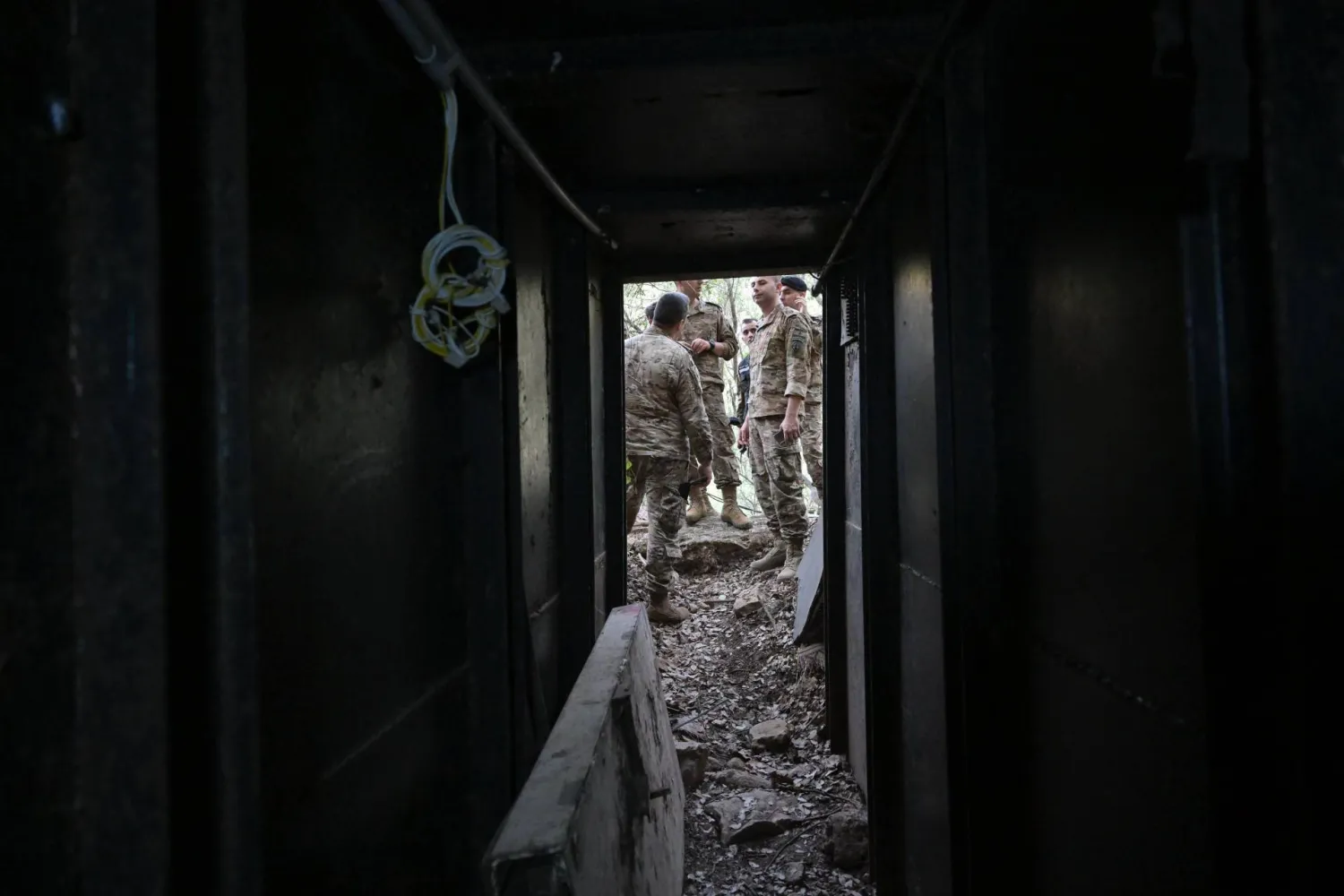
Members of the army are seen at the entrance of a tunnel in Zibqin. (Asharq Al-Awsat)
TT

Lebanese Army Shows its Efforts in Imposing State Monopoly over Arms, Rules Out Deadline Extension

Members of the army are seen at the entrance of a tunnel in Zibqin. (Asharq Al-Awsat)

The Lebanese army presented a field briefing on its work to remove Hezbollah’s weapons south of the Litani River, in an indirect response to Israeli pressure in the media and escalated attacks.

The army said it had completed more than 80% of Operation Shield of the Nation, which is aimed at restricting weapons in the area south of the Litani, and reported full cooperation from residents, without mentioning Hezbollah’s role.

The statement came as the Health Ministry said 335 people had been killed in Israeli attacks since the ceasefire took effect a year ago.

1,308 killed and wounded

The Health Ministry released figures showing casualties from Israeli attacks since the ceasefire was signed, covering the period from November 28, 2024, to November 27, 2025.

It said 335 people were killed and 973 wounded, a total of 1,308.

Army outlines results of weapons plan

In its first public accounting of its operations in the South Litani Sector, headed by Brig. Gen. Nicolas Tabet, the army said it had completed more than 80% of the plan mandated by the government to impose state monopoly over arms.

During a tour for journalists along the Blue Line, Tabet said the army had seized about 230,000 items during survey and inspection operations, including ammunition, tunnels, rocket platforms, rockets and weapons.

Tabet said from the sector headquarters at the Benoit Barakat barracks in Tyre that the army had handled 177 tunnels since the plan began, closed 11 passages along the Litani River, and confiscated 566 rocket launchers.

He said there was no intention to request an extension for the current phase, which is due to end at the end of the year.

Residents cooperate

Tabet said residents were cooperating, without referring to Hezbollah’s involvement. He said Israel had provided no proof to the mechanism overseeing the ceasefire that weapons had been smuggled.

He added that the army had faced no obstacles and that residents were assisting the military and welcoming the presence of the state.

Although information indicates that Hezbollah has not cooperated with the army by providing maps of its military infrastructure and tunnels, the army is proceeding alone.

It has reported cooperation from residents who notify troops when they find any sites or weapons, allowing the army to deal with them, and there have been no confrontations or objections from Hezbollah.

Hundreds of tunnels

Journalists toured one tunnel for fighters in the town of Zibqin that stretches about 100 meters.

An army source told Asharq Al-Awsat there were hundreds of similar tunnels along the border. The tunnel sits between trees on a hill about 50 meters high and contains a room, a kitchen and first aid equipment.

The source said the tunnel, built for personnel, was used for shelter and overnight stays after rocket launches.

10,000 troops south of the Litani

“We are showing media outlets the full details of the army’s plan for the first time, and no one has proven that any weapons were brought into the area south of the Litani,” Tabet said, adding that there was full cooperation from residents.

He said 10,000 soldiers were deployed south of the river despite challenges, and that the army runs 200 positions there. Twenty army posts had been destroyed by Israeli attacks, he added.

30,011 missions

Tabet said Israeli violations continued along the frontier and that the army had carried out 30,011 military missions south of the Litani. He repeated that implementation of the plan had surpassed 80% without obstacles or challenges and said the army was committed to international resolutions.

He stressed that the plan did not include entering homes except in cases of someone being “caught in the act”.

“The homes that were recently struck were civilian, and we were not asked to inspect them. We inspected them after the strikes and confirmed no weapons were inside,” he said.

He added that the United Nations Interim Force in Lebanon (UNIFIL) had withdrawn a number of its assets and naval units and that 640 of its personnel had left Lebanon so far.



EU Condemns Israel's West Bank Control Measures

The Israeli settlement of Har Homa, seen from the West Bank city of Bethlehem, Tuesday, Dec. 17, 2024. (AP)
TT

EU Condemns Israel's West Bank Control Measures

The Israeli settlement of Har Homa, seen from the West Bank city of Bethlehem, Tuesday, Dec. 17, 2024. (AP)

The European Union on Monday condemned new Israeli measures to tighten control of the West Bank and pave the way for more settlements in the occupied Palestinian territory, AFP reported.

"The European Union condemns recent decisions by Israel's security cabinet to expand Israeli control in the West Bank. This move is another step in the wrong direction," EU spokesman Anouar El Anouni told journalists.


Atrocities in Sudan's El-Fasher Were 'Preventable Human Rights Catastrophe'

Sudanese displaced people who left El Fasher after its fall, sit in the shade in Tawila at the Rwanda camp reception point on December 17, 2025. (Photo by AFP)
TT

Atrocities in Sudan's El-Fasher Were 'Preventable Human Rights Catastrophe'

Sudanese displaced people who left El Fasher after its fall, sit in the shade in Tawila at the Rwanda camp reception point on December 17, 2025. (Photo by AFP)

The atrocities unleashed on El-Fasher in Sudan's Darfur region last October were a "preventable human rights catastrophe", the United Nations said Monday, warning they now risked being repeated in the neighbouring Kordofan region.


"My office sounded the alarm about the risk of mass atrocities in the besieged city of El-Fasher for more than a year ... but our warnings were ignored," UN rights chief Volker Turk told the Human Rights Council in Geneva.


He added that he was now "extremely concerned that these violations and abuses may be repeated in the Kordofan region".


Arab League Condemns Israel's Decisions to Alter Legal, Administrative Status of West Bank

A general view shows the opening session of the meeting of Arab foreign ministers at the Arab League Headquarters (Reuters)
TT

Arab League Condemns Israel's Decisions to Alter Legal, Administrative Status of West Bank

A general view shows the opening session of the meeting of Arab foreign ministers at the Arab League Headquarters (Reuters)

The General Secretariat of the Arab League strongly condemned decisions by Israeli occupation authorities to impose fundamental changes on the legal and administrative status of the occupied Palestinian territories, particularly in the West Bank, describing them as a dangerous escalation and a flagrant violation of international law, international legitimacy resolutions, and signed agreements, SPA reported.

In a statement, the Arab League said the measures include facilitating the confiscation of private Palestinian property and transferring planning and licensing authorities in the city of Hebron and the area surrounding the Ibrahimi Mosque to occupation authorities.

It warned of the serious repercussions of these actions on the rights of the Palestinian people and on Islamic and Christian holy sites.

The statement reaffirmed the Arab League’s firm support for the legitimate rights of the Palestinian people, foremost among them the establishment of their independent state on the June 4, 1967 borders, with East Jerusalem as its capital.